
This page used to follow the family’s identification of this woman with Joan, the wife of John Greene of Quidnessett, and was titled “Joan Ann [Beggarly] Greene.” Two Providence town records settle the question the other way. In a letter to the town of 27 January 1682/3 the surgeon’s son, signing “John Greene ser,” wrote of the lot “Layd out to my motherinlawe before my father Mr John Greene ser maried her who was at that time called Mrs Alse Daniell,” next to William Harris’s lot, which “my father sould … to Valentine Whitman.”82 The deed of that sale, recorded in 1659, names the seller as “John Greene of Warwick Senr,” confirmed by “Philip Greene widdow, Lately wife and Exsecutirex” of the deceased John Greene: the surgeon, who died in the winter of 1658/9 and whose third wife was Philippa.83 Alice Daniell, called Mrs. Beggarly, was therefore the second wife of John Greene the surgeon of Warwick. She was not the wife of John Greene of Quidnessett, and she was not Joan.
What this means for the Greene family of this site. The family descends from John Greene of Quidnessett and his wife Joan, who is named in his deeds of March 1681/2 as the mother of James and Daniel and is otherwise unrecorded. Joan was a different woman from Alice; her maiden name, birth and origin are not known. Her record is on Joan, wife of John Greene of Quidnessett: the Narragansett record. This page remains the site’s record of Alice Daniell, whose life is well documented, and every document on it stands; what has changed is whose wife she became. The two films formerly shown here, made on the old identification, have been withdrawn. The two records are reproduced in the section “Which John Greene did she marry?” below.
This page was rewritten on 21 September 2026 from the surviving documents, each of which is reproduced below from the printed edition, with the original spelling, the page image, and a numbered note to its source. An earlier version of this page, written from secondary accounts, gave her a birth year of 1610, a death in either 1643/4 or 1682, and a first marriage “shortly before 1630”; the section “What this page said before” sets each of those statements against the record. This page is the site’s single record for her; the earlier companion page, “Alice and Joan Anne,” was folded into it on 21 September 2026. The passenger list of the fleet of 1630 on which she is said to have sailed, with Banks’s note on each family, is on its own page, The Winthrop Fleet of 1630. On which John Greene she married, a running question since the nineteenth century, this page followed the family’s identification of John Greene of Quidnessett until 23 September 2026; see the correction above.
Updated 22 September 2026. Added on this date: the Providence town meeting of 27 January 1682/3 (dated 1686/7 here until 23 September 2026), at which “Mr John Greene of Warwick” claimed her right of commoning; the Fones Record entries of 1663 and 1671/2 for John Greene of Quidnessett, with the note that he signed his name where others made their mark; the standing of the daughter “Joan Greene, 1649–1715,” since removed from the John Greene of Quidnessett page; the result of a search for the unprinted Kings Towne originals; her Salem cottage, placed on Perley’s plan of the block in 1700, on Saunders’ plan of the town of 1820, and on a map of Salem today, with the site of Skelton’s house and the zone of the cottage marked and pinned in Google Maps, and the old house of Hugh Laskin offered as a possibility; her farm, Skelton’s Neck at Danversport, on Perley’s plan of the Plains in 1700, the probate plan of 1716, and the county map of 1856, with the grant of 1632 and the deeds by which it passed to the Porters. The Narragansett record of her, document by document, now has its own page: Joan, wife of John Greene of Quidnessett: the Narragansett record. Corrected later the same day: the ages of the Skelton children and the date of Susanna Skelton’s marriage to John Marsh, which this page had given as “about 1635” after Perley; she was baptised in 1625 and married between 1641 and 1646. The record of her life now has its own page: Susanna Skelton, the minister’s daughter.
Who she was
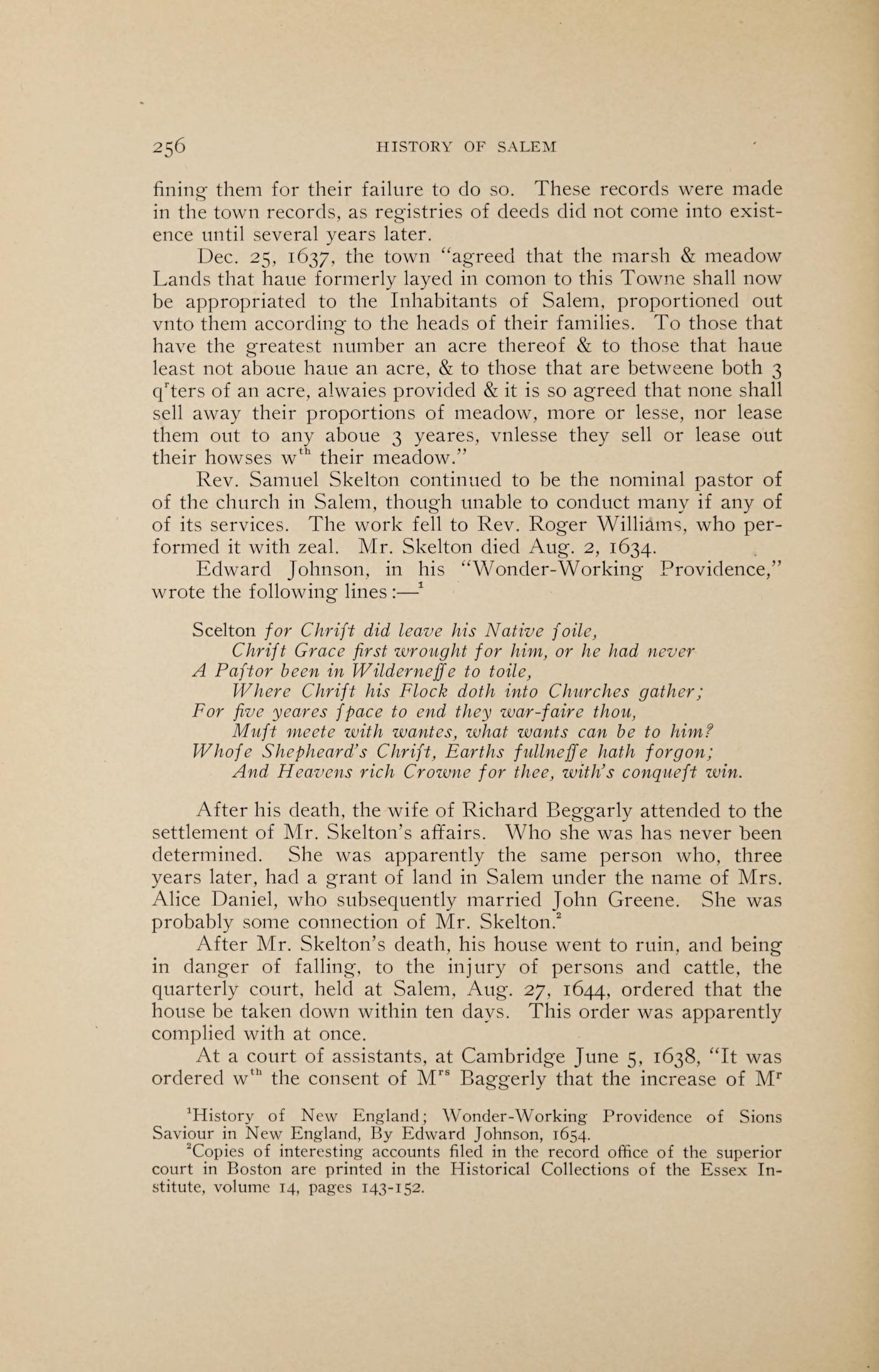
The woman the family long knew as Joan Ann Beggarly Greene, who was in fact the second wife of John Greene the surgeon of Warwick, appears in the records of the Massachusetts Bay Colony and of Providence between 1634 and 1638 under two names: Alice Daniell, the name she signed to her one surviving letter and the name on her Salem farm and her Providence lot, and Mrs. Beggarly, spelled Beggerly, Baggerly, and Bagerle, the name Winthrop’s circle and the Boston courts used, from her husband Richard, who appears at Salem as Beckly and in Connecticut as Beckley.1–8 That the two names belong to one woman is proved by twenty shillings: the sum the Governor and Council ordered her to advance Richard in June 1636, and the sum “Mrs. Daniell” recovered from “Richard Beckly” by suit at Salem in March 1638.4, 7, 9 William P. Upham made the connection in print in 1875, Trask restated it with her letter in 1881, and Staples, Turner, Pope, Perley, and George Sears Greene all treat Daniell and Beggarly as one person.9–15
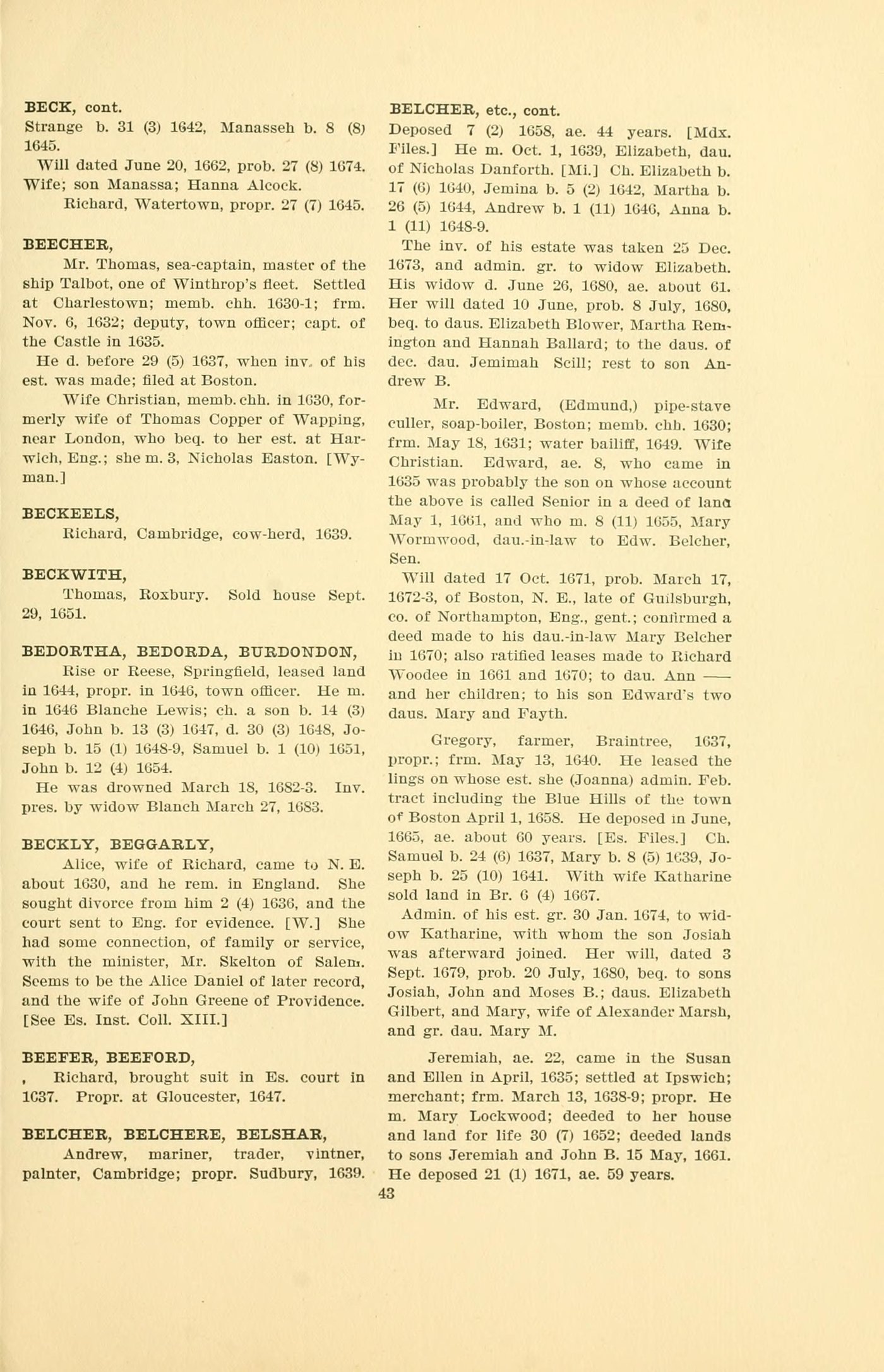
The forename Joan belongs to the deeds of March 1682 by which John Greene of Quidnessett conveyed land to his sons Daniel and James “as long as the father or mother should live”; the family held, and this page held until 23 September 2026, that the Alice of the 1630s and the Joan of 1682 were the same woman. They were two women: Alice married the surgeon, and Joan was the wife of John Greene of Quidnessett.16, 17 No record found gives her a birth year, a maiden name, or the date of her death, and none calls her Ann or Anne.1, 16, 18
She was in New England by the summer of 1630, in the year of the great migration, though no passenger list names her; Banks’s reconstruction of the Winthrop Fleet and his lists of the other ships of 1630 have no Beggarly, Beckley, or Daniell, and that is not evidence against her, since there is no manifest and Banks could name fewer than two thirds of the seven hundred aboard; his 483 named passengers are transcribed on The Winthrop Fleet of 1630.19–21 Her arrival in 1630 rests on Winthrop’s own sentence of 2 June 1636, that she “had been here six years, and he in England.”4 She did not come with her husband. Richard stayed in England, reached the colony only about 1636, and the first thing the records show him doing there is standing before the Governor and Council on her charge of adultery.4
Findings in brief
The records carry two names. Alice Daniell, also called Mrs. Beggarly, is documented from 1634 to 1638 at Salem, Boston, and Providence: she kept the household of Salem’s first minister, wrote to Governor Winthrop under her own signature, sought a divorce before the Governor and Assistants in 1636, held land at Salem and Providence, and by December 1638 had married a man Winthrop calls only “one Greene.”1, 2, 4, 22–24 Joan, wife of John Greene of Quidnessett and mother of his sons Daniel and James, is documented once, in two deeds of March 1681/2.16
Alice is on no passenger list of 1630. Banks’s reconstruction of the Winthrop Fleet, his list for the Mary and John, and his ship-by-ship Planters of the Commonwealth have no Beggarly, Beckley, or Daniell.19, 20 That is not evidence against her: there is no manifest, and Banks could name fewer than two thirds of the seven hundred Winthrop said were aboard.21 Her arrival in 1630 rests on Winthrop’s own sentence of 2 June 1636, that she “had been here six years, and he in England.”4 She did not come with her husband: Richard stayed in England and reached the colony only about 1636, and the first thing the records show him doing there is standing before the Governor and Council on her charge of adultery.4 See the section on Richard Beggarly below.
She married John Greene the surgeon, of Providence and Warwick. His son’s letter to the town of Providence in 1682/3 says so, and the 1659 deed of her lot confirms it; both are reproduced below.82, 83 The family’s identification with John Greene of Quidnessett, recorded in print by La Mance in 1904 and held by this site until 23 September 2026, does not stand.17, 25 There has been a running question about it since the nineteenth century, because Winthrop, the only contemporary witness, wrote “one Greene” and gave no forename,24 and the printed authorities from 1843 to 1903, reasoning from the Providence records, identified him instead as John Greene Senior of Providence, the surgeon from Salisbury who founded Warwick.9, 11, 12, 15, 23, 26 Their identification requires that the surgeon’s first wife was dead by 1638, and two of those same authorities, Savage and Turner, put her death in 1643.12, 26 The section on the marriage below sets out the question, the two answers once given, and the records that decide it.
The forename Joan, and the dates 1610, 1644, and 1682, come from different places. Joan is the name in the Quidnessett deeds of 1682.16 No Massachusetts or Providence record calls Alice by any forename but Alice, and none calls either woman Ann or Anne.1–3, 7 The death of January 1643/4 is Benedict Arnold’s report that “Mr. Green’s wife is dead” at Warwick: that is the wife of John Greene the Surgeon, not of John Greene of Quidnessett.27, 28 The year 1682 is the year Joan was alive to be named in the deeds; it is not a death date.16 The birth year 1610 appears in no record found.18
The migration of 1630
In the spring of 1630 the Massachusetts Bay Company moved itself, charter and all, from England to New England. Its governor, John Winthrop, sailed with the first four ships from the Isle of Wight on April 8; seven more followed. Winthrop told his wife there were seven hundred people aboard.21 The fleet made for Salem, where Endecott’s company had been settled since 1628 and where the Reverend Samuel Skelton had been pastor since 1629, and then moved on to Charlestown and Boston.21
There is no surviving manifest. Every list of the fleet’s people is a reconstruction. Charles Edward Banks built the standard one in 1930 from the first freemen’s oaths, the church admissions at Boston and Charlestown, the court and town records, and Winthrop’s journal and letters, accepting a name only when the record put that person in Massachusetts in 1630 and nothing tied them to another ship.19 His 483 named entries, with his note on each family, are transcribed on The Winthrop Fleet of 1630.
These four pictures are reproduced from Robert J. Jensen’s biography of John Marsh and Susanna Skelton, the eldest of the four Skelton children who were in Alice’s charge from 1634 to 1638; Susanna married John Marsh and lived out her life at Salem.29, 30 They are not records. The winter scene is a painting of 1867, the landing is a nineteenth-century engraving, the ships are a painting, and the village is a photograph of reconstructed houses. Each is shown as Jensen printed it, on the left, and as enhanced for this site, on the right; the enhanced versions add and change details and are pictures of pictures, not of Salem.29
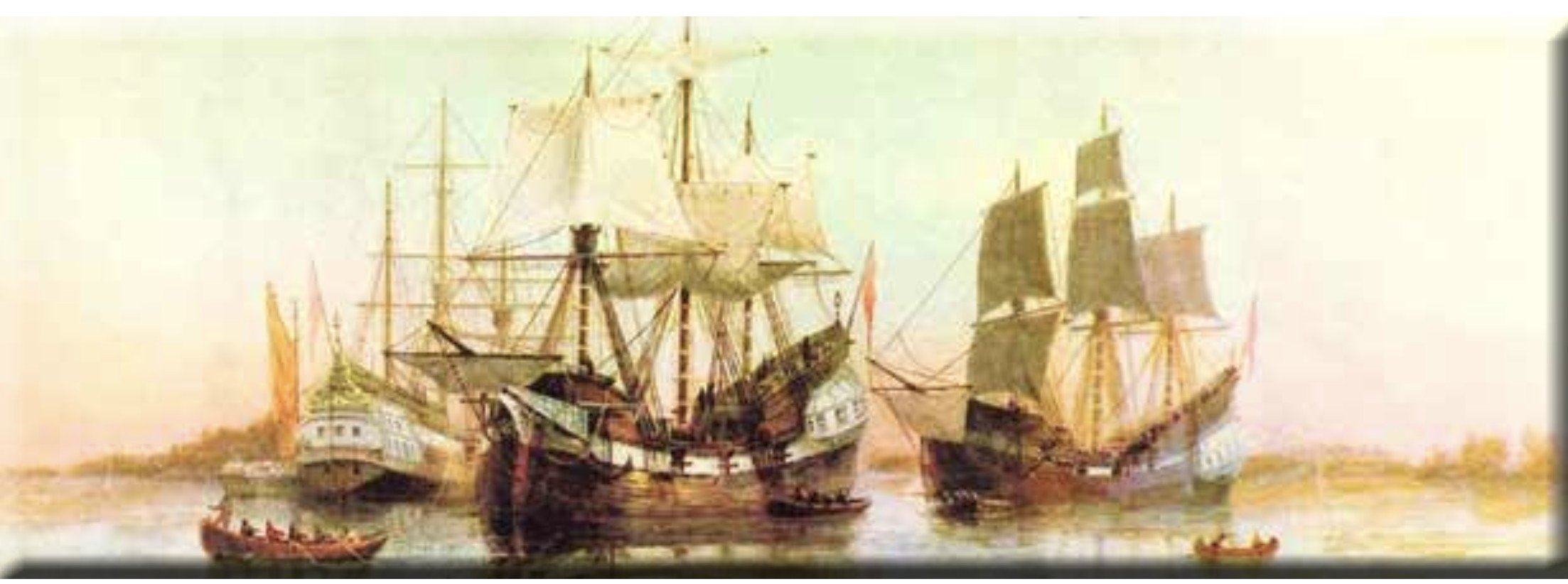
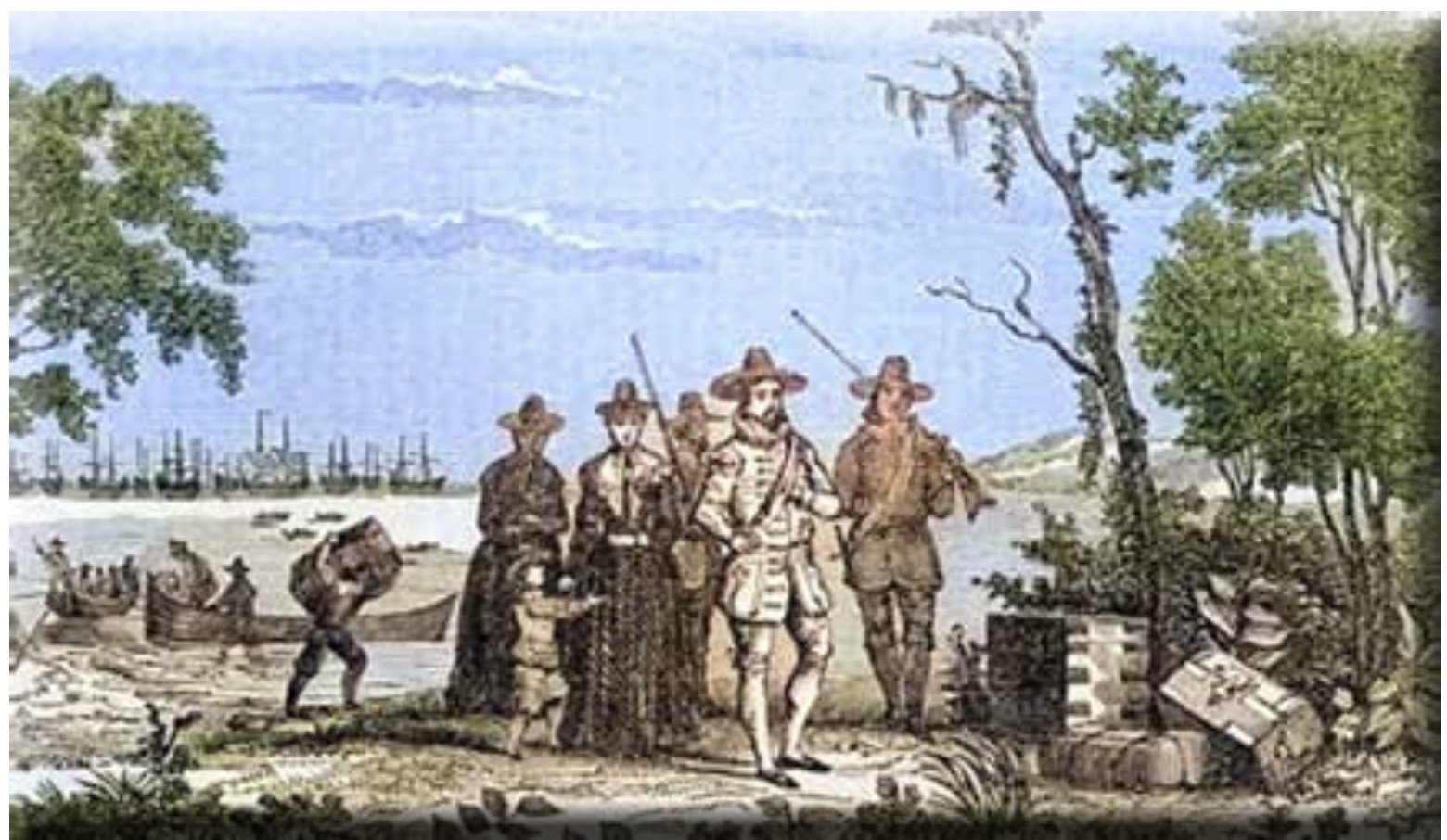
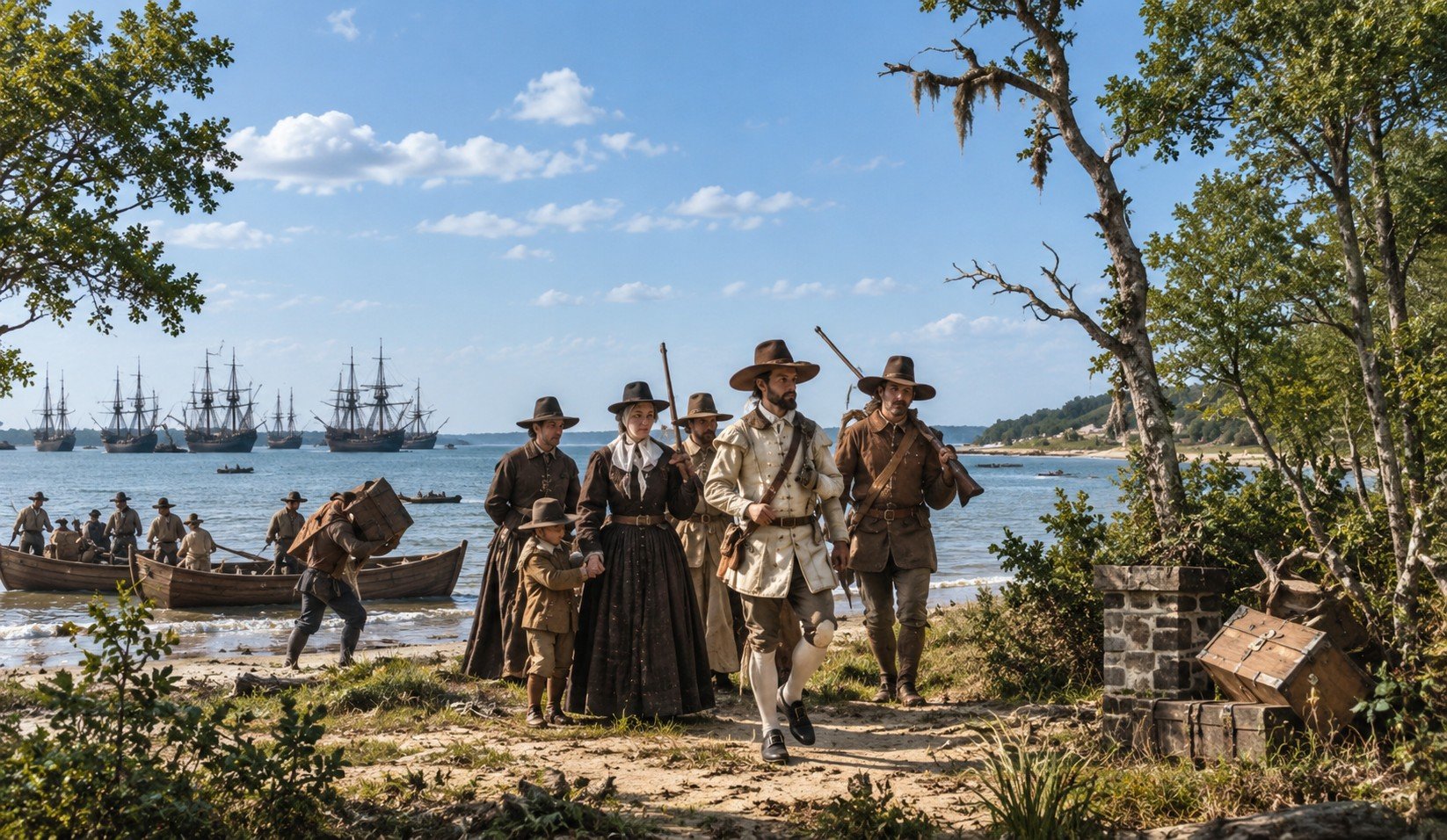
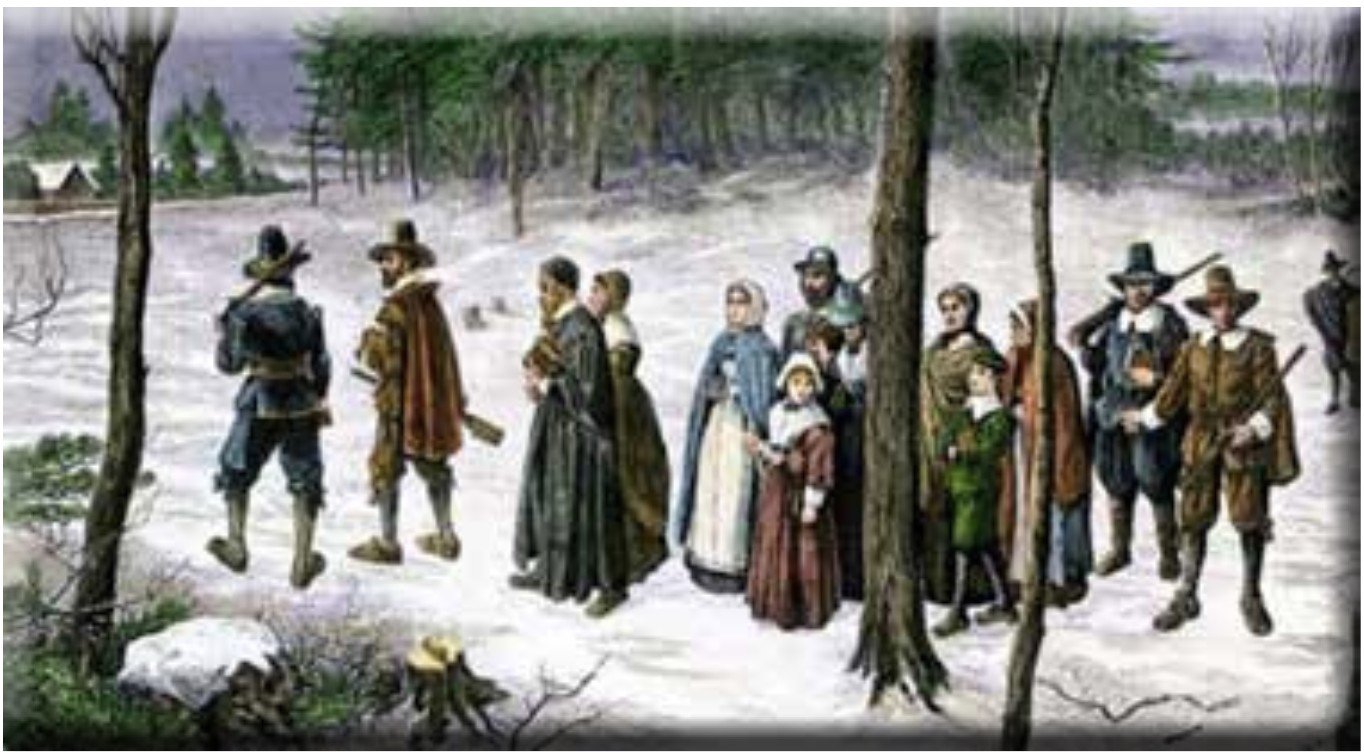
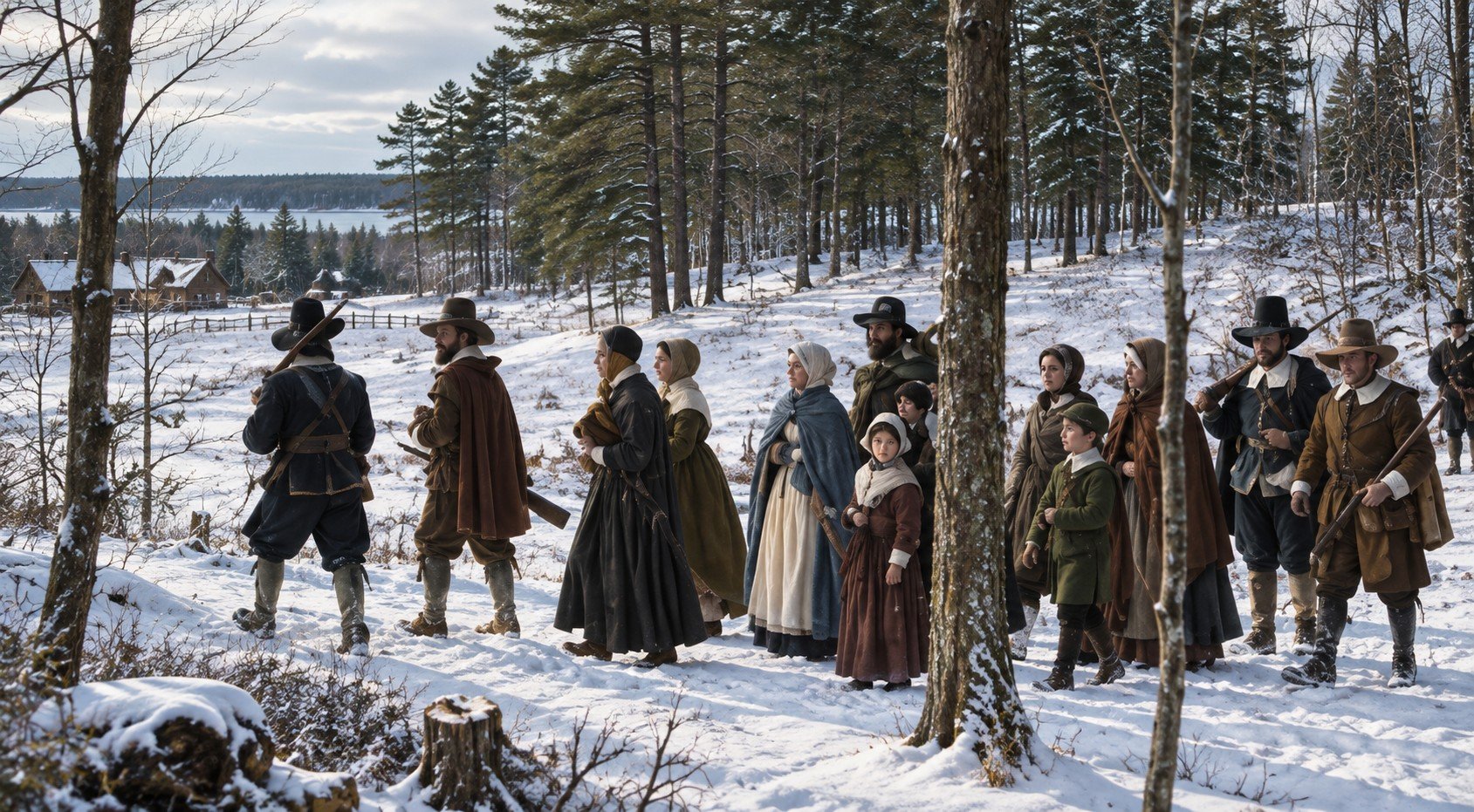
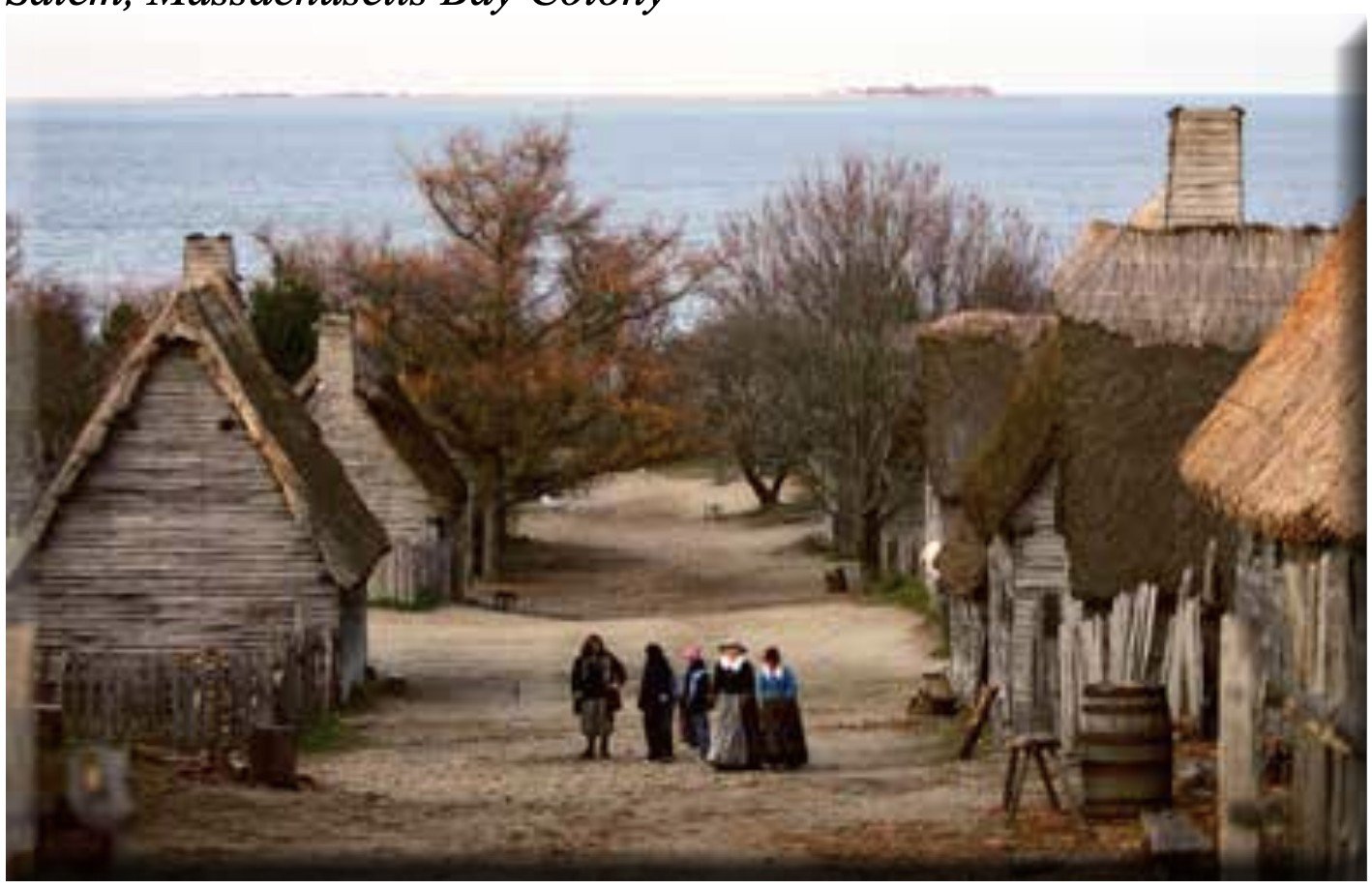
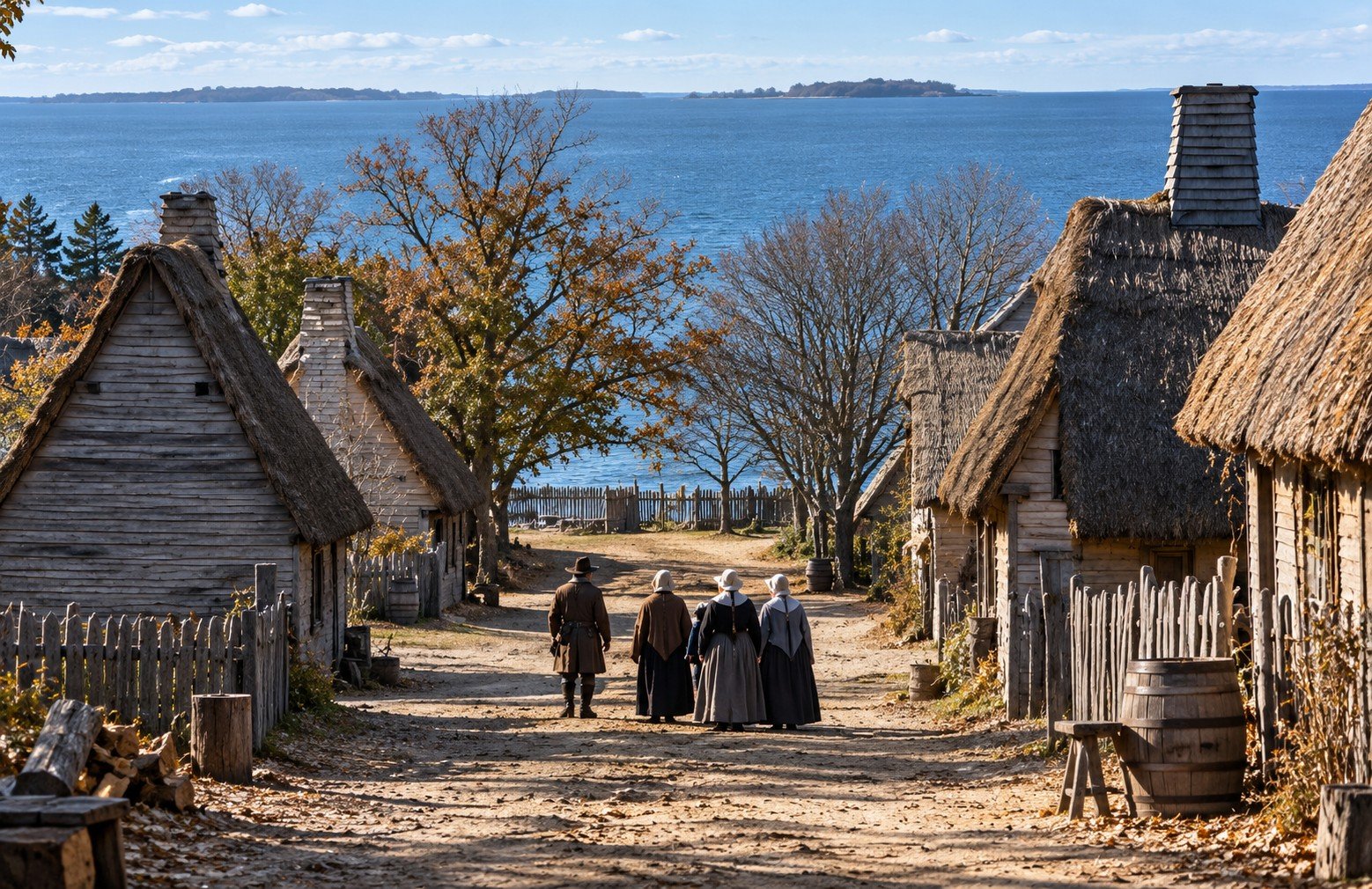
Source29
No Beggarly, Beggerly, Beckley, or Daniell appears in that list, in his Mary and John list, or in his Planters of the Commonwealth.19, 20 What places Alice in the migration of 1630 is Winthrop’s memorandum of June 1636: she “had been here six years, and he in England.”4 Everything else about her is at Salem, and the Skelton household she kept had been at Salem since 1629, so a landing at Salem is likely; whether she came on a fleet ship, on the Lyon, or on another vessel of that year, no record says.1, 22
Her life, as the documents tell it
Put in order, the records give this outline. By the winter of 1634 she was keeping the house of the Reverend Samuel Skelton at Salem, minister of the first church in the colony, whose wife had died in 1631 and who died himself on 2 August 1634 leaving four children, a farm, a herd of the Company’s cattle, and unsettled accounts.22, 31 She answered for that estate before the Governor, the Deputy Governor, and a jury, wrote to Winthrop in her own hand about the cattle and the children, and was trusted enough in the Winthrop household to be nursing the Governor’s wife through a dangerous illness a year later.1, 5, 22 Her husband Richard had stayed in England; when he came over she went before the Governor and Council in June 1636 and charged him with adultery, and the court kept him from her and made him take twenty shillings of her money to set himself to work.4 The town of Salem laid out her farm across the river from Lawrence Leach’s and, in November 1637, allowed her fifty acres more; her cottage stood beside Skelton’s on his land.2, 32, 33 In the same year she took ground in Roger Williams’s new plantation at Providence, outside the Bay Colony’s reach.23 In March 1638 she sued Richard at Salem for the twenty shillings and won; in June she consented to the division of Skelton’s cattle and goods among his three eldest children; by August the minister’s house, which the town still called hers, was falling down.6, 7, 34 In 1638 she held a home lot at Providence in her own name, and before the year was out Winthrop wrote that “one Greene” there had married her, her first husband living and no divorce granted.3, 24 After that the Massachusetts and Providence records are silent about her under any of her names.9, 15
How she came to be keeping Skelton’s house
The household. Skelton landed at Salem in June 1629 on the George Bonaventure with his wife Susanna and three small children, Samuel about six, Susanna four, and Mary nearly two. His contract with the Company promised diet, house, firewood, the milk of two cows, land, and care of his widow and children if he died. The Company also promised its ministers “2 maid servants to look to his family,” so a minister’s house was expected to have women in it besides the wife.22, 35
The break. A fourth child, Elizabeth, was born in 1631, and on 15 March 1630/1 Susanna Skelton died, “a godly and helpful woman,” in Dudley’s words. That left an ailing pastor with four motherless children, a house, a farm, and the Company’s cattle, while Roger Williams did much of his pulpit work.14, 36, 37
Her arrival. She had landed in 1630, the summer before, without her husband: a married woman living apart, with means but no household, and a minister’s house that had just lost its mistress. The two needs met. The records show her as head of the house from the winter after Skelton’s death.1, 4, 22
Kin or housekeeper. The record does not say. Trask guessed a sister or near relative; Pope, more carefully, “some connection, of family or service.” Her own words cut both ways: her charge is an “ingagement” resting on the will, the language of a trust, yet she spent twenty-five pounds of her own money and calls it the Lord’s hand calling her to the business. By January 1636 Endecott could write that “all her famly are well,” the Skelton children being by then spoken of as hers.1, 5, 13
How it ended. The 1638 court order divided the cattle and committed the three eldest children’s goods to the church of Salem, ending her charge, by which time she was a Providence landholder; Susanna, the eldest daughter, married John Marsh some years later, between 1641 and 1646. The years 1631 to 1634, and who brought her into the house, are a question for the Lincolnshire registers.1, 6, 23, 37
The records do not say when she entered the minister’s household or on what footing, and this page does not guess. What they do give is the situation into which she came, and it explains a good deal.22, 35, 36
Samuel Skelton came to Salem in June 1629 on the George Bonaventure with his wife Susanna and three small children, Samuel six, Susanna four, and Mary nearly two, the ages of their Tattershall baptisms of 1622/3, 1625 and 1627.30, 35, 38 He came under a written agreement with the Massachusetts Bay Company that promised him, beyond his salary, “necessaries of dyet housing fierwood,” the milk of two cows and half their increase, a house and land, and, if he should die there, that “the said Company shall take care for my widow dureing her widowhood … the like for my children whilst they remain upon the said plantation.”22 The Company also promised its ministers servants: the clerk added to the agreement that Higginson “was promised a man servant to take care and look to his things … and also 2 maid servants to look to his family,” and Skelton had “in every respect the like conditions.”22, 35 A minister’s household at Salem, then, was expected to have women in it besides the minister’s wife.
The household broke in the spring of 1631. A fourth child, Elizabeth, was born that year, and on 15 March 1630/1 Susanna Skelton died; Thomas Dudley, writing to England a fortnight later, called her “a godly and helpful woman; she lived desired, and died lamented.”36, 37 That left the pastor of the first church in the colony, in poor health himself, with four motherless children aged from a few weeks to about eight, a house, a farm across Porter’s River, and a herd of the Company’s cattle to be kept. Roger Williams was already doing much of his pulpit work.14, 36 Somebody had to run the house.
She had landed in New England the summer before Mrs. Skelton died, in 1630, without her husband.4 A married woman living apart from a husband in England, with means of her own but no household of her own, and a minister’s house at Salem that had just lost its mistress: the two needs met, and the records show her as the head of that house from the winter after Skelton’s death, with the cattle “in a compleate number” in her hands and the children in her charge.1, 22 Whether she went into the house as a kinswoman or as a housekeeper the records do not say. Trask, who first printed her letter, inferred from her charge of the family that she was “a connection or near relative” of Skelton or of his wife, “possibly a sister”; Pope, more carefully, wrote that she “had some connection, of family or service, with the minister.”1, 13 Her own words cut both ways. She calls her charge of the children an “ingagement” that rests on Skelton’s will, which is the language of a trust, not of blood; but she also says she has “seene the lords hand calling mee to this busines,” and she spent twenty-five pounds of her own money on it, which is not the language of a servant.1 Endecott’s message in January 1636, sent to her in the Winthrop house at Boston, that “all her famly are well,” shows that by then the Skelton children were spoken of as her family.5
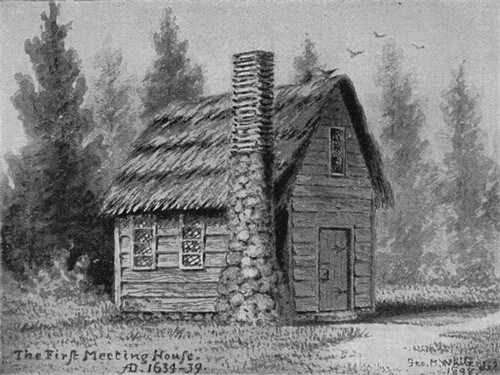
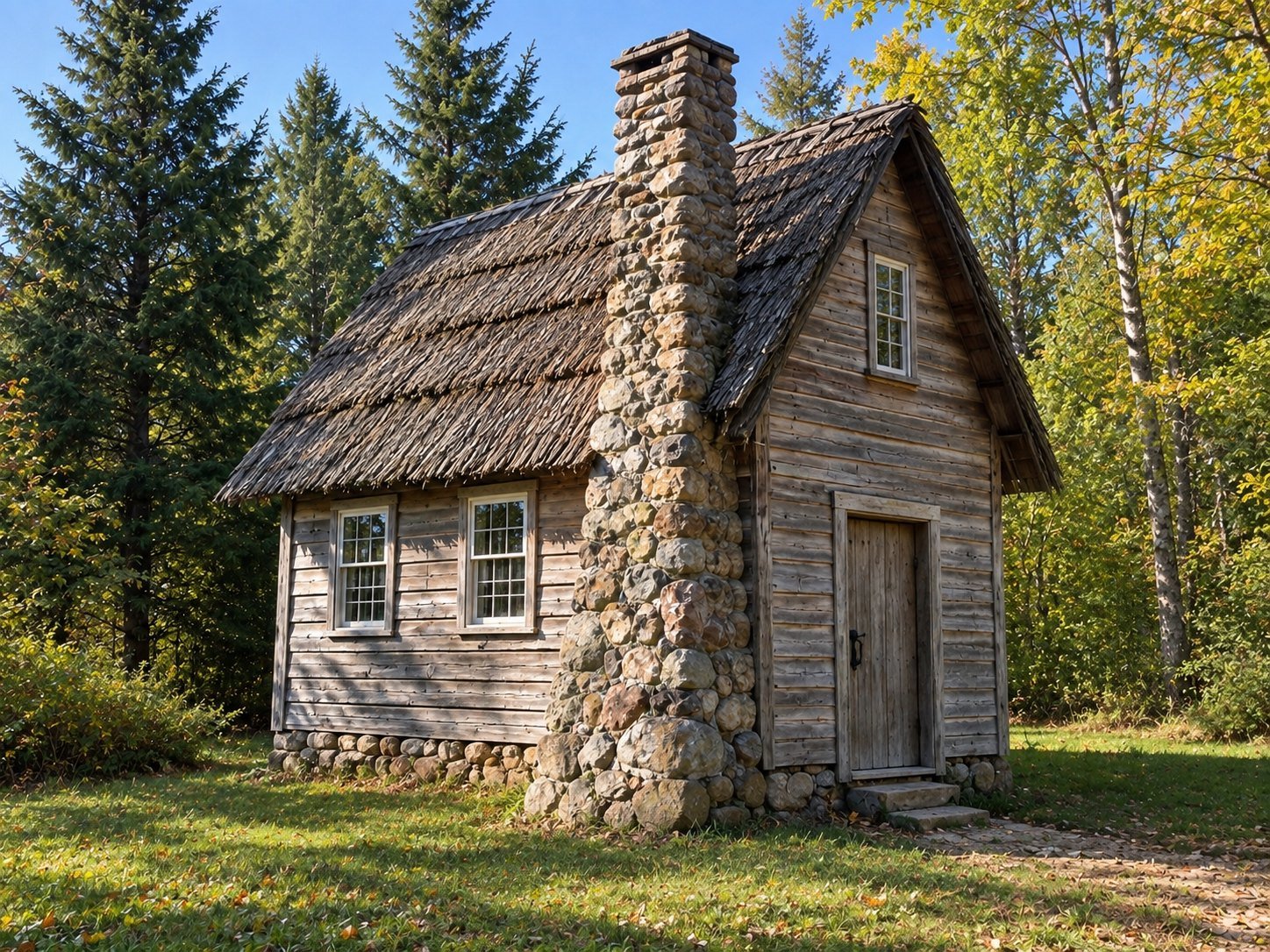
This is the meeting house built by the town of Salem in 1634, the year Skelton died, and used until 1639. In Puritan usage the church was the covenanted congregation, not the building; the meeting house was the town’s, and served both the congregation on the Lord’s day and the town meeting on weekdays.39, 40 Her connection to it runs both ways. The town meeting that sat here laid out her farm in 1636 and allowed “mrs. Alls Danill” her fifty acres on 8 November 1637; the church that gathered here was the one whose records never carried her name, and the one to which the Court of Assistants in 1638 committed the Skelton children’s goods when her charge of them ended.2, 6, 32, 40 The minister’s house she kept stood a short way off by the South River, with her own cottage beside it.41
The Skelton children in her charge
Four children were in the house when Skelton died on 2 August 1634. Their ages are reckoned from the Lincolnshire baptisms Perley prints from the Register: Samuel baptised at Tattershall on 8 January 1622/3, Susannah on 3 April 1625, Mary on 28 June 1627; the youngest, Elizabeth, was born at Salem in 1631, the year her mother died. A first daughter, Sarah, born and died in 1621, is not among them. Perley’s account of the 1629 voyage gives the same ages, Samuel six, Susanna four, and Mary nearly two. Corrected 22 September 2026: until that date this page followed an online tree that made Susanna born in 1620 and Samuel in 1621, and Perley’s statement that Susanna married John Marsh “about 1635”; both are set aside, for the reasons given in the table.30, 35, 36, 38
| Child | Age in August 1634 | What became of them |
|---|---|---|
| Samuel | About 11 | The only son. Came of age and in 1649 sold “Skelton’s Neck,” his father’s farm at Danversport, to John Porter, reserving sixty acres; the sisters’ shares were later bought up by Porter.30 |
| Susanna | About 9 | Married John Marsh of Salem, cordwainer, between 1641 and 1646. No marriage record survives; Marsh’s children baptised in 1637, 1639 and 1641 were by an earlier wife, and the Salem court record first names “John and Susan” as parents at Elizabeth’s birth on 8 July 1646. Perley’s “about 1635” is impossible for a girl baptised in 1625. With Marsh and her sister Mary she sold her share of the Neck in 1655; Marsh’s will of 28 March 1674 made her executrix; she then married Thomas Rix, barber. No record of her death has been found. Her record, document by document: Susanna Skelton, the minister’s daughter.30, 37, 38, 42 |
| Mary | About 7 | Married Nathaniel Felton of Salem, later Lieutenant Felton; with him joined in the 1655 deed of her share of the Neck; died 8 May 1701.30 |
| Elizabeth | About 3 | Married Robert Sanford of Boston; with him sold her twenty acres of the Neck to John Porter in 1652.30 |
The Company’s promise of care for Skelton’s children ran only “whilst they remain upon the said plantation,” and all four stayed at Salem.22 When the Court of Assistants ordered in June 1638 that the goods “which belongs to the 3 eldest children” be divided by the church of Salem, the three were Samuel, Susanna and Mary; why Elizabeth, then about seven, is not named the order does not say.6, 30
How long she kept them is clearer than how she began. The eldest daughter, Susanna, married John Marsh between 1641 and 1646; Mary later married Nathaniel Felton and Elizabeth Robert Sanford; the son Samuel came of age and sold his father’s Neck in 1649.37 In June 1638, with her consent, the Court of Assistants divided the cattle’s increase under the will and committed the three eldest children’s goods to the church of Salem, and with that her charge ended.6 By then she was already a landholder at Providence.23 What the years between 1631 and 1634 held, and who brought her into the house, is one of the things the Lincolnshire registers might still answer.1
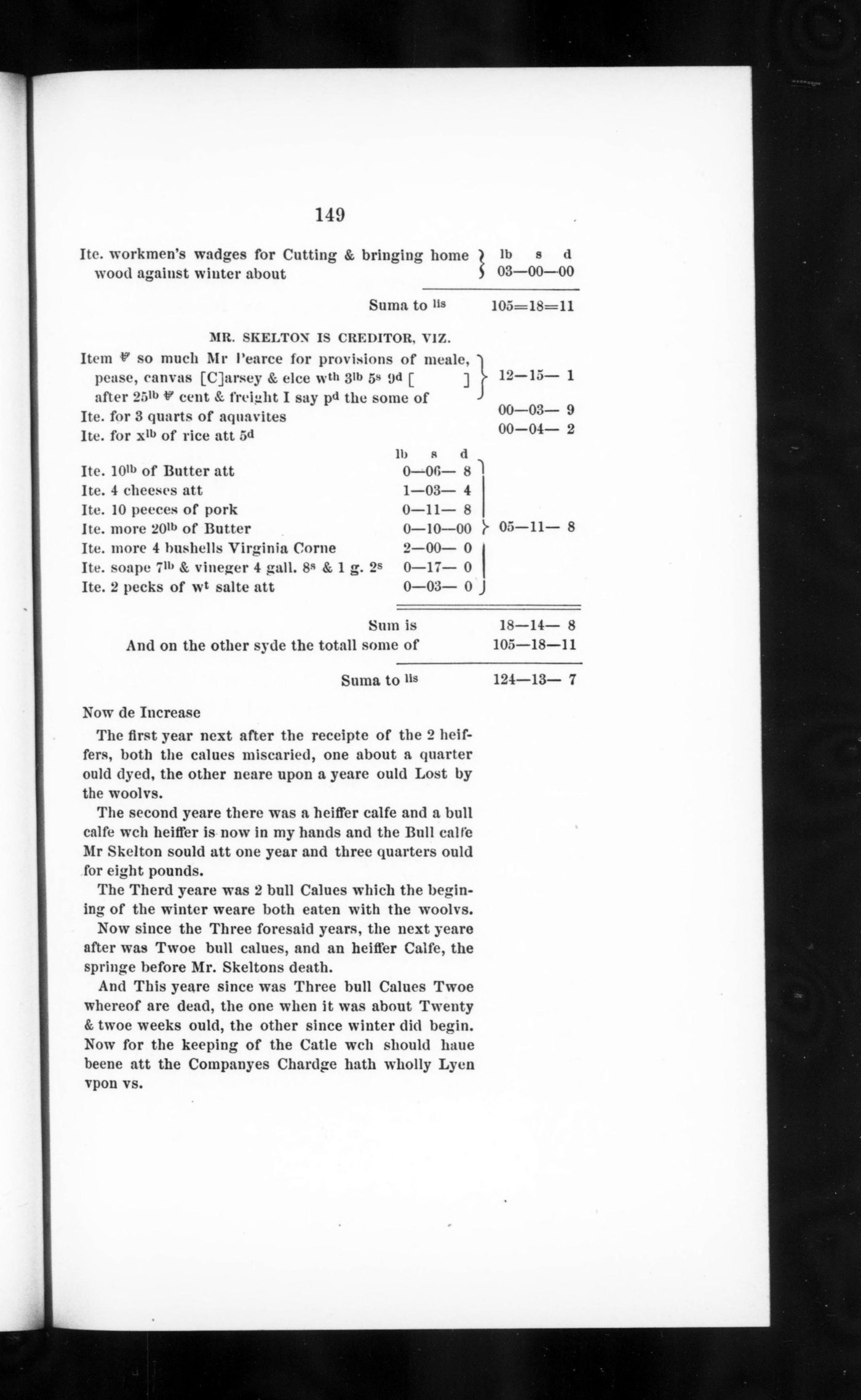
The Reverend Samuel Skelton, first pastor of Salem, died 2 August 1634, leaving four children; his wife had died on 15 March 1631.22, 31 The papers settling his account with the Company survive in the Suffolk court files, in the hand of Ralph Fogg, Salem town clerk.10, 22 The first is endorsed:
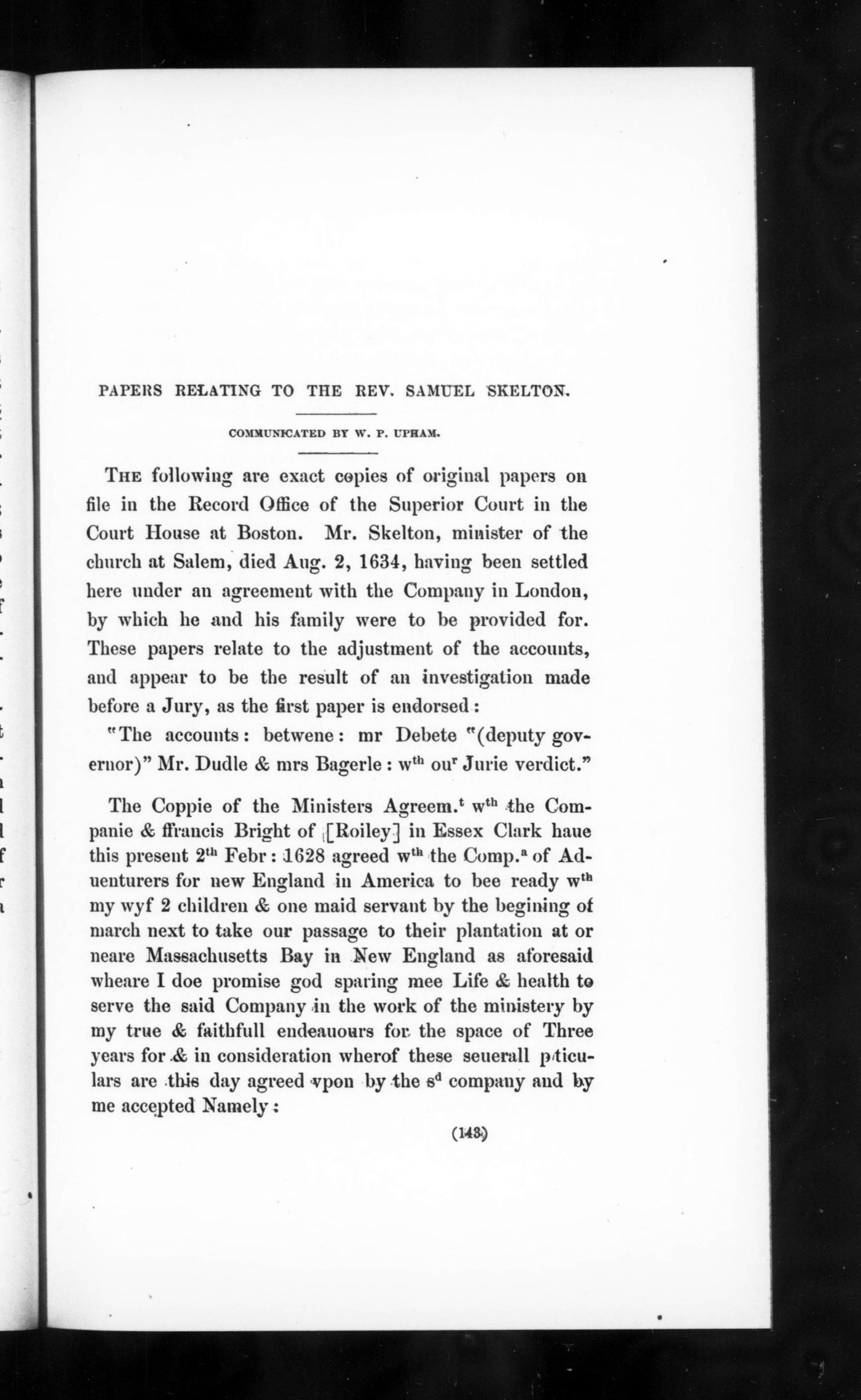
The accounts: betwene: mr Debete [Deputy Governor] Mr. Dudle & mrs Bagerle: wth our Jurie verdict.
The account of the cattle ends: “Now for the keeping of the Catle wch should haue beene att the Companyes Chardge hath wholly Lyen vpon vs.” The “us” is Skelton’s household, of which she was the surviving head.22 When Skelton came to Salem in 1629 he came under a written contract with the Massachusetts Bay Company, a copy of which heads these papers: twenty pounds a year for three years, diet, housing and firewood, the milk of two cows and half their increase, land, and a promise that if he died the Company would care for his widow and children while they stayed on the plantation.22 He died with money owed both ways. The Company had advanced him cloth, tools and provisions since 1629, itemised in the account down to pins, stockings, saffron, geese and a gallon of aqua vitae, to a total of one hundred and five pounds; the household had kept the Company’s cattle at its own charge and lost calves to the wolves.22 Somebody had to settle it. The endorsement names them. “Mr. Deputy” was Roger Ludlow, and Mr. Dudley was Thomas Dudley, the Governor of the colony, both elected in May 1634; they stood for the Company.43 “Mrs. Bagerle,” the clerk’s spelling of Beggarly, stood for the Skelton estate. Upham, who printed the papers from the originals in 1875, noted that this had led people to suppose she was Skelton’s widow, and that Winthrop’s memorandum of 1636 shows she was not.10 The person answering for the minister’s house, cattle and children, before the two chief magistrates of the colony and a jury, was Mrs. Beggarly. Fogg’s last entry counts calves that died “since winter did begin” in the year after Skelton’s death, which is how Upham placed the papers in the winter of 1634 to 1635. Whether the jury sat at Salem or before the Court of Assistants at Boston the papers do not say.10 It is the earliest record of her in New England, within months of Skelton’s death and eighteen months before her divorce hearing. It shows her as head of a minister’s household, in possession of his cattle, and able to hold her own in an audit with the Governor and Deputy Governor. Her own letter, next, is her side of the same dispute.1, 22
Undated, but written soon after Skelton’s death, and the only document in her own words. She encloses his will, accounts for his cattle, says she is out of pocket more than twenty-five pounds for keeping his house, and rejects the suggestion that she is bound to keep his children.1
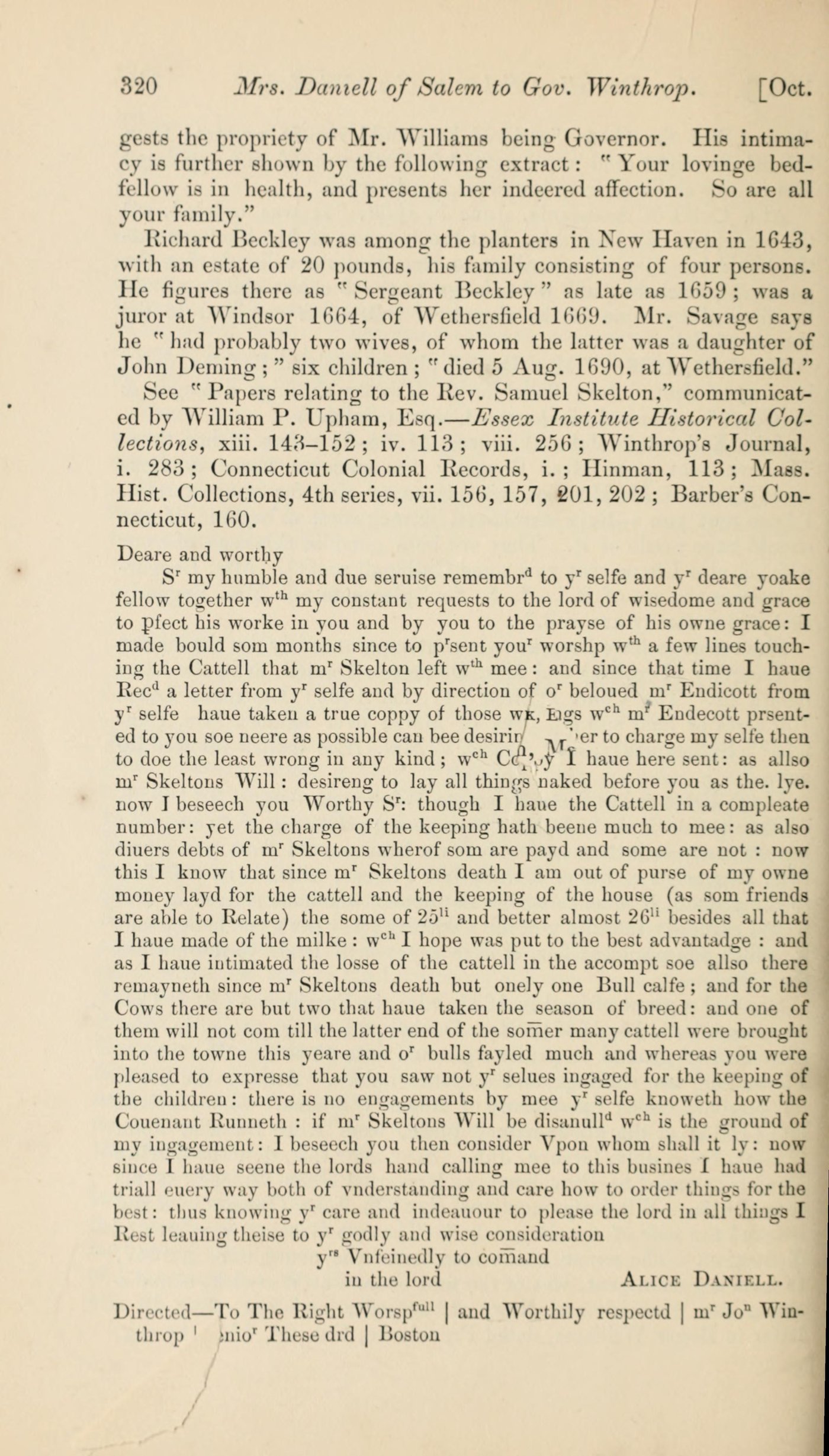
I made bould som months since to prsent your worshp wth a few lines touching the Cattell that mr Skelton left wth mee … as allso mr Skeltons Will: desireng to lay all things naked before you as they lye. now I beseech you Worthy Sr: though I haue the Cattell in a compleate number: yet the charge of the keeping hath beene much to mee: as also diuers debts of mr Skeltons wherof som are payd and some are not: now this I know that since mr Skeltons death I am out of purse of my owne money layd for the cattell and the keeping of the house (as som friends are able to Relate) the some of 25li and better almost 26li besides all that I haue made of the milke … and whereas you were pleased to exprease that you saw not yr selues ingaged for the keeping of the children: there is no engagements by mee yr selfe knoweth how the Couenant Runneth: if mr Skeltons Will be disanulld wch is the ground of my Ingagement: I beseech you then consider Vpon whom shall it ly … now since I haue seene the lords hand calling mee to this busines I haue had triall euery way both of vnderstanding and care how to order things for the best …
yrs Vnfeinedly to comand in the lord Alice Daniell.
Directed: To The Right Worll and Worthily respectd mr Jon Winthrop … Boston
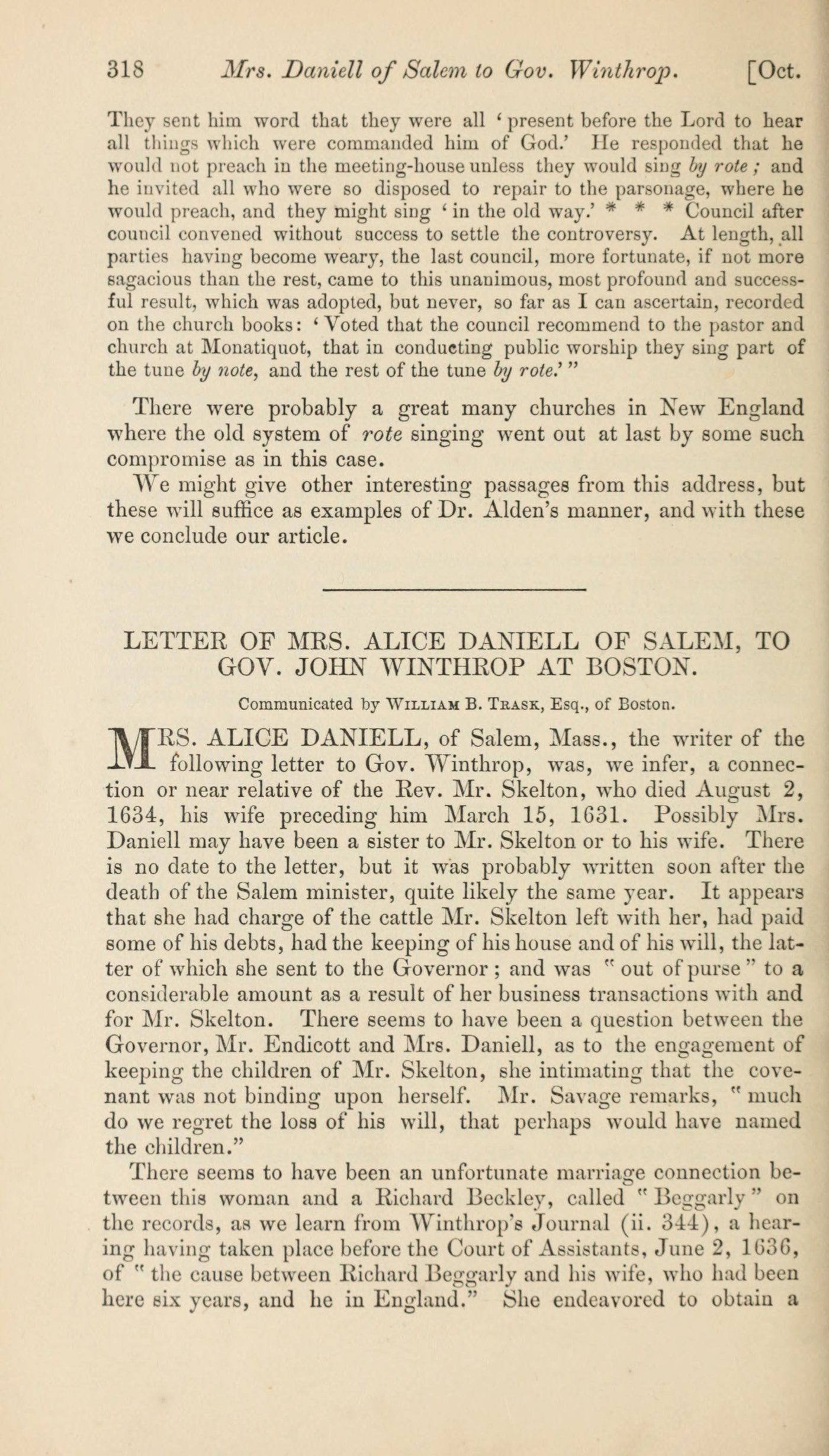
A letter among the Winthrop manuscripts, printed by William B. Trask in the New England Historical and Genealogical Register for October 1881. It has no date. Trask judged it written soon after Skelton’s death, “quite likely the same year,” because it is about the cattle, the will and the children, the matters the jury was settling.1 It is a second letter: she had written “som months since” and had since received Winthrop’s reply and Endecott’s directions.1 That she has the cattle “in a compleate number,” but their keeping has cost her; that some of Skelton’s debts are paid and some not; that she has laid out twenty-five pounds and more of her own money on the cattle and the house, which friends can attest; that only one bull calf remains of the increase and two cows have taken the bull; and that Winthrop’s remark that the Company did not see itself engaged to keep the children cuts both ways, because her own engagement rests on Skelton’s will, and if the will is set aside, “consider vpon whom shall it ly.”1 She writes in her own hand and signs her own name, argues the terms of a covenant with the Governor of the colony, keeps accounts, and has friends at Salem who will vouch for her outlay. Twenty-five pounds was more than a year of Skelton’s salary.1, 22 Trask inferred from her charge of the family that she was “a connection or near relative” of Skelton or his wife, possibly a sister; nothing found since has tested that.1 Trask also read the signature as the key to her other name, and his page 319 sets the Beggarly and Daniell records side by side for the first time with the letter.9
Source1
Margaret Winthrop lay dangerously ill at Boston. John Endecott, writing from Salem with every remedy he could find, shows that Mrs. Beggarly was then in the Winthrop household, trusted with the sick-room, and that her own family was at Salem.5, 44
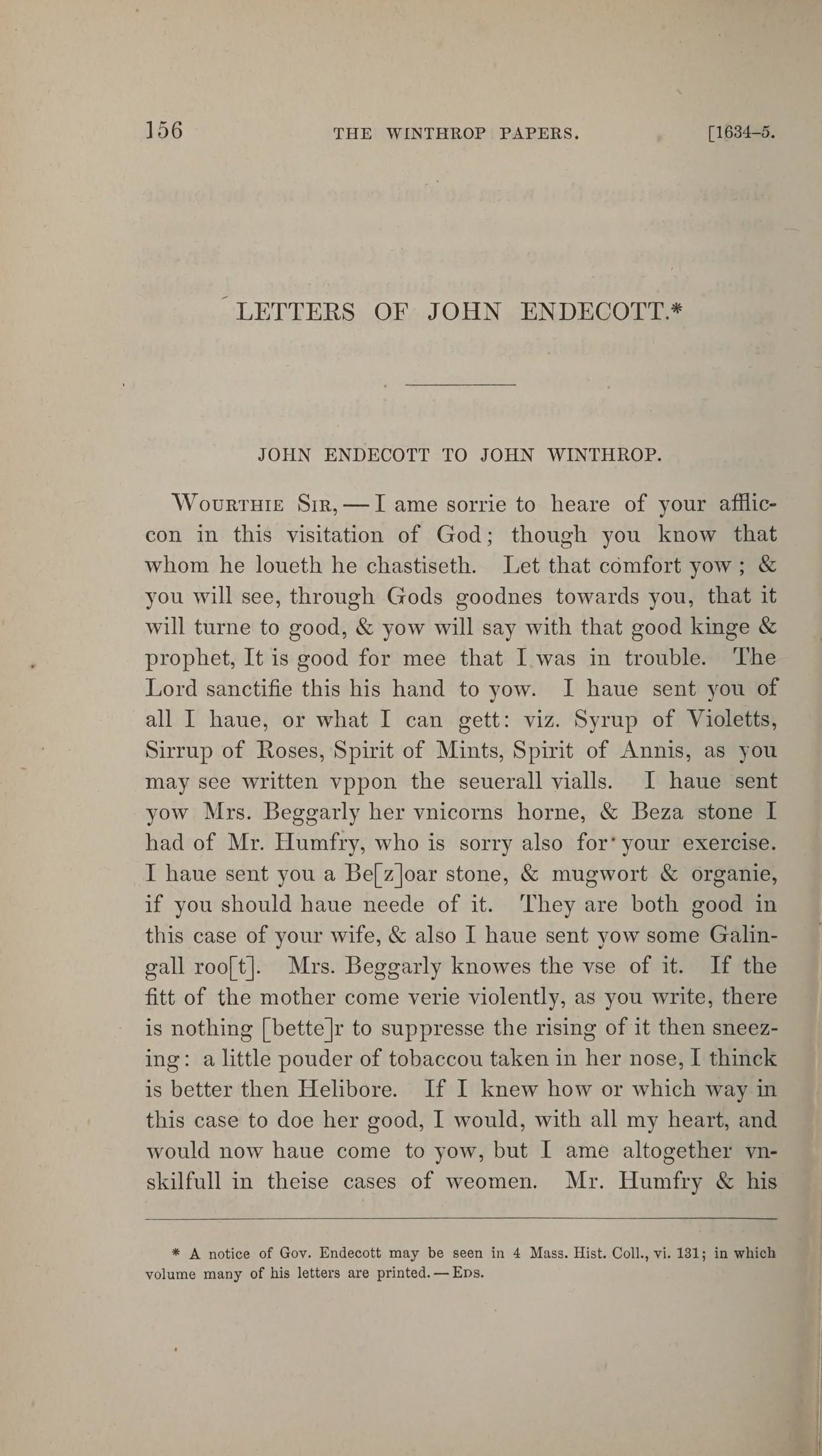
I haue sent you Mrs. Beggarly her vnicorns horne and Beza stone I had of Mr. Humfry … I haue sent you a Be[z]oar stone, and mugwort and organie if you should haue neede of it they are both good in this case of your wife, and also I haue sent you some Galingall root. Mrs. Beggarly knowes the vse of it. If the fitt of the mother come verie violently as you write, There is nothing better to suppresse the rising of it then sneezing … and if you please to tell Mrs. Beggerly that all her famly are well.
A letter from John Endecott, the founder of Salem and later Governor, to John Winthrop, then at Boston. It was first printed in 1865 from the Winthrop manuscripts, headed “1634–5,” and again in 1943, where it is dated about January 1635/6.5, 44, 45 Endecott is answering a letter from Winthrop about his wife’s illness, “the fitt of the mother,” and sends syrup of violets, syrup of roses, spirit of mint and of anise, a bezoar stone, mugwort, origanum and galingale root, apologising that he is “altogether vnskilfull in theise cases of weomen.”44 Three things. She was in the Winthrop house at Boston, not at Salem, and Winthrop was to pass messages to her; her family was at Salem, and was well. The unicorn’s horn and the bezoar stone, the most prized antidotes of the age, were hers, lent to the Governor’s household in its need. And Endecott, who did not know what to do with galingale root, says that Mrs. Beggarly did.44 A woman who kept a minister’s house and cattle was also the woman the Governor’s circle turned to in a sick-room.
This is the passage the 1904 edition of the Court of Assistants records cites, in a note to the quarter court of 7 June 1636, as “Winthrop II. 344.” It is not in the day-by-day journal but among Winthrop’s memoranda, printed by Savage as Addenda at page 344 of volume II in the 1825–26 edition and page 421 in the 1853 edition.4, 46
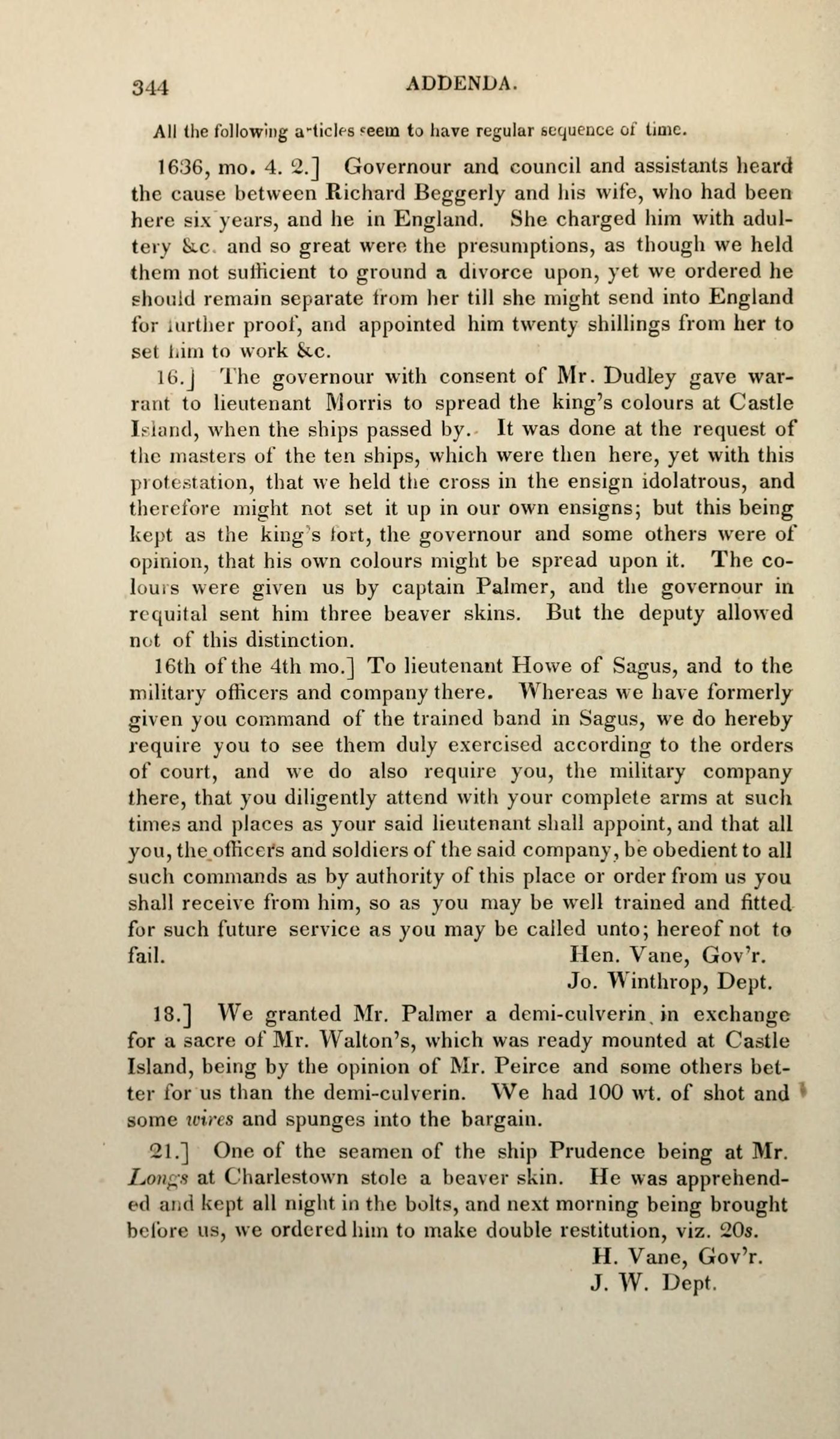
1636, mo. 4. 2.] Governour and council and assistants heard the cause between Richard Beggarly and his wife, who had been here six years, and he in England. She charged him with adultery, etc., and so great were the presumptions, as though we held them not sufficient to ground a divorce upon, yet we ordered he should remain separate from her till she might send into England for further proof, and appointed him twenty shillings from her to set him to work, etc.
A memorandum in John Winthrop’s hand, one of a series he kept in 1636 of the acts of the Governor and Council. Winthrop was Deputy Governor that year under Henry Vane, and the memoranda on the same page are signed “Hen. Vane, Gov’r. Jo. Winthrop, Dept.”4 The court record for the quarter court held five days later has no entry of the case; the 1904 editor added a note pointing readers to Winthrop’s page, and that note is the “Winthrop II. 344” citation.46 The magistrates believed her: the presumptions of Richard’s adultery were “so great.” But under the law as they understood it a divorce needed proof, and the proof was in England, so they ordered the couple kept apart until she could send for it, and made Richard take twenty shillings of her money to set himself to work.4 No later record of the proof, or of a divorce, has been found; Winthrop himself wrote in 1638 that there was none.24 That she had been in New England six years, which places her arrival in 1630. That Richard had stayed in England and had lately come over. That she was the party with means: the twenty shillings came from her, and she recovered it by suit two years later.4, 7 And that she took her case, alone, to the highest court in the colony and was believed.
The town book of Salem, kept by Ralph Fogg, records the farms laid out on the north side of the town.2, 47
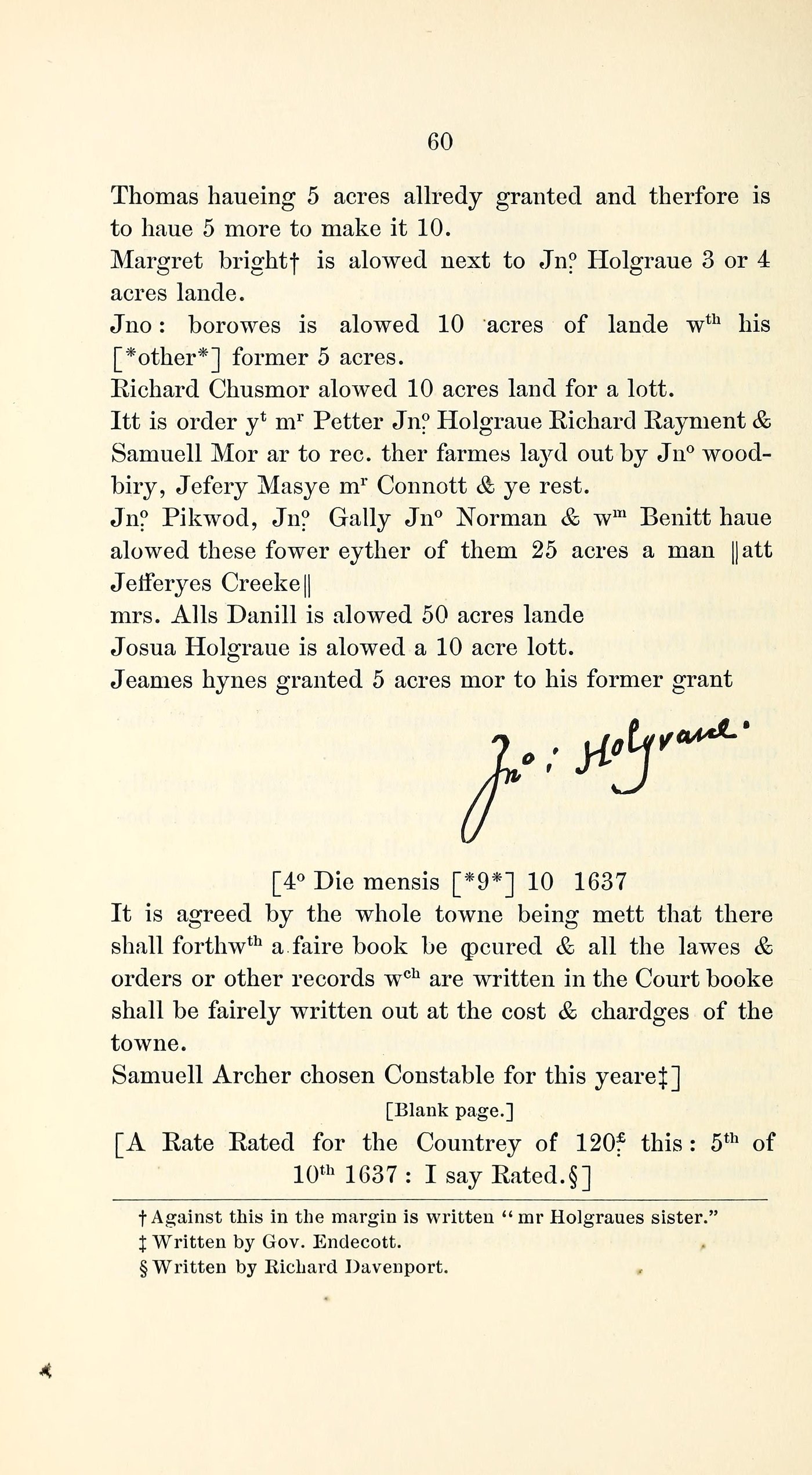
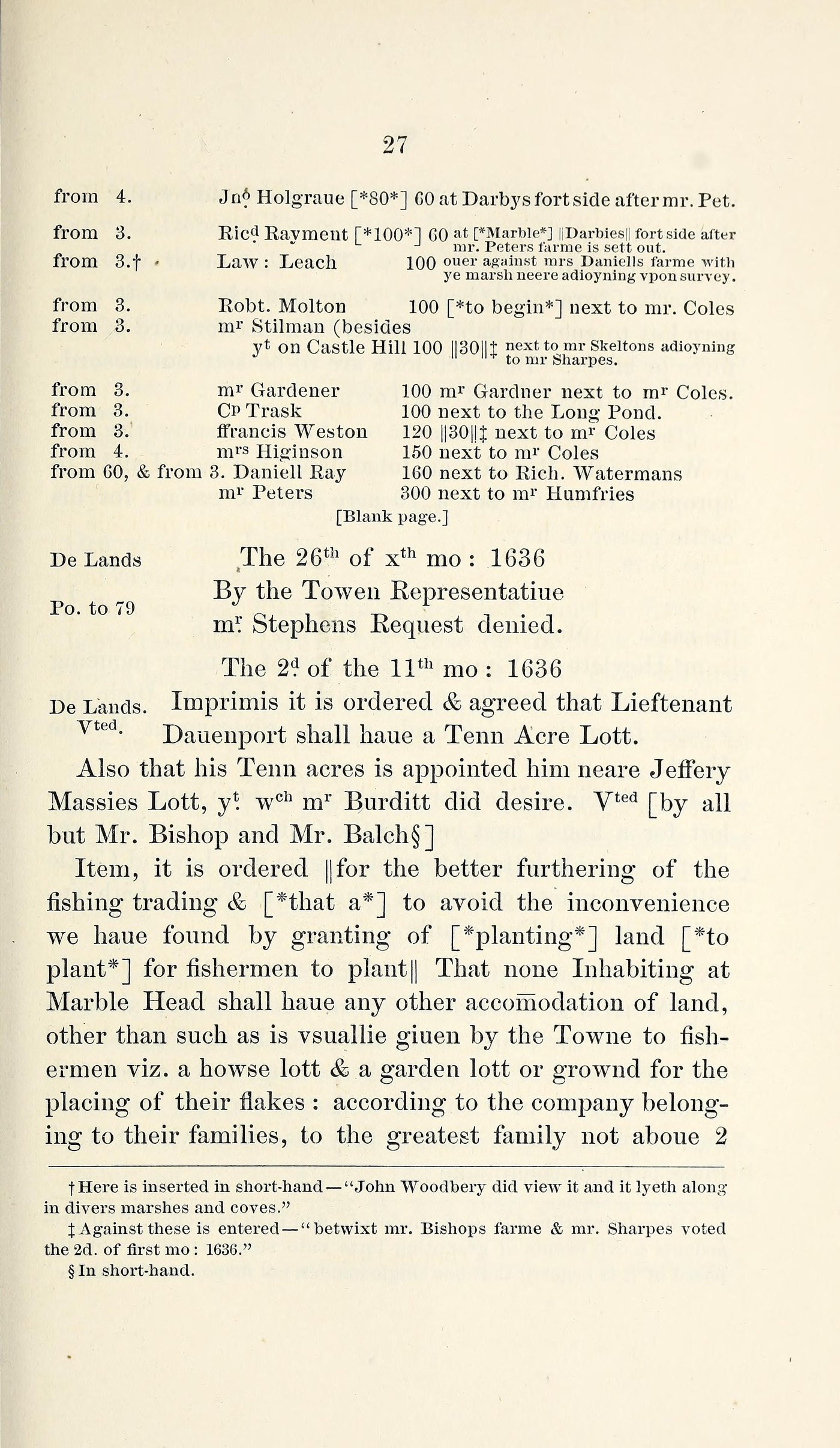
Law: Leach 100 ouer against mrs Daniells farme with ye marsh neere adioyning vpon survey. … Item pr Another warrant of 17th of 12th mo: 1636 for ye laying out to Law: Leach 100 acres upland & sixe acres marsh our agt mrs Daniells …
[8. 9. 1637] mrs. Alls Danill is alowed 50 acres lande
Entries in the first book of Salem town records, printed by the Essex Institute in 1868. Fogg’s list of farms as they stood in 1636 has “Mrs. Al: Daniell f.” among the farm holders; the grant to Lawrence Leach in February 1636/7 is bounded “ouer against mrs Daniells farme”; and on 8 November 1637 “mrs. Alls Danill” is allowed fifty acres.2, 32, 47 The volume’s index gathers these under “Daniell, Mrs. Alce.”32 Upham identified the ground: Leach’s land lay on the east side of Porter’s River, and Skelton’s farm, now Danversport, on the west, so “Mrs. Daniells farme” over against Leach’s was Skelton’s farm, in her possession.10 The commoners’ records allowed a “cottage right” for her house, which stood next to Skelton’s house and on his land.33 In the town’s division of its marsh and meadow she is entered “1. mris Daniell,” a household of one.48 That the town knew her as Mrs. Daniell, that she held Skelton’s farm in her own right for three years after his death, and that she was living alone. The fifty acres of November 1637 were granted in the same season that she took ground at Providence.23, 32
Providence: outside the Bay’s reach
Her move to Providence needs its own explanation, because Providence in 1637 was not simply the next town along. It was a settlement made by people the Bay Colony had put out, on land the Bay did not claim, under a rule the Bay held to be no rule at all. And the man who made it had been the teacher of her own town.49–51
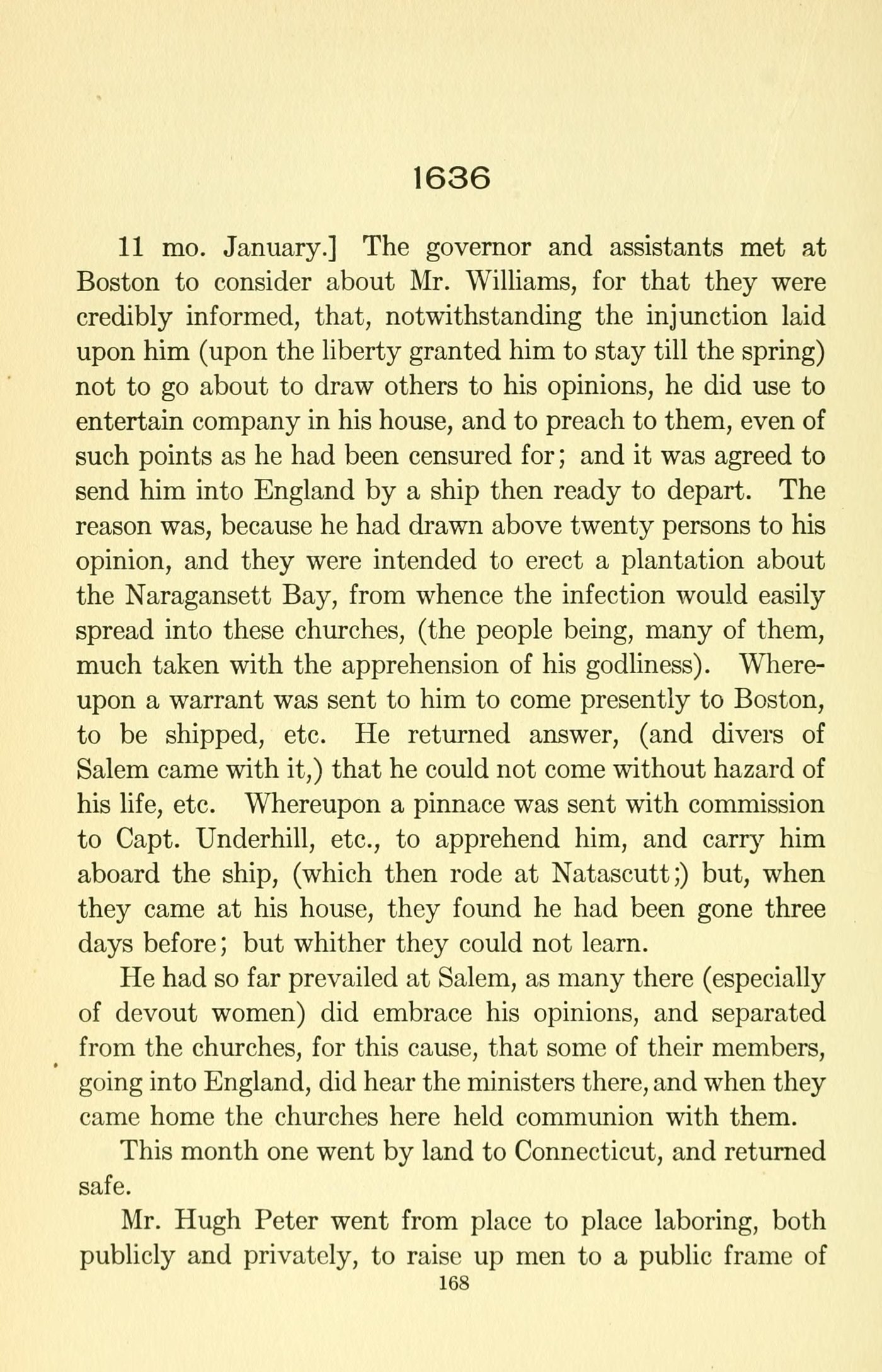
Roger Williams had come to Salem in 1633 and, after Skelton’s death, the Salem church chose him its teacher, in the face of the magistrates. In July 1635 the general court summoned “Mr. Williams of Salem” and laid to his charge four opinions, the first being “that the magistrate ought not to punish the breach of the first table, otherwise than in such cases as did disturb the civil peace”: that is, that the civil power had no business enforcing the duties owed to God. The court punished Salem for choosing him by refusing the town’s petition for Marblehead Neck, and the Salem church answered by writing to the other churches to admonish the magistrates.49 In the autumn the court sentenced him to leave the jurisdiction; in January 1636 the governor and assistants, hearing that he was still preaching in his house and that “he had drawn above twenty persons to his opinion, and they were intended to erect a plantation about the Naragansett Bay, from whence the infection would easily spread into these churches,” ordered him shipped to England, and sent Captain Underhill’s pinnace to take him. He had gone three days before. Winthrop added: “He had so far prevailed at Salem, as many there (especially of devout women) did embrace his opinions, and separated from the churches.”50
That is the Salem she was living in. Williams was its teacher from Skelton’s death until his flight, the very years in which she was keeping Skelton’s house; the town was in open quarrel with the Bay government over him; and the people the magistrates worried about most were Salem women. The records do not say she was one of them. They say only that she was not a member of the church, and that within two years she held ground in the plantation he founded.23, 40, 50
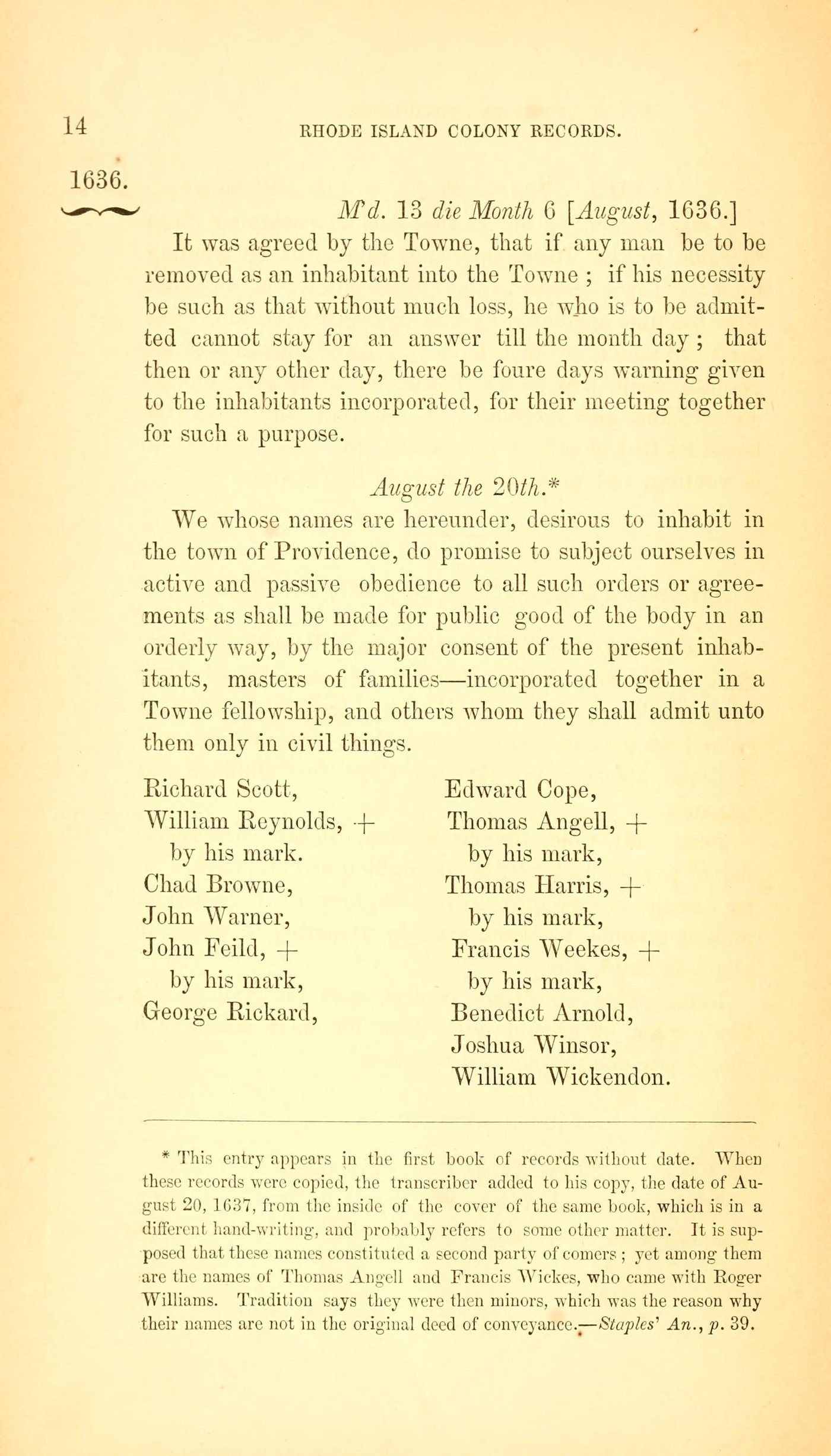
What Providence was, the first town book says in one sentence. The men who came after Williams and his first companions bound themselves to obey the orders made “by the major consent of the present inhabitants, masters of families … only in civil things.” No church covenant, no oath to a magistrate, no power in the town over what a person believed or how a household ordered its worship. The thirteen who signed included Benedict Arnold, Thomas Angell, Francis Weekes, and William Reynolds, the same men who stand beside “Mrs. Daniel” in the grant of ground in the plantation’s second year.23, 51 For a woman in her position the difference was not abstract. In the Bay her marriage was a matter for the Governor and Council, her husband could be ordered kept from her but not put away, and the court held her to a proof from England she could not get. At Providence there was no court to ask.4, 24, 51
The limit of that liberty shows in the same town book and in Winthrop’s note on it, and it shows in her own case. In 1638 the town disfranchised Joshua Verin for restraining his wife from going to Williams’s meetings, holding that liberty of conscience reached her as well as him; and it was in that debate that “one Greene” spoke for the wives, the Greene who, as Winthrop was careful to record, had married the wife of Beggarly “whose husband is living, and no divorce.” The Bay would have called that marriage no marriage. Providence, having no rule but civil peace, let it stand, and it is from that town, not from Salem, that the Greene family descends.24, 51
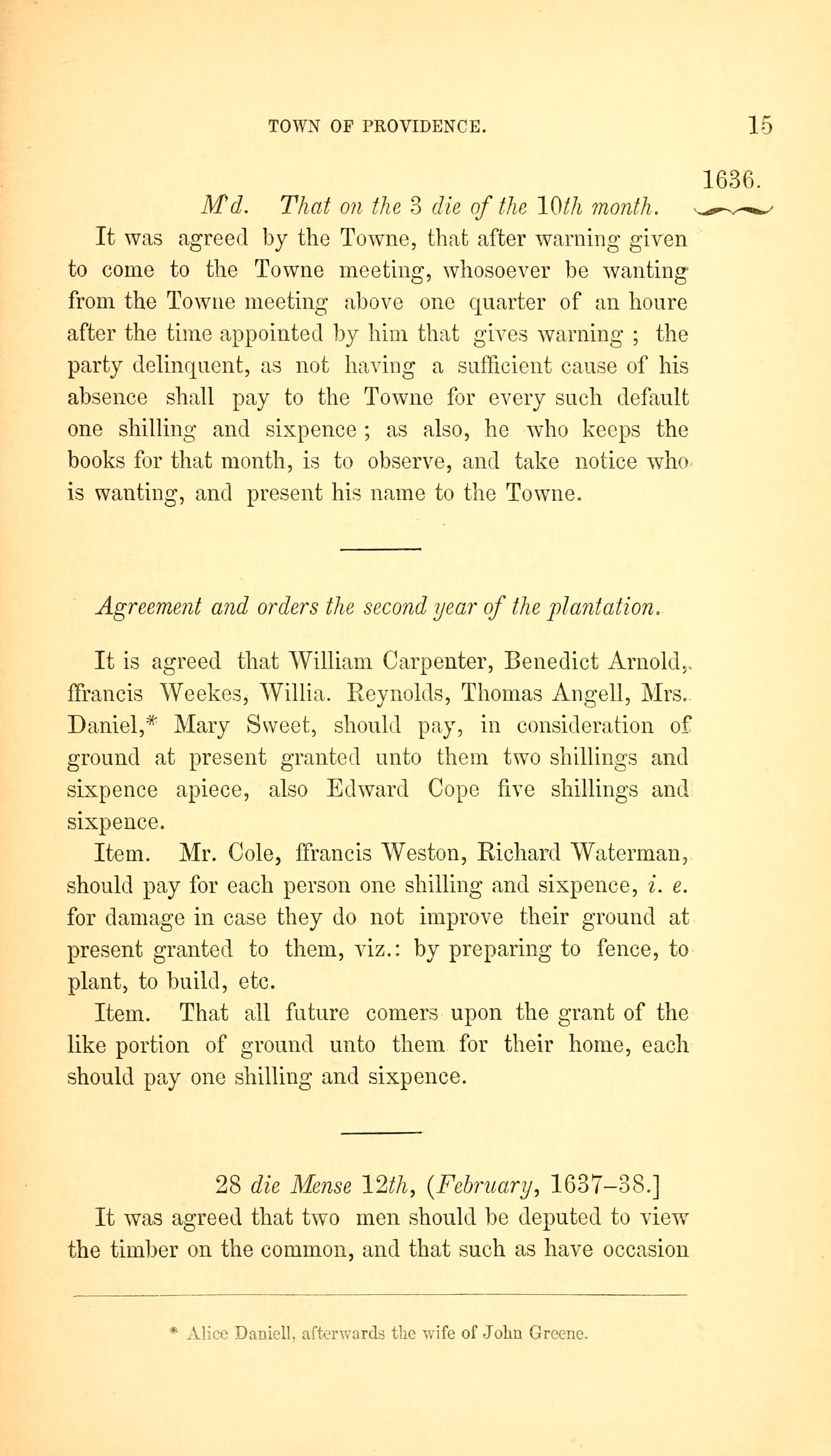
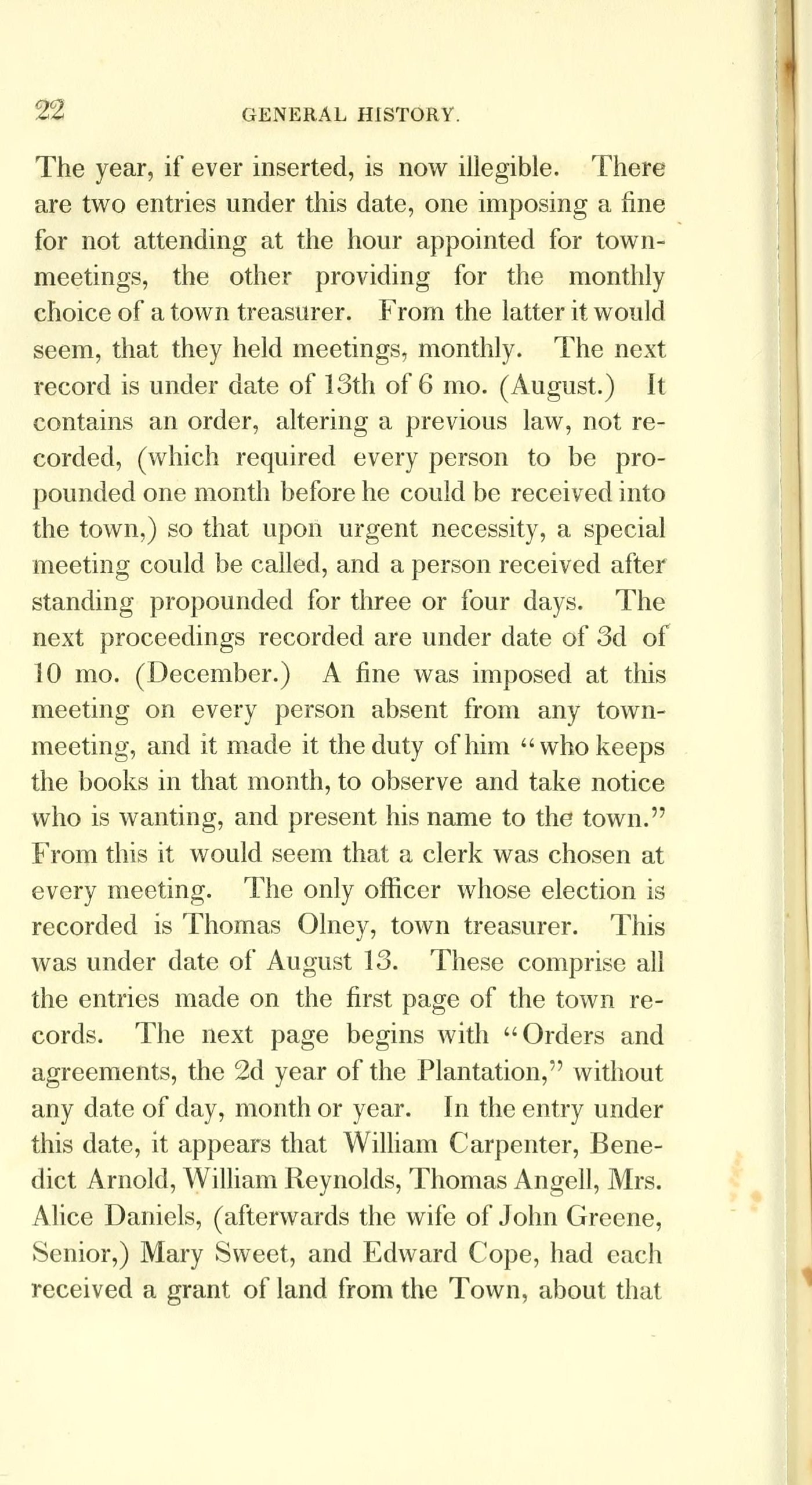
Agreement and orders the second year of the plantation. It is agreed that William Carpenter, Benedict Arnold, ffrancis Weekes, Willia. Reynolds, Thomas Angell, Mrs. Daniel, Mary Sweet, should pay, in consideration of ground at present granted unto them two shillings and sixpence apiece …
The editor of the colony records adds: “Alice Daniell, afterwards the wife of John Greene.”23 Staples, writing from the same town book in 1843, has “Mrs. Alice Daniels, (afterwards the wife of John Greene, Senior,).”11 The second page of the Providence town book, headed “Agreement and orders the second year of the plantation,” that is 1637, the year after Roger Williams and his companions settled there.11, 23 Seven new comers are to pay two shillings and sixpence apiece for the ground granted them; she is one, between Thomas Angell and Mary Sweet, the only two women on the list.23 That while her divorce was unresolved in Massachusetts and her farm still hers at Salem, she took ground in a town outside the Bay Colony’s jurisdiction, where Massachusetts law did not run.23, 32 The two editors who read the original book, Staples in 1843 and Bartlett in 1856, both knew her as the woman who afterwards married John Greene.11, 23
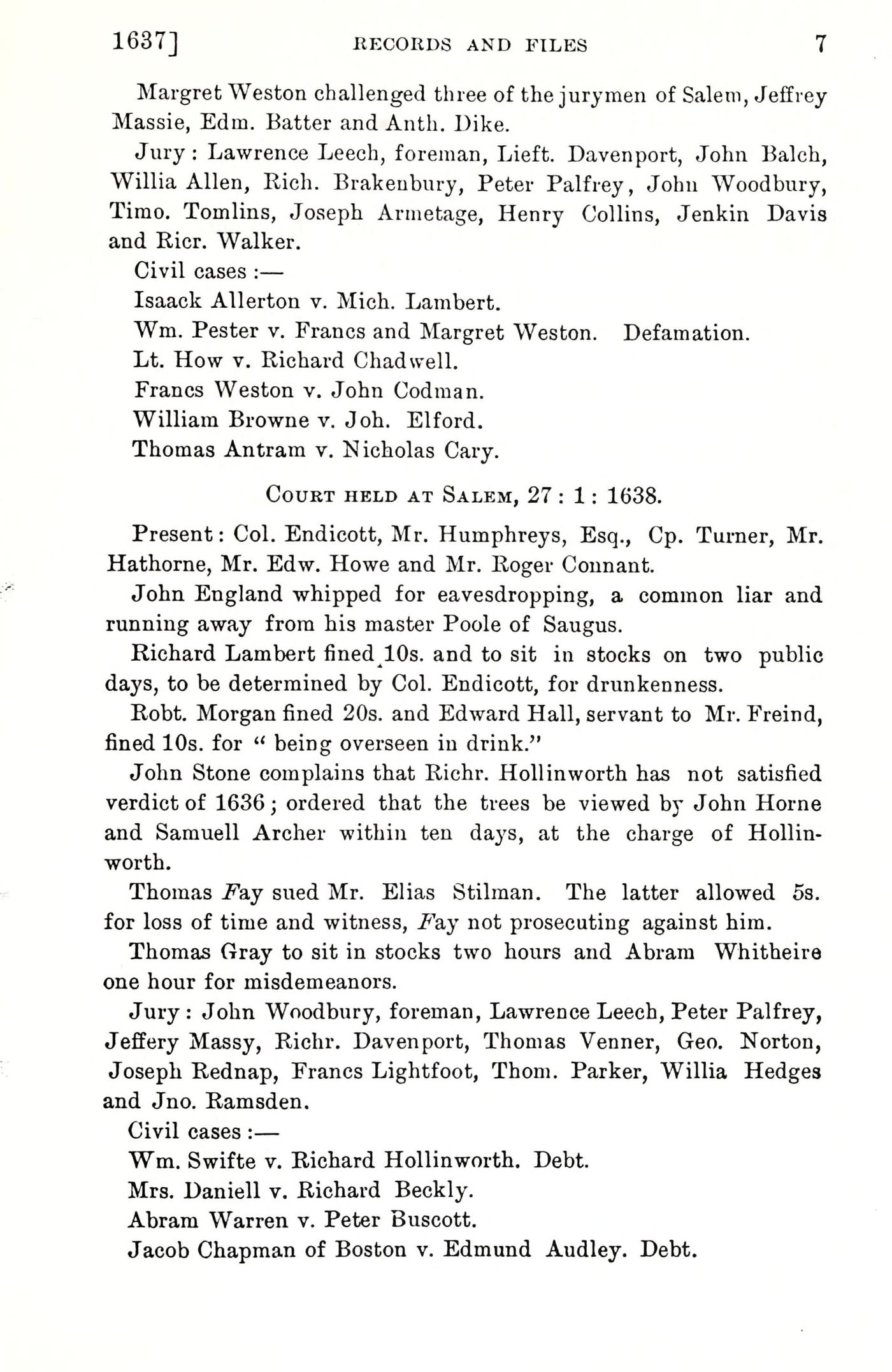
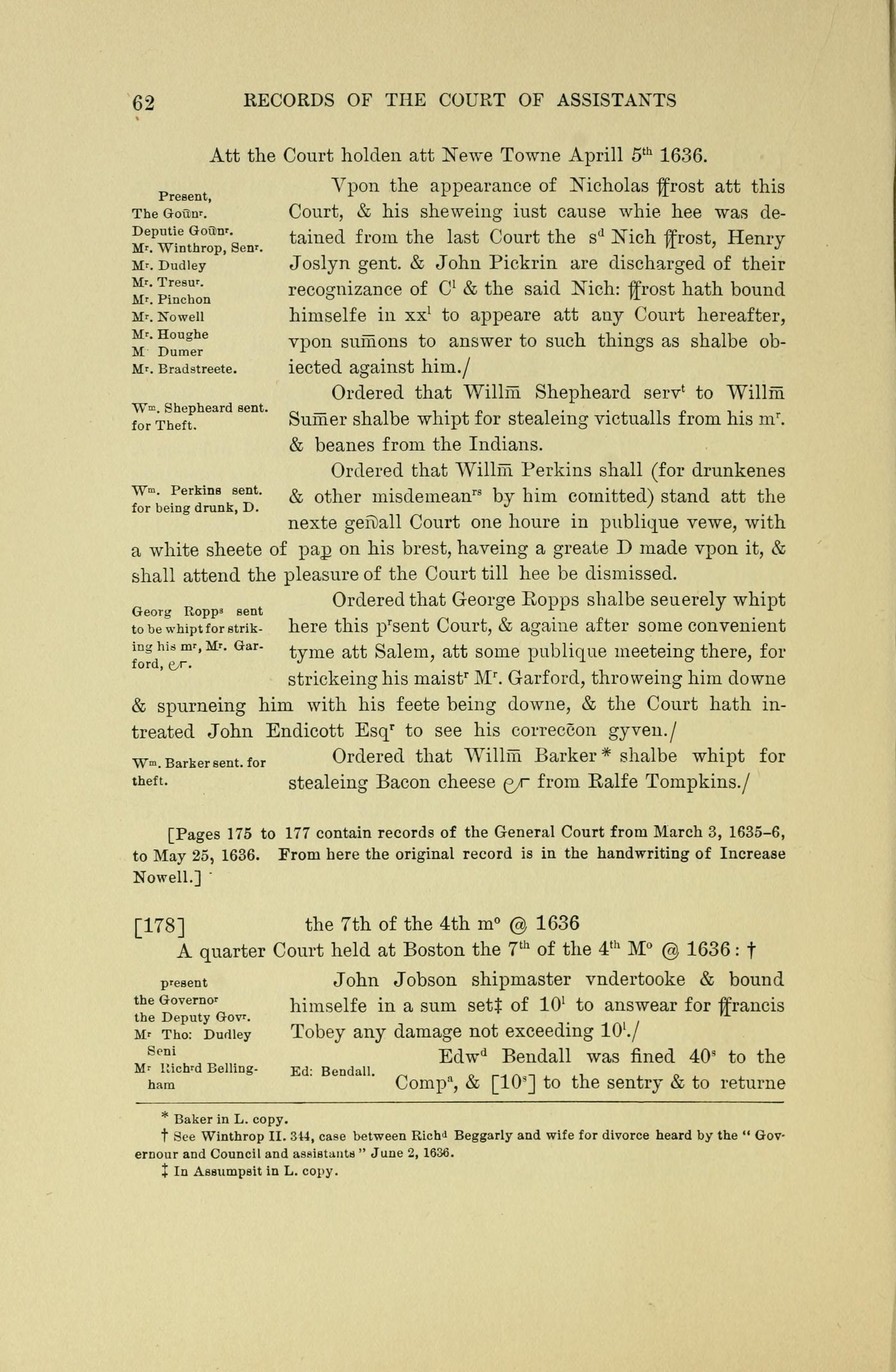
Court held at Salem, 27: 1: 1638. Present: Col. Endicott, Mr. Humphreys, Esq., Cp. Turner, Mr. Hathorne, Mr. Edw. Howe and Mr. Roger Connant. … Civil cases: … Mrs. Daniell v. Richard Beckly.
The Register, from the original record, gives the verdict: “Mrs. Daniell pl., agt Richard Beckley, deft., in a co of debt. Jury finds for pl. Twenty shillings damages & iiij Costs.”9 The record of the quarterly court held at Salem on 27 March 1638, before Endecott, John Humphrey and the other Salem magistrates, printed by the Essex Institute in 1911 from the county files.7 The civil cases are listed by name only; the verdict survives in the original book and was printed by Trask.9 Twenty shillings is exactly the sum the Governor and Council had ordered her to advance Richard in 1636. Here “Mrs. Daniell” recovers twenty shillings from “Richard Beckly” in an action of debt.4, 7, 9 This is the record that proves Mrs. Beggarly and Mrs. Daniell one woman: the wife of 1636 and the plaintiff of 1638 are pursuing the same twenty shillings against the same man, and the court knew him by a third spelling of his name. Upham saw the connection in 1875, and Pope in 1900 wrote that she “seems to be the Alice Daniel of later record.”10, 13
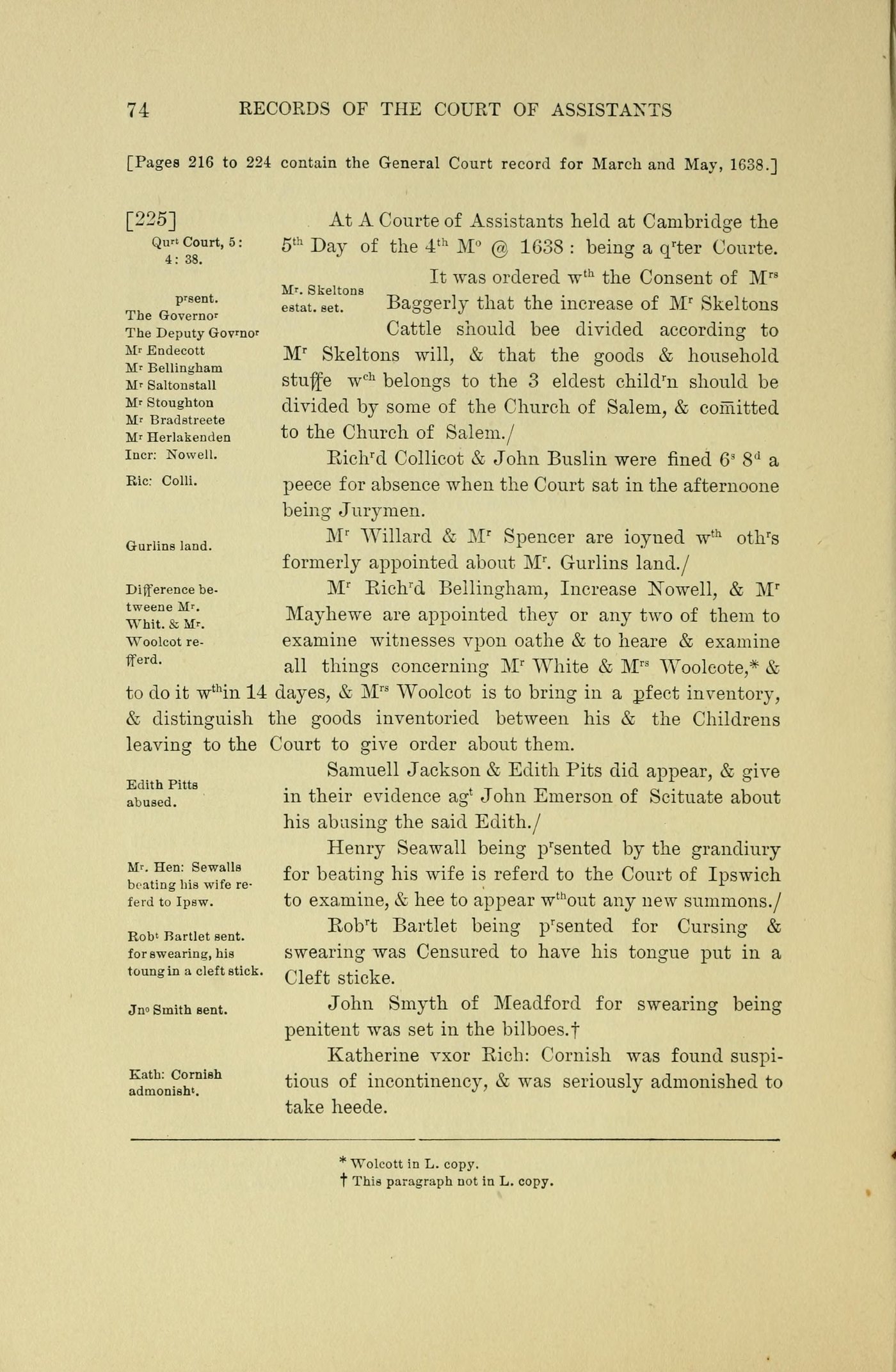
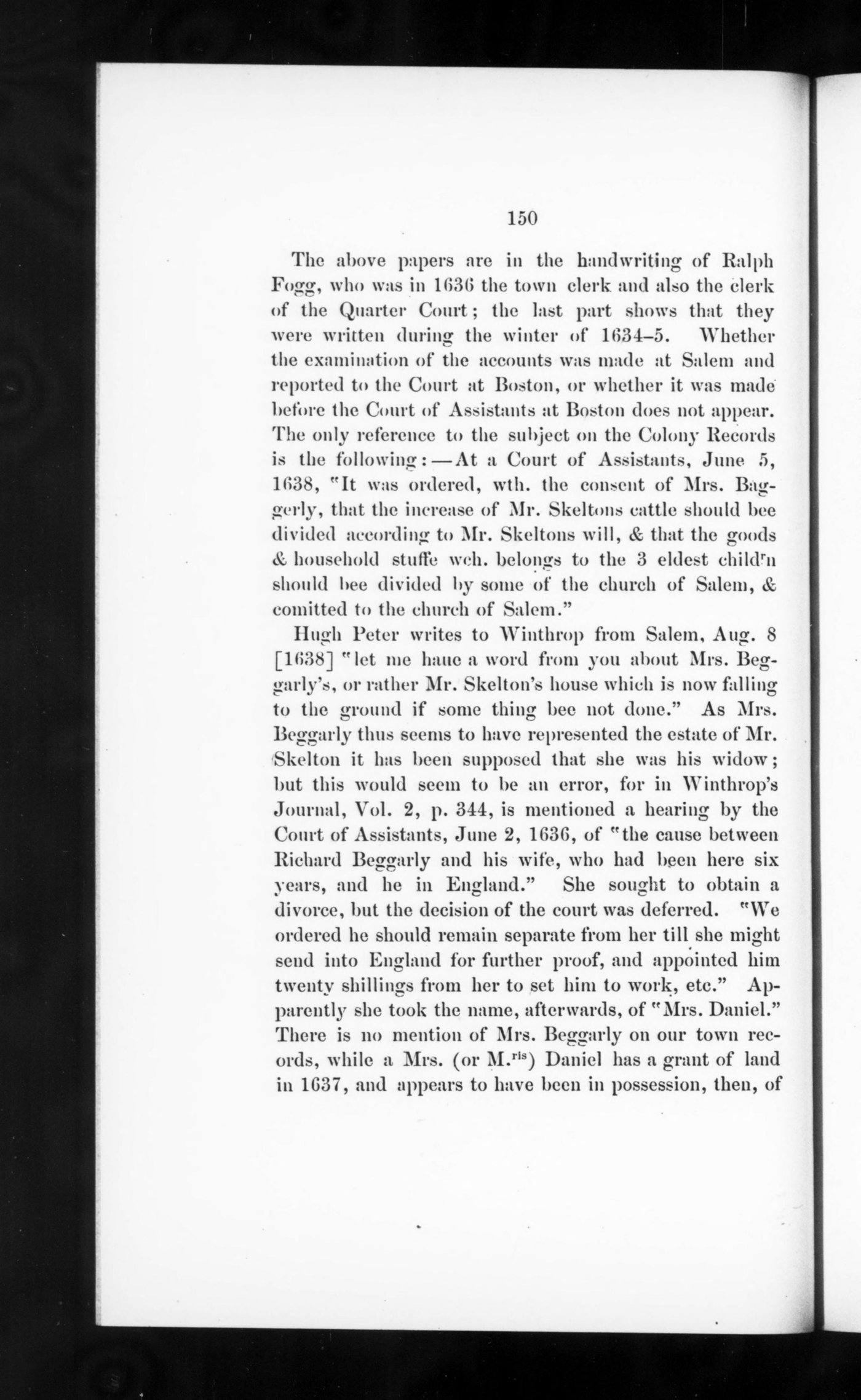
At A Courte of Assistants held at Cambridge the 5th Day of the 4th Mo 1638: being a qrter Courte. It was ordered wth the Consent of Mrs Baggerly that the increase of Mr Skeltons Cattle should bee divided according to Mr Skeltons will, & that the goods & household stufe wch belongs to the 3 eldest childrn should be divided by some of the Church of Salem, & comitted to the Church of Salem.
Four years after the minister’s death she still held his cattle and household goods, and her consent was needed to release them.6 An order of the Court of Assistants, the colony’s upper court, sitting at Cambridge with the Governor, the Deputy Governor, Endecott, Bellingham, Saltonstall and the other magistrates present, entered in the clerk’s hand with the marginal note “Mr. Skeltons estat. set.”6 That the will she had feared would be “disanulld” was upheld: the cattle’s increase was divided according to it.1, 6 That the three eldest children’s goods went to the church of Salem, not to her, so her charge of them ended. And that nothing was done without her consent, recorded by name, though she was already a landholder at Providence.6, 23 She is “Mrs Baggerly” here, in the Boston court, and “Mrs. Daniell” at Salem ten weeks before.7
Source6
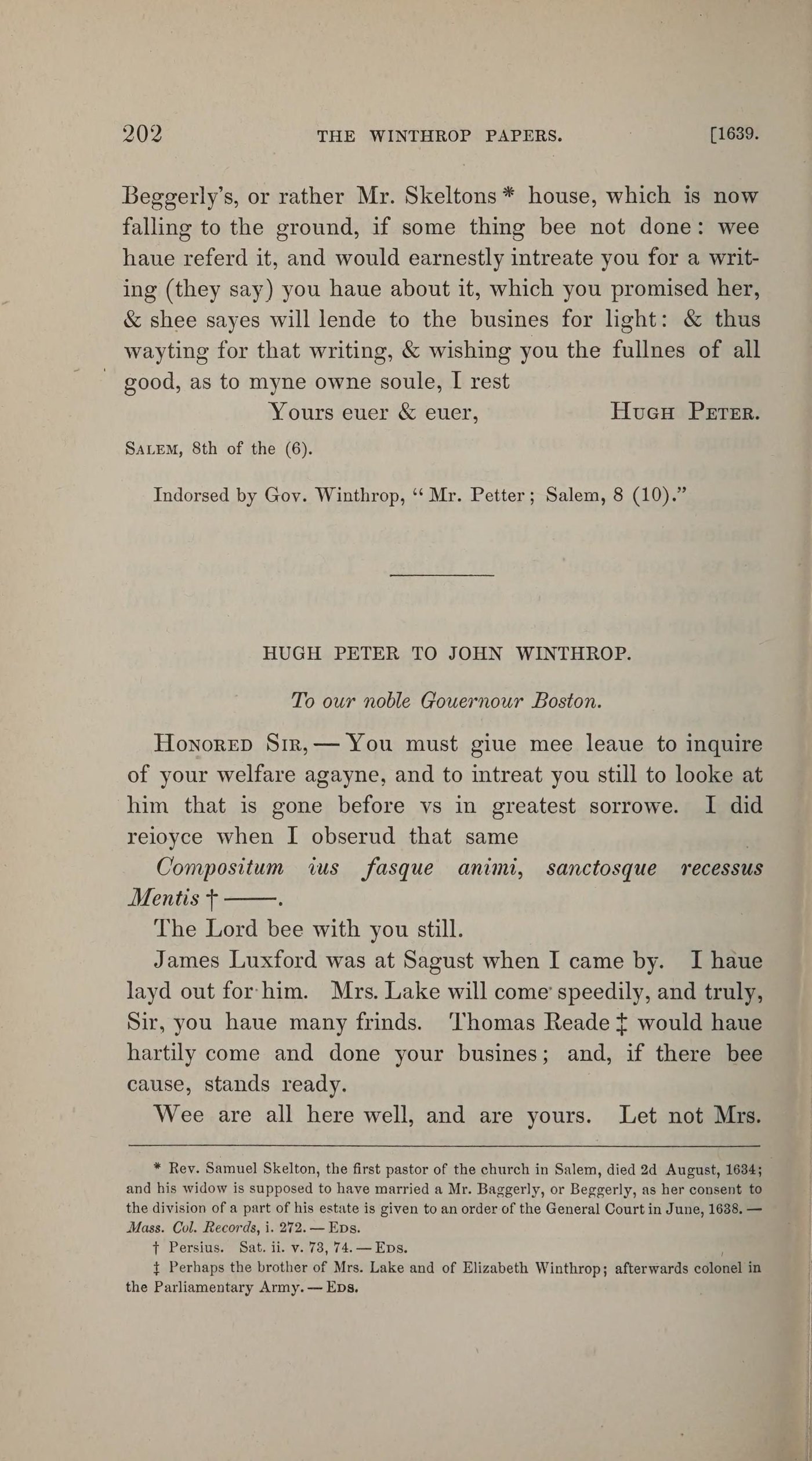
… earnestly to intreat you to let mee haue a word from you about Mrs. Beggerly’s, or rather Mr. Skeltons house, which is now falling to the ground, if some thing bee not done: wee haue referd it, and would earnestly intreate you for a writing (they say) you haue about it, which you promised her, & shee sayes will lende to the busines for light: & thus wayting for that writing … Yours euer & euer, Hugh Peter. Salem, 8th of the (6). Indorsed by Gov. Winthrop, “Mr. Petter; Salem, 8 (10).”
Skelton’s successor as Salem’s minister writes of the parsonage as hers.34, 52 The quarterly court at Salem ordered the house taken down on 27 August 1644.14 A letter from Hugh Peter, minister of Salem, to Governor Winthrop, first printed in 1865. Peter dated it the eighth of the sixth month, August; Winthrop’s endorsement reads the tenth month, December.52 The 1865 editors, not knowing the 1636 hearing, supposed in a footnote that she was Skelton’s widow; Upham corrected that in 1875.10, 52 That the town still called Skelton’s house hers four years after his death, that a paper of Winthrop’s about it had been promised to her, and that she was in touch with Peter and willing to lend the paper “for light” on the business.52 The house was past saving; in 1644 the court ordered it down within ten days as a danger to persons and cattle.14
The town’s revised list of home lots, as they were laid out along the Town Street from the Mile-end Cove, names fifty-four proprietors in order of their lots.3, 11
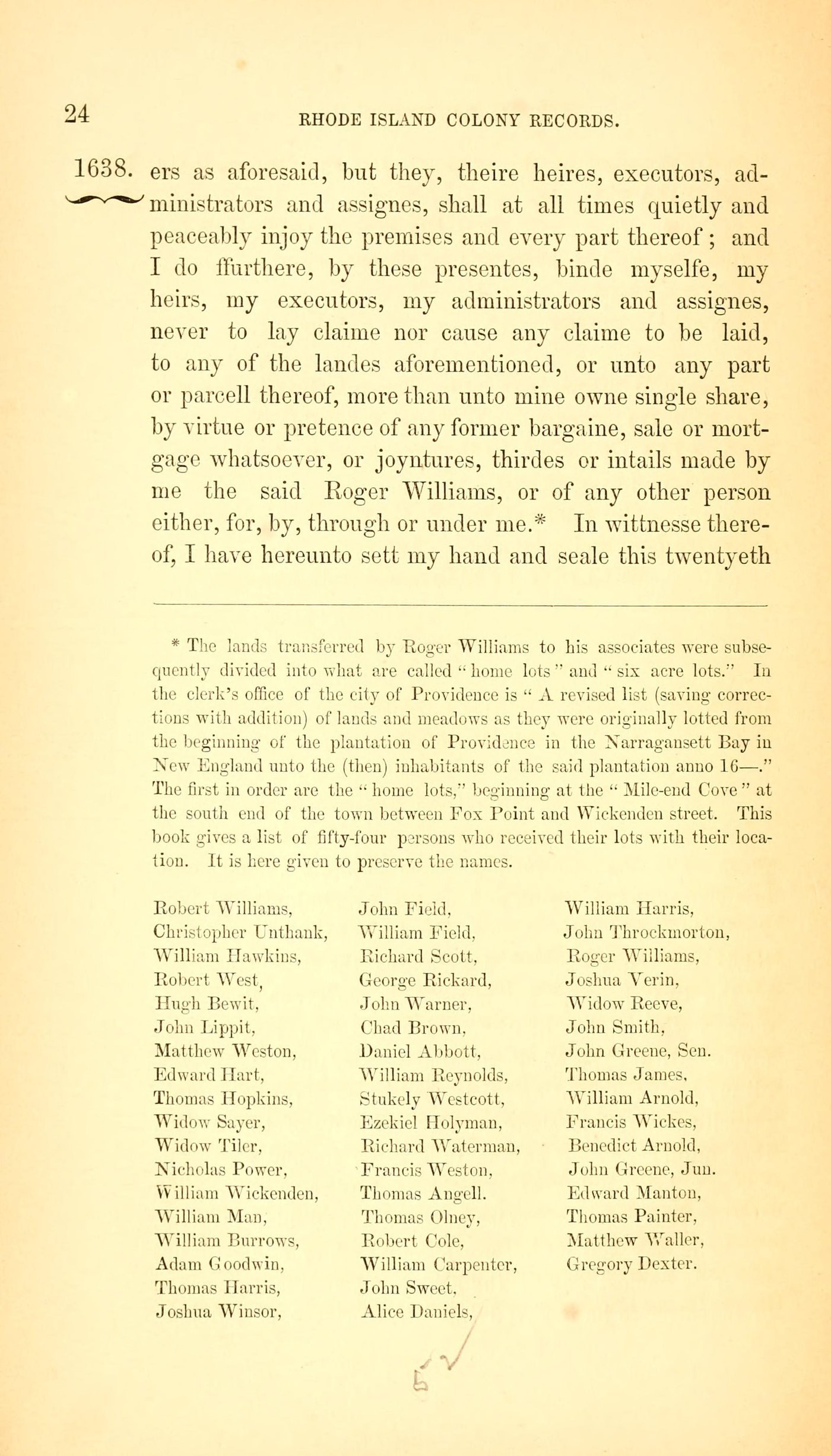
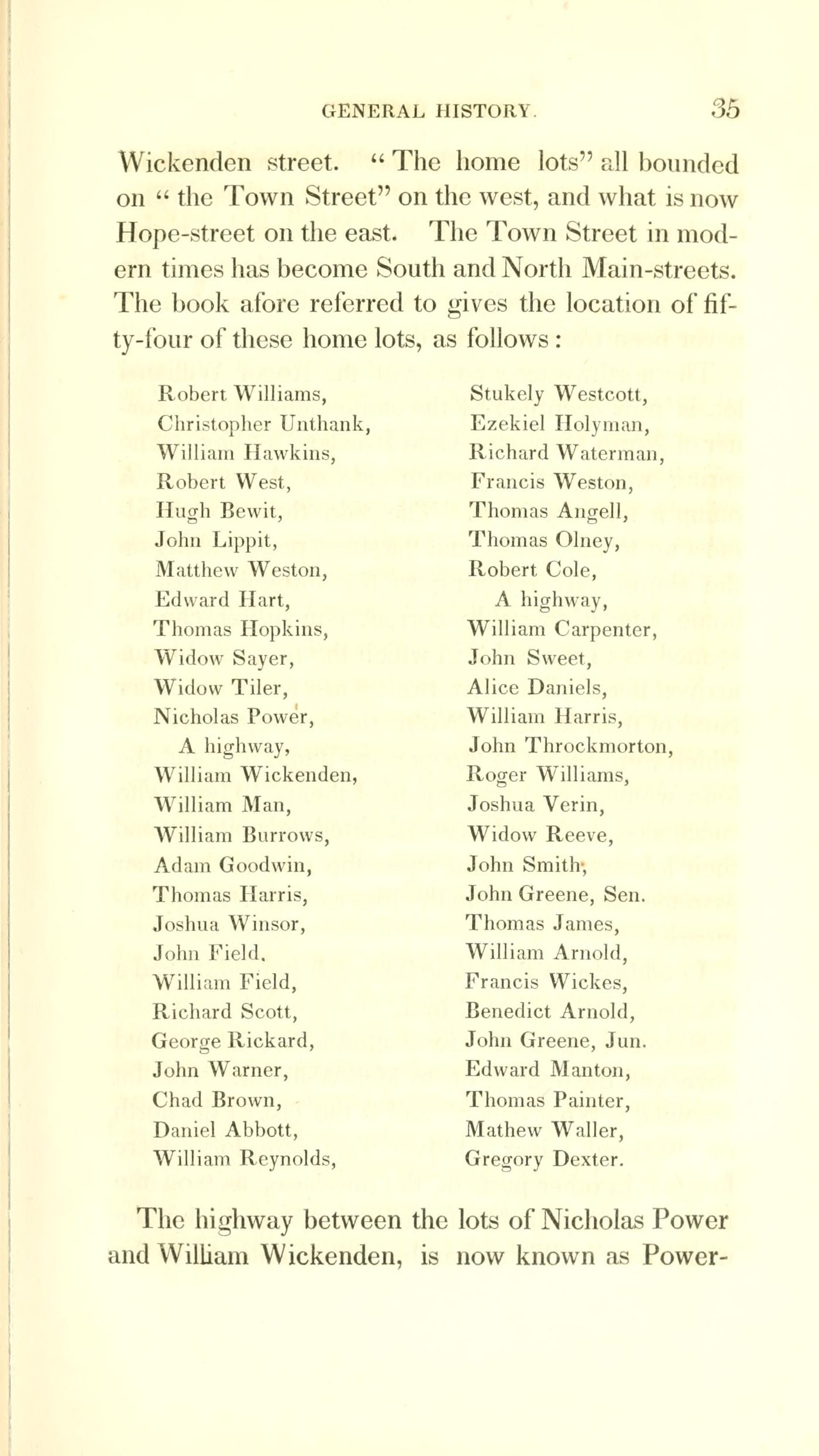
… Thomas Olney, Robert Cole, William Carpenter, John Sweet, Alice Daniels, William Harris, John Throckmorton, Roger Williams, Joshua Verin, Widow Reeve, John Smith, John Greene, Sen., Thomas James, William Arnold, Francis Wickes, Benedict Arnold, John Greene, Jun., Edward Manton, Thomas Painter, Matthew Waller, Gregory Dexter.
George Sears Greene, from the town’s lot book, adds that John Greene Senior “inherited the lot of Alice Daniels his second wife between Wm. Harris on the North and John Sweet on the South.” That sentence is Greene’s summary of the lot book, not the wording of the printed colony record, which is a bare list of names.3, 15 A list preserved in the Providence city clerk’s office, “A revised list of lands and meadows as they were originally lotted,” printed by Staples in 1843 and by Bartlett in 1856, giving the fifty-four persons who received home lots under Roger Williams’s deed of 1638.3, 11 The lots ran in order down the Town Street; her lot lay between John Sweet’s and William Harris’s, four lots from Roger Williams’s own.3 That in 1638 she was a proprietor of Providence in her own name, a woman holding a home lot among the founders of the town, the only woman on the list not styled Widow.3 She is “Alice Daniels” here; no Providence record calls her Beggarly or Joan.3, 23
Reporting the quarrel at Providence over whether Joshua Verin could keep his wife from Roger Williams’s meetings, Winthrop records who spoke against Verin.24
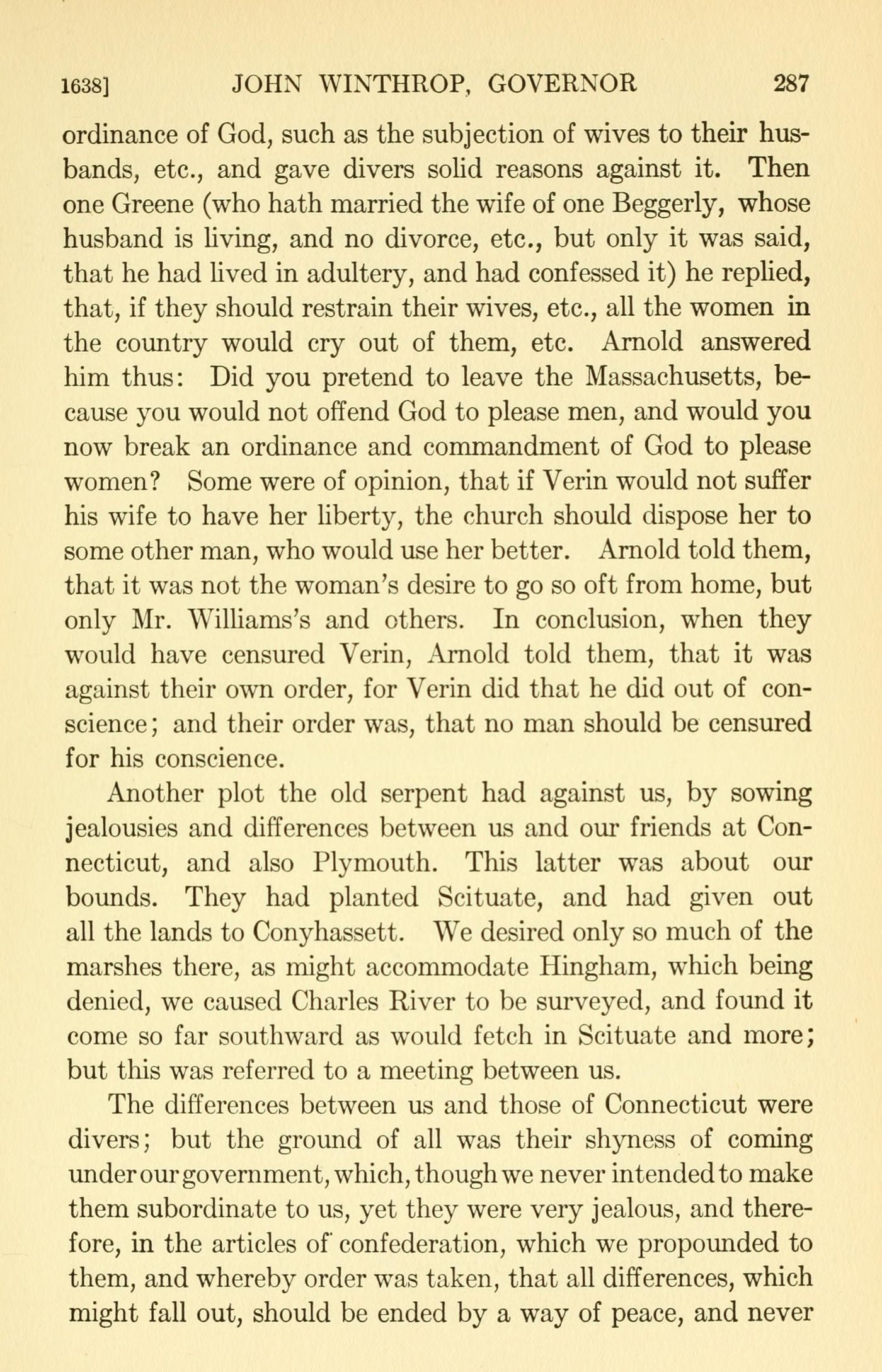
Then one Greene (who hath married the wife of one Beggerly, whose husband is living, and no divorce, etc., but only it was said, that he had lived in adultery, and had confessed it) he replied, that, if they should restrain their wives, etc., all the women in the country would cry out of them, etc. Arnold answered him thus: Did you pretend to leave the Massachusetts, because you would not offend God to please men, and would you now break an ordinance and commandment of God to please women?
Winthrop, who had heard her plea in 1636, is pointed: the marriage to Greene was made with the first husband alive and no divorce granted.4, 24 This is the only contemporary record of the marriage, and it does not give Greene’s forename.24 An entry in Winthrop’s journal, the running history of the colony he kept from 1630, written after 13 December 1638 among a series of notes on Providence, which he regarded as a warning of what liberty of conscience led to. Joshua Verin, one of the fifty-four proprietors, had been disfranchised by the town for restraining his wife from going to Roger Williams’s meetings; William Arnold argued that this broke God’s ordinance of the subjection of wives; “one Greene” answered him.3, 24 Winthrop’s parenthesis about Greene is his aside to the reader: this is the man who married Beggarly’s wife, and the reader should weigh his opinion of wives accordingly. That by the end of 1638 she had married a Greene at Providence; that Winthrop, who had sat on her case, held the marriage to be no marriage, “no divorce”; and that the ground on which Providence accepted it was Richard’s confessed adultery.4, 24 Her new husband stood up in the town meeting for the liberty of wives. Which John Greene he was is the question of the next section.
Source24
Her Salem years, revisited
Four further Salem records, found on a second search, fill in the shape of her life there between 1634 and 1638.40, 41, 53, 54
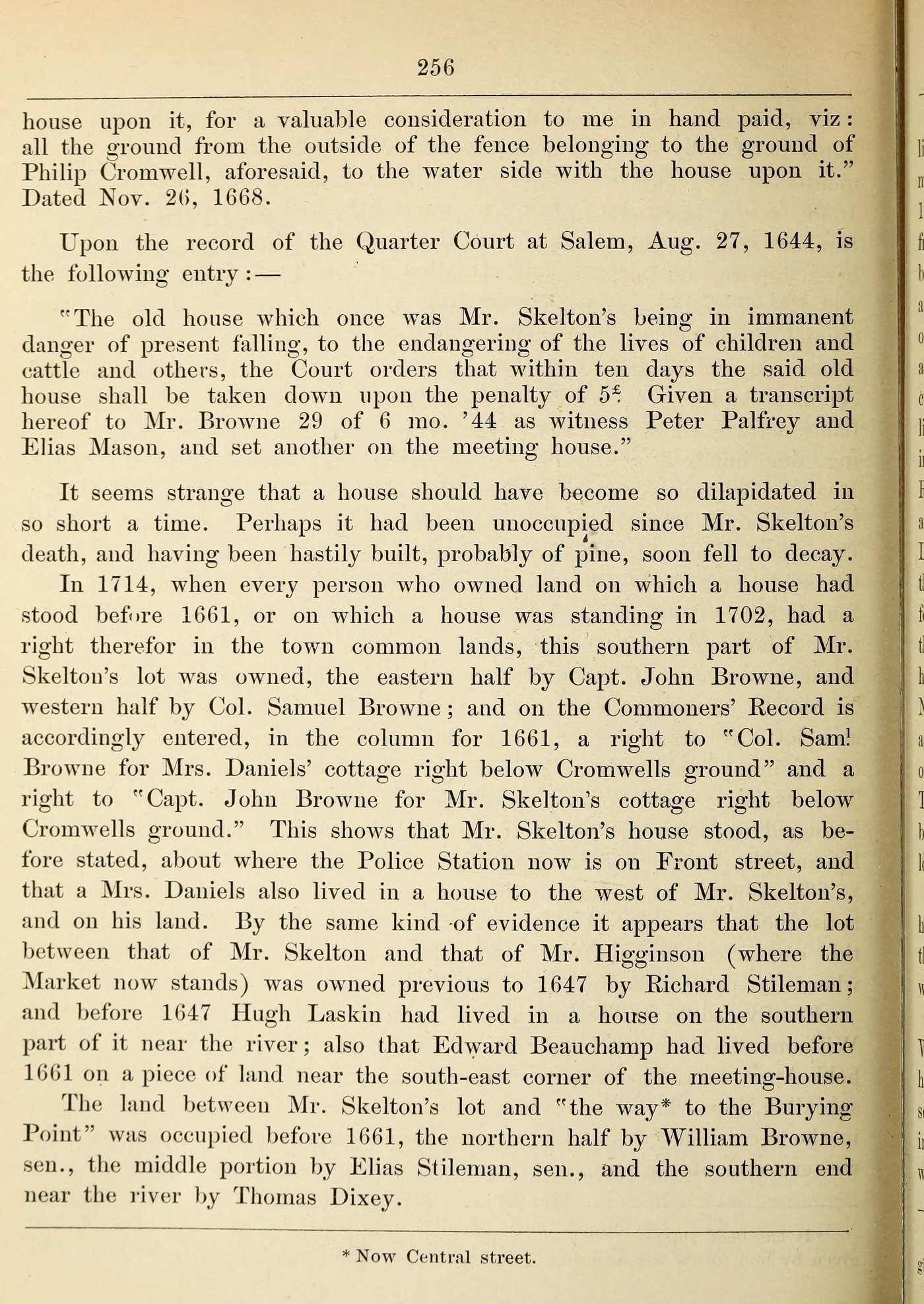
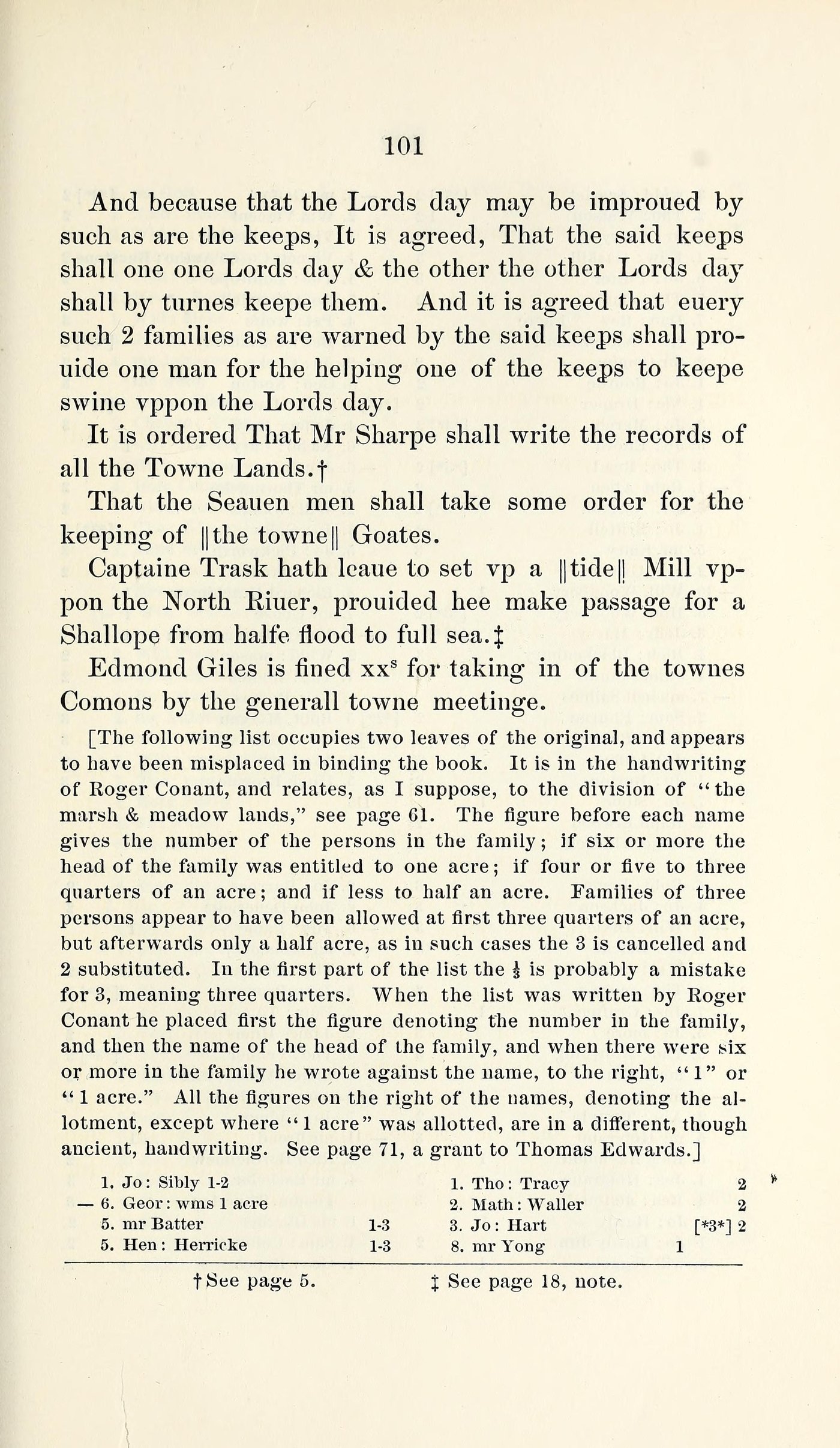
[Commoners’ Record, column for 1661:] a right to “Col. Saml Browne for Mrs. Daniels’ cottage right below Cromwells ground” and a right to “Capt. John Browne for Mr. Skelton’s cottage right below Cromwells ground.” This shows that Mr. Skelton’s house stood, as before stated, about where the Police Station now is on Front street, and that a Mrs. Daniels also lived in a house to the west of Mr. Skelton’s, and on his land.
[Quarter Court at Salem, 27 August 1644:] The old house which once was Mr. Skelton’s being in immanent danger of present falling, to the endangering of the lives of children and cattle and others, the Court orders that within ten days the said old house shall be taken down upon the penalty of 5£.
The Salem commoners’ book, when it counted in 1714 the houses that had stood before 1661, counted two on the minister’s lot by the South River: Skelton’s own, and “Mrs. Daniels’ cottage” west of it.41 She did not live in the minister’s house; she had a house of her own beside it, on his land, and it survived long enough after she left to earn a right in the commons. Roger Conant’s division of the town marsh, which lists each head of family with the number of persons in the household, enters her as “1. mris Daniell”: a household of one.48, 54 The 1636 list of farms brackets “Mrs. Daniell” among the farm holders, and the grant of November 1637 gave her fifty acres more.32, 54 Felt, working the same records in 1845, entered her among the settlers as “Daniels, Alice, Mrs. g. l. 1637,” granted land.40
Two Skelton lots have to be kept apart. His house lot was the block on the north bank of the South River that is now bounded by Essex, Washington, Front and Central Streets; Perley’s plan of that block as it stood in 1700 marks the “Site of House of Rev. Samuel Skelton” at the Front Street end of the William Browne lot, with the Cromwell lots between it and Washington Street, which “originally belonged to Rev. Samuel Skelton, and to Mr. Philip Cromwell as early as 1647.”55 That is the ground Upham meant by “about where the Police Station now is on Front street,” and it is where the commoners’ book puts “Mrs. Daniels’ cottage,” west of Skelton’s house, on his land, “below Cromwells ground.”41 His four acres of 1630, a different parcel, lay a few hundred yards west at the head of the river, between Sweet’s Cove and the water “where Mill Street now crosses over into Southfields”; that is the land of the mill suit of 1664, and no house of his stood on it.56
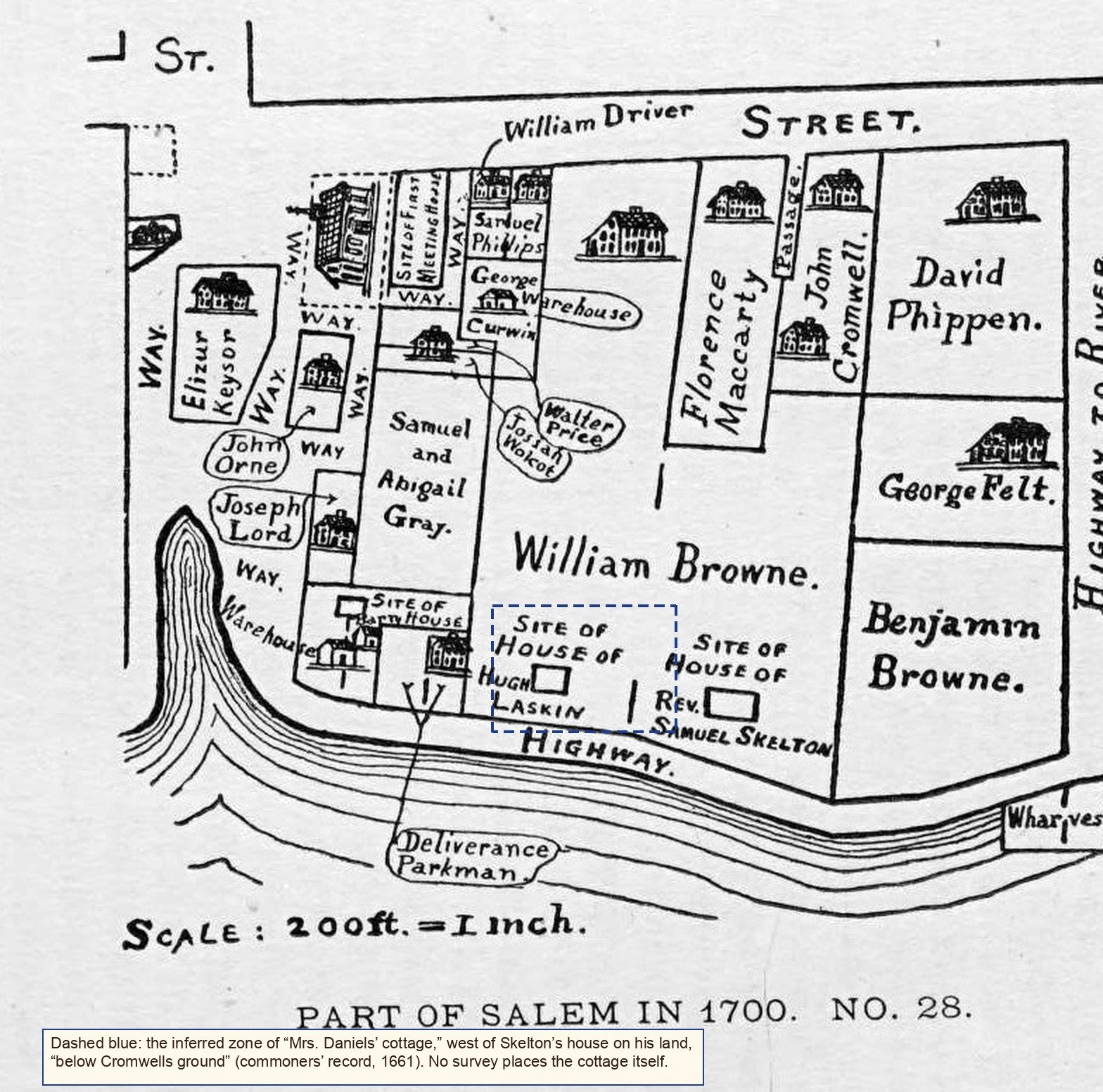
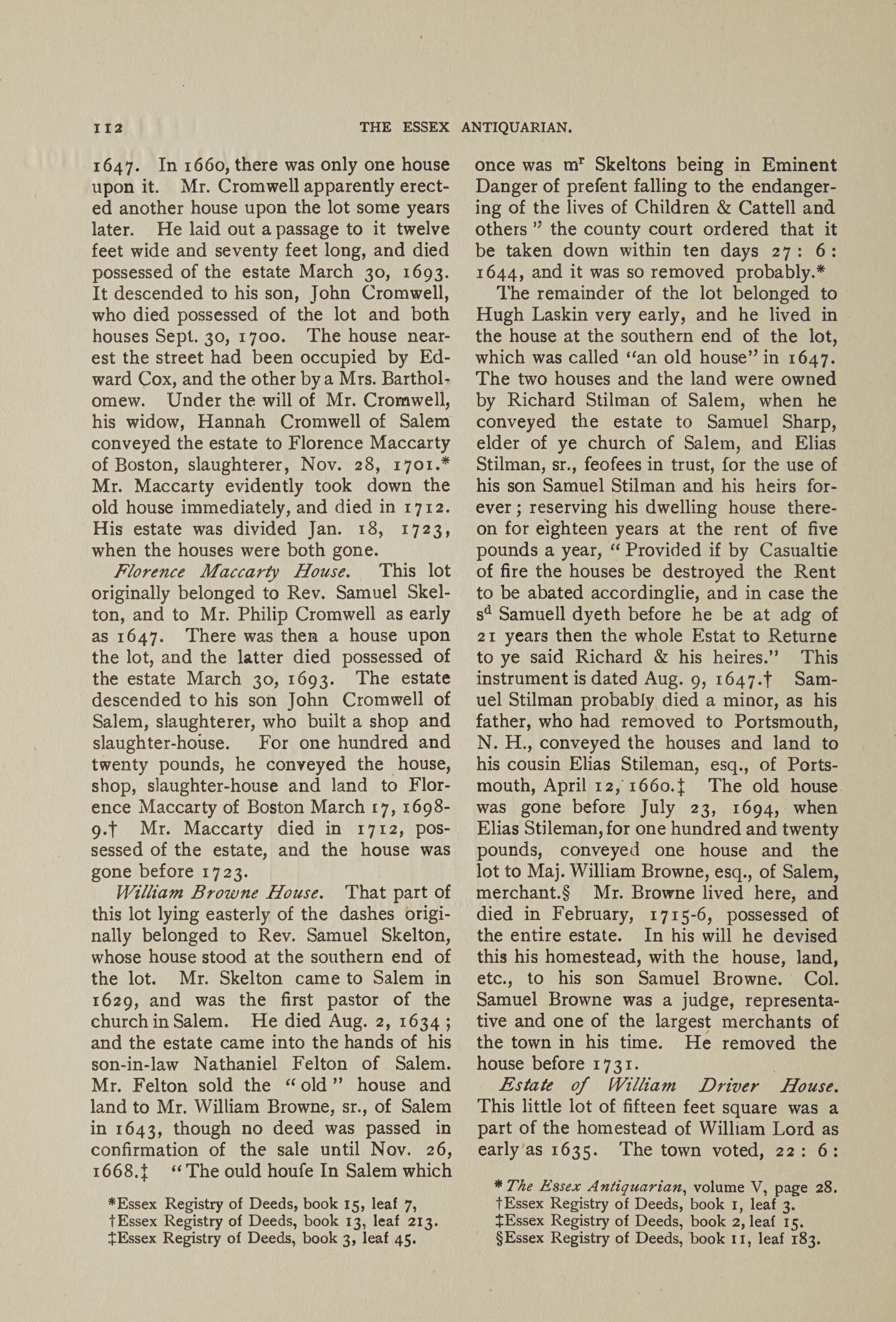
[Perley, 1907, p. 112:] William Browne House. That part of this lot lying easterly of the dashes originally belonged to Rev. Samuel Skelton, whose house stood at the southern end of the lot. Mr. Skelton came to Salem in 1629, and was the first pastor of the church in Salem. He died Aug. 2, 1634; and the estate came into the hands of his son-in-law Nathaniel Felton of Salem. Mr. Felton sold the “old” house and land to Mr. William Browne, sr., of Salem in 1643, though no deed was passed in confirmation of the sale until Nov. 26, 1668. “The ould houfe In Salem which once was mr Skeltons being in Eminent Danger of prefent falling to the endangering of the lives of Children & Cattell and others” the county court ordered that it be taken down within ten days 27: 6: 1644, and it was so removed probably. The remainder of the lot belonged to Hugh Laskin very early, and he lived in the house at the southern end of the lot, which was called “an old house” in 1647.
[Perley, 1907, pp. 110–112:] Florence Maccarty House. This lot originally belonged to Rev. Samuel Skelton, and to Mr. Philip Cromwell as early as 1647. There was then a house upon the lot, and the latter died possessed of the estate March 30, 1693. … John Cromwell Houses. This lot of land originally belonged to Rev. Samuel Skelton, and to Mr. Philip Cromwell in 1647. In 1660, there was only one house upon it.
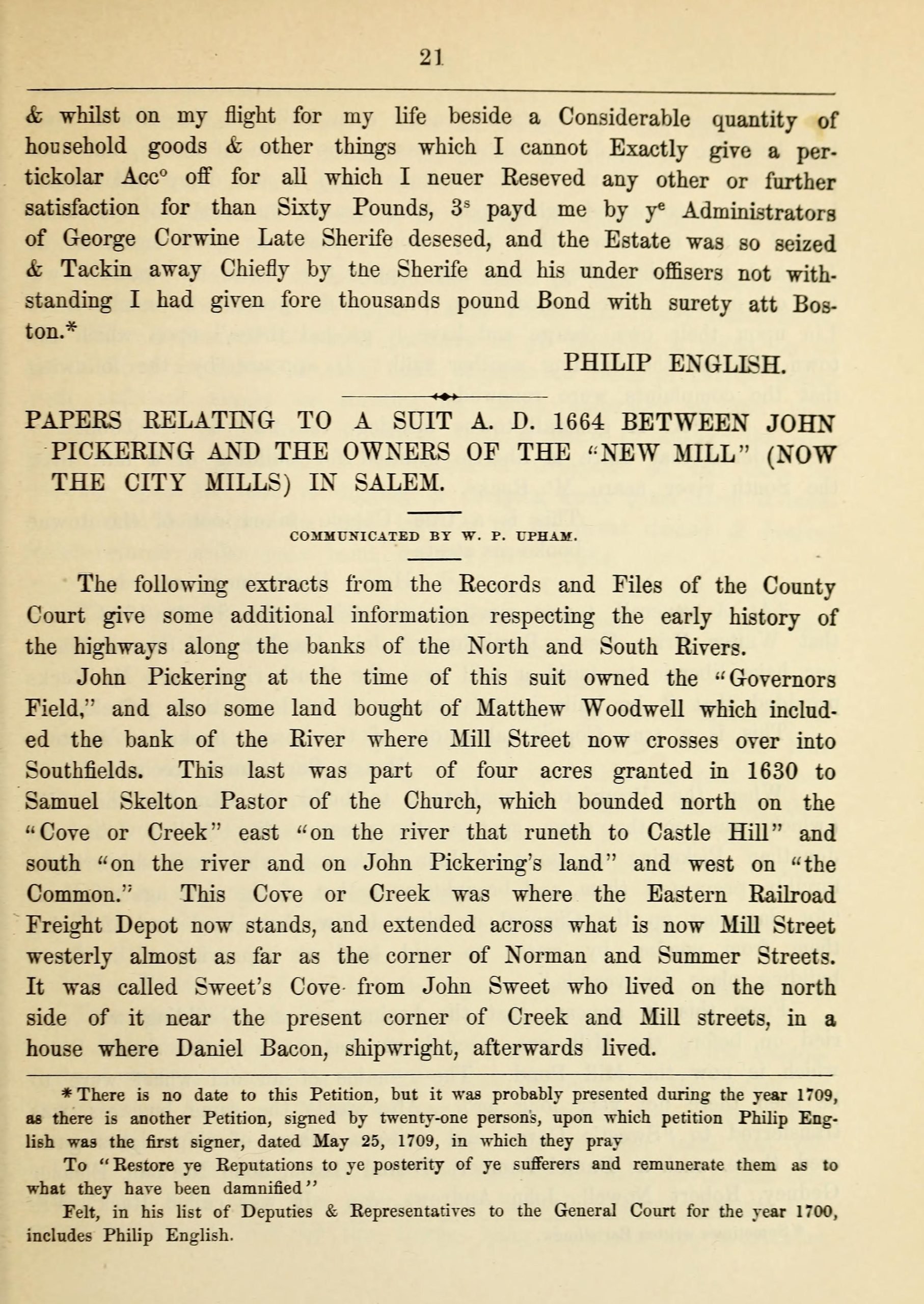
[Upham, 1866, p. 21:] John Pickering at the time of this suit owned the “Governors Field,” and also some land bought of Matthew Woodwell which included the bank of the River where Mill Street now crosses over into Southfields. This last was part of four acres granted in 1630 to Samuel Skelton Pastor of the Church, which bounded north on the “Cove or Creek” east “on the river that runeth to Castle Hill” and south “on the river and on John Pickering’s land” and west on “the Common.” This Cove or Creek was where the Eastern Railroad Freight Depot now stands, and extended across what is now Mill Street westerly almost as far as the corner of Norman and Summer Streets. It was called Sweet’s Cove from John Sweet who lived on the north side of it near the present corner of Creek and Mill streets, in a house where Daniel Bacon, shipwright, afterwards lived.
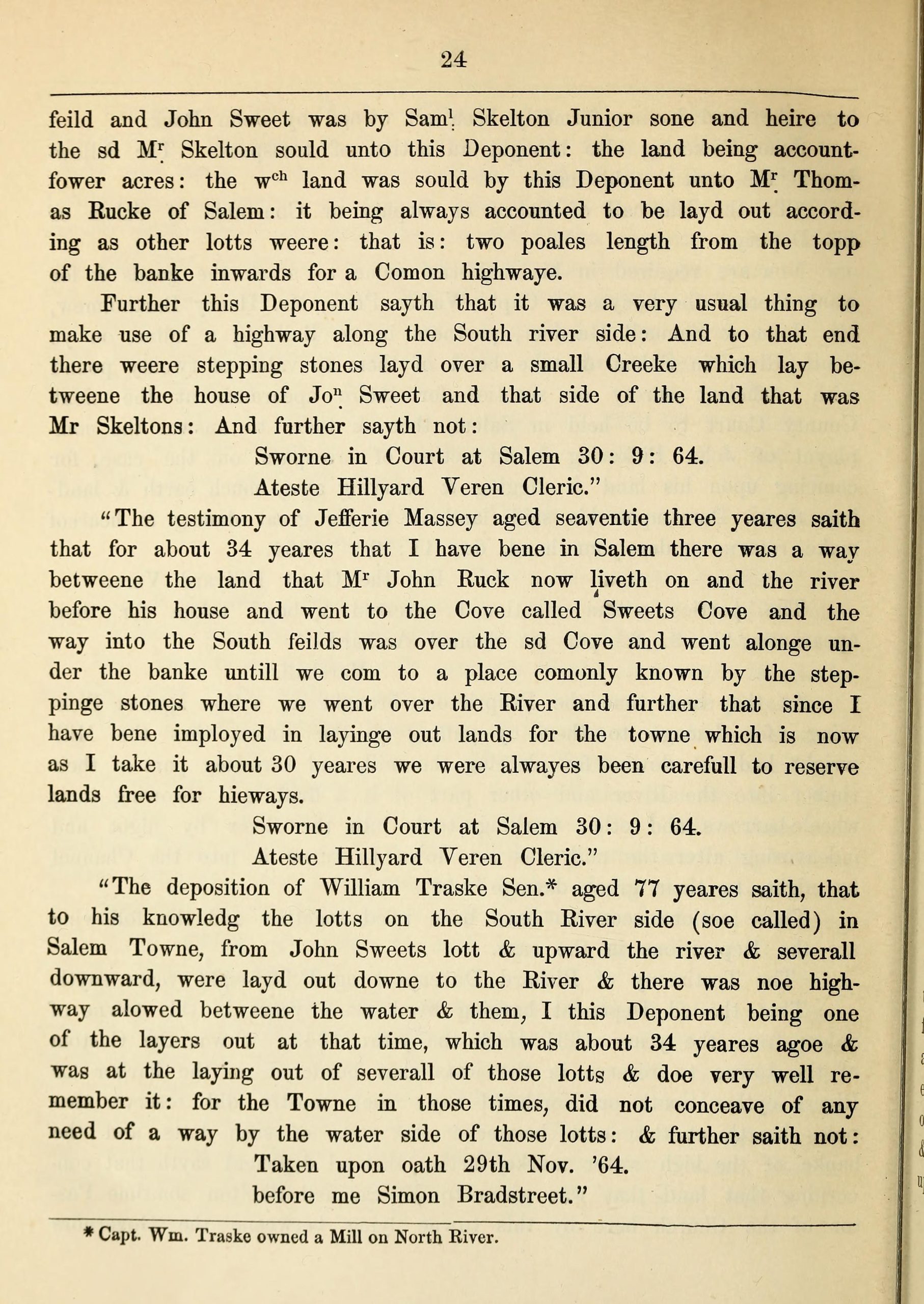
[Upham, 1866, p. 24, Richard Davenport, sworn 30: 9: 64:] … concerning that land that was given to Mr Samuell Skelton somtime Pastor of the Church here by this towne lying betweene the Governors feild and John Sweet was by Saml. Skelton Junior sone and heire to the sd Mr Skelton sould unto this Deponent: the land being accounted fower acres: the wch land was sould by this Deponent unto Mr Thomas Rucke of Salem: it being always accounted to be layd out according as other lotts weere: that is: two poales length from the topp of the banke inwards for a Comon highwaye. Further this Deponent sayth that it was a very usual thing to make use of a highway along the South river side: And to that end there weere stepping stones layd over a small Creeke which lay betweene the house of Jon Sweet and that side of the land that was Mr Skeltons: And further sayth not.
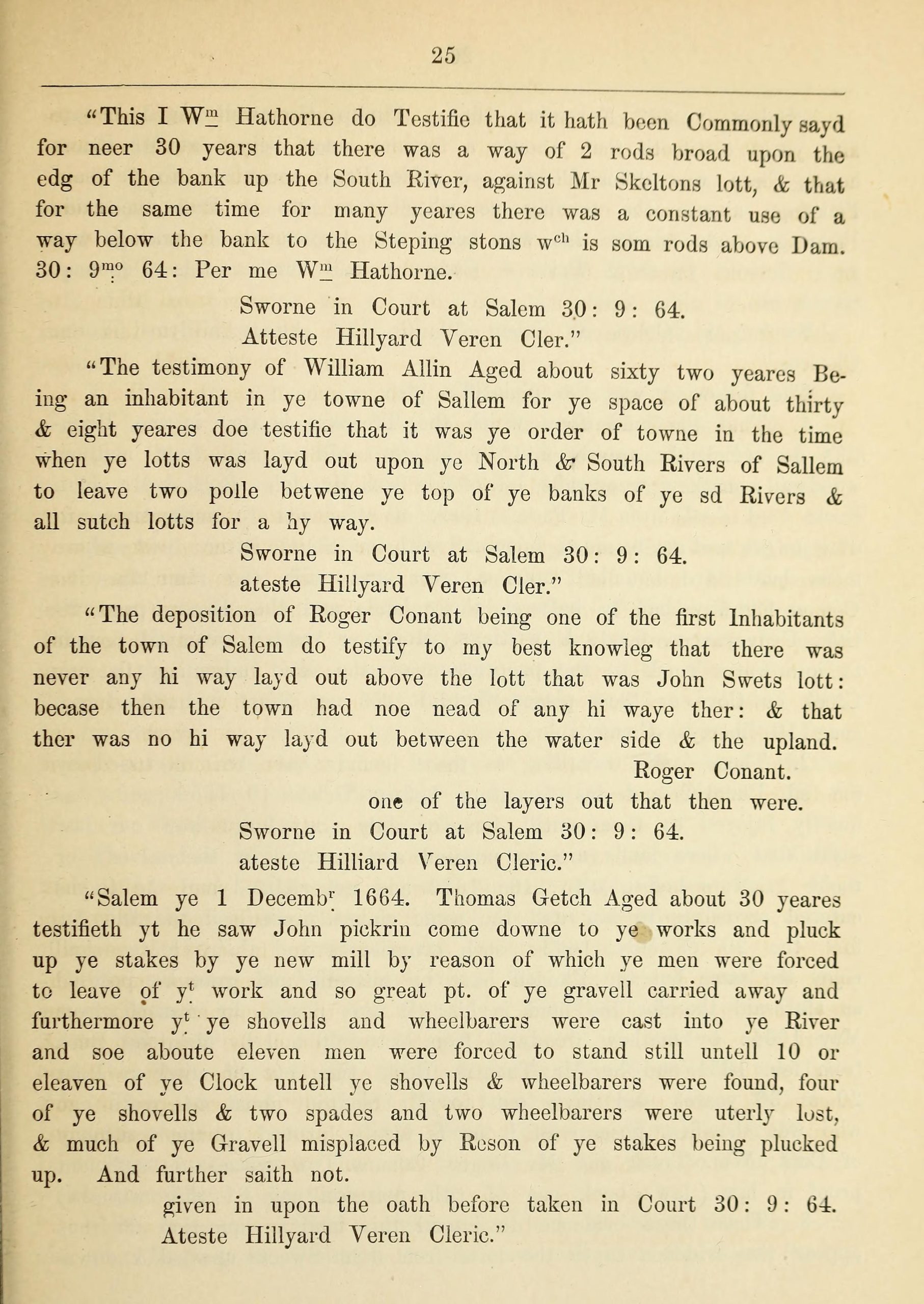
[Upham, 1866, p. 25, William Hathorne:] This I Wm Hathorne do Testifie that it hath been Commonly sayd for neer 30 years that there was a way of 2 rods broad upon the edg of the bank up the South River, against Mr Skeltons lott, & that for the same time for many yeares there was a constant use of a way below the bank to the Steping stons wch is som rods above Dam. 30: 9mo 64: Per me Wm Hathorne.
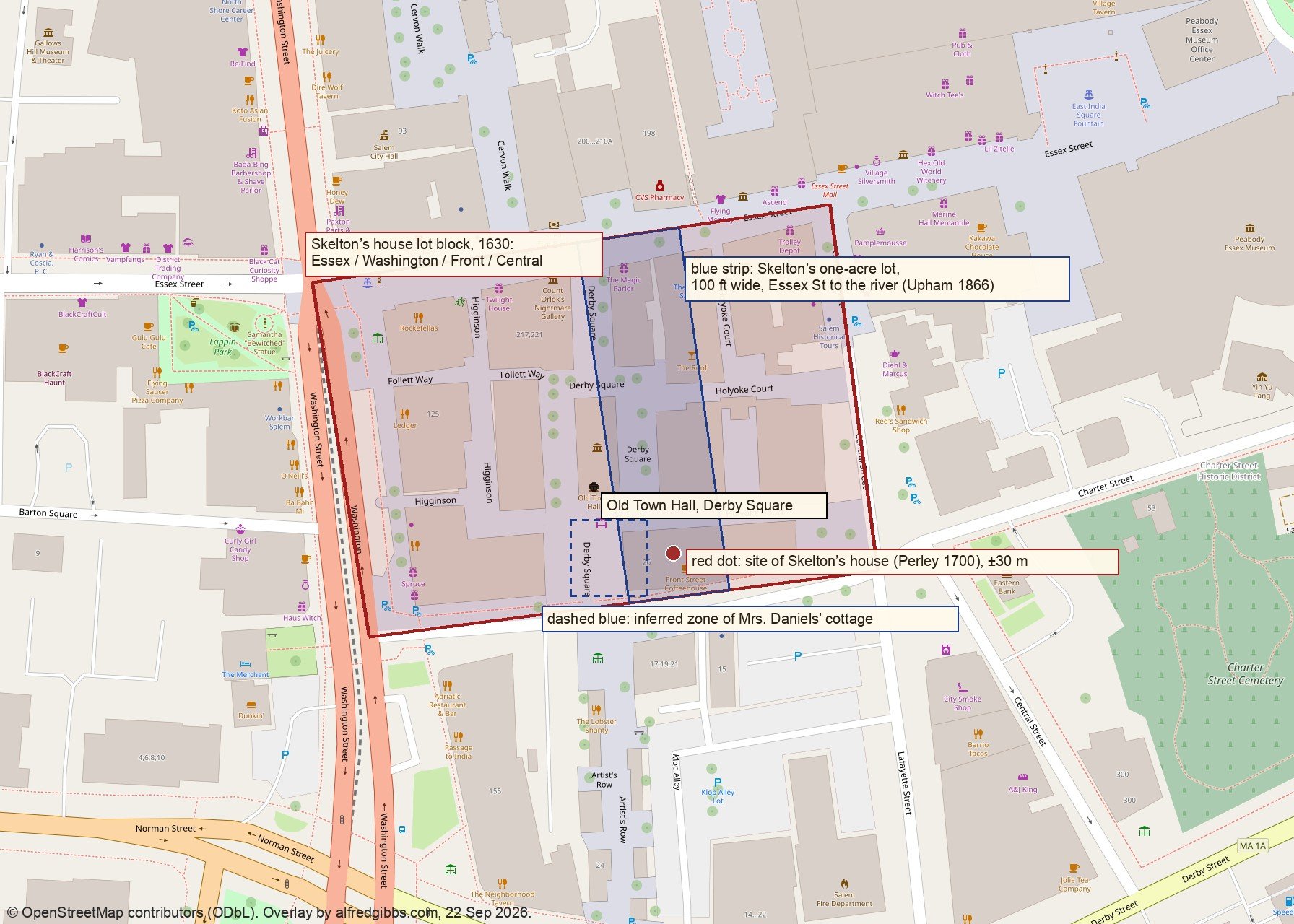
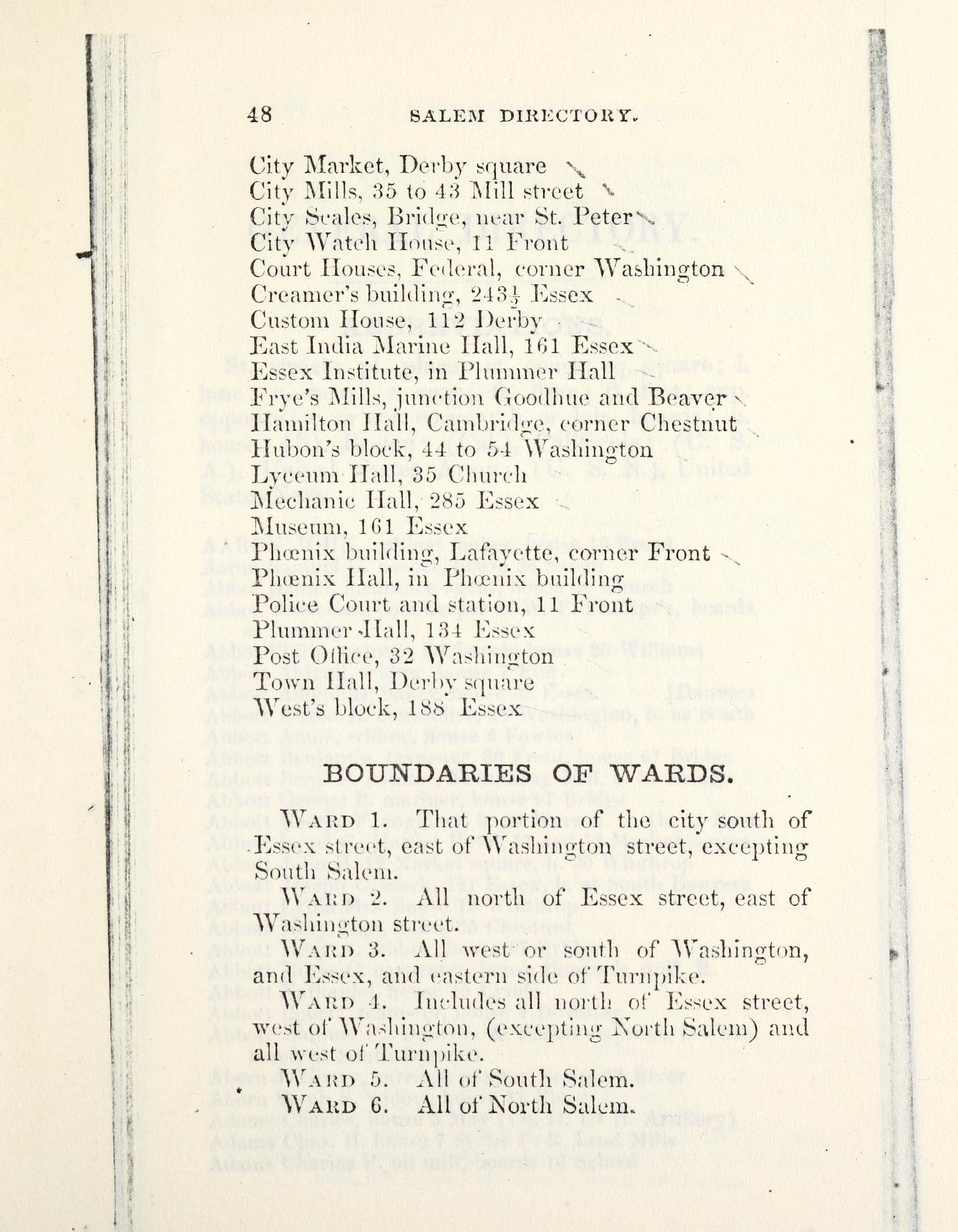
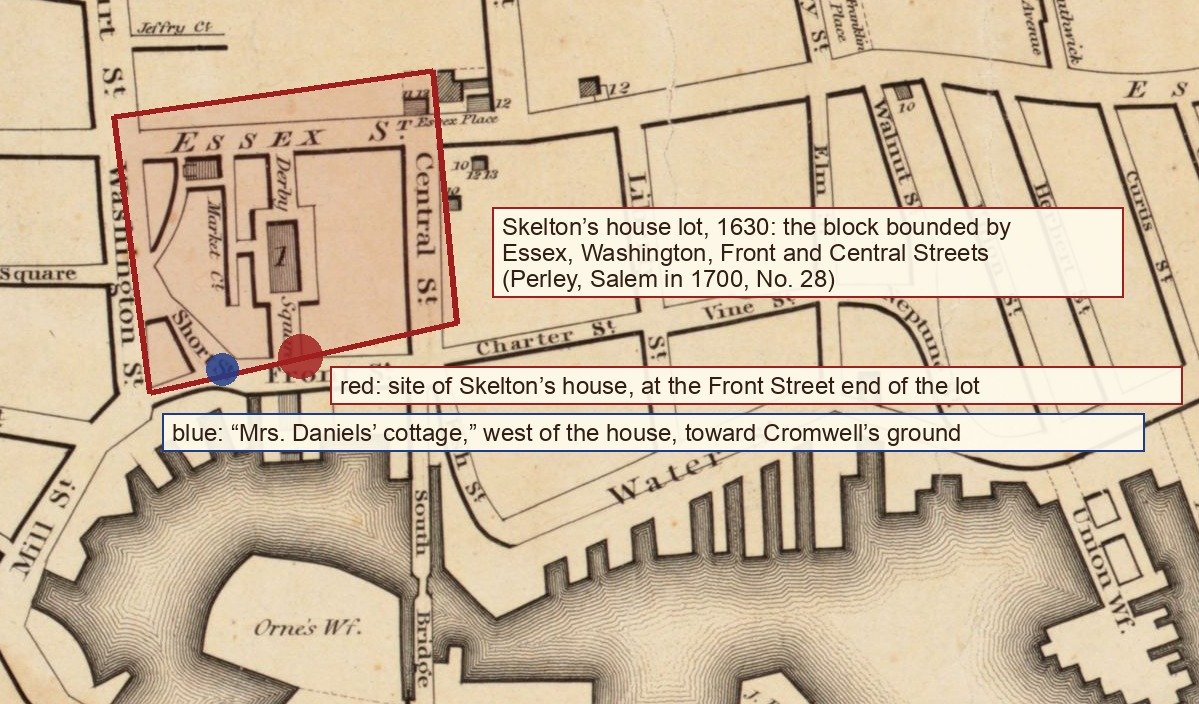
Where it is today. The block is Derby Square. Upham wrote in 1866 that the eastern half of Skelton’s lot became Dr. E. A. Holyoke’s and the western half part of the Derby estate, and the lane called Holyoke Court still runs down the east side of the square, so the lot lay along the east side of Derby Square, from Essex Street to Front Street.41 Skelton’s house stood at the Front Street end of that strip, which puts it on the north side of Front Street just east of the square’s southern opening, about where the Front Street shops now stand between Derby Square and Central Street, some forty metres south-east of the Old Town Hall.55 The police station Upham used as his landmark in 1866 was the City Watch House, which the Salem Directory of 1864 lists at 11 Front Street, on that same stretch beside the Town Hall in Derby Square; Salem’s street numbers have been changed since, so the number does not transfer to a modern door.57 The cottage zone lies immediately west of that, at the mouth of the square on Front Street. The South River, which lapped the foot of the lot in her day, was filled in the nineteenth century; Front Street runs on the old bank, and Derby Square, the Old Town Hall of 1816, and the shops are all built on ground that was Skelton’s. Open the house site in Google Maps, or the centre of the cottage zone; the two pins are about twenty metres apart, and the cottage pin is the middle of an inferred zone, not a surveyed spot.
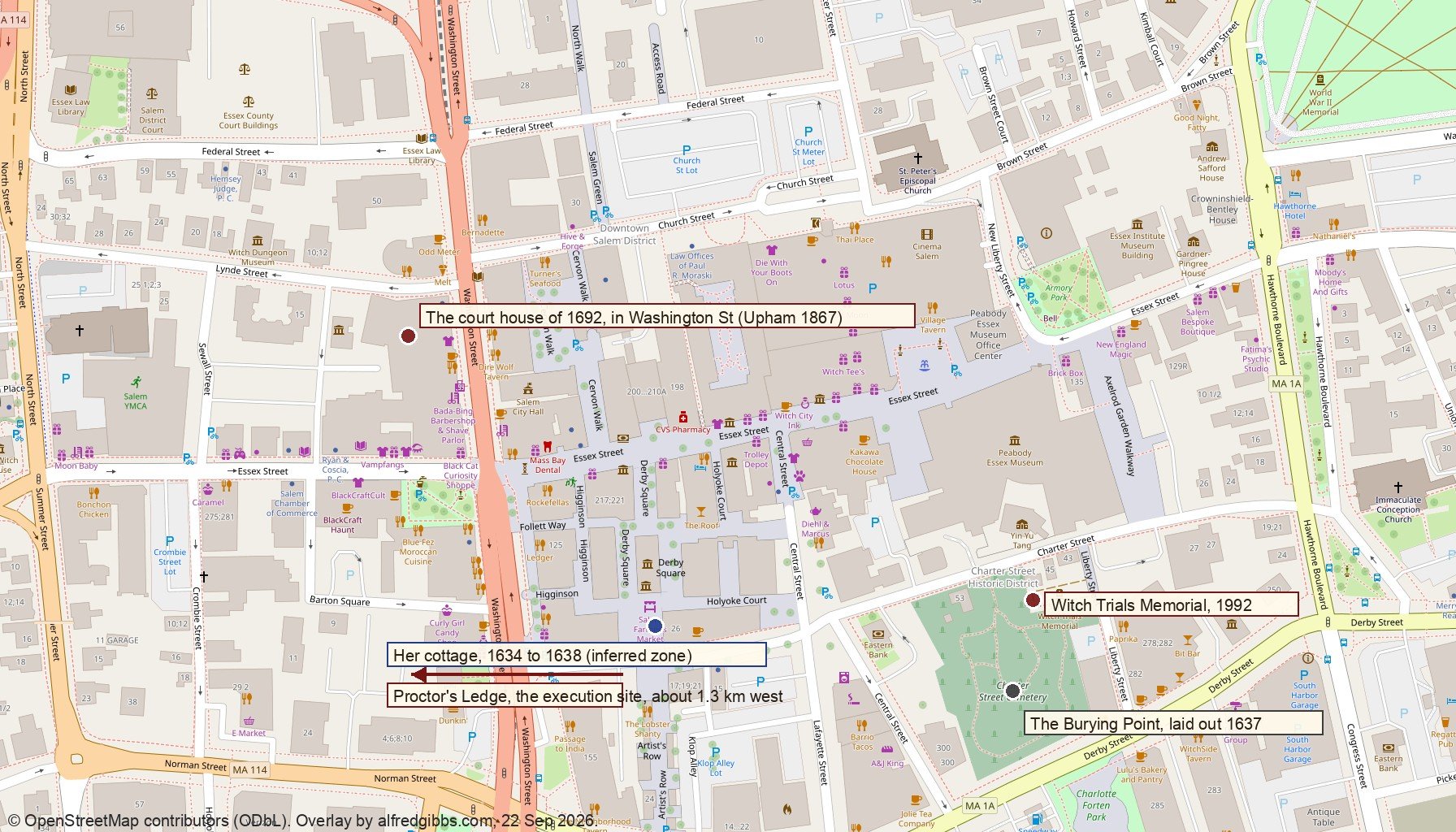
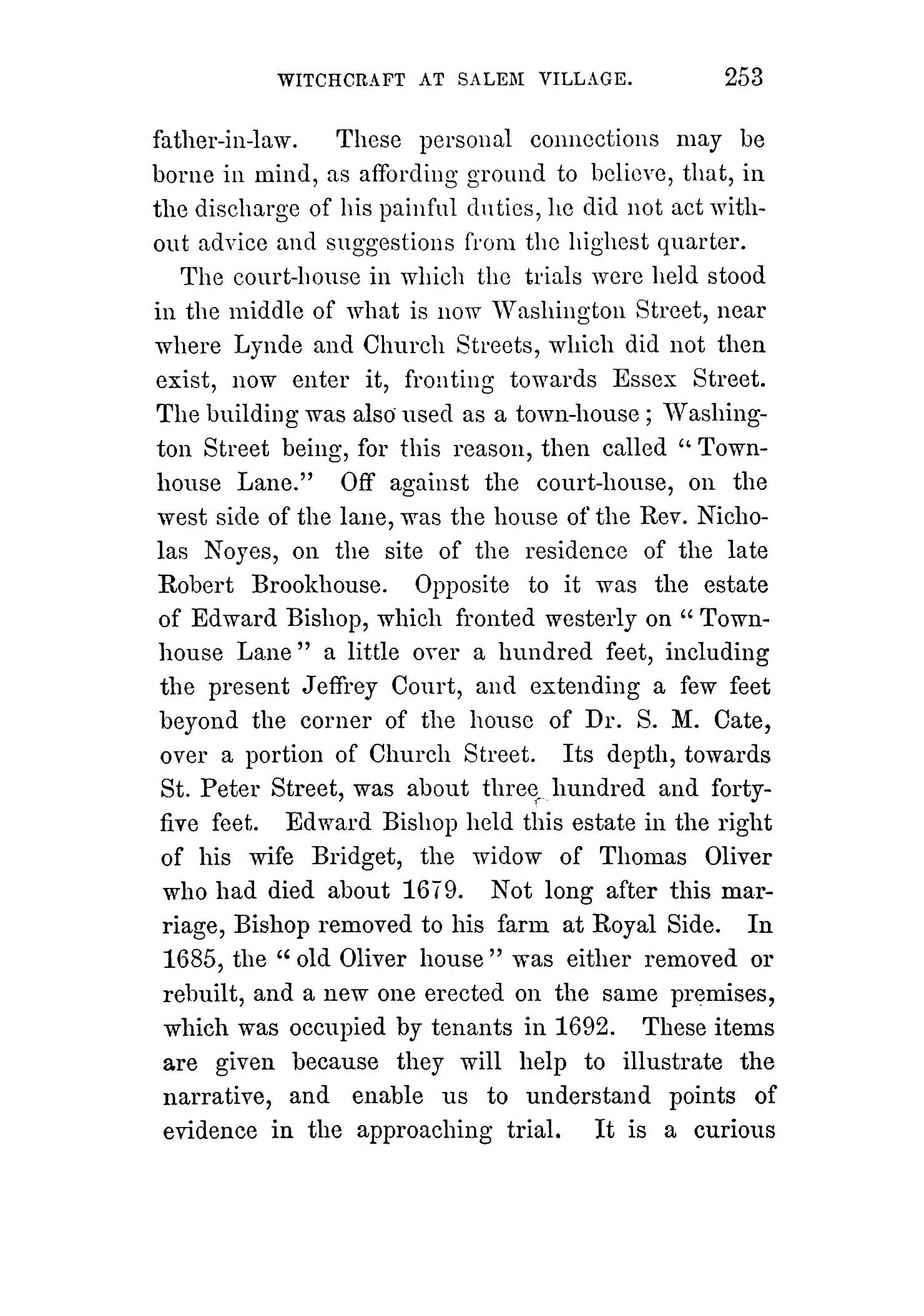
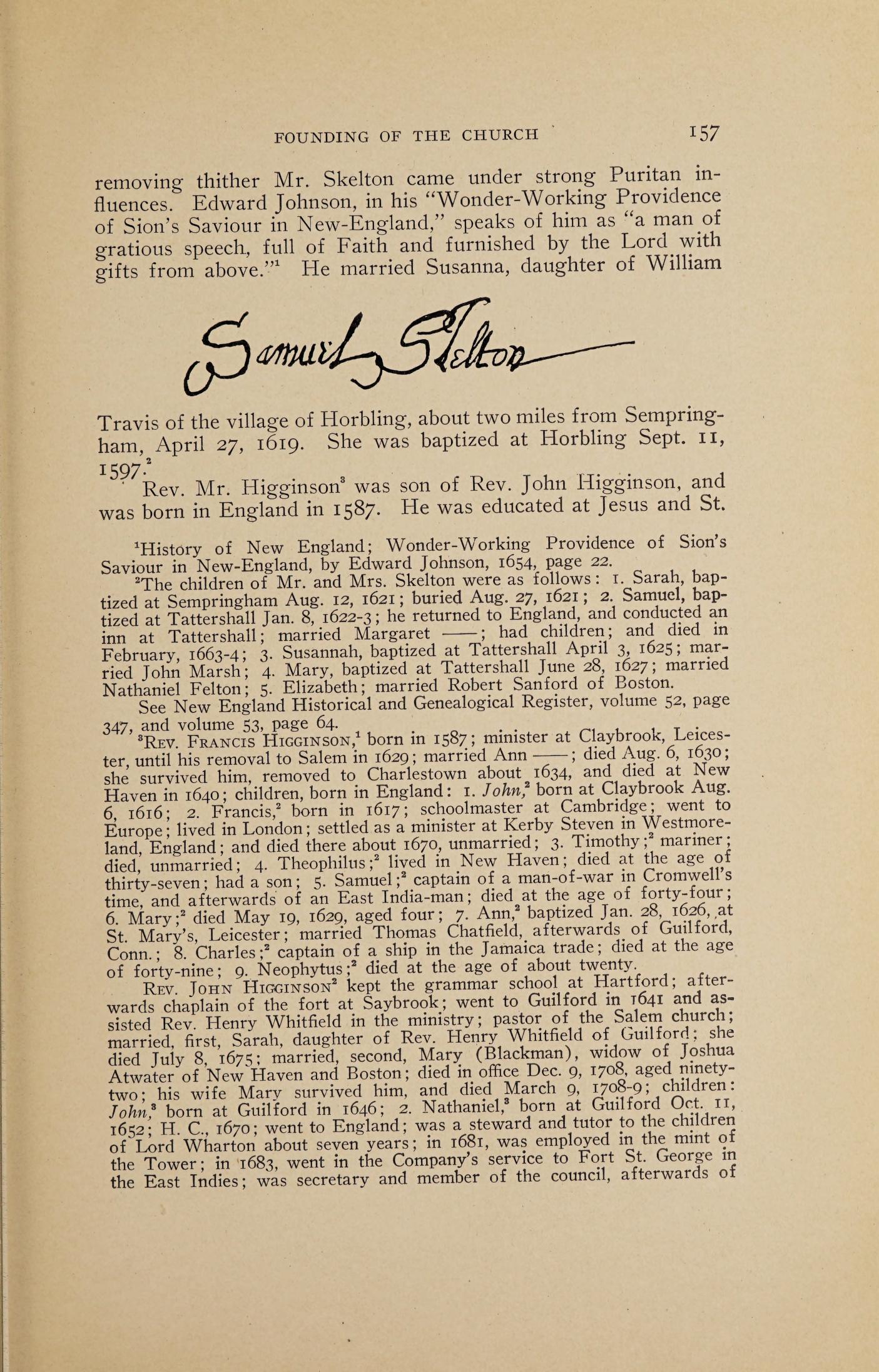
Fifty-four years later: the same ground in 1692. Readers who know Salem for its witch trials may want the two stories set side by side, because they happened within a few hundred yards of each other. The trials of 1692 were held in the court house that stood in the middle of Washington Street, opposite the head of Lynde Street, about two hundred metres north-west of her cottage; Washington Street was then called Town-house Lane, and the accused were brought along Essex Street past the meeting house to reach it.58 The Burying Point on Charter Street, laid out in 1637, the year the town allowed her fifty acres, lies two hundred metres to the east, and the memorial to the twenty people executed in 1692 was built beside it in 1992.58 The hangings themselves were not in the town but on the hill about a mile to the west, at the place now marked as Proctor’s Ledge.58 She had left Salem for Providence more than fifty years before any of it, in 1637 or 1638, and on either identification of her she was long dead or far away in 1692.16, 23 The Skelton child she raised was not. Susanna Skelton married John Marsh between 1641 and 1646 (not “about 1635,” as Perley wrote and this page repeated until 22 September 2026: she was baptised in 1625, and Marsh’s children of 1637 to 1641 were by an earlier wife); she outlived Marsh, married Thomas Rix, and, if the family trees Jensen relied on are right that she died in 1695, was an old woman in Salem while the court sat a few streets from the house she had grown up in.29, 38, 42 Her Salem record, with her father’s baptismal note, her husband’s will and the vital records, is on its own page: Susanna Skelton, the minister’s daughter.
A possibility, stated as such. Perley writes that the west part of the Browne lot “belonged to Hugh Laskin very early, and he lived in the house at the southern end of the lot, which was called ‘an old house’ in 1647.”55 That house stood on ground that had been Skelton’s, west of his own house, at the river end of the lot: the place the commoners’ record gives to “Mrs. Daniels’ cottage.”41 A house already “old” in 1647, on that spot, may be her cottage under a later occupant, Laskin having taken it after she left for Providence in 1637 or 1638. No deed or record found says so, and Perley does not make the connection; it is offered here as the one candidate on the plan, not as a finding. It is the reason the dashed zone on the plate above is drawn over Laskin’s site.
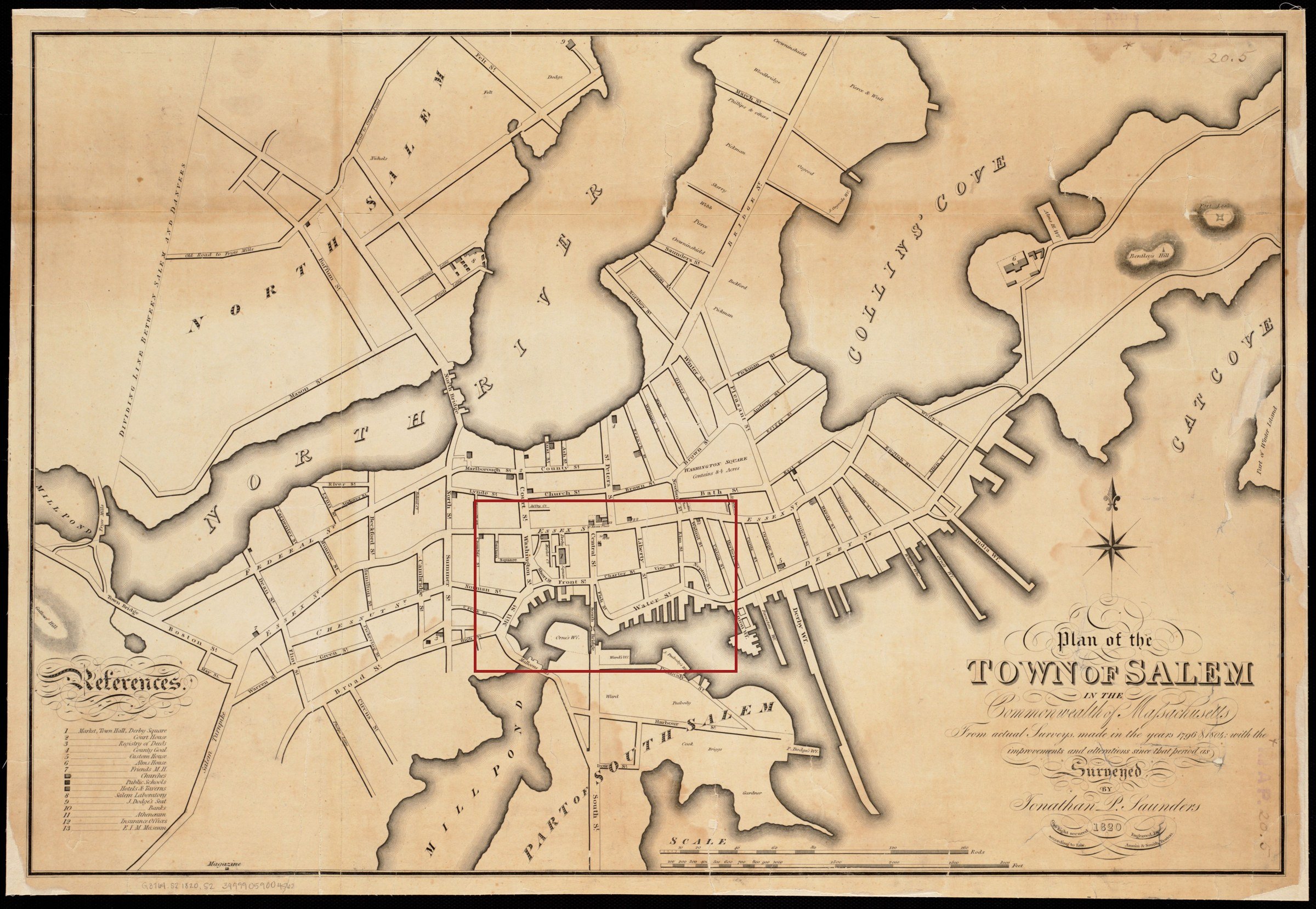
So the cottage can be placed, within a house lot, on a modern street plan: on the Front Street side of the block that holds Derby Square, a little west of the site of Skelton’s house and short of the corner of Washington Street. The 1820 plan is the earliest surveyed plan of the town and shows the block and its streets as they were before the South River was filled; the wharves and the Market House drawn on it stand on what was bank and water in her day.55, 59 Perley’s plan of 1700 is a reconstruction from deeds and surveys, and his placing of the house is his reading of them; the depositions of 1664 concern the four acres, not the house lot, and are given here because they are the earliest description of any Skelton ground in the words of men who laid it out.55, 56 Her farm across Porter’s River lies beyond the edge of both plans.
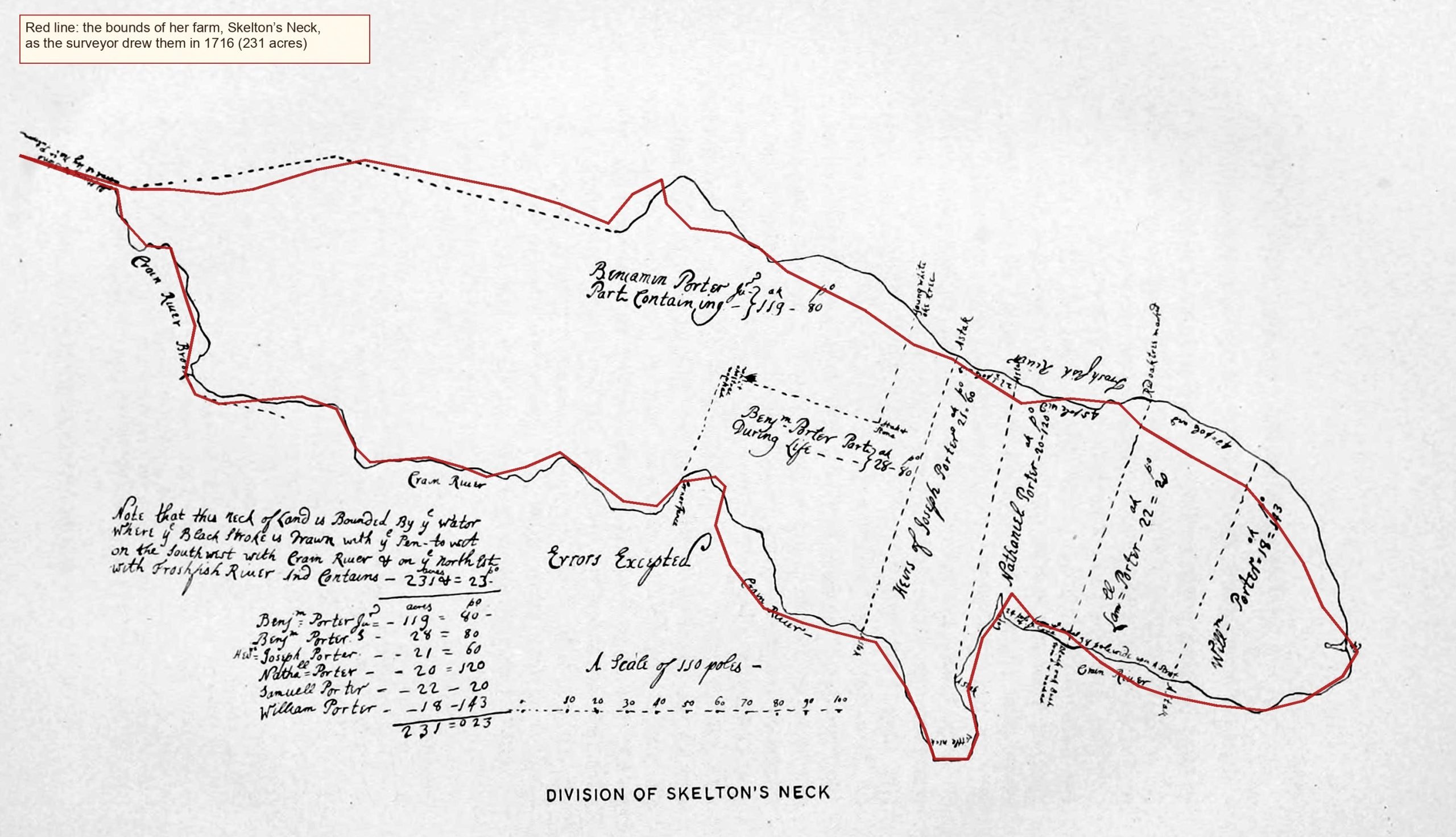
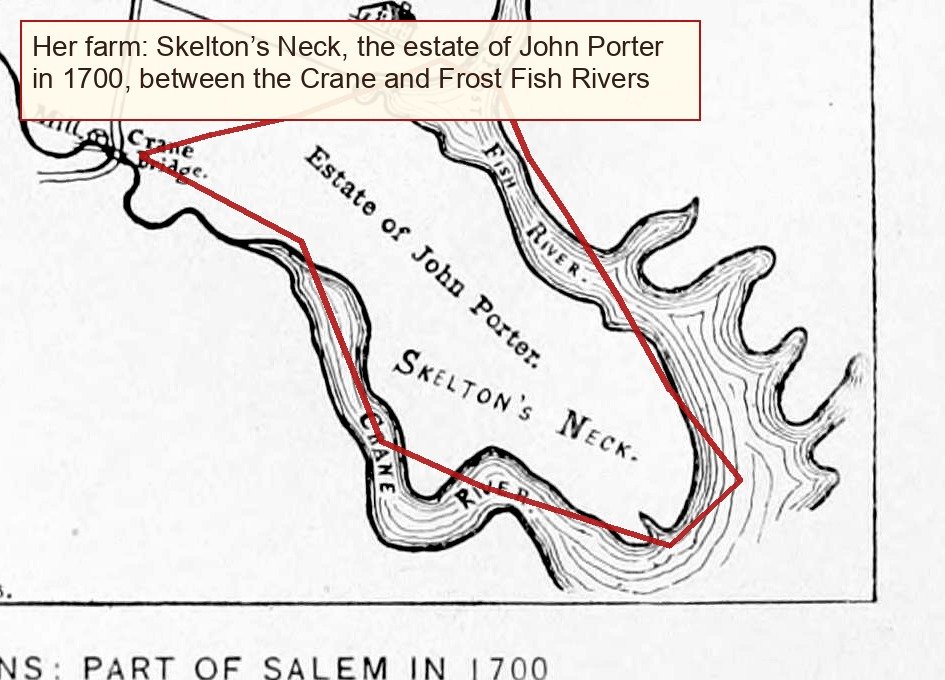
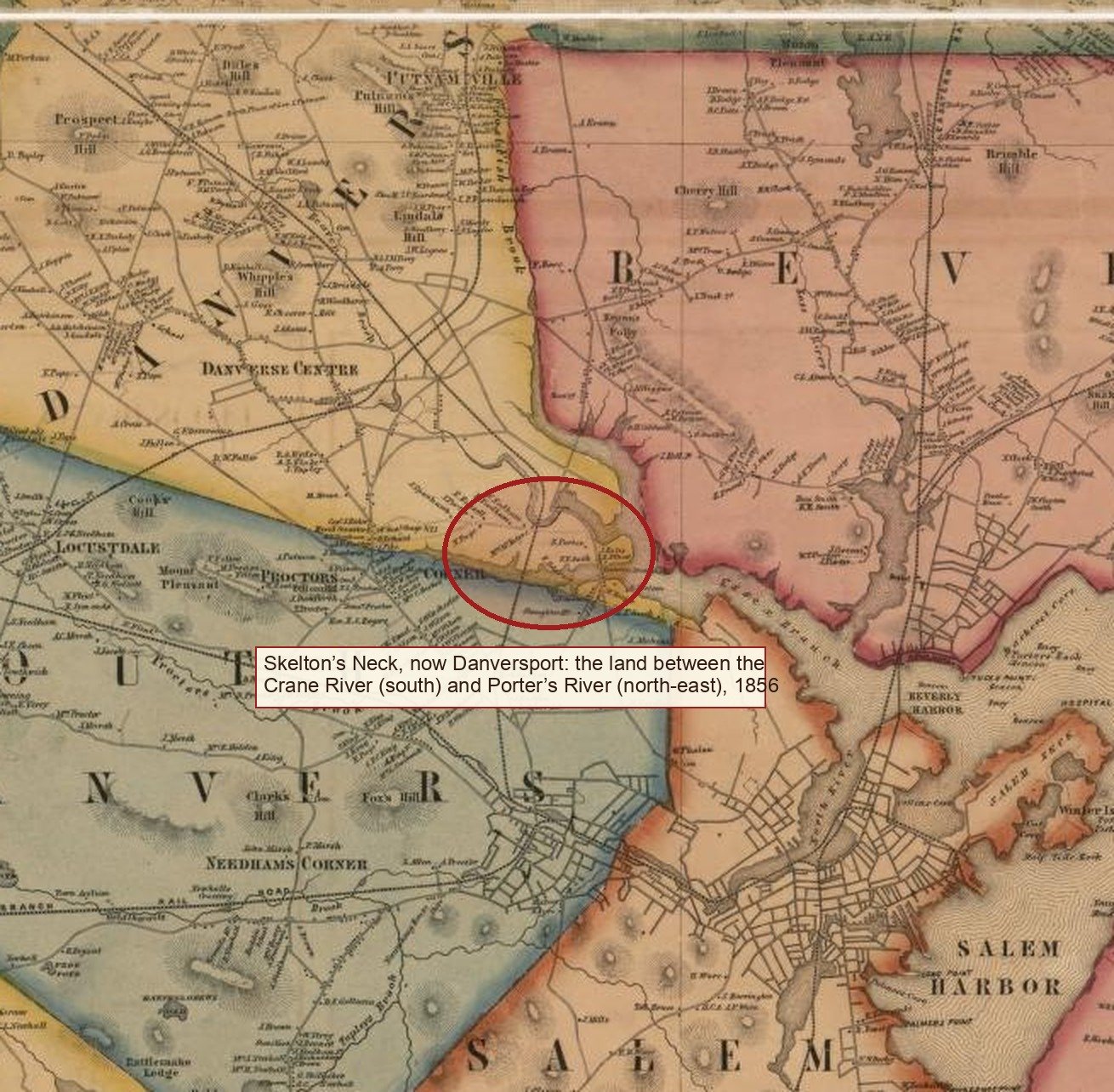
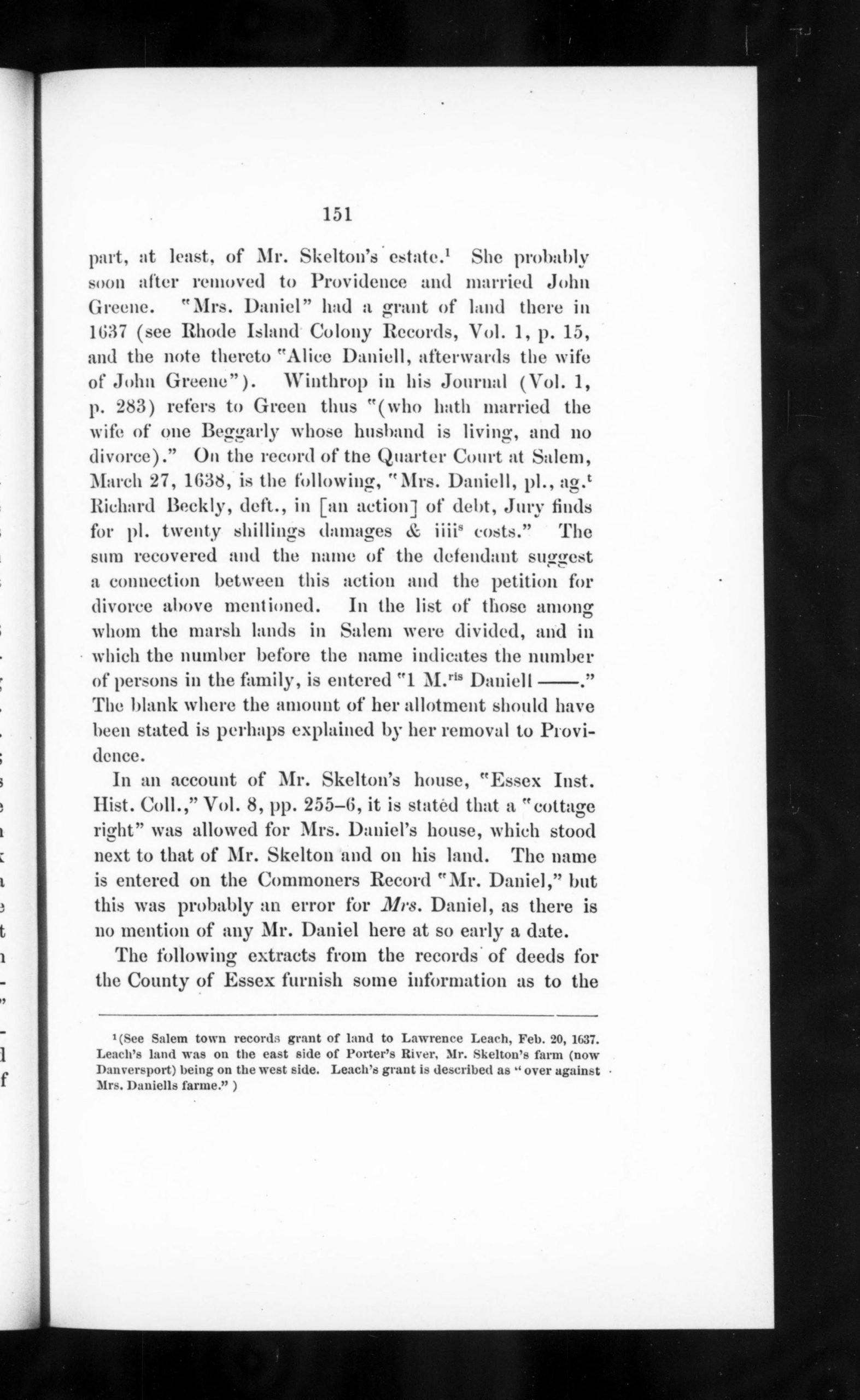
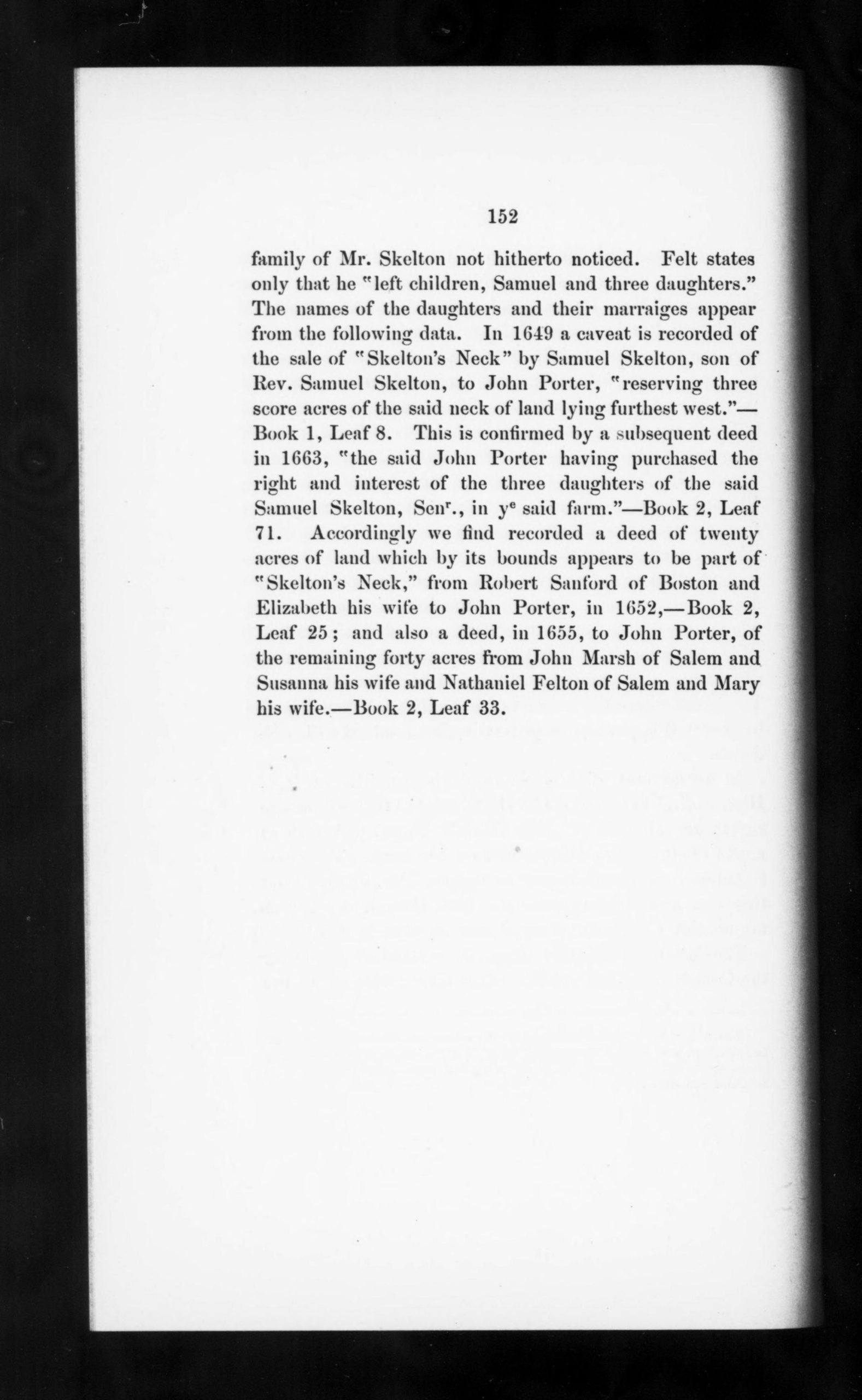
The farm the town records call “Mrs. Daniells farme” was not a grant to her. It was Skelton’s: the neck of two hundred acres the General Court gave him on 3 July 1632, “called by the Indeans Wahquack,” three miles from Salem between two rivers, which she held and worked as the keeper of his estate after his death.60, 61 Upham identified it: Lawrence Leach’s grant of February 1636/7 was “over against Mrs. Daniells farme,” and Leach’s land lay on the east side of Porter’s River, so her farm was Skelton’s neck on the west side, the ground that is now Danversport.2, 61 Skelton’s son sold the neck to John Porter in 1649, keeping sixty acres at the west end that the three daughters and their husbands, Sanford, Marsh, and Felton, sold to Porter in 1652 and 1655; it stayed in the Porter family until 1716, when it was divided by a plan that survives in the probate court at Salem.61, 62 The plan is the nearest thing to a survey of her farm that exists.
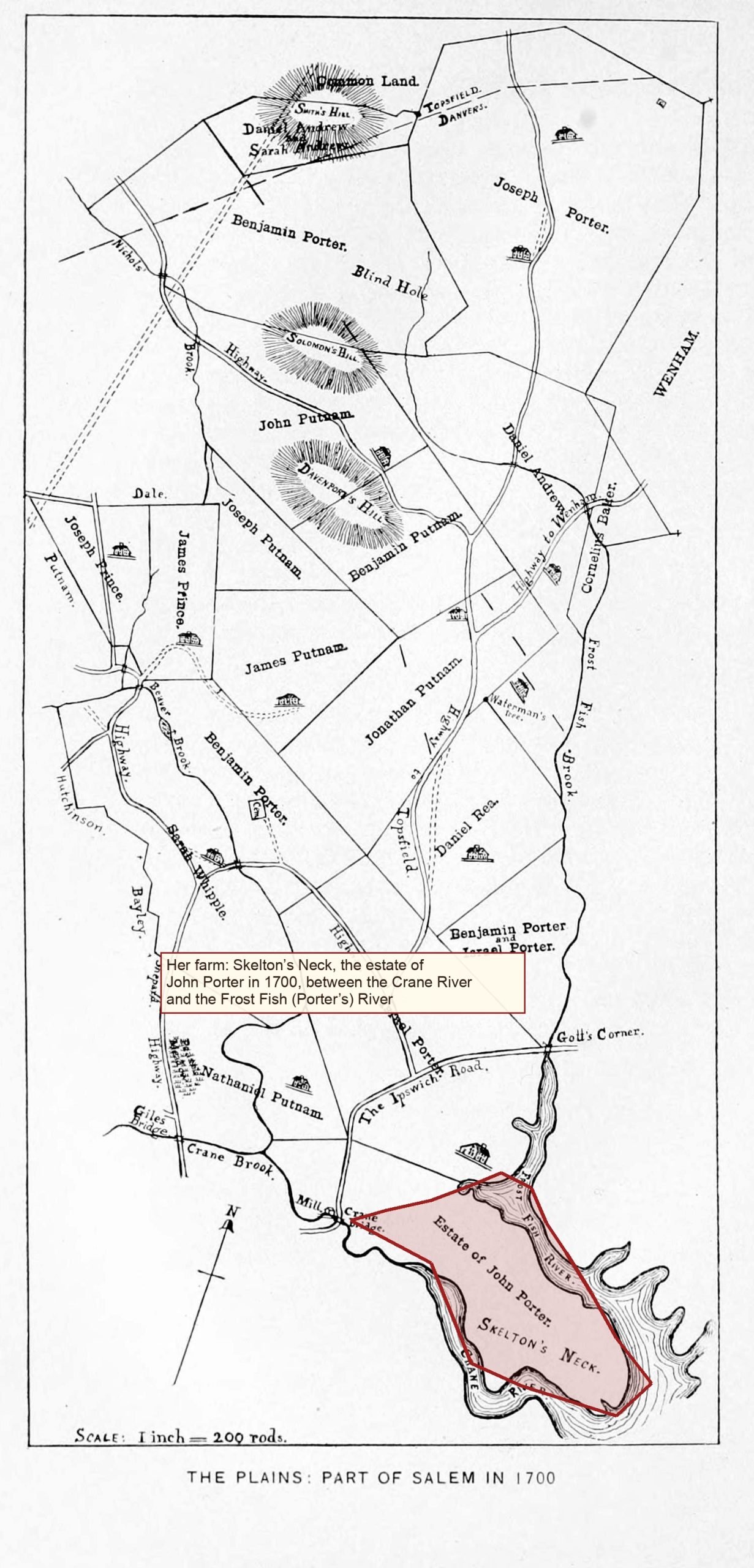
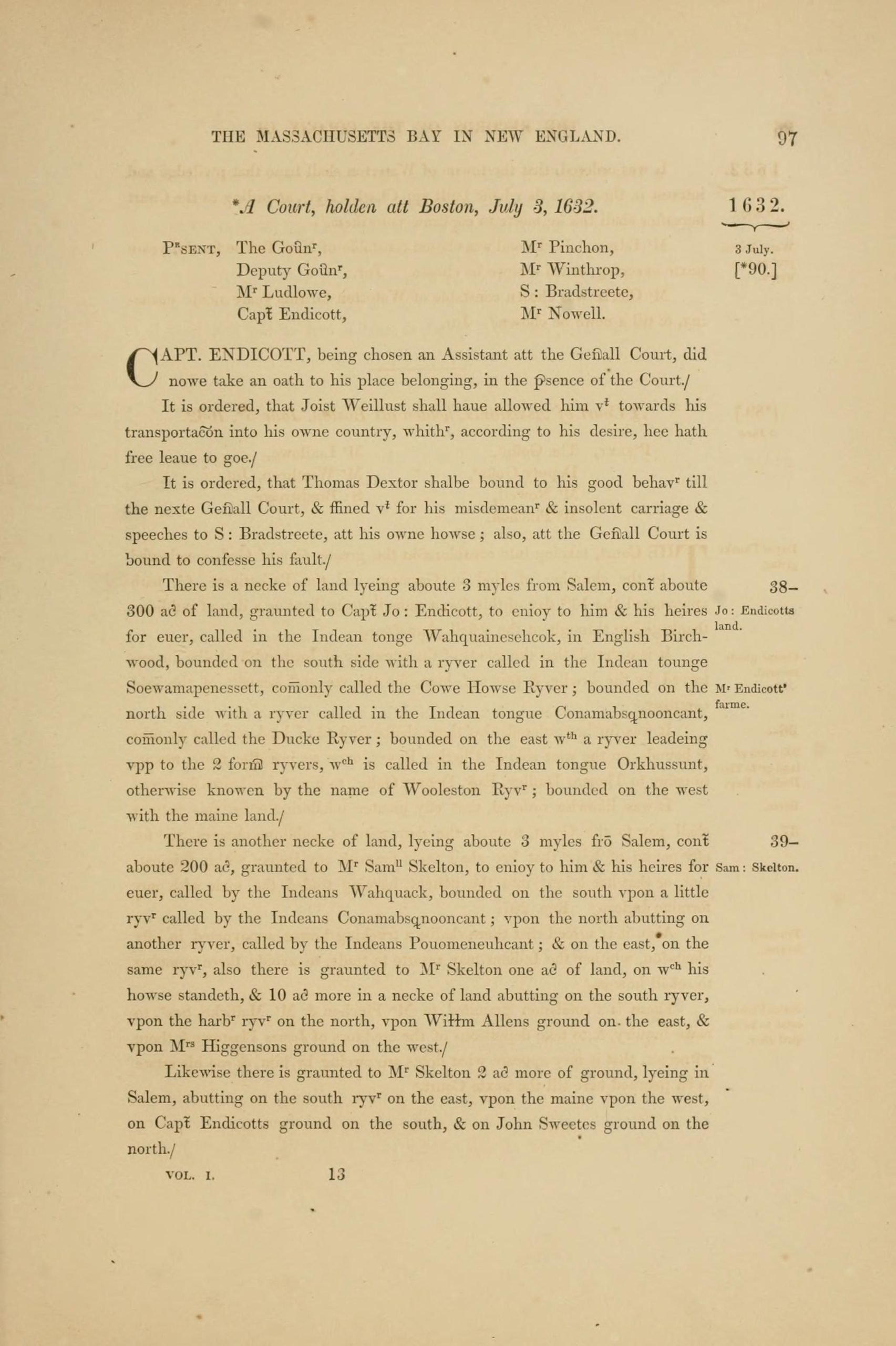
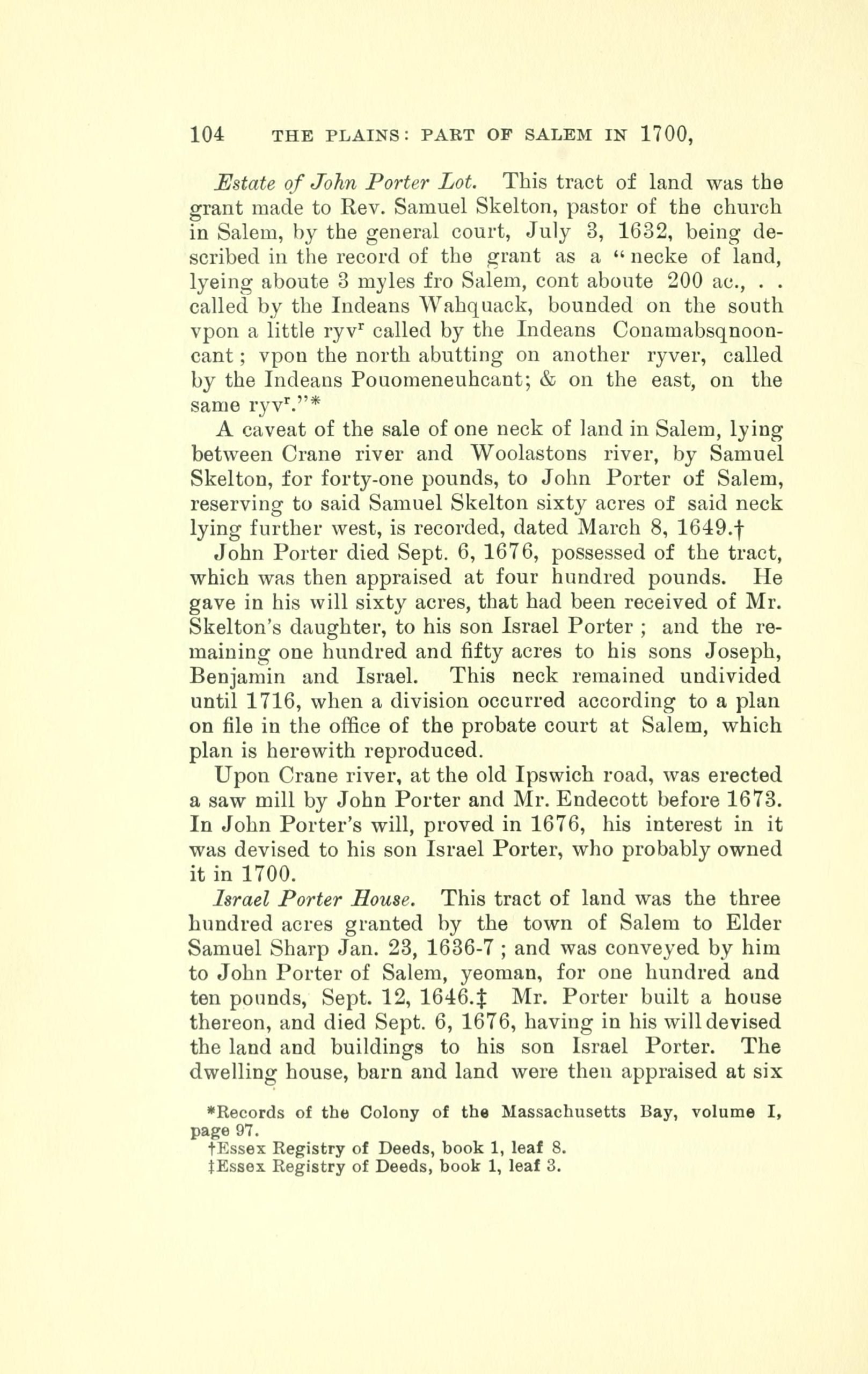
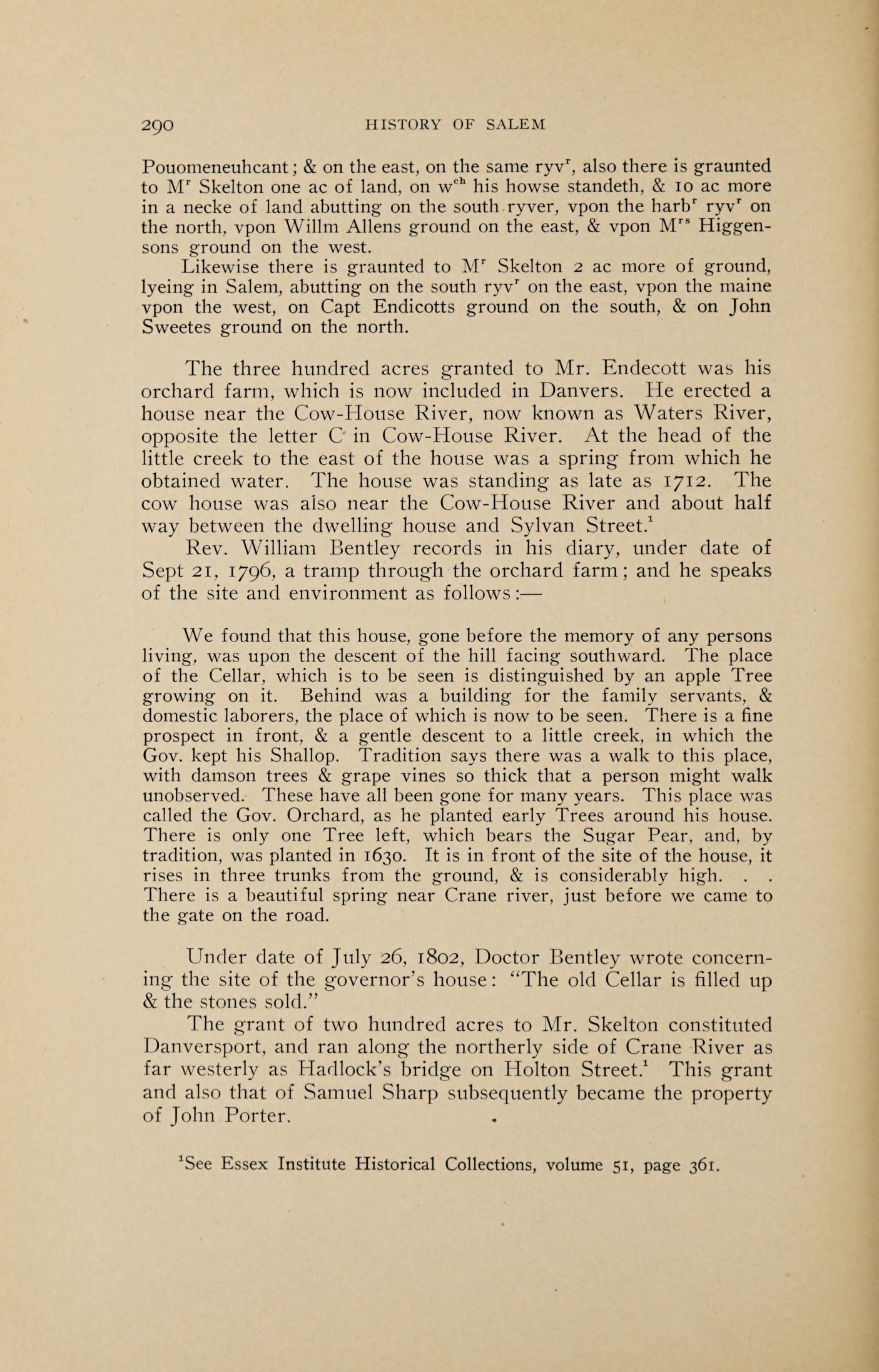
[Massachusetts Bay Records, I, 97, Court at Boston, 3 July 1632:] There is another necke of land, lyeing aboute 3 myles frō Salem, cont aboute 200 aĉ, graunted to Mr Samll Skelton, to enioy to him & his heires for euer, called by the Indeans Wahquack, bounded on the south vpon a little ryvr called by the Indeans Conamabsqnooncant; vpon the north abutting on another ryver, called by the Indeans Pouomeneuhcant; & on the east, on the same ryvr, also there is graunted to Mr Skelton one aĉ of land, on wch his howse standeth, & 10 aĉ more in a necke of land abutting on the south ryver, vpon the harbr ryvr on the north, vpon Willm Allens ground on the east, & vpon Mrs Higgensons ground on the west. Likewise there is graunted to Mr Skelton 2 aĉ more of ground, lyeing in Salem, abutting on the south ryvr on the east, vpon the maine vpon the west, on Capt Endicotts ground on the south, & on John Sweetes ground on the north. Margin: “39– Sam: Skelton.”
[Upham, EIHC 13 (1875), 151, footnote:] (See Salem town records grant of land to Lawrence Leach, Feb. 20, 1637. Leach’s land was on the east side of Porter’s River, Mr. Skelton’s farm (now Danversport) being on the west side. Leach’s grant is described as “over against Mrs. Daniells farme.”)
[Upham, EIHC 13, 152:] In 1649 a caveat is recorded of the sale of “Skelton’s Neck” by Samuel Skelton, son of Rev. Samuel Skelton, to John Porter, “reserving three score acres of the said neck of land lying furthest west.”—Book 1, Leaf 8. This is confirmed by a subsequent deed in 1663, “the said John Porter having purchased the right and interest of the three daughters of the said Samuel Skelton, Senr., in ye said farm.”—Book 2, Leaf 71. Accordingly we find recorded a deed of twenty acres of land which by its bounds appears to be part of “Skelton’s Neck,” from Robert Sanford of Boston and Elizabeth his wife to John Porter, in 1652,—Book 2, Leaf 25; and also a deed, in 1655, to John Porter, of the remaining forty acres from John Marsh of Salem and Susanna his wife and Nathaniel Felton of Salem and Mary his wife.—Book 2, Leaf 33.
[Perley, The Plains (1919), 104:] Estate of John Porter Lot. This tract of land was the grant made to Rev. Samuel Skelton, pastor of the church in Salem, by the general court, July 3, 1632, being described in the record of the grant as a “necke of land, lyeing aboute 3 myles fro Salem, cont aboute 200 ac, . . called by the Indeans Wahquack, bounded on the south vpon a little ryvr called by the Indeans Conamabsqnooncant; vpon the north abutting on another ryver, called by the Indeans Pouomeneuhcant; & on the east, on the same ryvr.” A caveat of the sale of one neck of land in Salem, lying between Crane river and Woolastons river, by Samuel Skelton, for forty-one pounds, to John Porter of Salem, reserving to said Samuel Skelton sixty acres of said neck lying further west, is recorded, dated March 8, 1649. John Porter died Sept. 6, 1676, possessed of the tract, which was then appraised at four hundred pounds. He gave in his will sixty acres, that had been received of Mr. Skelton’s daughter, to his son Israel Porter; and the remaining one hundred and fifty acres to his sons Joseph, Benjamin and Israel. This neck remained undivided until 1716, when a division occurred according to a plan on file in the office of the probate court at Salem, which plan is herewith reproduced. Upon Crane river, at the old Ipswich road, was erected a saw mill by John Porter and Mr. Endecott before 1673.
[The plan of 1716, so far as its note can be read on the reproduction:] Note that this neck of Land is Bounded By ye water where ye Black stroke is Drawn with ye Pen, to wit on the Southwest with Crane River & on ye north East with Frostfish River and Contains 231 [acres] … Errors Excepted. A Scale of 100 poles. The divisions are lettered to Benjamin Porter Senr, Benjamin Porter, the heirs of Joseph Porter, Nathaniel Porter, Samuel Porter, and William Porter.
[Perley, History of Salem, I (1924), 290:] The grant of two hundred acres to Mr. Skelton constituted Danversport, and ran along the northerly side of Crane River as far westerly as Hadlock’s bridge on Holton Street. This grant and also that of Samuel Sharp subsequently became the property of John Porter.
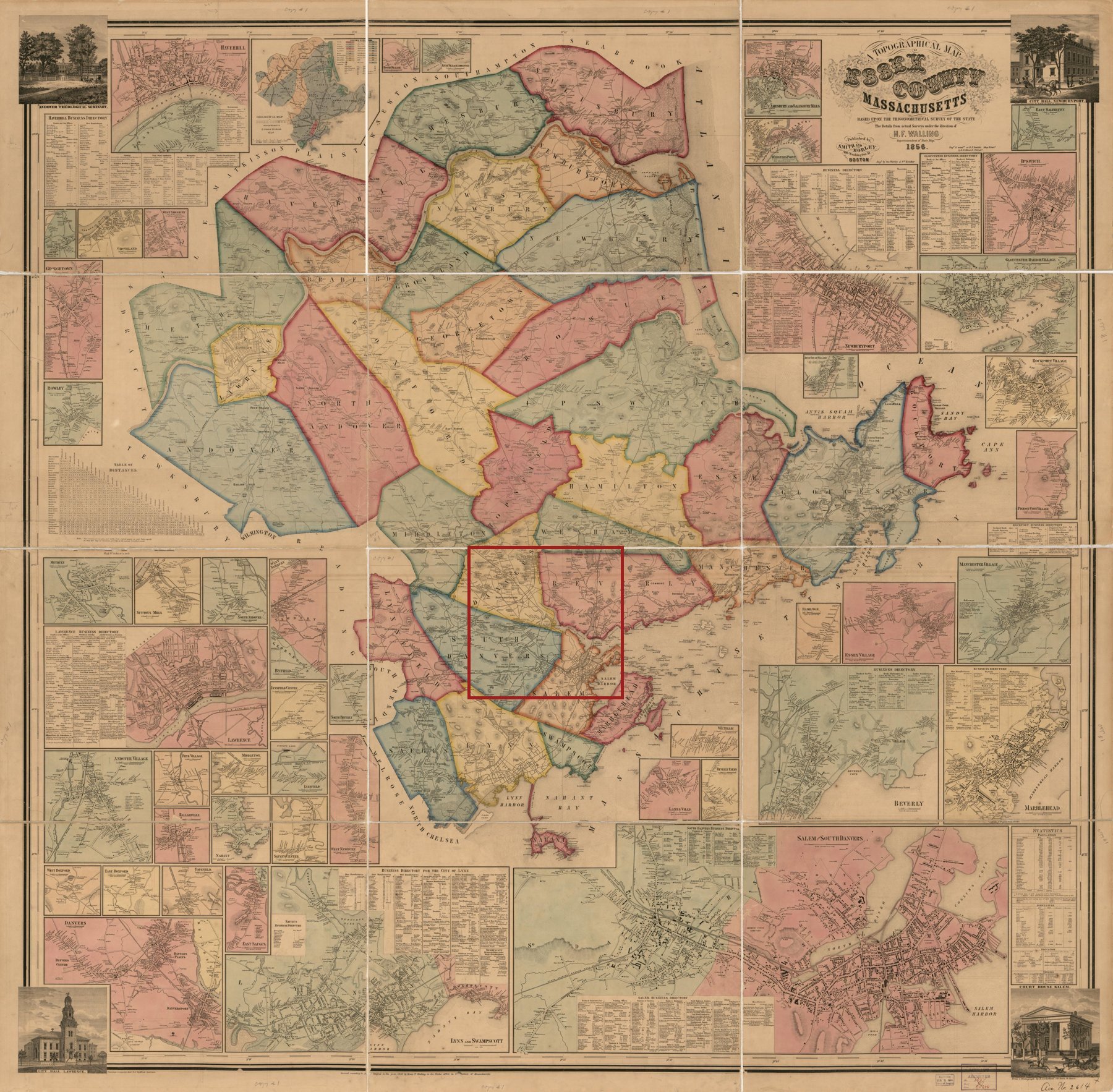
So the farm can be placed exactly. It is the neck of land at the head of the Danvers River that the 1856 county map shows between the Crane River and Porter’s River, with the Danversport village at its point; in her time it was open ground three miles from her cottage by the road through the North Fields, and Skelton’s cattle, which the Court of Assistants divided in 1638 with her consent, were kept on it.6, 63, 64 The fifty acres the town allowed her on 8 November 1637 are a separate grant whose bounds are not given, and they cannot be placed.2 The plan of 1700 and the plan of 1716 are both later than her by two generations, but the neck is bounded by water on three sides and its shape had not changed; what they show is the ground she farmed.62
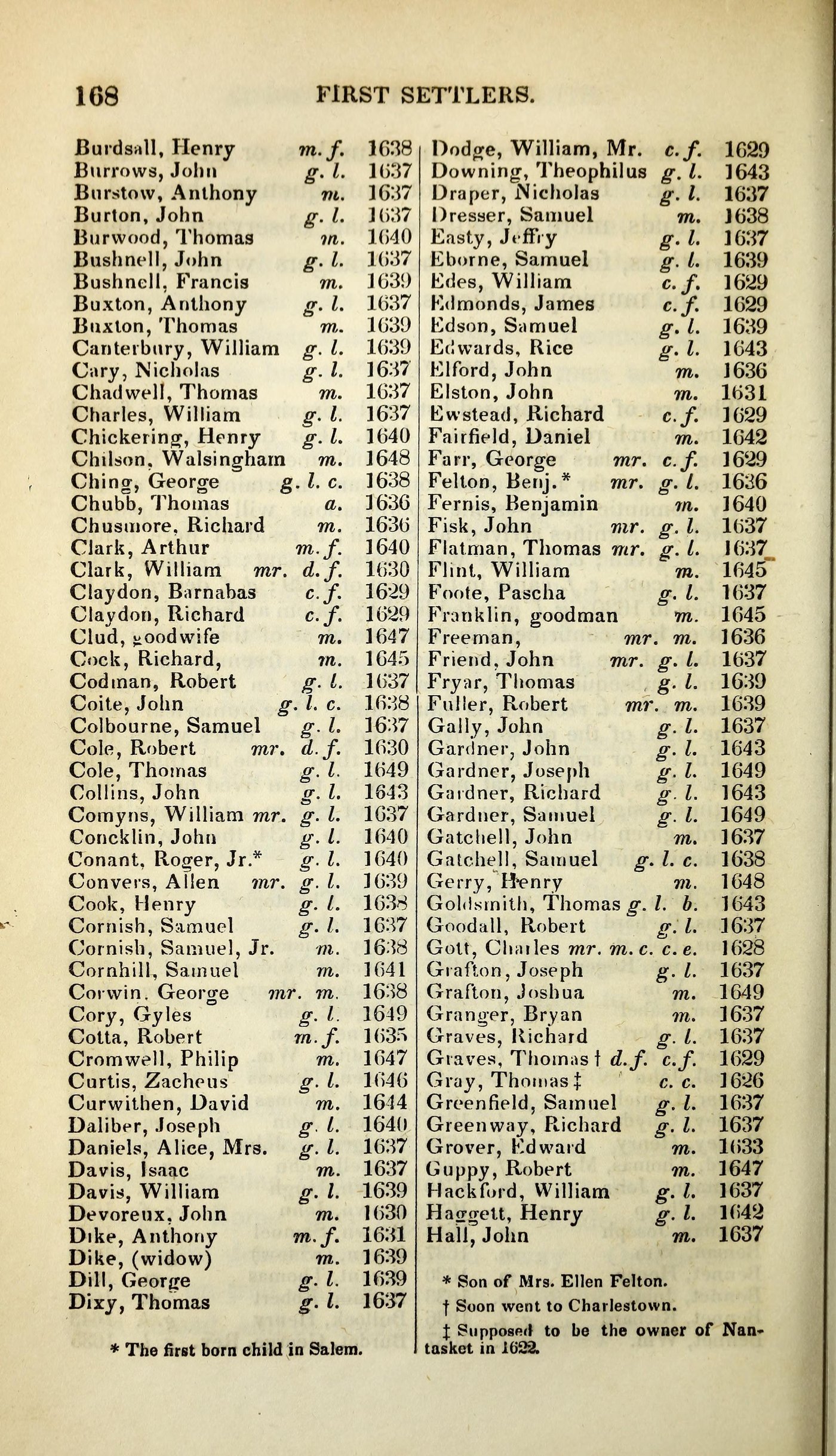
The first of our proposed lists will contain names not found on the church records, down to 1651. … g. l. granted land by Salem authorities … The numerical years, to the right of the persons designated, are the dates when they are known, or appear to have begun their abode in this settlement.
Daniels, Alice, Mrs. g. l. 1637
Felt divided Salem’s first settlers into those on the church records and those not, and put her in the second list.40 A woman who kept the first minister’s house and cattle, and whose consent the Court of Assistants required to divide his goods, was not a member of his church. That fits the rest of the record: the Salem church admitted members on examination and kept the letters of dismission by which they moved from one church to another, and no such letter for her, to or from Salem, Boston, or Providence, has ever been found. It also fits her removal in 1637 to Roger Williams’s plantation, which had no church covenant to satisfy. And it means the one register in which a seventeenth-century woman’s origin was most often written down, the church book, cannot help with hers.23, 40
Source40
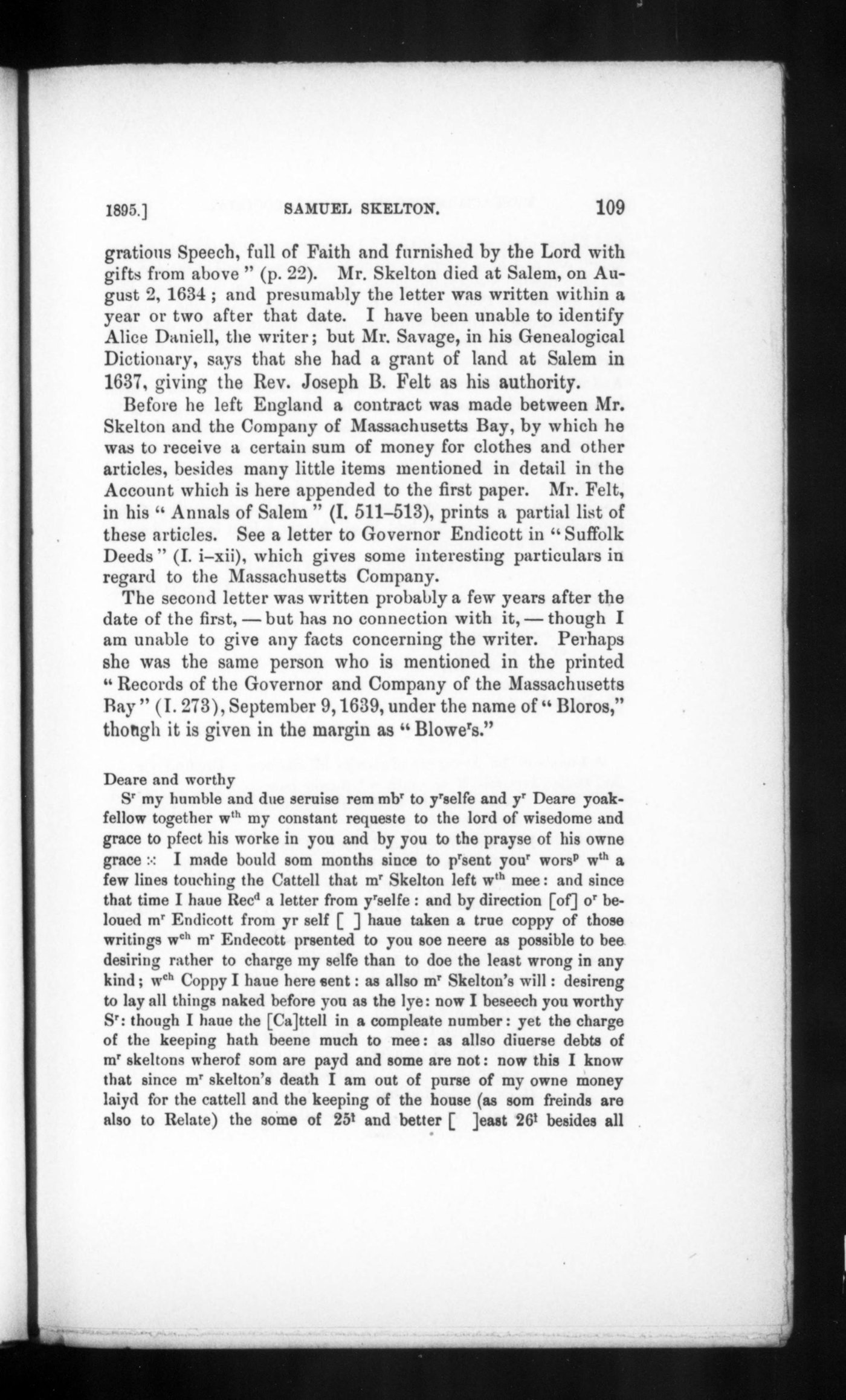
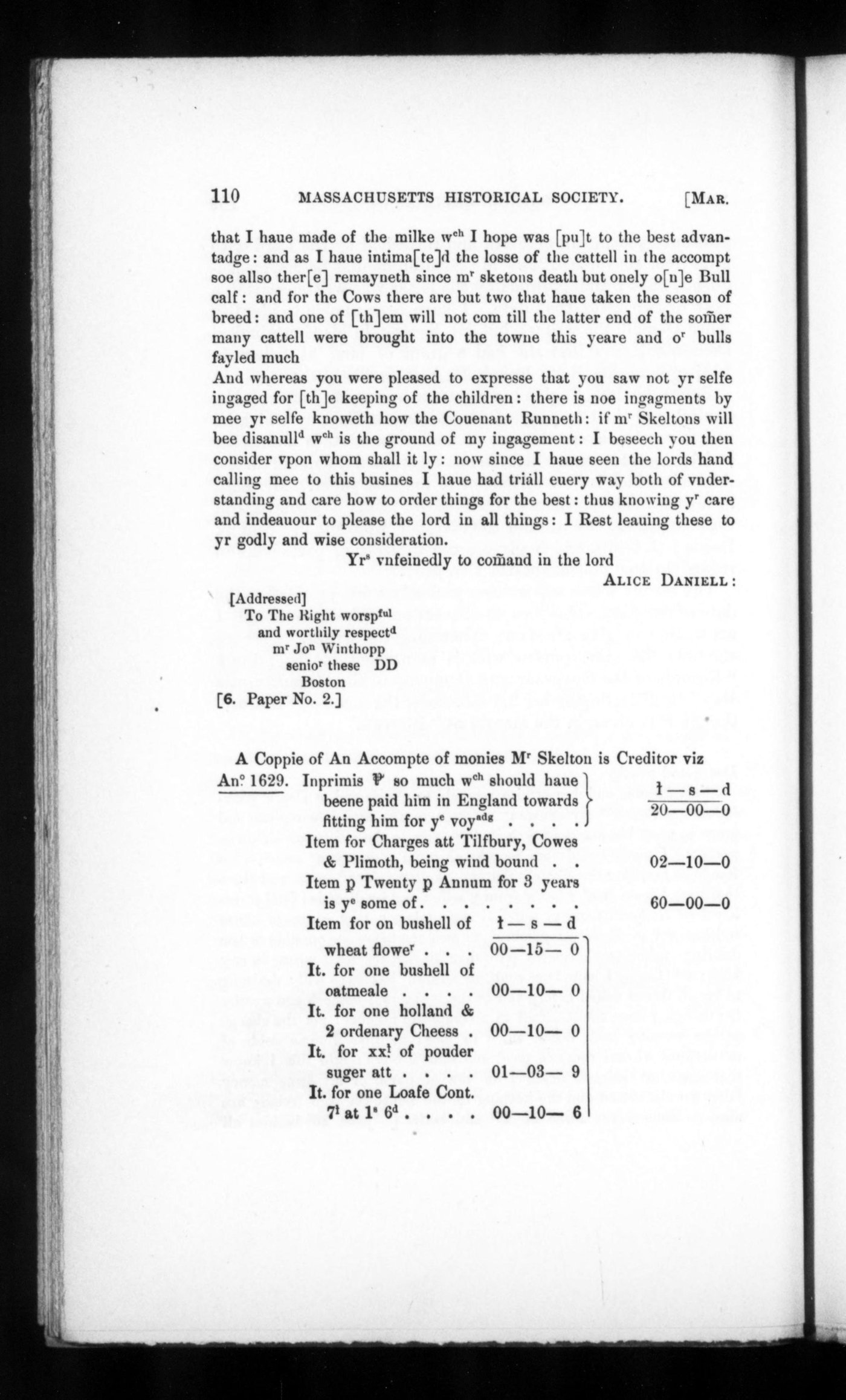
The first letter relates to Samuel Skelton, the earliest minister of Salem. … Mr. Skelton died at Salem, on August 2, 1634; and presumably the letter was written within a year or two after that date. I have been unable to identify Alice Daniell, the writer; but Mr. Savage, in his Genealogical Dictionary, says that she had a grant of land at Salem in 1637, giving the Rev. Joseph B. Felt as his authority.
… and since that time I haue Recd a letter from yrselfe: and by direction [of] or beloued mr Endicott from yr self [ ] haue taken a true coppy of those writings wch mr Endecott prsented to you soe neere as possible to bee desiring rather to charge my selfe than to doe the least wrong in any kind; wch Coppy I haue here sent: as allso mr Skelton’s will …
The 1881 Register printed her letter from a transcript; Samuel A. Green, in 1895, printed the whole file it belongs to, and the file is not among the Winthrop papers but in the Suffolk County Court Files, number 6, where her letter is paper no. 2 and the Skelton accounts in Ralph Fogg’s hand are the rest.1, 22, 53 So the letter was the covering letter to the accounts: she copied Endecott’s papers herself, “desiring rather to charge my selfe than to doe the least wrong,” sent them to Winthrop with Skelton’s will, and the whole went into the court’s file when the jury’s verdict was recorded.53 Green, the Society’s librarian and a careful antiquary, could not identify her; nor could Perley in 1924, who wrote that “who she was has never been determined.”14, 53 The original, with whatever endorsement it carries, is at the Massachusetts State Archives among the Suffolk Files.
Source53
What Salem establishes, and what it cannot
Put together, the Salem records give a woman styled “Mrs.,” the title of standing, who could write a business letter in her own hand and keep an account; who kept the minister’s house and cattle for the four years after his death, and had a house of her own on his lot; who held his farm across Porter’s River and was granted fifty acres more; who lived alone; who was not a church member; and who, with her husband alive and the divorce refused, took ground at Providence in the same season the town gave her the fifty acres.1, 2, 4, 22, 23, 32, 40, 41, 48 What Salem cannot give is the thing wanted. No Salem record names a Greene, mentions Narragansett or Wickford or Richard Smith, or connects her to anyone who went there. The only bridge from Salem to Quidnessett is Winthrop’s sentence of December 1638 about “one Greene” at Providence, and the family’s reading of it.24, 25 The Salem leads that remain are English: the Skelton connection, which Trask guessed at and no one has tested in the Lincolnshire registers of Sempringham and Tattershall where Skelton served and married; and Richard Beckley’s own parish, which would carry the marriage of Richard Beckley to Alice Daniell, widow, and with it her first husband’s name.1, 8
“One Greene”: which John Greene did she marry?
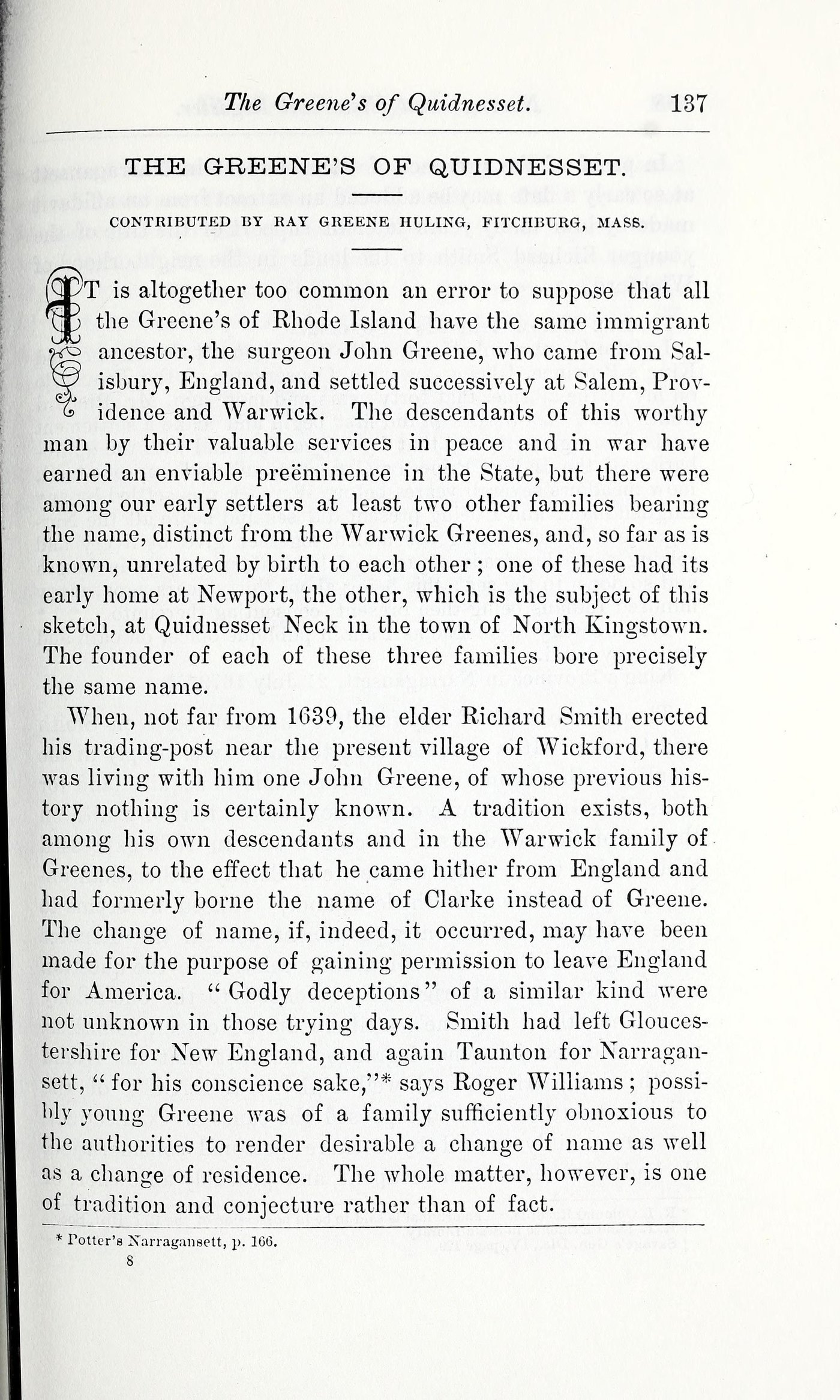
Two men named John Greene were among the first settlers of Rhode Island, and Huling warned in 1883 that it was “altogether too common an error” to confuse them.65 One was the surgeon from Salisbury, Wiltshire, who came in the James in 1635, was a Providence proprietor in 1638, went with Gorton to Shawomet (Warwick) in 1642 and 1643, and died there in the winter of 1658/9.12, 26 The other, the ancestor of this family, was living in Richard Smith’s household at the Wickford trading post about 1639, held land at Quidnessett Neck from the 1660s, and died between 1692 and 1696; nothing is known of him before Wickford.65 Winthrop’s “one Greene” must be one of them, and Winthrop does not say which.24 Which he meant has been a running question since Staples first named the surgeon in 1843.11 The Providence town records answer it: he was the surgeon. The two cases as they stood before those records were found are kept below, followed by the records themselves.
The family’s identification: John Greene of Quidnessett (held by this site until 23 September 2026; set aside)
- The family’s tradition, on this site and in the online genealogies, makes Mrs. Beggarly the wife of John of Quidnessett and the mother of his sons.17, 18, 66
- The first statement of it in print is La Mance, 1904: Winthrop, “speaking of one held to be John of Quidnessett, uses this language: ‘One Greene who married the wife of one Beggarly.’ So his wife was a young widow, Mrs. Joan Beggarly.”25
- The surgeon’s first wife, Joan Tattersall, the mother of all his children, is said by Savage and by Turner to have died in 1643 at Conanicut.12, 26 If she was living in December 1638, the surgeon cannot be the Greene who had then “married the wife of one Beggerly,” and the identification of the printed authorities fails.24
- What remains to be shown: a record placing John of Quidnessett at Providence in 1638 (the earliest record of him is at Wickford about 1639, and he is not among the fifty-four Providence proprietors), and the relation of Alice, whom no record calls Joan, to the Joan of the 1682 deeds.3, 16, 65
The identification in the printed authorities: John Greene Senior, the surgeon (confirmed)
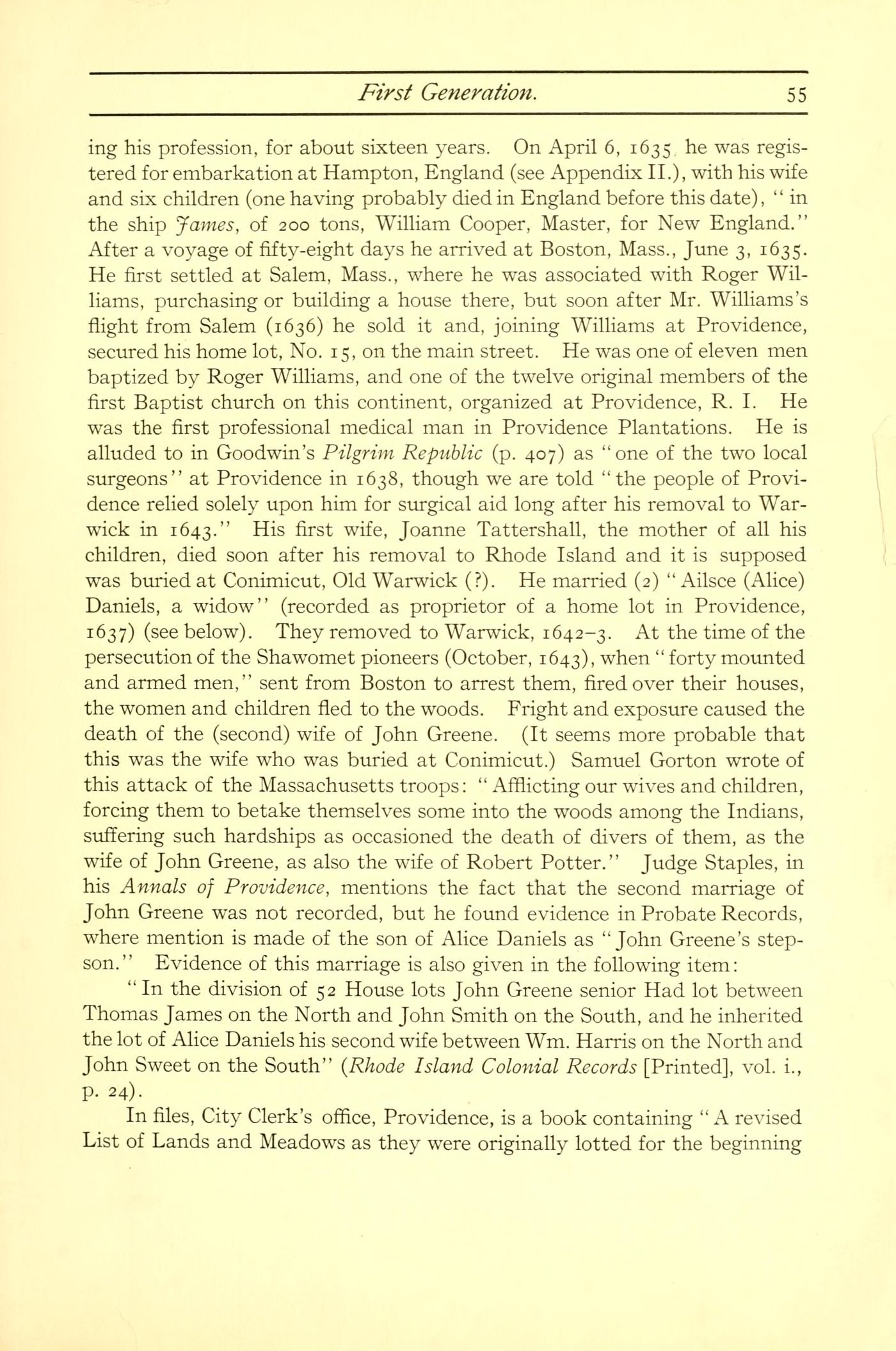
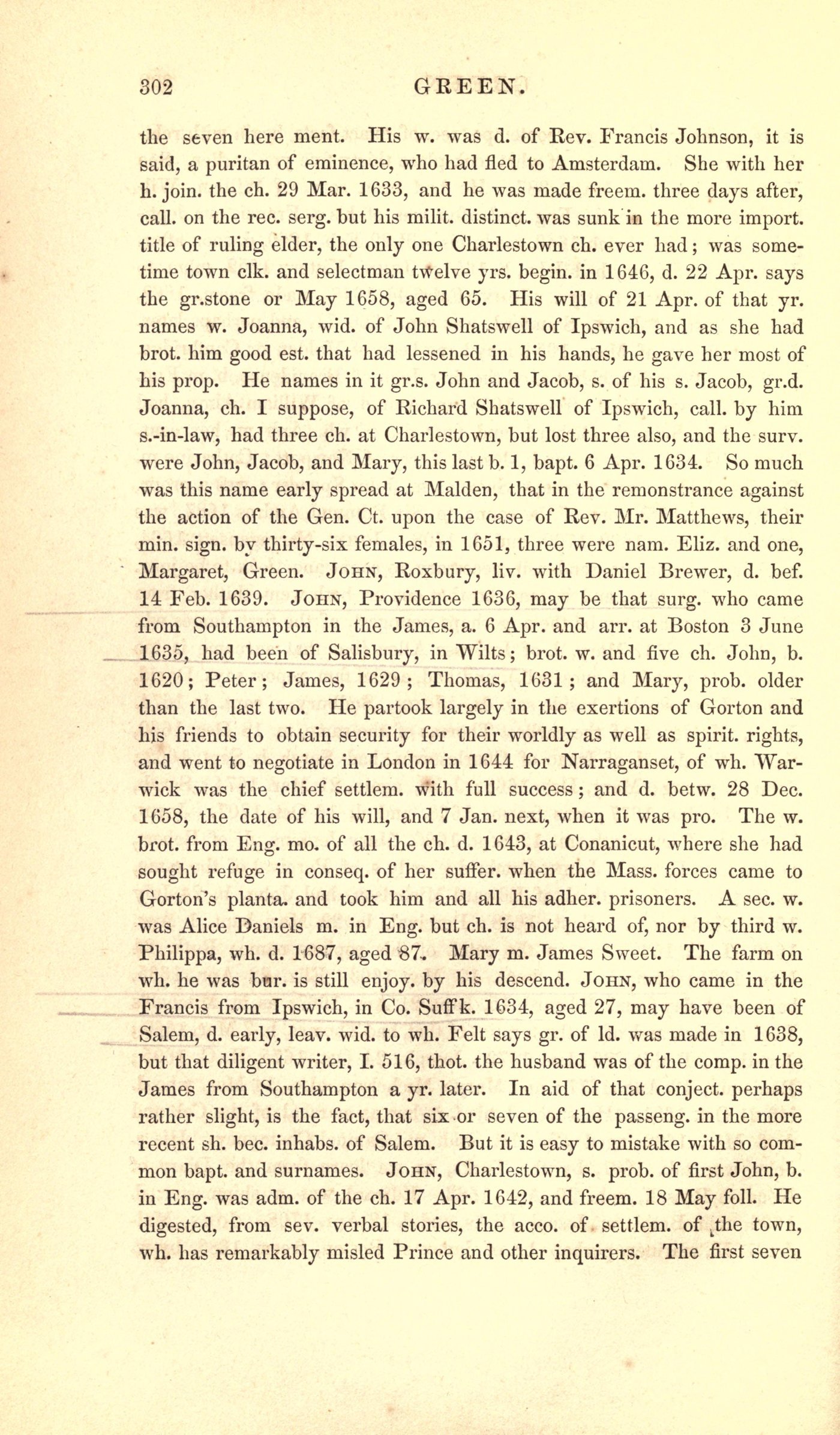
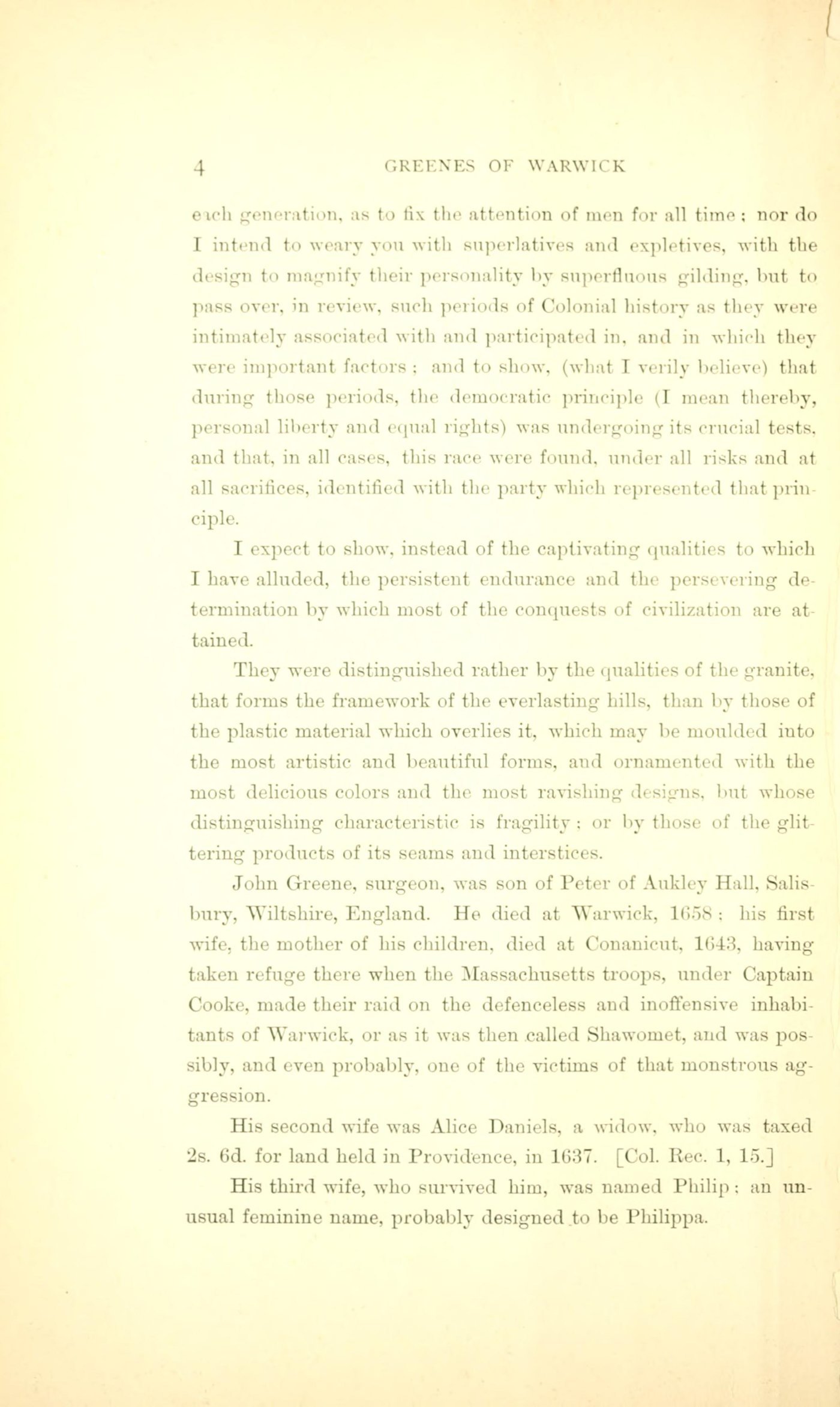
- Every writer from 1843 to 1903 who names the husband names him: Staples (1843), the editor of the colony records (1856), Savage (1860), Turner (1877), Trask (1881), Pope (1900), and G. S. Greene (1903).9, 11–13, 15, 23, 26
- The quarrel Winthrop describes was a Providence town matter, and “Alice Daniels” and “John Greene, Sen.” stand together on the Providence proprietors’ list of 1638.3, 24
- The Providence lot book, as read by G. S. Greene, records that John Greene Senior inherited Alice Daniels’s lot as her husband, and Staples reported a probate entry naming “the son of Alice Daniels” as “John Greene’s step-son.”15
- On 27 January 1682/3 “Mr John Greene of Warwick” came to the Providence town meeting and claimed the right of commoning that went with her lot, “upon ye account of mris Alice Daniell”; the record is reproduced below.67
- What it requires: that the surgeon’s first wife, Joan Tattersall, was dead by 1638. Savage and Turner say she died in 1643; G. S. Greene, who had the Providence records in hand, says she died soon after the family reached Rhode Island and that the wife who died in 1643 was Alice.12, 15, 26 The printed authorities never resolved that contradiction among themselves.
The answer: John Greene Senior, the surgeon
A letter to the Providence town meeting from the surgeon’s son, endorsed “Mr Greenes Bill to ye Town.” It is the written bill he presented in person that day; the town’s answer is in the town book, reproduced below. “Motherinlawe” is the usage of the time for a stepmother.82
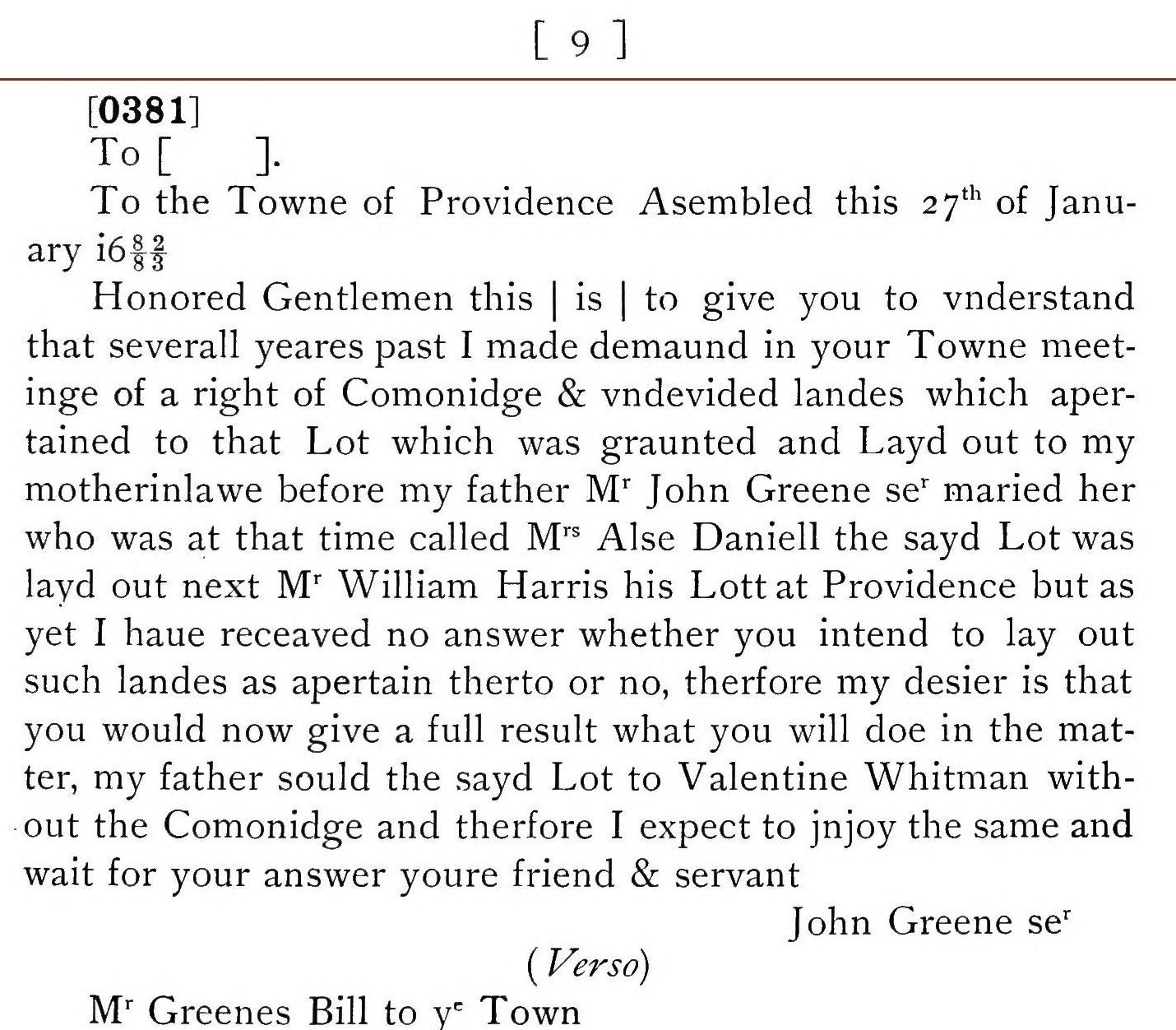
[0381] To [ ].
To the Towne of Providence Asembled this 27th of January 1682/83
Honored Gentlemen this | is | to give you to vnderstand that severall yeares past I made demaund in your Towne meetinge of a right of Comonidge & vndevided landes which apertained to that Lot which was graunted and Layd out to my motherinlawe before my father Mr John Greene ser maried her who was at that time called Mrs Alse Daniell the sayd Lot was layd out next Mr William Harris his Lott at Providence but as yet I haue receaved no answer whether you intend to lay out such landes as apertain therto or no, therfore my desier is that you would now give a full result what you will doe in the matter, my father sould the sayd Lot to Valentine Whitman without the Comonidge and therfore I expect to jnjoy the same and wait for your answer youre friend & servant
John Greene ser
(Verso) Mr Greenes Bill to ye Town
The sale the son describes. The lot is bounded by William Harris’s lot, as hers was in 1638 (“John Sweet, Alice Daniels, William Harris”), and the seller’s widow and executrix is Philip Greene, the surgeon’s third wife Philippa. John Greene of Quidnessett was alive until the 1690s and his wife in 1682 was Joan, so he cannot be this seller.83, 3
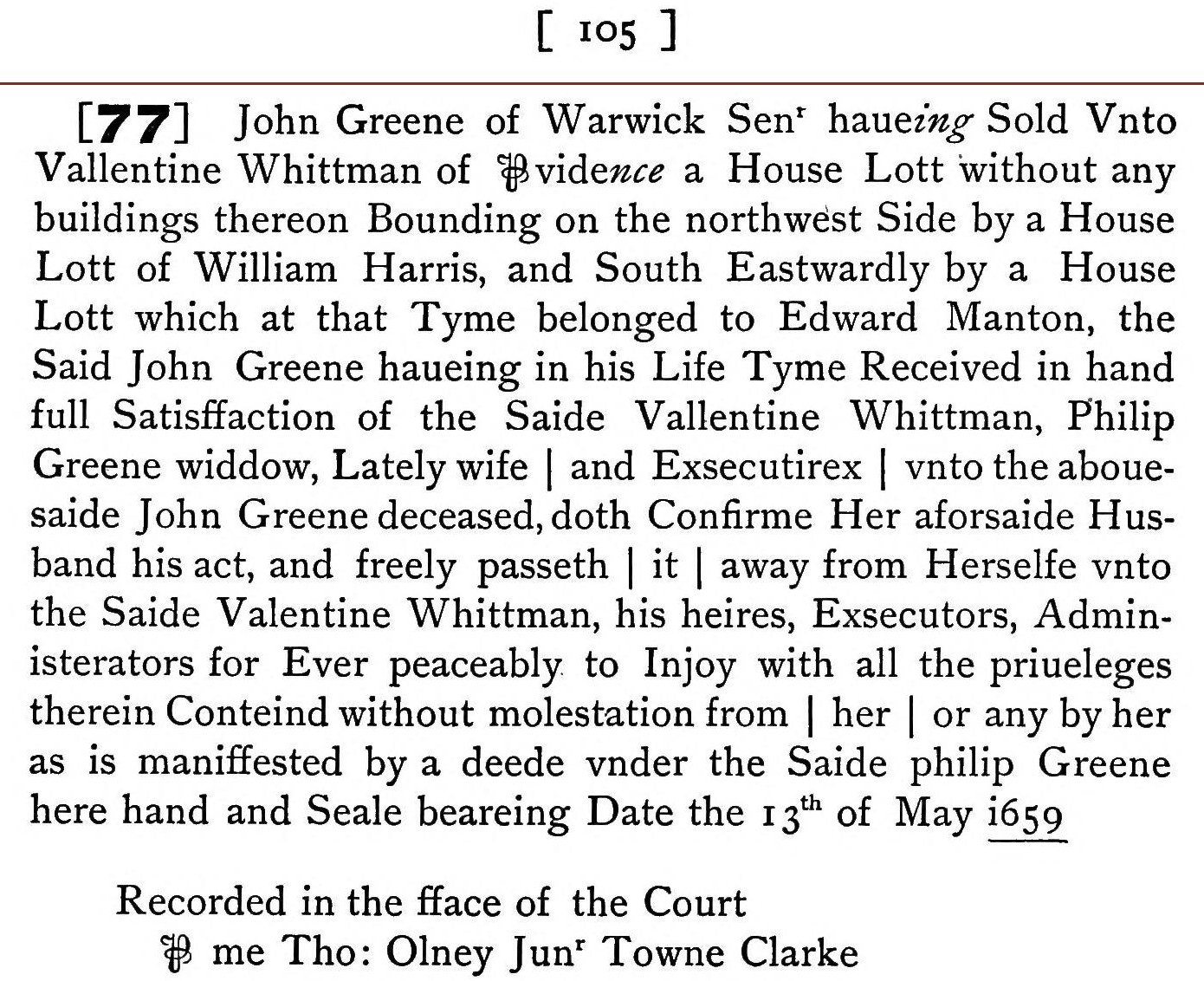
[77] John Greene of Warwick Senr haueing Sold Vnto Vallentine Whittman of ℘vidence a House Lott without any buildings thereon Bounding on the northwest Side by a House Lott of William Harris, and South Eastwardly by a House Lott which at that Tyme belonged to Edward Manton, the Said John Greene haueing in his Life Tyme Received in hand full Satisffaction of the Saide Vallentine Whittman, Philip Greene widdow, Lately wife | and Exsecutirex | vnto the abouesaide John Greene deceased, doth Confirme Her aforsaide Husband his act, and freely passeth | it | away from Herselfe vnto the Saide Valentine Whittman, his heires, Exsecutors, Administerators for Ever peaceably to Injoy with all the priueleges therein Conteind without molestation from | her | or any by her as is maniffested by a deede vnder the Saide philip Greene here hand and Seale beareing Date the 13th of May 1659
Recorded in the fface of the Court ℘ me Tho: Olney Junr Towne Clarke
Together these records answer the question the printed authorities could only infer. The lot granted to Alice Daniell beside William Harris’s was sold by John Greene Senior of Warwick, whose widow was Philippa, and his son calls her his stepmother and says in so many words that his father married her. The disputed date of Joan Tattersall’s death no longer matters: whenever the surgeon’s first wife died, his son’s letter shows that the surgeon married Alice Daniell. The family’s identification with John Greene of Quidnessett, first printed by La Mance in 1904 without a source, is set aside; the case for it, as this page formerly gave it, is kept above for the record.82, 83, 25
The town’s answer: Providence, 27 January 1682/3
The Providence town book records, at the quarter-day meeting of 27 January 1682/3, the same day as the letter above, the latest entry found in which her name appears. The year is printed as a fraction, 1682/3; this page read it as 1686/7 until 23 September 2026.67
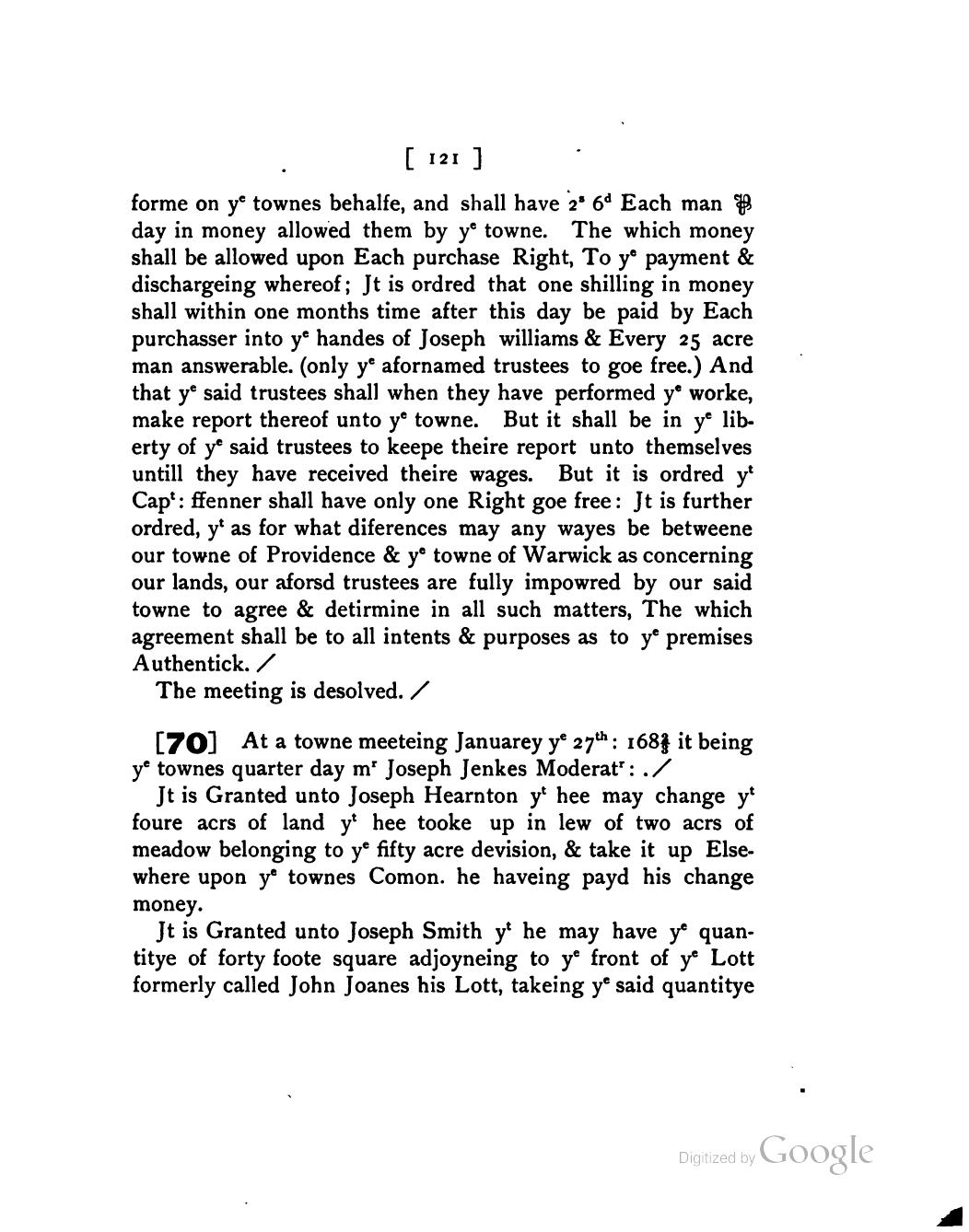
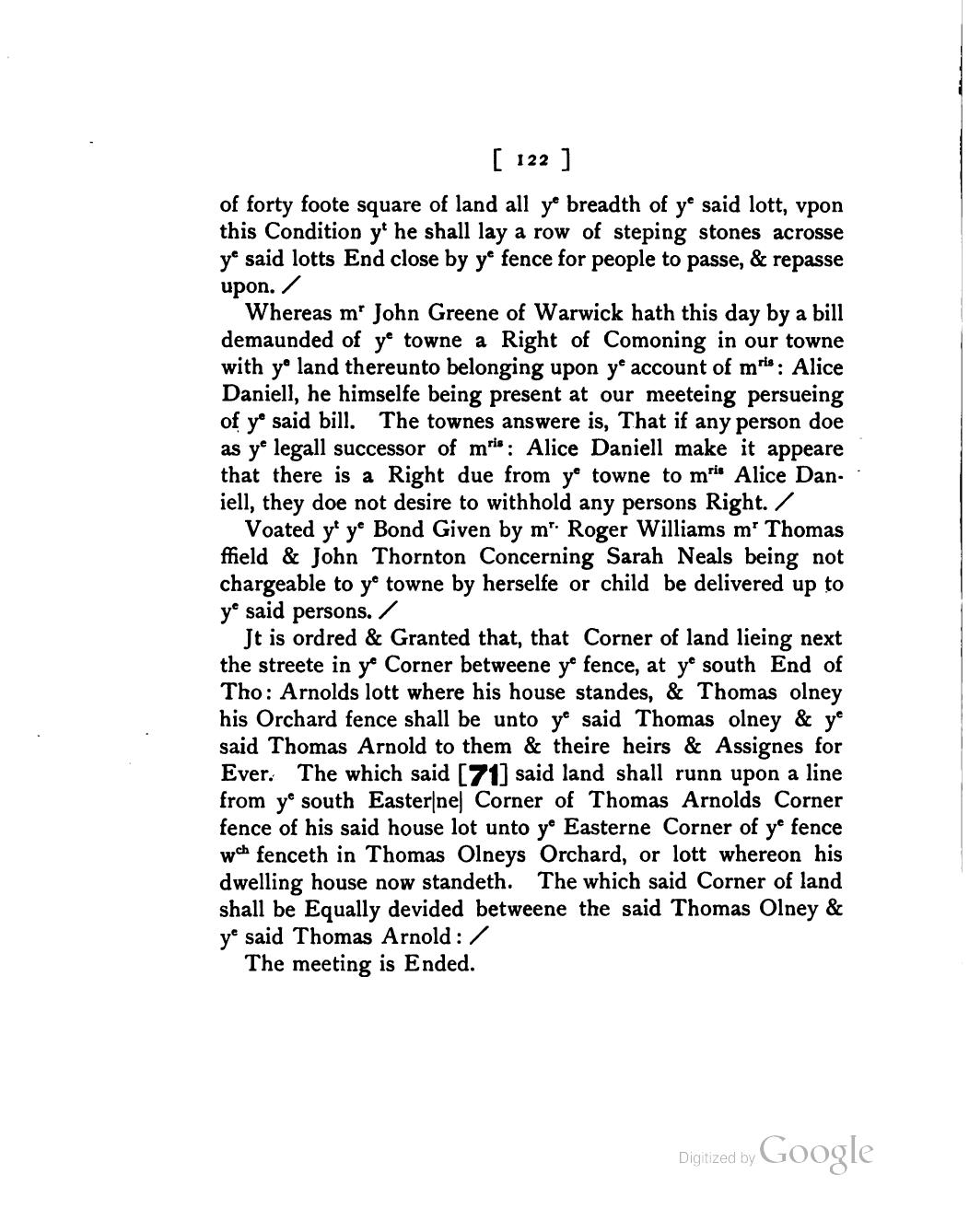
At a towne meeteing Januarey ye 27th: 1682/3 it being ye townes quarter day mr Joseph Jenkes Moderatr: …
Whereas mr John Greene of Warwick hath this day by a bill demaunded of ye towne a Right of Comoning in our towne with ye land thereunto belonging upon ye account of mris: Alice Daniell, he himselfe being present at our meeteing persueing of ye said bill. The townes answere is, That if any person doe as ye legall successor of mris: Alice Daniell make it appeare that there is a Right due from ye towne to mris Alice Daniell, they doe not desire to withhold any persons Right.
Forty-four years after the lot list of 1638, a John Greene styled “of Warwick” came in person to Providence and claimed, by a written bill, the right of commoning that belonged to her lot. The town neither granted nor refused it: whoever could prove himself her “legal successor” might have what was due to her. The John Greene of Warwick in 1683 was Major John Greene, the surgeon’s eldest son, deputy for Warwick, one of the colony’s agents in England in the 1670s, and Deputy Governor from 1690; no John Greene of Quidnessett is ever styled of Warwick.12, 15, 67 So the only claim found to succeed to Alice Daniell’s Providence right was made from Warwick, by the surgeon’s family, which is the reading of the printed authorities; on what title he claimed, the town book does not say, but his own bill, above, does: she was his stepmother. No claim from Quidnessett has been found. The “step-son” of the list above has not been found in Staples; the only John Greene called “son in law” in G. S. Greene’s own appended note is Major John, so called in a Warwick deed of 27 August 1668 as the step-son of the surgeon’s widow Philippa, which is no evidence of a son of Alice.15
Source67
A death at Warwick, January 1643/4: the Surgeon’s wife
In October 1643 Massachusetts sent forty armed men to Shawomet to arrest Samuel Gorton and his company, among them John Greene Senior. The women and children fled into the woods. Gorton wrote of the soldiers “afflicting our wives and children, forcing them to betake themselves some into the woods among the Indians, suffering such hardships as occasioned the death of divers of them, as the wife of John Greene, as also the wife of Robert Potter.”28 Three months later Benedict Arnold, writing to Winthrop from Providence about the Mohawks, added a postscript:
I thought good to send you this word, to certify your Worship, that mr. greens wife is dead, about a weeke since. PROVIDENCE: this 19th of the 11th mo. 1643[/44]
The wife who died was the wife of John Greene the Surgeon, John Greene Senior of Warwick, who was among the Gortonists arrested that October.12, 27, 28 She was not Joan of Quidnessett. Whether she was Joan Tattersall or Alice Daniell is not recorded; either way she was the surgeon’s wife.12, 15, 26 Either way, the surgeon married a third wife, Philippa, who survived him.12, 26 The Story page on this site assigns Arnold’s report to the wife of John Greene of Quidnessett; but Joan of Quidnessett was alive in March 1682, so the report cannot be of her.16, 18
Richard Beggarly: his arrival, and what became of him
The one document that speaks to it says the opposite. Winthrop’s memorandum of 2 June 1636 describes “Richard Beggarly and his wife, who had been here six years, and he in England.”4 She had come in 1630; he had stayed behind, and appeared in the colony only about 1636, six years later.4 No record found gives the date or place of their marriage, so whether she left him in England or he left her is not known.1, 13 Nothing explains why they came apart, or why he followed when he did. The hearing shows what happened when he came. She went to the Governor and Council, charged him with adultery, and was believed: the presumptions were “so great.” The court would not grant a divorce without proof from England, but it ordered him to remain separate from her until she could send for it, and made him take twenty shillings of her money “to set him to work.”4 He had arrived, that is, to find his wife a landholder and the head of a minister’s household, and within weeks of his landing she had the colony’s magistrates standing between them.4, 22 Two years later, still at Salem, she sued him for the twenty shillings and won.7, 9 The records put him in the colony for about two years and no more. He was present at the hearing in Boston in June 1636; he was the defendant at the Salem quarterly court in March 1638; and by 1639 he was at New Haven.4, 7, 8 No Massachusetts record shows him as a freeman, a landholder, or a church member, and the Salem town book never names him.2, 69 He appears in the colony only as her husband, once at the hearing and once as the man she sued. Winthrop’s note of December 1638 that her husband was “living” is the last Massachusetts word of him.24
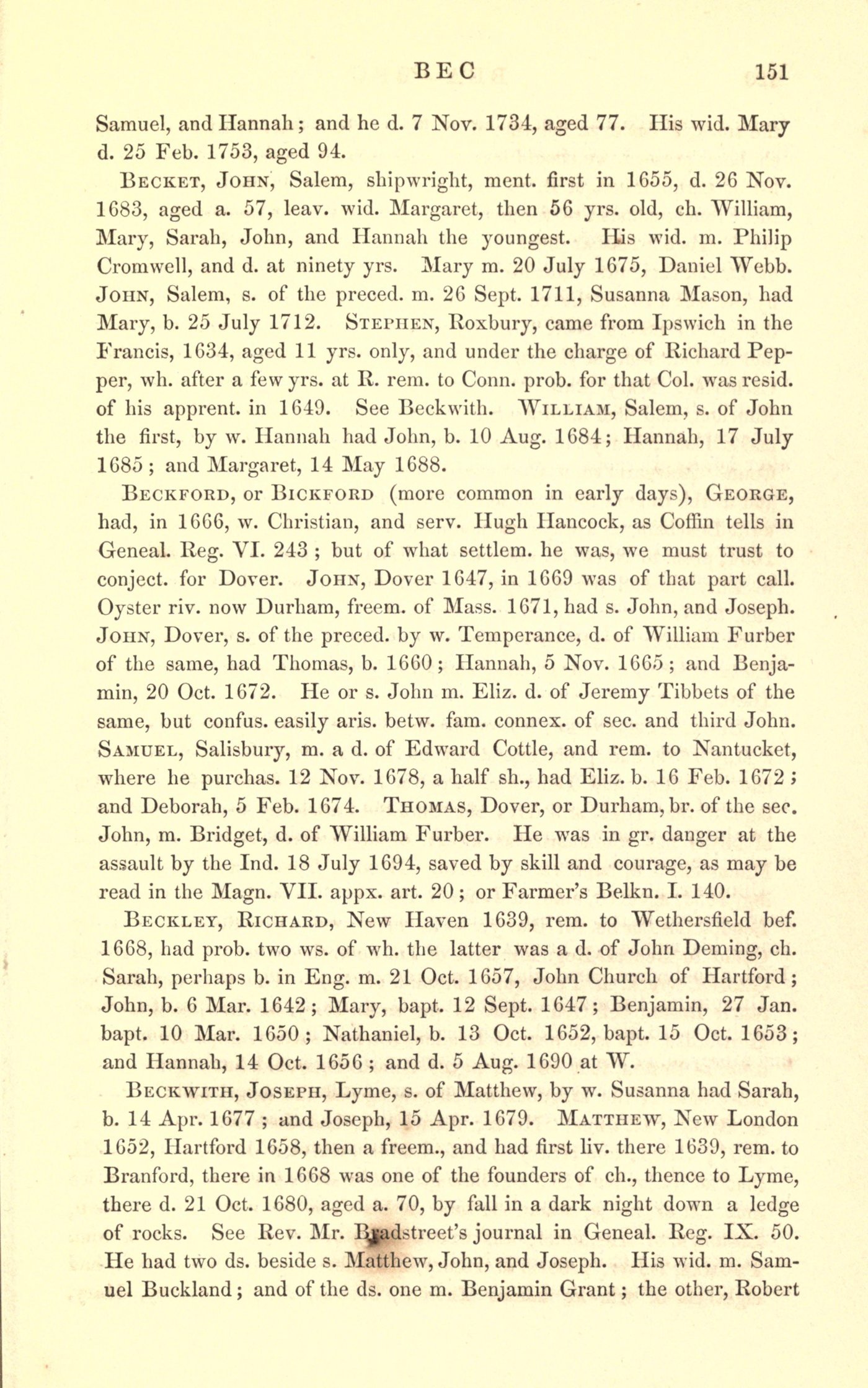
BECKLEY, RICHARD, New Haven 1639, rem. to Wethersfield bef. 1668, had prob. two ws. of wh. the latter was a d. of John Deming, ch. Sarah, perhaps b. in Eng. m. 21 Oct. 1657, John Church of Hartford; John, b. 6 Mar. 1642; Mary, bapt. 12 Sept. 1647; Benjamin … Nathaniel … and Hannah, 14 Oct. 1656; and d. 5 Aug. 1690 at W.
Source8
The Register adds that he was among the New Haven planters of 1643 with an estate of twenty pounds and a family of four, was “Sergeant Beckley” there as late as 1650, and a juror at Windsor in 1664.9 He remarried and raised a second family in Connecticut.8 He was never divorced from Alice, and she was never his widow: Winthrop says in 1638 that “her husband is living, and no divorce,” and Beckley lived until 1690.8, 24 The word “widow” applied to her by Turner and G. S. Greene is a courtesy of the genealogists, not a fact of the record.12, 15
Joan, wife of John Greene of Quidnessett: the Narragansett record
This section uses only the records of Kings Towne, the Narragansett Country, and the Rhode Island Land Evidences. Nothing in it depends on the Massachusetts material above, and nothing in it names Salem, Beggarly, Beckley, or Daniell.16, 70, 71
The whole Narragansett record of her, every document in order with its scan and transcription, the list of what the record does not contain, and the list of the unprinted originals, is on its own page: Joan, wife of John Greene of Quidnessett: the Narragansett record.
John Greene was at Wickford by 1639, living with Richard Smith at the trading post, by his own affidavit of 21 July 1679: “forty years and more ago, Mr. Richard Smith that I then lived with did first begin and make a settlement in the Narragansett.”71, 72 In 1663 he and the other Wickford men declared for Connecticut; in May 1664 Rhode Island sent a warrant, and Smith wrote that “they came to John Green’s house att Aquidnesett … and forceably fetched him awaye to Rode Island”; he was pardoned and declared a freeman.73 The plat of 1666 assigns 151 acres to “John Greene and Son”; the court at Aquidnesset of May 1671 confirmed him in his land and took his engagement; in January 1671/2 he was one of the six purchasers of the Devil’s Foot tract.72 In none of these is a wife named.
Two of the records named above are printed in full in the Fones Record, the book of the Narragansett proprietors, published in 1894.74, 75
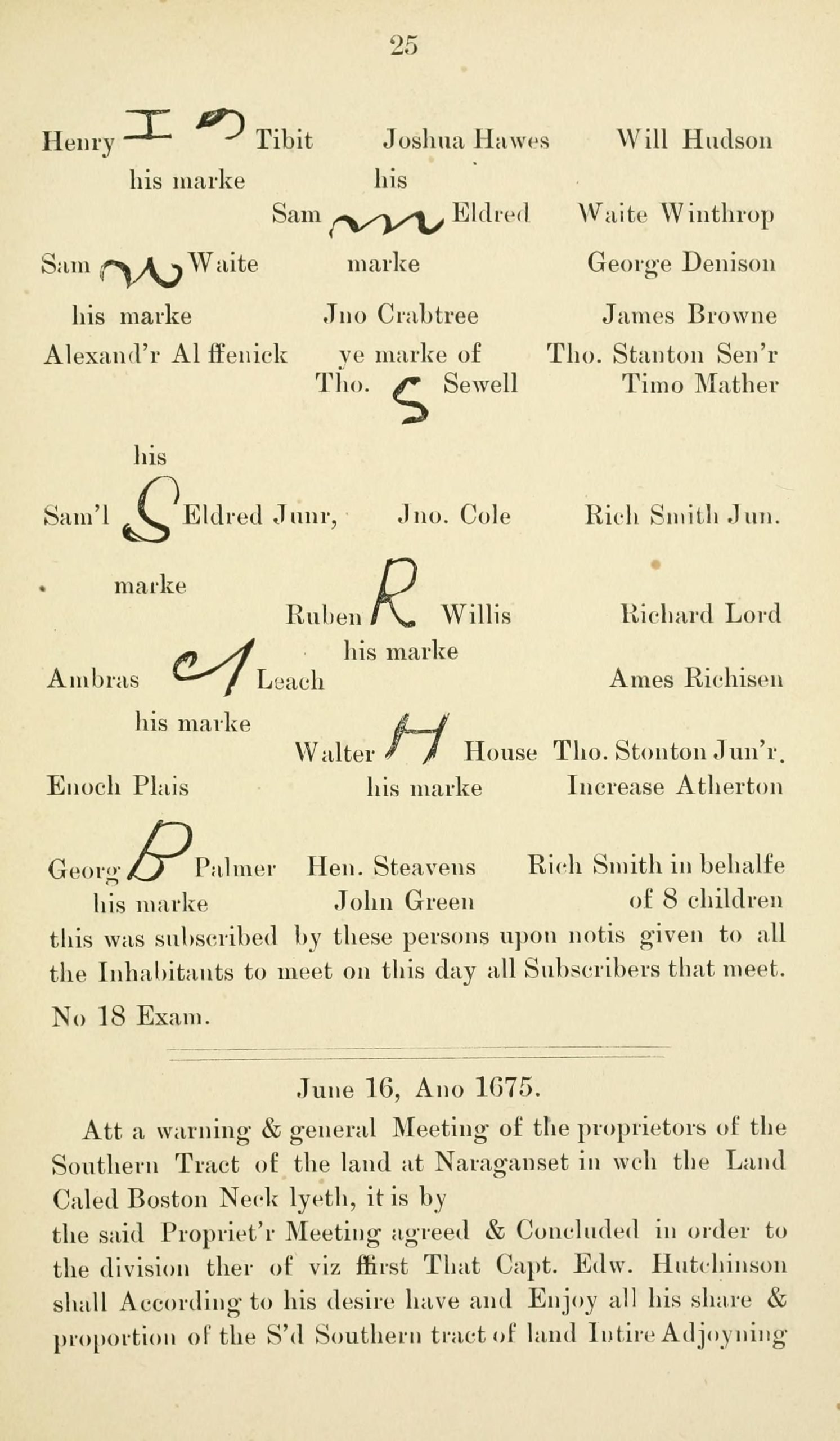
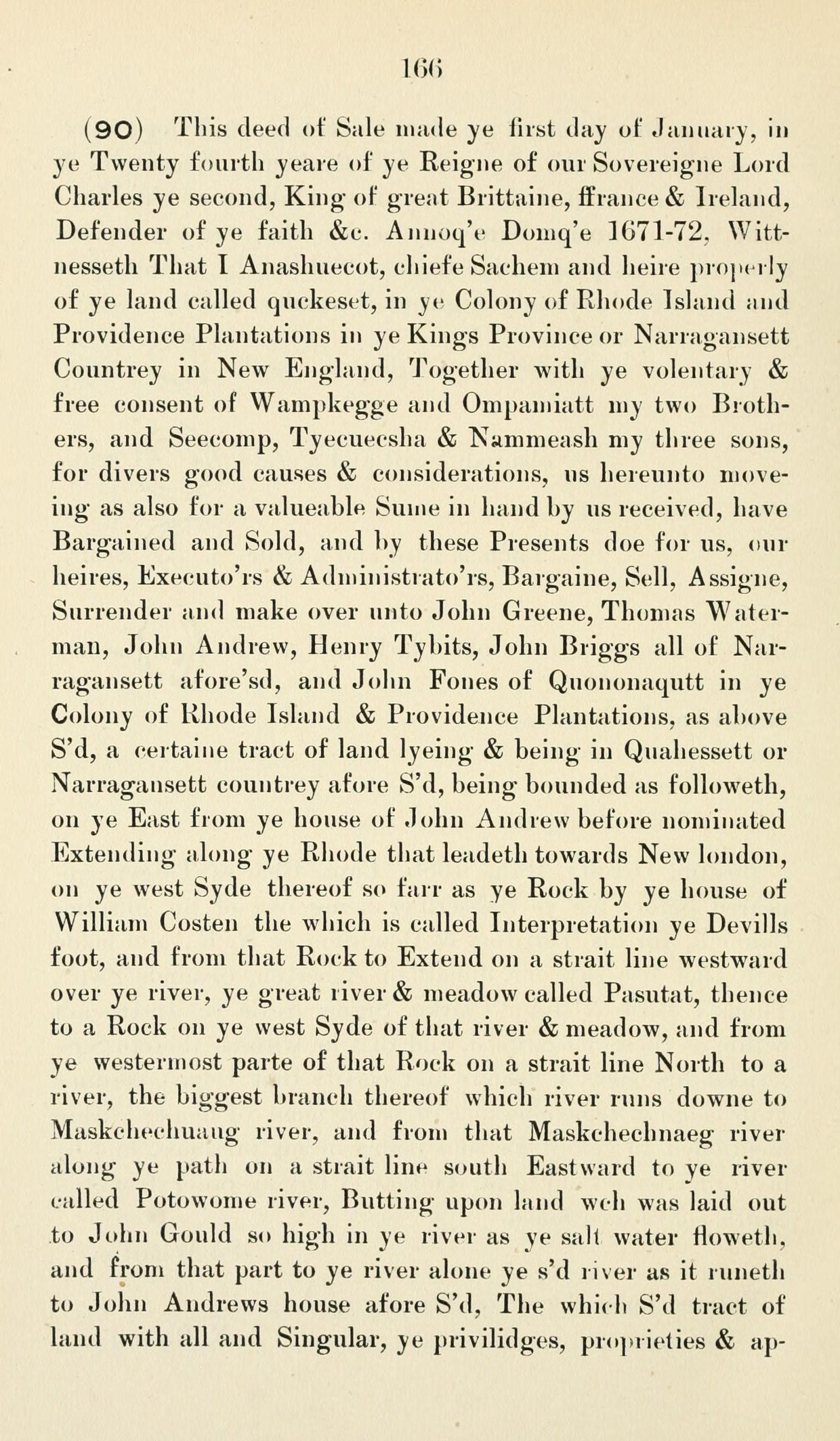
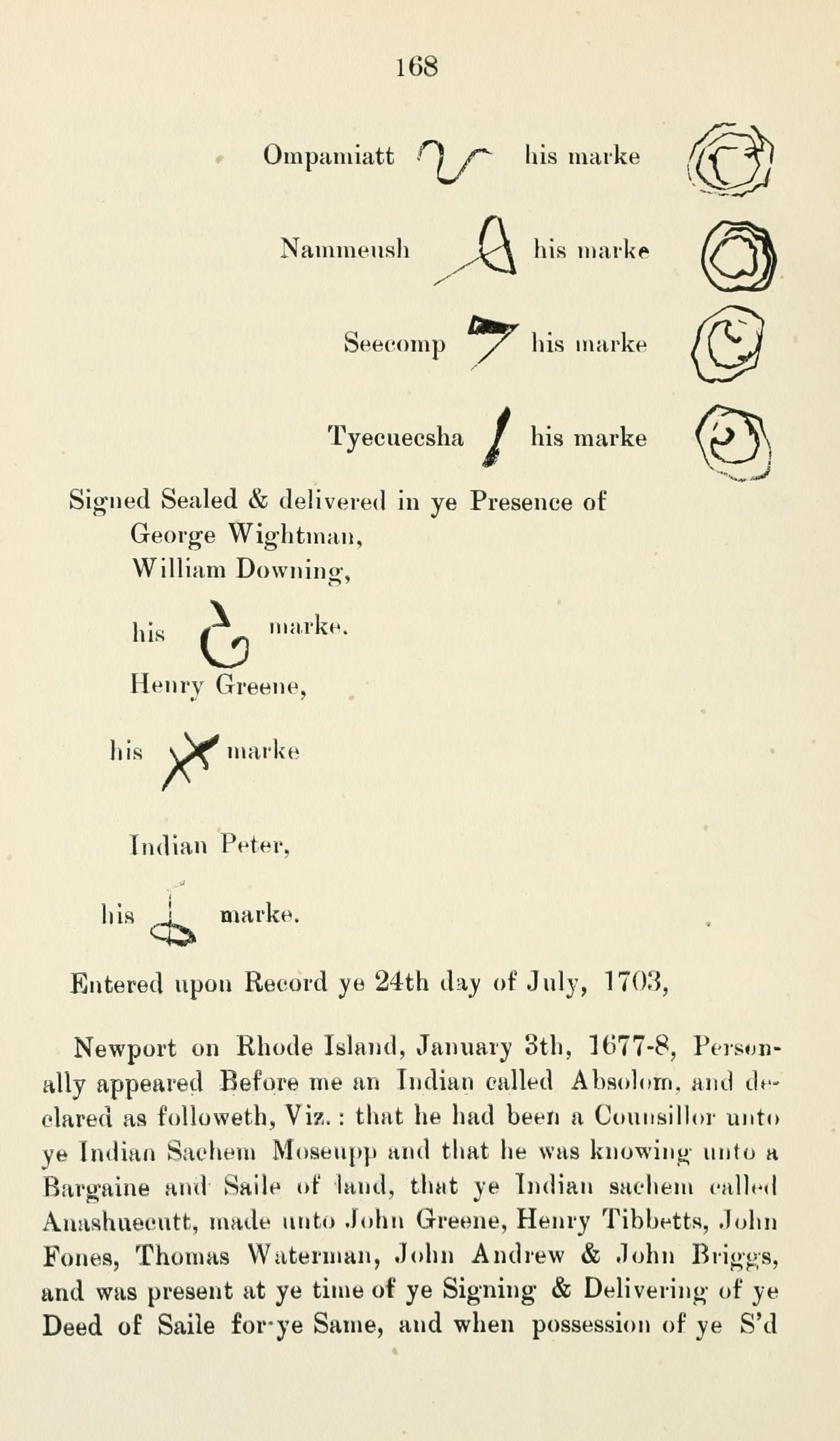
[3 July 1663] We whose names are under written being the Inhabitants & the proprietors of the lands lying in the Naraganset have & doe desire (according to his Majesties grante) to be under the Govern’tt of Conecticot Collony & Request there protection accordinge to a letter sent in June last. … John Green … this was subscribed by these persons upon notis given to all the Inhabitants to meet on this day all Subscribers that meet.
[1 January 1671/2] … I Anashuecot, chiefe Sachem and heire properly of ye land called quckeset, in ye Colony of Rhode Island and Providence Plantations in ye Kings Province or Narragansett Countrey in New England, Together with ye volentary & free consent of Wampkegge and Ompamiatt my two Brothers, and Seecomp, Tyecuecsha & Nammeash my three sons … have Bargained and Sold … unto John Greene, Thomas Waterman, John Andrew, Henry Tybits, John Briggs all of Narragansett afore’sd, and John Fones of Quononaqutt … a certaine tract of land lyeing & being in Quahessett or Narragansett countrey afore S’d … Signed Sealed & delivered in ye Presence of George Wightman, William Downing, his marke, Henry Greene, his marke, Indian Peter, his marke. Entered upon Record ye 24th day of July, 1703.
Neither names a wife. The subscription of 1663 is John’s first signature in the Narragansett record, ten months before the Rhode Island warrant that took him from his house at Quidnessett; his name stands in the middle column of the printed page, and the words “of 8 children” in the column beside it belong to Richard Smith’s entry, not to his.73, 74 On the printed page a “marke” is set only against the men who could not write their names, Tibbits, Waite, the two Eldreds, Sewell, Willis, Leach, House, and Palmer; “John Green” stands without one, so he signed his own name. Eight years later the witness “Henry Greene” to the deed of 1671/2 is entered with “his marke”: if Henry was John’s son, the father wrote and the son did not. The deed of 1671/2 is the purchase from which the deeds of 1682 were carved: John Greene is the first named of the six purchasers, and a Henry Greene, who signed with a mark, witnessed it. The family’s account makes Henry a son of John and Joan, engaged as a freeman with his father in 1671, and this is the one record found in which he appears.72, 75, 76
Recorded in the colony’s Land Evidences at Newport, book I, entry 260, and printed in abstract in 1921. It is the only surviving document that names her.70
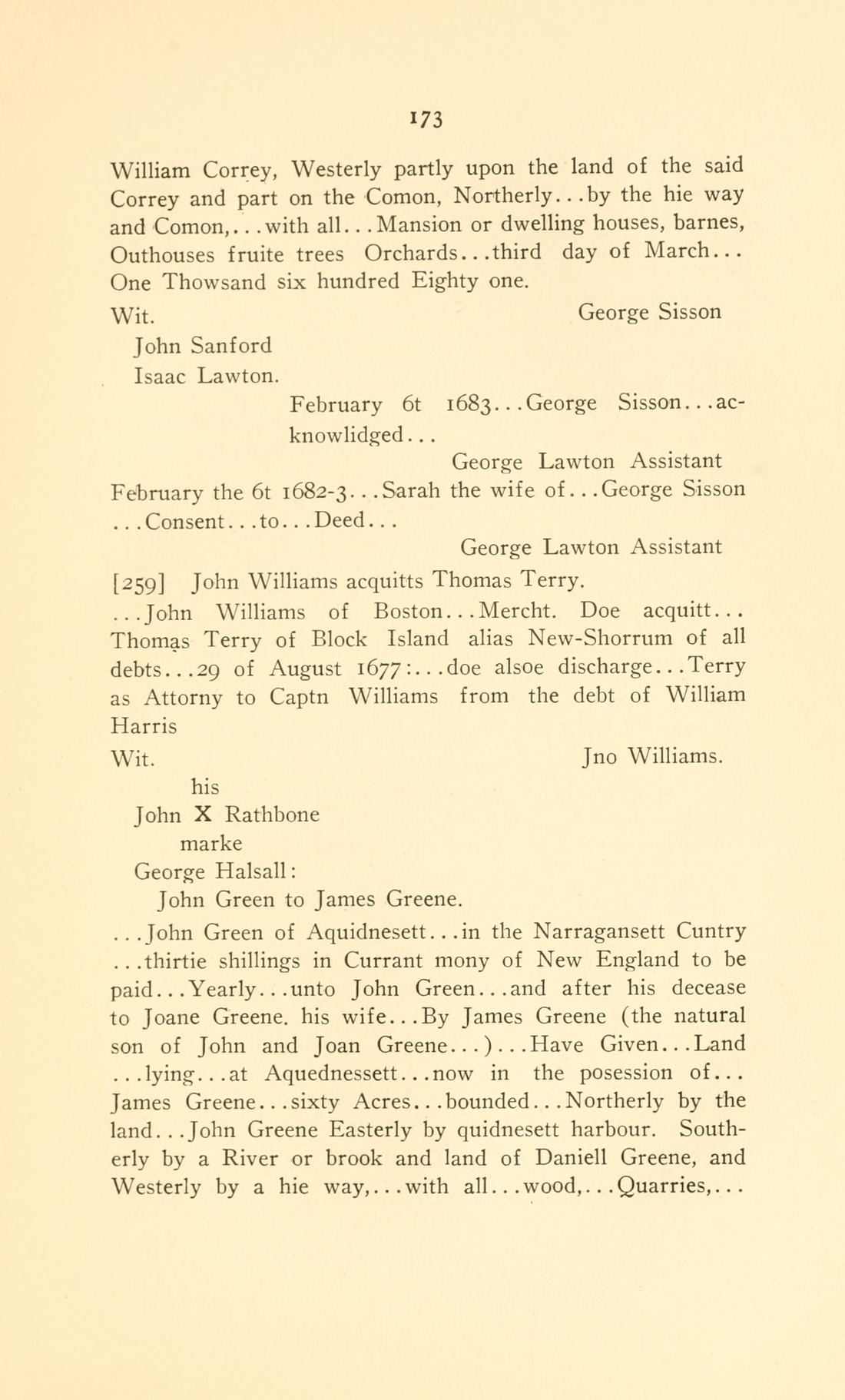
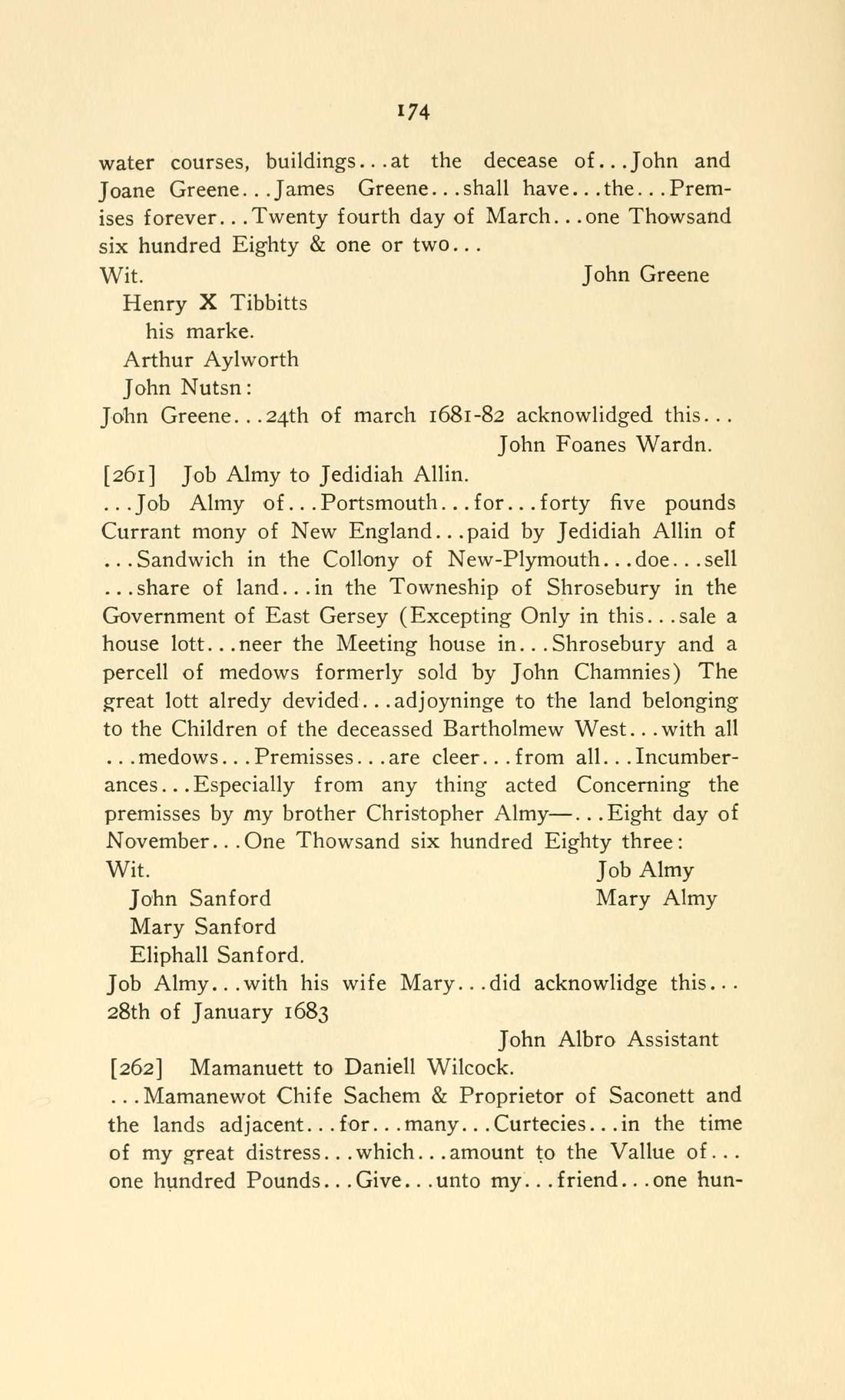
John Green to James Greene. … John Green of Aquidnesett … in the Narragansett Cuntry … thirtie shillings in Currant mony of New England to be paid … Yearly … unto John Green … and after his decease to Joane Greene, his wife … By James Greene (the natural son of John and Joan Greene …) … Have Given … Land … lying … at Aquednessett … now in the posession of … James Greene … sixty Acres … bounded … Northerly by the land … John Greene Easterly by quidnesett harbour. Southerly by a River or brook and land of Daniell Greene, and Westerly by a hie way, … with all … wood, … Quarries, … water courses, buildings … at the decease of … John and Joane Greene … James Greene … shall have … the … Premises forever … Twenty fourth day of March … one Thowsand six hundred Eighty & one or two …
Wit. Henry X Tibbitts his marke. Arthur Aylworth. John Nutsn: John Greene. John Greene … 24th of march 1681-82 acknowlidged this … John Foanes Wardn.
The thirty shillings is an annuity for the parents’ lives, hers after his. James is their “natural son,” the phrase of the time for a son of the body. The land is bounded by Daniel’s, and Daniel’s own deed of the same day, 120 acres on Allen’s Harbor with the same provision “as long as the father or mother should live,” is in the North Kingstown records and has never been printed in full.16, 70, 71 The witnesses are Quidnessett neighbours: Henry Tibbitts, whose daughter Mary married Edward Greene; Arthur Aylworth; and the warden John Fones.70, 71 The 1921 abstract omits words at each ellipsis; the full text is in the original book at the Rhode Island State Archives.
Source70
Huling, from the Rhode Island land evidences and the North Kingstown records:
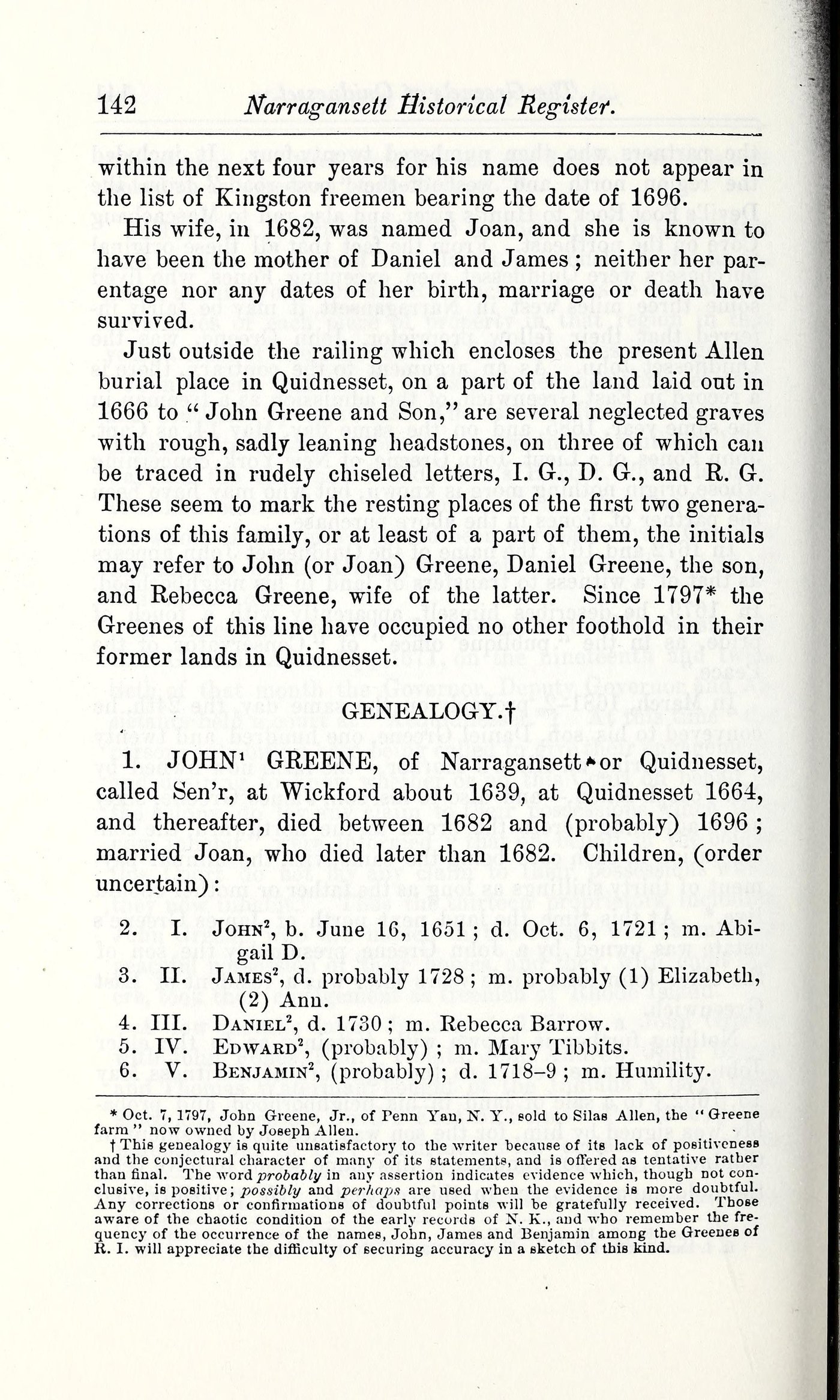
In March, 1681-2, probably on the same day, the 24th, he conveyed to his son, Daniel Greene, one hundred and twenty acres bordering on Allen’s Harbor, the farm now owned by Mr. Joseph Allen, and also to his son, James Greene, sixty acres adjoining across the brook to the northward, the consideration in each case being the same, viz., the annual payment of thirty shillings as long as the father or mother should live. …
His wife, in 1682, was named Joan, and she is known to have been the mother of Daniel and James; neither her parentage nor any dates of her birth, marriage or death have survived.
Source16
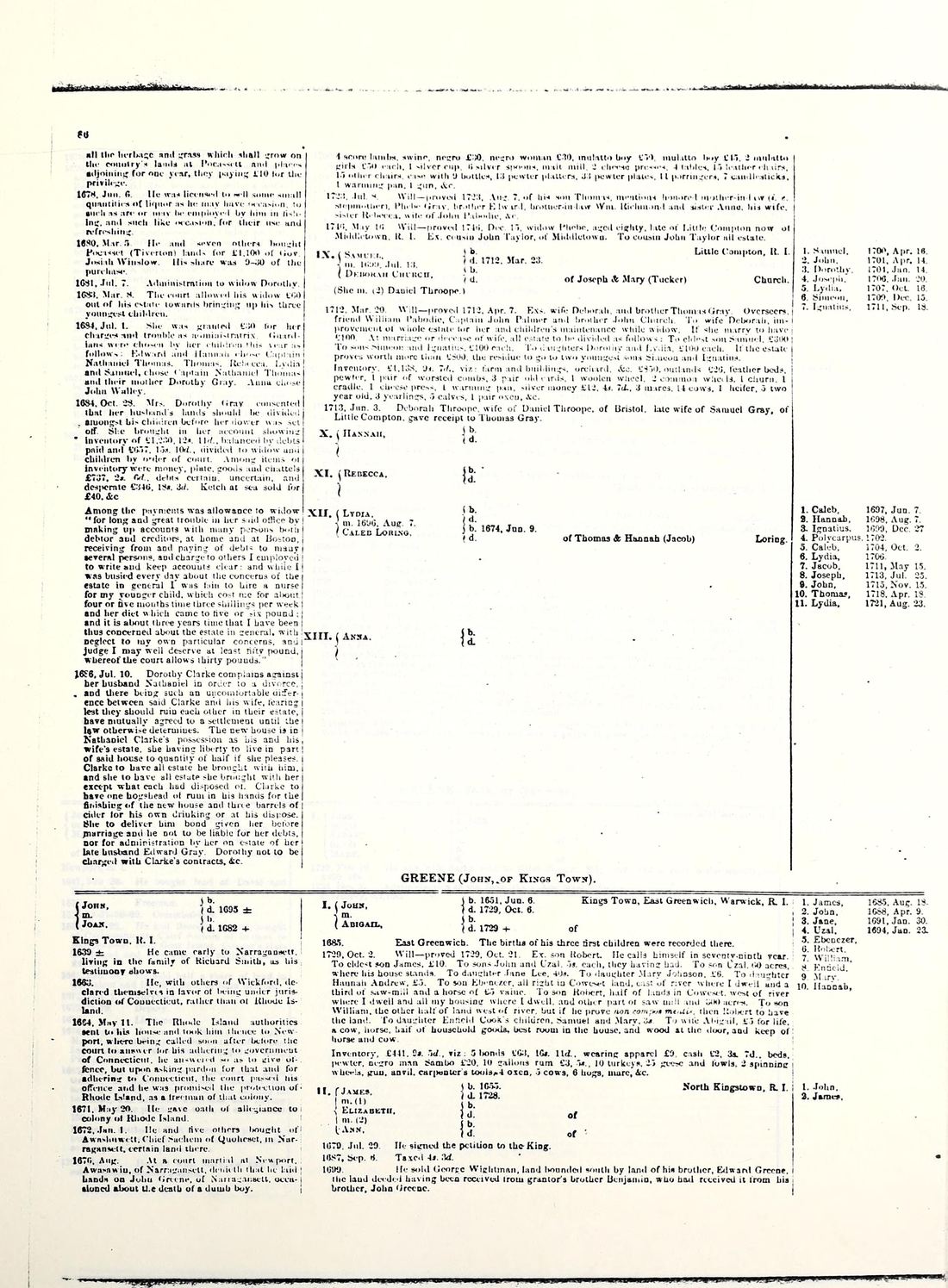
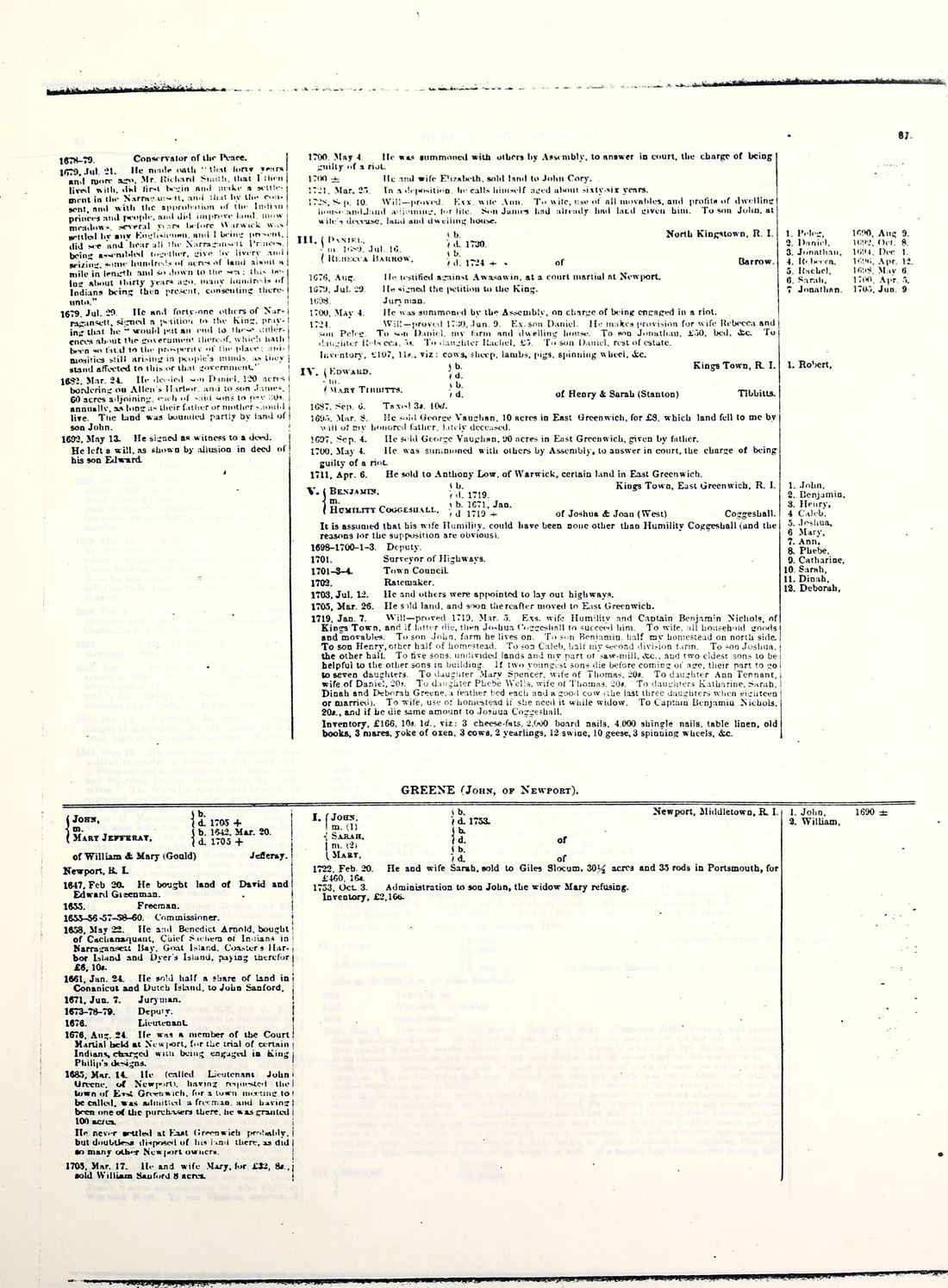
John witnessed a deed on 13 May 1692. On 8 March 1694/5 his son Edward sold ten acres in East Greenwich “which land fell to me by will of my honored father, lately deceased.” So John died between those dates and left a will; the will has not been found in print, and Huling warned in 1883 of “the chaotic condition of the early records of N. K.”16, 71 Whether Joan outlived him is not recorded. Austin, who worked the Kings Town records in the 1880s, summarised the couple as “John, d. 1695 ±; m. Joan, d. 1682 +,” and could give her no more.71 Huling also noted three rough headstones outside the Allen burial ground, on the land laid out in 1666 to “John Greene and Son,” lettered I. G., D. G., and R. G., which he thought might mark John or Joan, their son Daniel, and Daniel’s wife Rebecca.16
Her children, as the Quidnessett records give them
| Child | Record | Names his mother? |
|---|---|---|
| James | Deed of 24 March 1681/2, “the natural son of John and Joan Greene”; born 1655 by Huling; died 1728; Lieutenant; signed the petition to the King in 1679.16, 70, 71 | Yes, as Joan. |
| Daniel | Deed of 24 March 1681/2, 120 acres, “as long as the father or mother should live”; married 16 July 1689 Rebecca Barrow; died 1730.16, 71 | Implicitly, as “the mother.” |
| John, Lieutenant, of East Greenwich and Coventry | Held the land next north of James’s in 1682, “presumably the son”; of East Greenwich by 1685; will proved 21 October 1729. Austin gives his birth as 6 June 1651, a date La Mance says belongs to the Warwick Lieutenant-Governor and was borrowed for him.16, 71, 76 | No. |
| Edward, Captain | Sold land in 1695 that “fell to me by will of my honored father, lately deceased”; married Mary Tibbitts.71 | No. |
| Benjamin | Deputy 1698 to 1703; married Humility; died 1719.71 | No. |
| Henry | Engaged as a freeman with his father and brothers in 1671, by the family’s account; not in Austin’s list.76 | No. |
| “Joan Greene, 1649–1715” | Was listed as a daughter on this site’s John Greene of Quidnessett page, in a list of nine children with birth and death years, until 22 September 2026, when the entry was removed with a dated correction note. No daughter Joan appears in Austin, Huling, or the Land Evidences, and none is attached to the WikiTree profile for John, which lists seven sons. The list of nine, with its years, has the form of the online family trees and cites no record; a search on 22 September 2026 found no record for a daughter Joan or for the years 1649 and 1715.16, 17, 71, 77 | Not found. |
What the Narragansett record does not contain
- Any mention of Joan before 24 March 1681/2. The subscription of 1663, the 1664 arrest, the 1671 court, the purchase of 1671/2, the 1679 affidavit, and the petition to the King name only John.72–75
- Her maiden name, parentage, birth, marriage, or death.16, 71
- Any tie to Massachusetts, Salem, Providence, Beggarly, Beckley, or Daniell. No Kings Towne or Land Evidence entry uses any of those names.70, 71
- A daughter Joan, or a step-son.16, 71
So the Quidnessett records establish her name, her marriage, her motherhood of James and Daniel, and that she was alive in March 1682, and nothing else. They never connect her with Mrs. Beggarly of Salem, and the Providence records show that Mrs. Beggarly married the surgeon; the identification of the two women was La Mance’s, set out in the next section.24, 25 The originals that could still yield her origin are the full James deed at the Rhode Island State Archives (Land Evidences book I, entry 260); the Daniel deed of the same day, the Fones Purchase, and Edward’s 1695 deed in North Kingstown Land Evidence book 2; the Kings Towne council and probate books of 1692 to 1696, for John’s will and any widow’s dower; and the wills of the sons, Daniel (1730), James (1728), Benjamin (1719), and Lieutenant John (1729), for any mention of “my mother.” Austin’s abstracts of Daniel’s and Benjamin’s wills name no mother, which suggests she was dead by 1719.16, 71 A search on 22 September 2026 for printed or online copies of these originals found none beyond the abstracts already used: they remain in the manuscript books at North Kingstown and at the State Archives, and on microfilm that cannot be read without an account.78
Two things follow from the deeds. Joan was alive in March 1682, thirty-eight years after the death Benedict Arnold reported at Warwick, so that death cannot have been hers.16, 27 And she was the mother of sons born, on the family’s reckoning, from about 1643 into the 1650s.16, 17 On the family’s former identification she was the woman who came in 1630, kept Skelton’s house at Salem, and married “one Greene” at Providence in 1638; the Providence records show that woman married the surgeon, so Joan was someone else.4, 16, 24, 25 The Salem and Providence records on this page belong to the surgeon’s second wife, Alice Daniell.11, 15
Where the name Joan Ann Beggarly came from
The joining of Mrs. Beggarly with Joan of Quidnessett can be dated and attributed. Lora S. La Mance, in The Greene Family and its Branches (1904), a book written for the Quidnessett descendants, wrote:
John of Quidnessett’s wife’s name was Joan. There has been much idle conjecture as to whom she was. She was not the daughter of Surgeon John Greene, as some have claimed, for the Surgeon’s daughter Joan died in childhood. Nor was she the daughter of Richard Smith, as others have insisted, for Joan Smith married a Mr. Newton. Gov. Bradford of Massachusetts, speaking of one held to be John of Quidnessett, uses this language: “One Greene who married the wife of one Beggarly.” So his wife was a young widow, Mrs. Joan Beggarly, whom he probably married on one of his business trips to Massachusetts.
Whether she was handsome or plain-featured; whether she was brilliant or dull, we do not know. But we do know she possessed a remarkably even, sweet temper that nothing could ruffle or disturb. After the then English custom, she had been baptized Joan, but was always called Jane.
Source25
And in her chapter on the Quidnessett line:
The date of John of Quidnessett’s marriage can be nearly approximated. After living several years in Richard Smith’s family, he married a young widow, Mrs. Joan Beggarly. It is Governor Winthrop of Massachusetts who gives her name. Therefore, she was doubtless a member of that Colony. Greene and Smith must have made many trips to Boston after goods for their Indian trading post. On one of these trips, Greene may have married the widow.
Source76
Each step is visible. The quotation is Winthrop’s, though she attributes it to Bradford in one place.24, 25 Winthrop gives no forename, so “Joan” is carried over from the 1682 deeds.16, 24 “Young widow” is her gloss; Winthrop says the husband was living.24 “One held to be John of Quidnessett” is the only authority offered.25 The sweet temper and the name Jane have no source.25 The second passage is reproduced on this site’s John Greene of Quidnessett page, where it is credited to G. S. Greene’s 1903 book; that book does not contain it and never mentions a Beggarly.17, 79
From La Mance the composite passed into the online genealogies. The Find a Grave memorial cited on this site, “Joan Beggarly Greene (1610–1644),” adds a birth year found in no record and assigns to Joan the January 1643/4 death that Arnold reported for the wife of John Greene of Warwick.18, 27, 28 The middle name Ann or Anne appears in no printed source consulted.1, 16, 25
What this page said before, and what the records say
| As this page said before 21 September 2026 | What the records say | Origin of the claim |
|---|---|---|
| Her name was Joan Ann Beggarly | Every Massachusetts and Providence record calls her Alice Daniell or Mrs. Beggarly.1–3, 5, 7, 46 “Joan” is the Quidnessett wife of the 1682 deeds.16 No record has “Ann.” | La Mance 190425 |
| Born 1610 | No record gives a birth year for Alice or for Joan.1, 16 | Find a Grave memorial 3599935818 |
| Married Richard Beggarly in England shortly before 1630 | Married to Richard by 1636; date and place not recorded. Winthrop puts her in New England from 1630, him in England.4 | Inference from Winthrop |
| Arrived at Salem in 1630 | “Had been here six years” in June 1636. Port not recorded; Salem likely from her later life there.4, 22 | Winthrop 1636 |
| A young widow when she married John Greene | Richard was alive, undivorced, and living in Connecticut until 1690.8, 24 | La Mance 190425 |
| She was Joan, wife of John Greene of Quidnessett (the family’s identification, held by this page until 23 September 2026) | She was Alice Daniell, second wife of John Greene the surgeon; Joan of Quidnessett was a different woman.82, 83, 16 | La Mance 190425 |
| The Providence claim to her right of commoning was made on 27 January 1686/7 | 27 January 1682/3; the year is printed as a fraction.67, 82 | Misreading of the printed fraction |
| Married John Greene of Quidnessett about 1642 | Married “one Greene” at Providence by December 1638, not about 1642.24 He was John Greene Senior, the surgeon of Warwick: his son’s letter of 1682/3 and the 1659 deed of her lot. This site followed the family tradition of John Greene of Quidnessett until 23 September 2026.11, 15, 25 | La Mance 1904 for the date 164276 |
| Died about 12 January 1643/4 | The wife of John Greene the Surgeon, of Warwick, died then.27, 28 Joan of Quidnessett was alive in March 1682.16 | Arnold’s letter, applied to Joan by Find a Grave18 |
| Died 1682 | Joan was alive in 1682; her death date is unknown.16 | Misreading of Huling’s “in 1682”66 |
| Her part in Skelton’s estate shows education and standing | Correct, and it belongs to Alice: her own letter survives.1, 22 | Trask 18811 |
What remains open
- A record for the marriage. Settled 23 September 2026: the Providence records name her husband as John Greene Senior, the surgeon. No record of the ceremony itself survives.15, 26, 65
- Alice’s ship and port. No record.19, 20
- Daniell. Maiden name or first husband’s? The Register’s guess that she was kin to Skelton or to his wife has not been tested against English parish registers.1 G. S. Greene’s report of a son, “John Greene’s step-son,” has not been traced to the probate record he cites.15
- Joan of Quidnessett’s origins, birth, marriage, and death. Huling found none in 1883; nothing found since is better than his.16, 80
- The Hugh Peter letter’s date. Peter wrote August 8; Winthrop endorsed it December 8.34
Searched and found empty of either woman: Banks’s two books; the Massachusetts Bay Company records, volume I; Life and Letters of John Winthrop, volume II; the Narragansett Historical Register apart from Huling; Staples beyond the entries quoted; and G. S. Greene beyond the passage quoted.11, 19, 20, 65, 69, 79, 81
Notes
- Trask, W. B. (ed.), “Letter of Mrs. Alice Daniell of Salem, to Gov. John Winthrop at Boston,” New England Historical and Genealogical Register 35 (1881), 318–320. https://archive.org/details/newenglandhistor35wate
- Town Records of Salem, Massachusetts, 1634–1659 (Salem: Essex Institute, 1868), grants of 17.12.1636 (Lawrence Leach, “ouer against mrs Daniells farme”) and 8.9.1637 (“Mrs. Daniell … 50”). https://archive.org/details/townrecordsofsalv1sale
- Records of the Colony of Rhode Island, I, 24 (the 1638 list of house lots: “… John Sweet, Alice Daniels, William Harris, John Throckmorton, Roger Williams, Joshua Verin, Widow Reeve, John Smith, John Greene, Sen., Thomas James … Benedict Arnold, John Greene, Jun. …”).
- Winthrop, J., The History of New England from 1630 to 1649, ed. J. Savage (Boston, 1825–26), II, 344 (Addenda, memorandum of 2 June 1636); 2nd ed. (Boston, 1853), II, 421. https://archive.org/details/historyofnewengl02wint ; https://archive.org/details/historynewengla08savagoog
- John Endecott to John Winthrop, [ca. January 1635/6], Winthrop Papers, III (Massachusetts Historical Society, 1943), 221–222. https://archive.org/details/winthroppapersv3wint
- Records of the Court of Assistants, II, 74 (Court of Assistants at Cambridge, 5 June 1638, marginal note “Mr. Skeltons estat. set.”). https://archive.org/details/recordsofcourtof02massuoft
- Records and Files of the Quarterly Courts of Essex County, Massachusetts, I (Salem, 1911), 7 (court of 27 March 1638, “Mrs. Daniell v. Richard Beckly”). https://archive.org/details/recordsfilesofqu01mass
- Savage, Genealogical Dictionary, I (1860), 151, s.v. Beckley, Richard. https://archive.org/details/genealogicaldic01savarich
- NEHGR 35 (1881), 320 (editor’s note on the 1638 verdict, the Providence lot list, Richard Beckley at New Haven, and the marriage).
- Upham, in Historical Collections of the Essex Institute 13 (1875), 150–151: the editor’s note dating the papers to the winter of 1634–5 from the calves “dead … since winter did begin,” rejecting the supposition that Mrs. Beggarly was Skelton’s widow, and first connecting her with “Mrs. Daniel,” the 1638 debt suit, and John Greene of Providence. https://archive.org/details/sim_peabody-essex-museum-collections_1875-04_13_2
- Staples, W. R., Annals of the Town of Providence (Providence, 1843), 22 (“Mrs. Alice Daniels, (afterwards the wife of John Greene, Senior,)”), 35 (the lot list). https://archive.org/details/annalsoftownofpr00stap
- Turner, H. E., Greenes of Warwick in Colonial History (Newport, 1877), 4–5. https://archive.org/details/greenesofwarwick00turn
- Pope, C. H., The Pioneers of Massachusetts (Boston, 1900), 43, s.v. Beckly, Beggarly (“Alice, wife of Richard, came to N. E. about 1630 … Seems to be the Alice Daniel of later record, and the wife of John Greene of Providence”) and s.v. Daniel. https://archive.org/details/pioneersofmassac00pope
- Perley, S., The History of Salem, Massachusetts, I (Salem, 1924), 256 (Skelton house ordered taken down by the quarterly court at Salem, 27 August 1644; “After his death, the wife of Richard Beggarly attended to the settlement of Mr. Skelton’s affairs. Who she was has never been determined”). https://archive.org/details/historyofsalemma01perl
- Greene, G. S., The Greenes of Rhode Island, with Historical Records of English Ancestry, 1534–1902 (New York, 1903), 55–56. https://archive.org/details/greenesofrhodeis00gree
- Huling, “The Greene’s of Quidnesset,” 141–142 (the deeds of 24 March 1681/2 and “His wife, in 1682, was named Joan”).
- “John Greene of Quidnessett 1606–1695,” this site, https://alfredgibbs.com/john-greene-of-quidnessett/ (the paragraph “The date of John of Quidnessett’s marriage can be nearly approximated” and its Sources note).
- “The Story of John Greene of Quidnessett and Joan Ann Beggarly,” this site, https://alfredgibbs.com/the-story-of-john-greene-of-quidnessett-and-his-wife-joan/ , citing Find a Grave memorial 35999358, “Joan Beggarly Greene (1610–1644).”
- Banks, C. E., The Winthrop Fleet of 1630 (Boston, 1930), Appendix A (pp. 57–99, 483 named entries), Appendix B (the Mary and John); searched for Beggarly, Beggerly, Baggerly, Beckley, Beckly, Daniell, Daniel, Daniels: no entry. https://archive.org/details/winthropfleetof100bank
- Banks, C. E., The Planters of the Commonwealth (Boston, 1930), ship lists 1620–1640, searched for the same names: no entry. https://archive.org/details/plantersofcommon00bank
- Banks, Winthrop Fleet, ch. VI (Winthrop’s count of seven hundred; about four hundred and fifty accounted for by name); ch. V (arrival table).
- Upham, W. P. (ed.), “Papers relating to the Rev. Samuel Skelton,” Historical Collections of the Essex Institute 13 (1875), 143–152; endorsement quoted at 143. https://archive.org/details/sim_peabody-essex-museum-collections_1875-04_13_2
- Bartlett, J. R. (ed.), Records of the Colony of Rhode Island and Providence Plantations, I (Providence, 1856), 15 and editor’s note (“Alice Daniell, afterwards the wife of John Greene”). https://archive.org/details/recordsofcolonyo01rhod
- Winthrop’s Journal, “History of New England,” 1630–1649, ed. J. K. Hosmer (New York, 1908), I, 286–287 (entry following 13 December 1638); Savage’s 1825 edition, I, 283. https://archive.org/details/winthropsjournal00wint
- La Mance, L. S., The Greene Family and its Branches from A.D. 861 to A.D. 1904 (Floral Park, N.Y., 1904), 59. https://archive.org/details/greenefamilyitsb00lama
- Savage, J., A Genealogical Dictionary of the First Settlers of New England, II (Boston, 1860), 302, s.v. Greene, John, Providence 1636. https://archive.org/details/genealogicaldic02savarich
- Benedict Arnold to John Winthrop, Providence, 19th of the 11th month 1643[/44], postscript, Winthrop Papers, IV, 433–434. https://archive.org/details/winthroppapersvo0004comm
- Gorton, S., Simplicities Defence against Seven-Headed Policy (London, 1646), as quoted in Greene, The Greenes of Rhode Island, 55.
- Jensen, R. J. (2025). John Marsh / Susanna Skelton: An early Puritan cordwainer (unpublished family biography, 8 pp., PDF), pictures captioned “Puritan Ships” (p. 2), “Arriving in Salem (colorized)” (p. 3), “Puritans on Their Way to Church in Winter” (p. 4) and “Salem, Massachusetts Bay Colony” (p. 5). The PDF names no artist or photographer for them; the winter scene is identified by this site as George Henry Boughton’s painting Pilgrims Going to Church (1867). Copy in the site’s files. The “enhanced” versions were made for this site with an image-upscaling tool from the printed reproductions and alter details (faces, figures, ships); they are shown beside the originals so the difference is visible.
- The children: Perley, History of Salem, I, 110 (Samuel aged six, Susanna four, Mary nearly two, on the George, 1629); Upham, EIHC 13 (1875), 152 (the daughters’ husbands from the Essex deeds: Robert Sanford and Elizabeth, 1652; John Marsh and Susanna, and Nathaniel Felton and Mary, 1655; Samuel the son’s sale of Skelton’s Neck, 1649); Perley, I, 252 (Marsh married Susanna “about 1635,” a date corrected on this page; Mary Felton died 8 May 1701). The children’s ages follow the baptisms Perley prints at I, 157, from the Tattershall and Sempringham registers as searched for the Register: Sarah 12 August 1621 (buried 27 August 1621), Samuel 8 January 1622/3, Susannah 3 April 1625, Mary 28 June 1627. Elizabeth’s birth in 1631, at Salem, is the date given in the FamilySearch tree for Samuel Skelton (L69P-FSH) and is not confirmed by any record found here; that she was the youngest and born after the family reached Salem is consistent with Perley’s count of three children in 1629. Until 22 September 2026 this page followed the tree’s dates of 1620 for Susanna and 1621 for Samuel; they are set aside for the printed baptisms.
- Winthrop’s Journal, ed. Hosmer, I, 49 n. (Savage’s note on Samuel Skelton: “His wife died 15 March, 1631, as we learn from Dudley”). https://archive.org/details/winthropsjournal00wint
- Town Records of Salem, 60 (grant of 8.9.1637: “mrs. Alls Danill is alowed 50 acres lande”); the volume’s index enters her as “Daniell, Mrs. Alce, 20, 21, 27, 37, 60, 101.” https://archive.org/details/townrecordsofsalv1sale
- Historical Collections of the Essex Institute 8, 255–256, as cited by Upham (1875), 151: a “cottage right” allowed for Mrs. Daniel’s house, “which stood next to that of Mr. Skelton and on his land”; the Commoners’ Record enters it as “Mr. Daniel.”
- Hugh Peter to John Winthrop, Salem, 8th of the (6) [1638], Winthrop Papers, IV (1944), 51. Peter dated it August; Winthrop’s endorsement reads December. https://archive.org/details/winthroppapersvo0004comm
- Perley, The History of Salem, I (1924), 109–110: the ministers’ agreement of 1629, the clerk’s note that Mr. Higginson “was promised a man servant … and also 2 maid servants to look to his family,” and the passengers of the George Bonaventure: “Rev. Samuel Skelton and his family, consisting of his wife Susanna and three children, Samuel, aged six, Susanna, four, and Mary, nearly two,” arrived at Naumkeag 22 June 1629. https://archive.org/details/historyofsalemma01perl
- Thomas Dudley to the Countess of Lincoln, Boston, 12 and 28 March 1630/1, on the death of Mrs. Skelton, as quoted by Savage: “she was a godly and helpful woman; she lived desired, and died lamented, and well deserves to be honorably remembered” (Winthrop’s Journal, ed. Hosmer, I, 49 n.). https://archive.org/details/winthropsjournal00wint
- Upham (1875), 152, and Perley, History of Salem, I: the Skelton daughters’ marriages, Susanna to John Marsh between 1641 and 1646, Mary to Nathaniel Felton, Elizabeth to Robert Sanford; Samuel the son sold “Skelton’s Neck” to John Porter in 1649.
- Perley, History of Salem, I (1924), 157 and note 2: Skelton “married Susanna, daughter of William Travis of the village of Horbling … April 27, 1619”; the children, “3. Susannah, baptized at Tattershall April 3, 1625; married John Marsh,” citing NEHGR 52, 347 and 53, 64. https://archive.org/details/historyofsalemma01perl
- “The First Meeting House, A.D. 1634–39,” a pen sketch signed and dated 1898, preserved as a memory attached to Samuel Skelton (L69P-FSH) on FamilySearch, https://ancestors.familysearch.org/en/L69P-FSH/samuel-skelton-1593-1634 . A nineteenth-century reconstruction, not a period image; the frame of the 1634 building survives at Salem. The second image is a modern computer rendering made after the sketch for this site, and is not a photograph.
- Felt, J. B., Annals of Salem, 2nd ed., I (Salem, 1845), 167–168: “Daniels, Alice, Mrs. g. l. 1637,” in “the first of our proposed lists,” which “will contain names not found on the church records, down to 1651”; g. l. means “granted land by Salem authorities.” https://archive.org/details/annalsofsalem01felt_0
- [Upham, W. P.], “The House of Rev. Samuel Skelton,” Historical Collections of the Essex Institute 8 (1866), 255–256: the Quarter Court order of 27 August 1644, and the Commoners’ Record entries in the column for 1661, “Col. Saml Browne for Mrs. Daniels’ cottage right below Cromwells ground” and “Capt. John Browne for Mr. Skelton’s cottage right below Cromwells ground.” https://archive.org/details/essexinstitutehiv8esse
- Perley, History of Salem, I (1924), 252: “John Marsh married Susanna Skelton about 1635; died in the autumn of 1674; she survived him, and married, secondly, Thomas Rix; children: 1. Zachariah, baptized April 30, 1637 …” Perley’s “about 1635” cannot stand against the baptism of 3 April 1625 that he prints at I, 157 (see the next note): Marsh’s children of 1637 to 1641 were by an earlier wife, and the Salem court record first names “John and Susan” as parents in July 1646. Corrected on this page 22 September 2026. The date of Susanna’s death is not given by Perley; the family trees used by Jensen give 1695.
- Winthrop’s Journal, ed. Hosmer, I, 125 (General Court of May 1634: “The court chose a new governor, viz., Thomas Dudley, Esq., the former deputy; and Mr. Ludlow was chosen deputy”). https://archive.org/details/winthropsjournal00wint
- Collections of the Massachusetts Historical Society, 4th ser., VII (Boston, 1865), 156–157 (the first printing of Endecott’s letter, from the Winthrop manuscripts). https://archive.org/details/collectionsofmas00unse_6
- The 1865 editors headed Endecott’s letter “1634–5”; the Massachusetts Historical Society’s 1943 edition dates it about January 1635/6. Either date falls between Skelton’s death and her divorce hearing.
- Records of the Court of Assistants of the Colony of the Massachusetts Bay, 1630–1692, ed. J. Noble (Boston, 1904), II, 62, editor’s note to the quarter court of 7 June 1636: “See Winthrop II. 344, case between Richd Beggarly and wife for divorce heard by the ‘Governour and Council and assistants’ June 2, 1636.” The page reference is to Savage’s 1825 edition. https://archive.org/details/recordsofcourtof02massuoft
- Town Records of Salem, 20 (the list of farms as laid out in 1636: “Mrs. Al: Daniell f.”). https://archive.org/details/townrecordsofsalv1sale
- Town Records of Salem, 104 (division of the marsh and meadow: “1. mris Daniell,” the figure being the number of persons in the family). https://archive.org/details/townrecordsofsalv1sale
- Winthrop’s Journal, ed. Hosmer, I, 154–155, 157 (general court of 8 July 1635: the charges against Mr. Williams of Salem, first among them “that the magistrate ought not to punish the breach of the first table, otherwise than in such cases as did disturb the civil peace”; Salem’s petition for Marblehead Neck refused because the town had chosen him teacher; his protestation from his sickbed that he could not communicate with the churches in the bay). https://archive.org/details/winthropsjournal00wint
- Winthrop’s Journal, ed. Hosmer, I, 168 (January 1635/6: the order to ship him to England; “he had drawn above twenty persons to his opinion, and they were intended to erect a plantation about the Naragansett Bay”; his flight three days before Underhill’s pinnace reached his house; “He had so far prevailed at Salem, as many there (especially of devout women) did embrace his opinions, and separated from the churches”). https://archive.org/details/winthropsjournal00wint
- Records of the Colony of Rhode Island, I, 14, the undated compact of the Providence newcomers, entered in the first town book (the transcriber’s date of 20 August 1637 is doubtful): “We whose names are hereunder, desirous to inhabit in the town of Providence, do promise to subject ourselves in active and passive obedience to all such orders or agreements as shall be made for public good of the body in an orderly way, by the major consent of the present inhabitants, masters of families … only in civil things.” Signed by thirteen men, among them Benedict Arnold, Thomas Angell, Francis Weekes, and William Reynolds, who stand with her in the 1637 grant. https://archive.org/details/recordsofcolonyo01rhod
- Collections of the Massachusetts Historical Society, 4th ser., VII (1865), 201–202 (the first printing of Hugh Peter’s letter). https://archive.org/details/collectionsofmas00unse_6
- Green, S. A., “Papers relating to Samuel Skelton,” Proceedings of the Massachusetts Historical Society, 2nd ser., X (1895), 108–114, printing the Suffolk Court Files, no. 6, in full; her letter is paper no. 2 of that file. “I have been unable to identify Alice Daniell, the writer.” https://archive.org/details/sim_massachusetts-historical-society-proceedings_1895-1896_10
- Town Records of Salem, 21 (“[*Mrs. Daniell.” among the farm holders, a bracketed entry in the 1636 list) and 101 (the editor’s note that Conant’s marsh list gives “the number of the persons in the family” before each name). https://archive.org/details/townrecordsofsalv1sale
- Perley, S., “Part of Salem in 1700. No. 28,” The Essex Antiquarian 11 (1907), 109–114, map at 111: the block “bounded by Essex, Washington, Front and Central streets”; the William Browne lot, “that part of this lot lying easterly of the dashes originally belonged to Rev. Samuel Skelton, whose house stood at the southern end of the lot”; the Florence Maccarty and John Cromwell lots, which “originally belonged to Rev. Samuel Skelton, and to Mr. Philip Cromwell as early as 1647.” Reprinted in Perley, Salem in 1700, II. https://archive.org/details/essexantiquarian11unse ; https://archive.org/details/salemin170002perl
- Upham, W. P., “Papers relating to a suit A. D. 1664 between John Pickering and the owners of the ‘New Mill’ (now the City Mills) in Salem,” Historical Collections of the Essex Institute 8 (1866), 21–27, at 21 (Skelton’s four acres of 1630, bounded north on the Cove or Creek, Sweet’s Cove, “where Mill Street now crosses over into Southfields”), 24 (Davenport: the land “given to Mr Samuell Skelton … lying betweene the Governors feild and John Sweet”; Massey; Trask), 25 (Hathorne: the way “against Mr Skeltons lott”; Allin; Conant). https://archive.org/details/essexinstitutehiv8esse
- The Salem Directory, containing the city record, the names of the citizens, and a business directory, with an almanac for 1864 (Boston: Adams, Sampson & Co., 1864), 48 (“City Watch House, 11 Front”; “Police Court and station, 11 Front”; “Town Hall, Derby square”). Street numbers in Salem have been changed since; the number is given as the directory gives it. https://archive.org/details/salemdirectoryco1864unse
- Upham, C. W., Salem Witchcraft; with an Account of Salem Village, and a History of Opinions on Witchcraft and Kindred Subjects (Boston, 1867), II, 253 (the court-house of 1692 “stood in the middle of what is now Washington Street, near where Lynde and Church Streets … now enter it, fronting towards Essex Street”; Washington Street was then “Town-house Lane”) and 257 (Bridget Bishop brought “up Essex Street, by the First Church, into Town-house Lane, to the Court-house”). The execution ground Upham calls Witch Hill or Gallows Hill; the exact site at its foot, Proctor’s Ledge, was identified by the Gallows Hill Project and marked by the City of Salem in 2017, a modern finding not in Upham. https://archive.org/details/cu31924075437768
- Saunders, J. P., Plan of the Town of Salem in the Commonwealth of Massachusetts, from actual surveys made in the years 1796 & 1804, with the improvements and alterations since that period (1820). Boston Public Library, Leventhal Map & Education Center, commonwealth:3f4631459 (public domain). The marking of Skelton’s lot, his house site and the cottage site is this site’s, made 22 September 2026 from Perley’s plan of the block and Upham’s notes; the 1820 wharves and Derby Square stand on ground that was bank and water in the 1630s. https://collections.leventhalmap.org/search/commonwealth:3f4631459
- Shurtleff, N. B. (ed.), Records of the Governor and Company of the Massachusetts Bay in New England, I (Boston, 1853), 97: Court at Boston, 3 July 1632, the grant to Mr. Samuel Skelton of a neck of land “called by the Indeans Wahquack.” https://archive.org/details/recordsofgoverno01mass
- Upham, EIHC 13 (1875), 151 n. (“Leach’s land was on the east side of Porter’s River, Mr. Skelton’s farm (now Danversport) being on the west side. Leach’s grant is described as ‘over against Mrs. Daniells farme’”) and 152 (the 1649 caveat of the sale of “Skelton’s Neck” and the daughters’ deeds of 1652 and 1655).
- Perley, S., “The Plains: Part of Salem in 1700,” Historical Collections of the Danvers Historical Society 7 (1919), 97–124, map facing 97 (“Estate of John Porter, Skelton’s Neck”), the plan “Division of Skelton’s Neck” facing 101, and 104 (“Estate of John Porter Lot”). https://archive.org/details/historicalcollec06danv
- Perley, History of Salem, I (1924), 290 (“The grant of two hundred acres to Mr. Skelton constituted Danversport, and ran along the northerly side of Crane River as far westerly as Hadlock’s bridge on Holton Street”). https://archive.org/details/historyofsalemma01perl
- Walling, H. F., A topographical map of Essex County, Massachusetts (New York, 1856). Library of Congress, Geography and Map Division, G3763.E7 1856 .W3 (public domain). The marking of the neck is this site’s, from Perley’s plan of 1700 and the plan of 1716. https://www.loc.gov/item/2012592410/
- Huling, R. G., “The Greene’s of Quidnesset,” Narragansett Historical Register 2, no. 2 (October 1883), 137–142. https://archive.org/details/narragansetthistv1v2rhod
- “Joan Ann [Beggarly] Greene 1610–1682,” this site, https://alfredgibbs.com/alice-daniell-mrs-beggarly/
- The Early Records of the Town of Providence, VIII, Being Part of the Book of Records of Town Meetings No. 3, 1677 to 1750, ed. H. Rogers, G. M. Carpenter and E. Field, Record Commissioners (Providence, 1895), 121–122: the town meeting of 27 January 1682/3, Joseph Jenkes moderator. https://archive.org/details/earlyrecordstow01unkngoog
- The Arnold letter was first printed in Winthrop Papers IV (1944) from the Trumbull manuscripts at the Massachusetts Historical Society; no nineteenth-century printing exists, so the page is linked rather than reproduced here.
- Records of the Governor and Company of the Massachusetts Bay in New England, ed. N. B. Shurtleff, I (Boston, 1853), searched for the same names: no entry. https://archive.org/details/recordsofgoverno01mass
- Rhode Island Land Evidences, vol. I, 1648–1696, abstracts (Providence: Rhode Island Historical Society, 1921), 173–174, entry [260], John Green to James Greene, 24 March 1681/2, acknowledged the same day before John Fones, Warden. https://archive.org/details/rhodeislandlande00wort
- Austin, J. O., The Genealogical Dictionary of Rhode Island (Albany, 1887), 86–87, s.v. Greene (John, of Kings Town): “John, d. 1695 ±; m. Joan, d. 1682 +”; the 1679 affidavit; the deeds of 24 March 1682; Edward’s deed of 8 March 1695 of land that “fell to me by will of my honored father, lately deceased.” https://archive.org/details/genealogicaldict00aust
- Huling, “The Greene’s of Quidnesset,” 138–141 (the 1679 affidavit, from the Rhode Island Colonial Records; the 1666 plat of “John Greene and Son”; the court at Aquidnesset of 19–20 May 1671; the Fones Purchase of 1 January 1671/2, R. I. Land Evidences 2:189).
- Records of the Colony of Rhode Island and Providence Plantations, II (Providence, 1857), 45–51 (warrant of May 1664 for John Greene Sen’r of Narragansett; Richard Smith’s letter of 14 May 1664, “they came to John Green’s house att Aquidnesett”; his pardon). https://archive.org/details/recordsofcolonyo02rhod
- Arnold, J. N. (ed.), The Records of the Proprietors of the Narragansett, otherwise called the Fones Record (Providence, 1894), 24–25: the subscription of the inhabitants and proprietors at Narragansett, 3 July 1663, to be under the government of Connecticut, “John Green” among the subscribers. The entry to the right of his, “Rich Smith in behalfe of 8 children,” belongs to Richard Smith; a machine reading of the page runs the two columns together. https://archive.org/details/recordsofproprie00arno
- The Fones Record, 166–168: deed of Anashuecot, chief sachem of Quidnessett, with his two brothers and three sons, 1 January 1671/2, to John Greene, Thomas Waterman, John Andrew, Henry Tibbits, John Briggs and John Fones; witnesses George Wightman, William Downing, Henry Greene (his mark) and Indian Peter; entered upon record 24 July 1703; with the declaration of Absolom, counsellor to the sachem, at Newport, 3 January 1677/8. https://archive.org/details/recordsofproprie00arno
- La Mance, The Greene Family, 66 (“The date of John of Quidnessett’s marriage can be nearly approximated … a young widow, Mrs. Joan Beggarly”).
- WikiTree, profile Greene-950, “John Greene (abt. 1606 – abt. 1695),” consulted 22 September 2026: wife Joan, maiden name “elusive”; children John, Daniel, James, Edward and Benjamin, taken from Austin and Huling; seven sons and no daughter attached in the tree. https://www.wikitree.com/wiki/Greene-950
- Search of 22 September 2026. In print: the 1921 abstract of the James deed (Land Evidences I, [260]); Austin’s abstracts (1887) of the sons’ wills; the Fones Record (1894) for the Narragansett proprietors. Not in print, and not online in any form reachable without an account: North Kingstown Land Evidence book 2 (the Daniel deed, the Fones Purchase, Edward’s deed of 1695), the Kings Towne council and probate books of 1692 to 1696, and the sons’ wills in full. They are held by the North Kingstown Town Clerk and the Rhode Island State Archives; FamilySearch holds microfilm of the North Kingstown books, which requires an account and was not consulted.
- Greene, The Greenes of Rhode Island (1903), searched in full: the word Beggarly (in any spelling) does not occur; the passage beginning “The date of John of Quidnessett’s marriage” is not in it.
- Greene, F. L., Descendants of Joseph Greene of Westerly, R. I. (Albany, 1894), sketch of John Greene of Quidnessett. https://archive.org/details/descendantsofjos00gree ; reproduced on this site at https://alfredgibbs.com/descendants-of-joseph-greene-of-westerly-r-i/#quidnessett
- Winthrop, R. C., Life and Letters of John Winthrop, II (Boston, 1867), checked at p. 314 and searched throughout, because the Court of Assistants note could have meant this work: no Beggarly. https://archive.org/details/lifelettersofjoh02wint
- The Early Records of the Town of Providence, XVII (Providence, 1903), p. 9, Providence Town Papers no. 0381: letter of “John Greene ser” to the town, 27 January 1682/3, endorsed “Mr Greenes Bill to ye Town.” https://archive.org/details/cu31924092200694/page/n24
- The Early Records of the Town of Providence, I (Providence, 1892), p. 105, entry [77]: John Greene of Warwick Senr to Valentine Whittman, confirmed by Philip Greene, widow and executrix, 13 May 1659; recorded 27 October 1659. https://archive.org/details/cu31924092202393/page/n120
References
Arnold, J. N. (Ed.). (1894). The records of the proprietors of the Narragansett, otherwise called the Fones record. Narragansett Historical Publishing Co. https://archive.org/details/recordsofproprie00arno
Banks, C. E. (1930). The Winthrop fleet of 1630: An account of the vessels, the voyage, the passengers, and their English homes from original authorities. Houghton Mifflin. https://archive.org/details/winthropfleetof100bank
Banks, C. E. (1930). The planters of the commonwealth. Houghton Mifflin. https://archive.org/details/plantersofcommon00bank
Bartlett, J. R. (Ed.). (1856). Records of the Colony of Rhode Island and Providence Plantations (Vol. 1). A. C. Greene. https://archive.org/details/recordsofcolonyo01rhod
Dow, G. F. (Ed.). (1911). Records and files of the Quarterly Courts of Essex County, Massachusetts (Vol. 1). Essex Institute. https://archive.org/details/recordsfilesofqu01mass
Essex Institute. (1868). Town records of Salem, Massachusetts, 1634–1659. https://archive.org/details/townrecordsofsalv1sale
Greene, F. L. (1894). Descendants of Joseph Greene of Westerly, R. I. Joel Munsell’s Sons. https://archive.org/details/descendantsofjos00gree
Greene, G. S. (1903). The Greenes of Rhode Island, with historical records of English ancestry, 1534–1902. Knickerbocker Press. https://archive.org/details/greenesofrhodeis00gree
Jensen, R. J. (2025). John Marsh / Susanna Skelton: An early Puritan cordwainer [Unpublished family biography, PDF]. Copy in the site’s files.
Huling, R. G. (1883). The Greene’s of Quidnesset. Narragansett Historical Register, 2(2), 137–142. https://archive.org/details/narragansetthistv1v2rhod
La Mance, L. S. (1904). The Greene family and its branches from A.D. 861 to A.D. 1904. The author. https://archive.org/details/greenefamilyitsb00lama
Massachusetts Historical Society. (1943). Winthrop papers (Vol. 3, 1631–1637). https://archive.org/details/winthroppapersv3wint
Massachusetts Historical Society. (1944). Winthrop papers (Vol. 4, 1638–1644). https://archive.org/details/winthroppapersvo0004comm
Noble, J. (Ed.). (1904). Records of the Court of Assistants of the Colony of the Massachusetts Bay, 1630–1692 (Vol. 2). County of Suffolk. https://archive.org/details/recordsofcourtof02massuoft
Perley, S. (1919). The Plains: Part of Salem in 1700. Historical Collections of the Danvers Historical Society, 7, 97–124. https://archive.org/details/historicalcollec06danv
Perley, S. (1907). Part of Salem in 1700, No. 28. The Essex Antiquarian, 11, 109–114. https://archive.org/details/essexantiquarian11unse
Perley, S. (1924). The history of Salem, Massachusetts (Vol. 1). The author. https://archive.org/details/historyofsalemma01perl
Pope, C. H. (1900). The pioneers of Massachusetts. The author. https://archive.org/details/pioneersofmassac00pope
Rogers, H., Carpenter, G. M., & Field, E. (Eds.). (1895). The early records of the town of Providence (Vol. 8). Snow & Farnham. https://archive.org/details/earlyrecordstow01unkngoog
Saunders, J. P. (1820). Plan of the town of Salem in the Commonwealth of Massachusetts [Map]. Boston Public Library, Leventhal Map & Education Center. https://collections.leventhalmap.org/search/commonwealth:3f4631459
Adams, Sampson & Co. (1864). The Salem directory, containing the city record, the names of the citizens, and a business directory, with an almanac for 1864. https://archive.org/details/salemdirectoryco1864unse
Savage, J. (1860). A genealogical dictionary of the first settlers of New England (Vols. 1–2). Little, Brown. https://archive.org/details/genealogicaldic01savarich ; https://archive.org/details/genealogicaldic02savarich
Shurtleff, N. B. (Ed.). (1853). Records of the Governor and Company of the Massachusetts Bay in New England (Vol. 1). W. White. https://archive.org/details/recordsofgoverno01mass
Staples, W. R. (1843). Annals of the town of Providence. Knowles and Vose. https://archive.org/details/annalsoftownofpr00stap
Upham, C. W. (1867). Salem witchcraft; with an account of Salem Village, and a history of opinions on witchcraft and kindred subjects (Vol. 2). Wiggin and Lunt. https://archive.org/details/cu31924075437768
Upham, W. P. (1866). Papers relating to a suit A. D. 1664 between John Pickering and the owners of the “New Mill” (now the City Mills) in Salem. Historical Collections of the Essex Institute, 8, 21–27. https://archive.org/details/essexinstitutehiv8esse
Trask, W. B. (1881). Letter of Mrs. Alice Daniell of Salem, to Gov. John Winthrop at Boston. New England Historical and Genealogical Register, 35, 318–320. https://archive.org/details/newenglandhistor35wate
Turner, H. E. (1877). Greenes of Warwick in colonial history. Rhode Island Historical Society. https://archive.org/details/greenesofwarwick00turn
WikiTree. (n.d.). John Greene (abt. 1606 – abt. 1695) [Profile Greene-950]. Retrieved September 22, 2026, from https://www.wikitree.com/wiki/Greene-950
Upham, W. P. (1875). Papers relating to the Rev. Samuel Skelton. Historical Collections of the Essex Institute, 13, 143–152. https://archive.org/details/sim_peabody-essex-museum-collections_1875-04_13_2
Walling, H. F. (1856). A topographical map of Essex County, Massachusetts [Map]. Library of Congress, Geography and Map Division. https://www.loc.gov/item/2012592410/
Winthrop, J. (1825–1826). The history of New England from 1630 to 1649 (J. Savage, Ed.; Vols. 1–2). Phelps and Farnham. https://archive.org/details/historyofnewengl02wint
Winthrop, J. (1853). The history of New England from 1630 to 1649 (J. Savage, Ed.; 2nd ed., Vol. 2). Little, Brown. https://archive.org/details/historynewengla08savagoog
Winthrop, J. (1908). Winthrop’s journal, “History of New England,” 1630–1649 (J. K. Hosmer, Ed.; Vol. 1). Scribner. https://archive.org/details/winthropsjournal00wint
Winthrop, R. C. (1867). Life and letters of John Winthrop (Vol. 2). Ticknor and Fields. https://archive.org/details/lifelettersofjoh02wint
Research and transcription: AlfredGibbs.com, September 2026. Quotations are verbatim from the printed editions cited; original spelling is kept. Nothing illegible or missing in a source has been supplied.
Views: 89
Explore the evidence
View this article’s connected sources and media →
About this page
This article was brought over from AlfredGibbs.com. Its preserved text, media and citations remain available for comparison.