
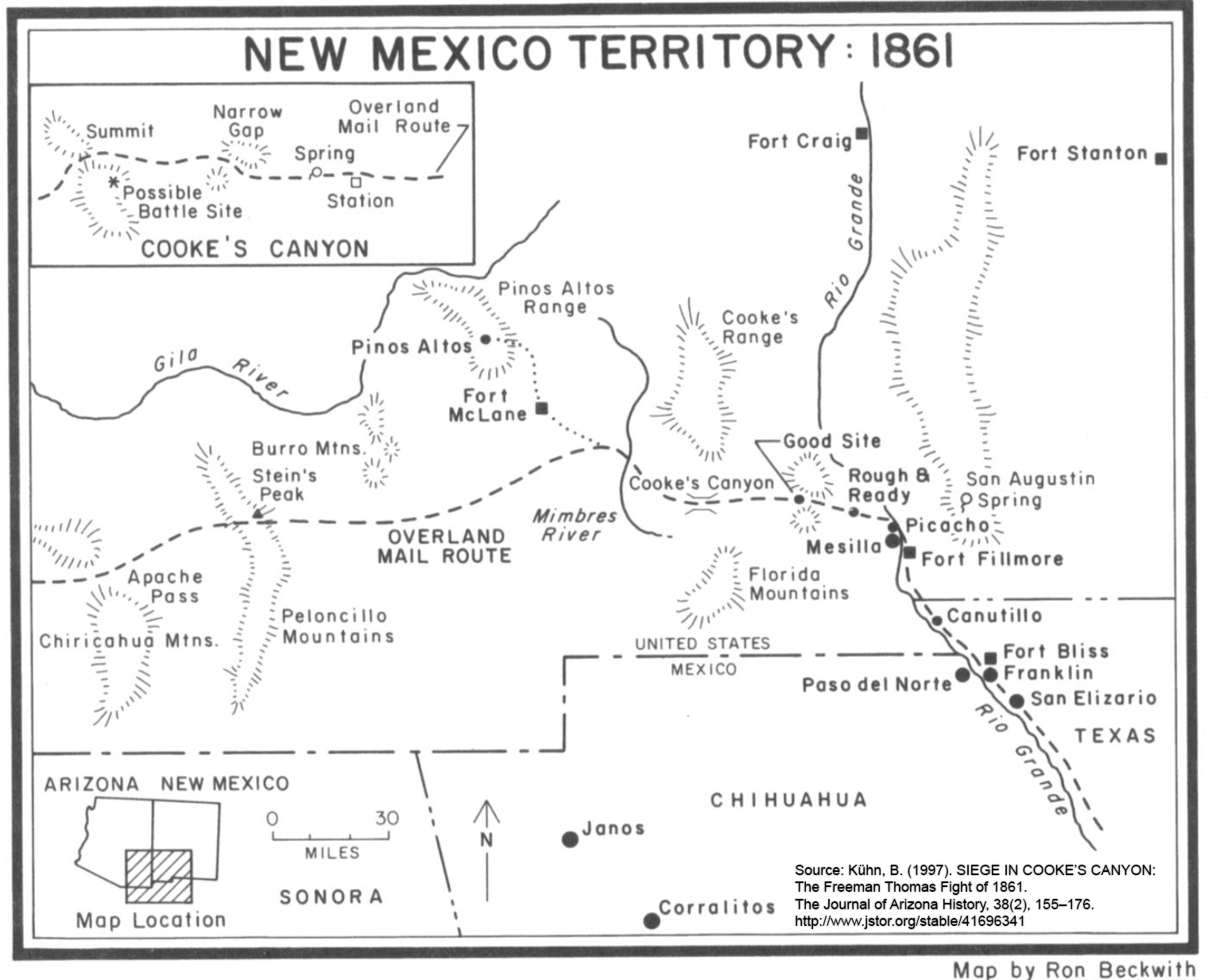
On the morning of March 8, 1857, eight Chiricahua Apaches ran off the horses of an American deputy surveyor, John Wesley Garretson, near the Rio Grande and reported the theft to the garrison of Fort Fillmore. First Lieutenant Alfred Gibbs of the Regiment of Mounted Riflemen took sixteen men and two armed civilians — Garretson and a guide named Dickens — and struck the Apache trail, which crossed the Rio Grande about ten miles north of Doña Ana and bent away to the northwest toward the Mimbres Mountains. What followed, a day later at Cooke’s Spring, was a hard little running fight that nearly cost Gibbs his life.
The Trail from Fort Fillmore
The theft was a common enough spark on the frontier. Garretson, deputy surveyor of the territory, lost his stock to a small Chiricahua party and carried word to Fort Fillmore, the post on the Rio Grande below Las Cruces. Gibbs was ordered out at once. With his detachment of the Mounted Riflemen and the two civilian guides, he took up a trail that crossed the river north of Doña Ana and led steadily northwest into the broken country toward the Mimbres. He pushed the pursuit through the night and into the next day, and by noon on the 9th his scouts found the place where the Apaches had halted to rest their animals — seven warriors in all, some mounted and some on foot, close under the mountains where a hunted man might yet slip away.
The Fight at the Spring
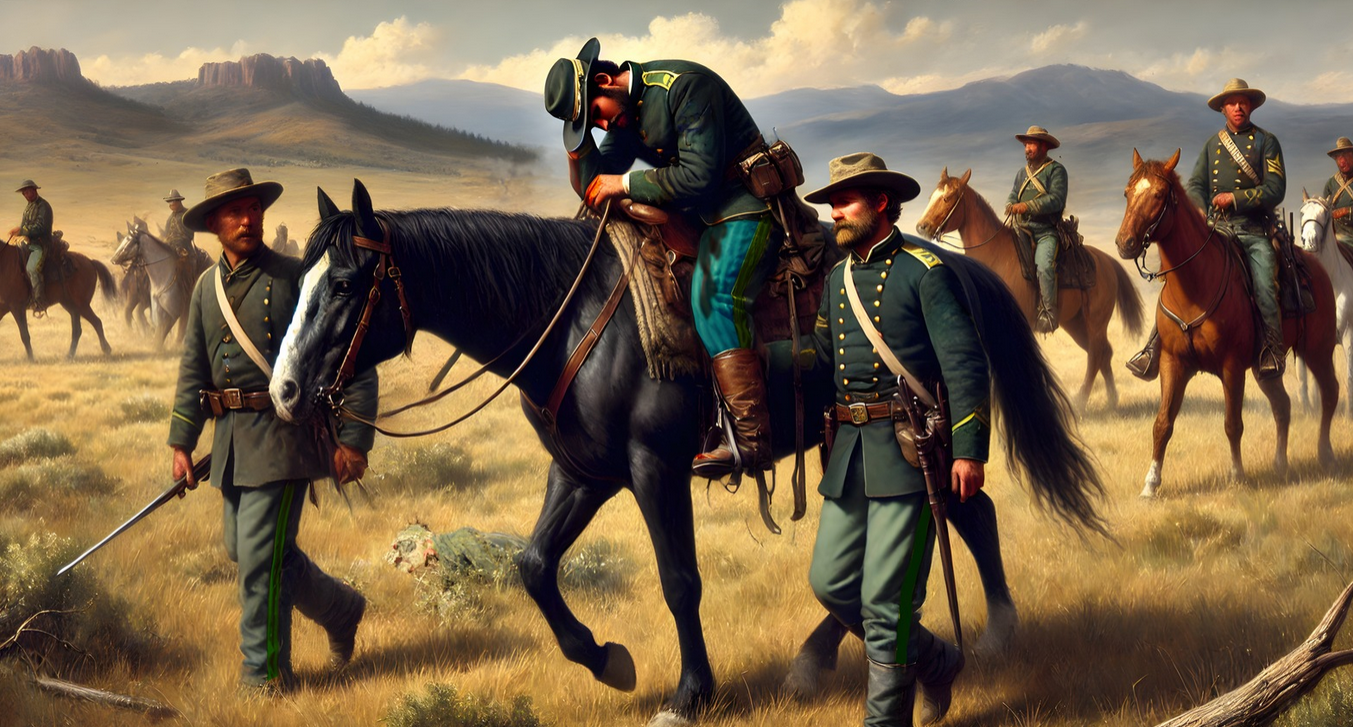
About half past one that afternoon the soldiers came in sight of the Apaches at Cooke’s Spring, an arroyo a mile out from the foot of the range. One warrior was advancing to meet them; the rest, with the stolen mules, broke into a run. Gibbs dismounted his men, loosed a volley from the rifles, then remounted and drove after the fleeing party at a gallop. The Apache leader — badly wounded early in the fight — refused to quit, rallying his warriors and wheeling them back in furious counter-charges whenever the troopers closed. The chase ran on toward the high ground, the fight scattering across a mile of open desert.
“Ascending a little rise, we saw an Indian about fifty yards off coming to meet us, and at the same moment we saw the mules at the bottom of a little arroyo and six Indians looking at us and then beginning to run. The men were immediately dismounted and we commenced on them with rifles. As fast as the rifles were discharged, the men loaded and mounted, and followed at a gallop the Indians, who ran like wild turkeys. … As we rode on, the chief who was badly wounded, kept encouraging his men, whenever he did this they turned and charged us furiously. As I passed near him, he was making at one of the men on foot, whose horse had been shot, and I stopped and shot him a fifth shot with my revolver. He turned on me, and as my horse reared, he passed his lance into me although parried with my pistol. One of the men then brought him down. … Here, becoming very faint from loss of blood, I dismounted to prevent from falling off, and giving my horse to Corporal Collins, whose horse had been shot from under him, directed him to keep up with the party, until he killed all the Indians, or until the pursuit was hopeless. … I found the chief dead with ten balls in him.”— 1st Lt. Alfred Gibbs, Regiment of Mounted Riflemen, in his report of the action at Cooke’s Spring, March 1857, as preserved in Edwin R. Sweeney, Mangas Coloradas (1998), p. 350.
The Duel and the Wound
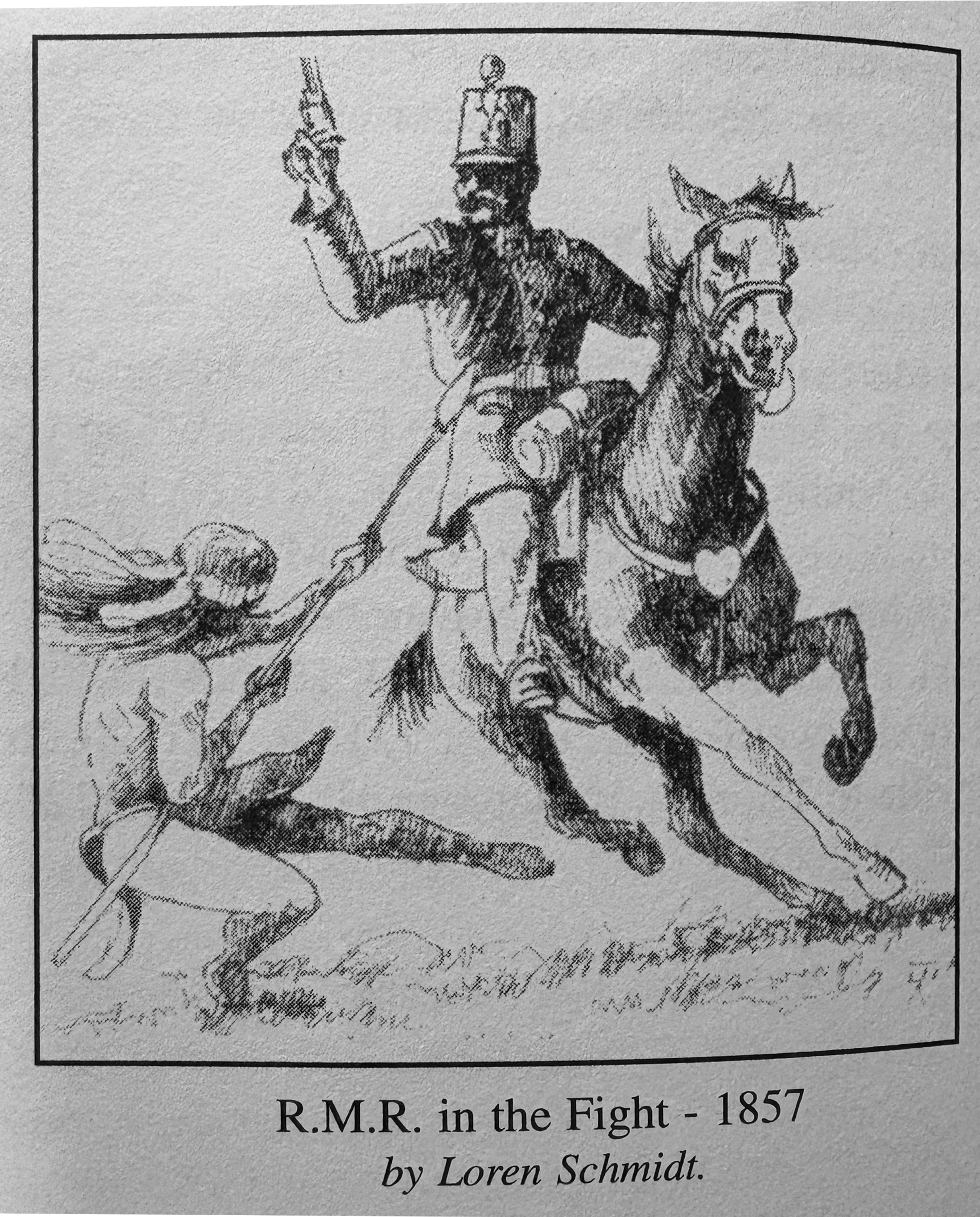
The climax was the meeting of the two leaders. As Gibbs spurred to save a dismounted corporal, he closed with the wounded chief and shot him a fifth time; the Apache drove a lance into the lieutenant’s side, the thrust turned partly aside by Gibbs’s pistol and his right arm, before a trooper finally brought the chief down. He was found dead with ten balls in him. Faint from loss of blood and unwilling to fall from the saddle, Gibbs handed his own horse to Corporal Collins — whose mount had been shot — and sent him on to finish the pursuit. The troopers ran the surviving Apaches down at the foothills and killed five more; one badly wounded warrior escaped and was thought to have died. Gibbs was the only American hurt. Garretson recovered his stock, and the command took a horse, five mules, and the abandoned arms and gear of the raiders. The young lieutenant lived to recover — and, seven years on, to lead the First New York Dragoons as a Union brigadier.
The Wound Itself
Gibbs’s own report gives the lance one clause: “he passed his lance into me although parried with my pistol.” The men who treated him gave it pages. What follows is the wound as the surgeons described it, from the papers of the widow’s pension claim filed after his death in 1868, and it is the reason this small fight matters so much to the rest of his life. The lieutenant who rode out of Fort Fillmore on March 8, 1857 was not the same man who rode back.
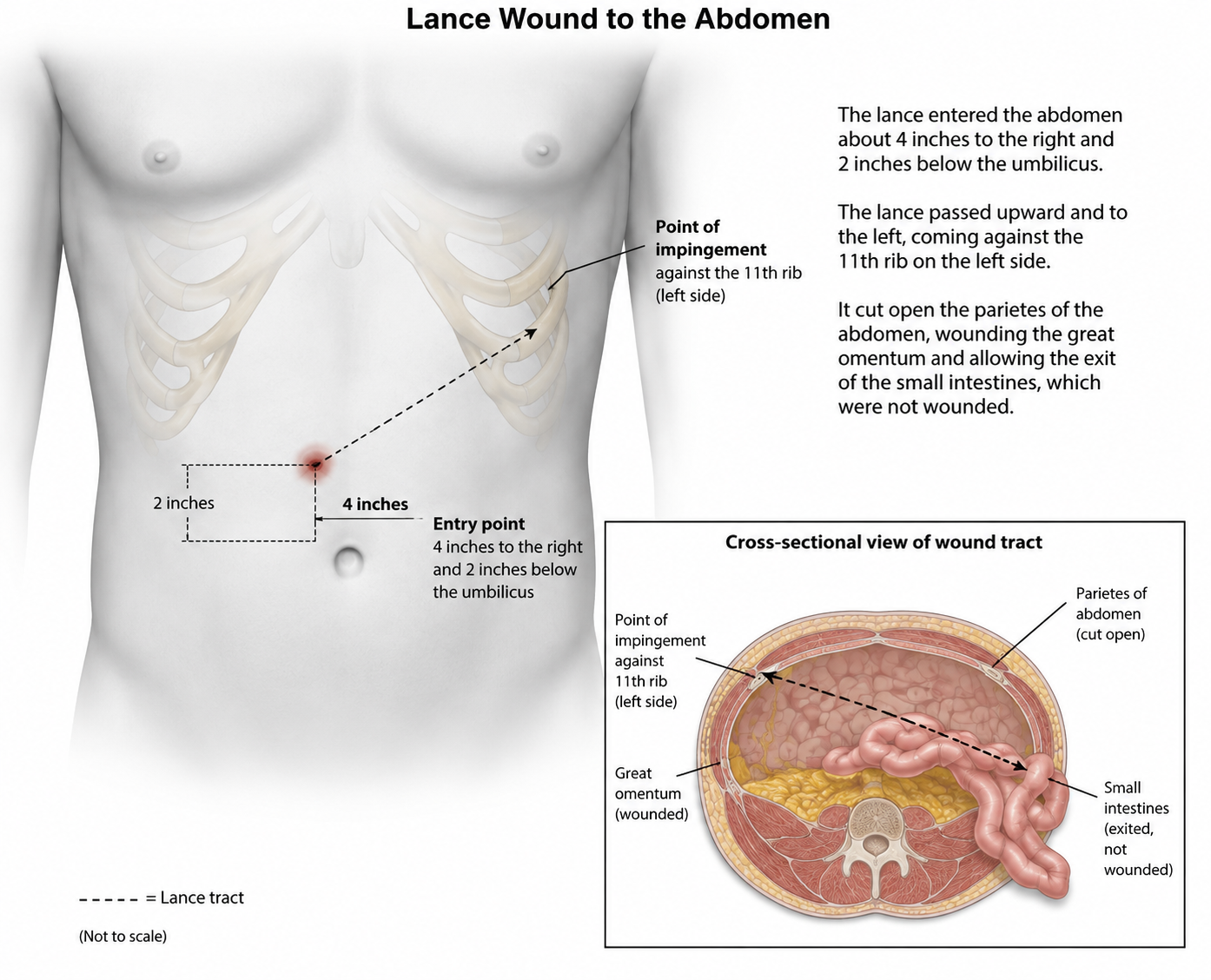
The Apache’s thrust came upward as Gibbs’s horse reared, which is why the point slipped along the rib instead of going through him. That deflection, and the pistol he parried with, are what he had to thank for his life. Everything else went against him. He lay on the ground at Cooke’s Spring for fifteen hours before a surgeon reached him, with his bowels outside his body, and was then carried twelve hours back across open country to the post. In 1857 there was no way to repair such a wound from the inside. The surgeon could only put back what had come out, close the cut, and keep him absolutely still.
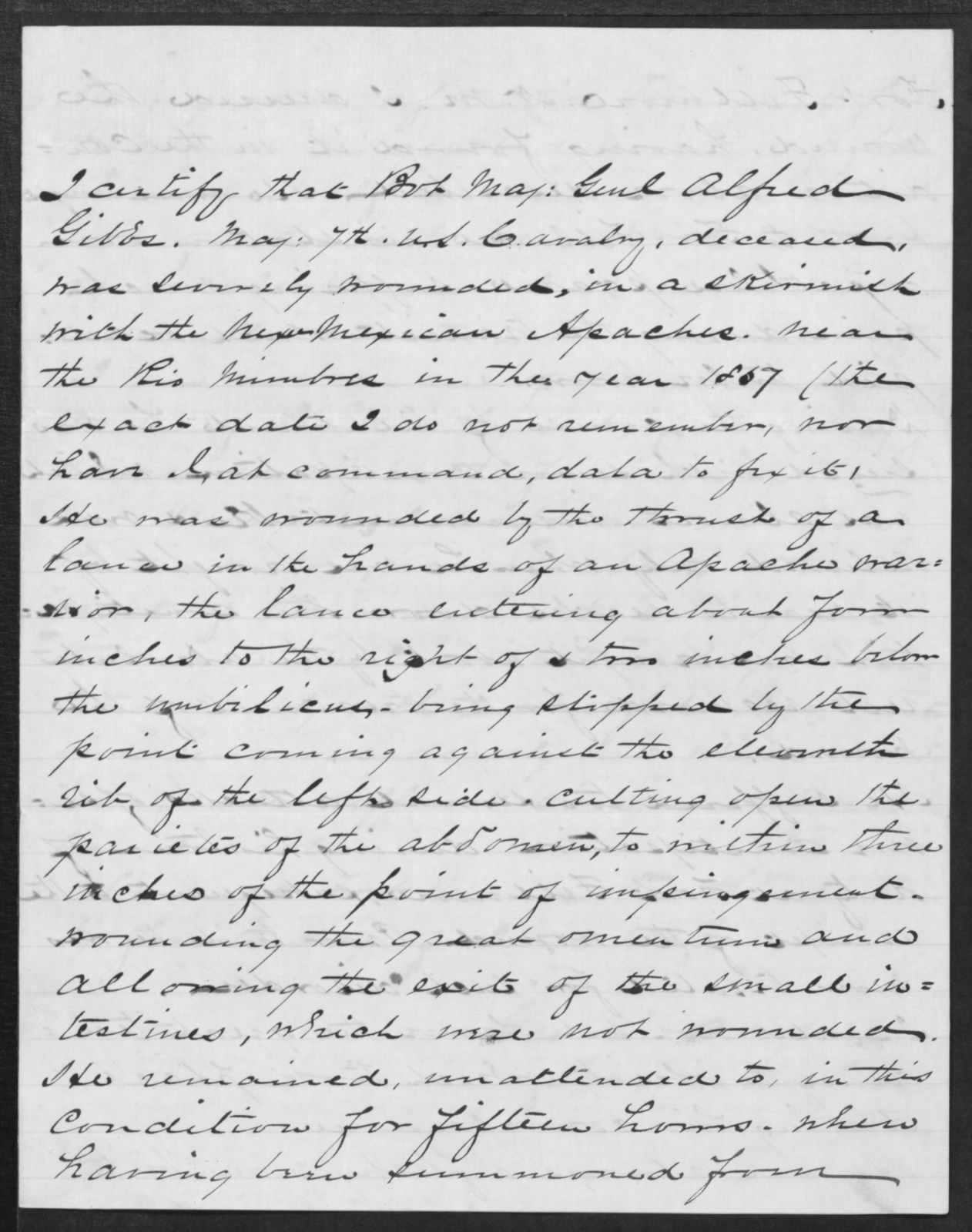
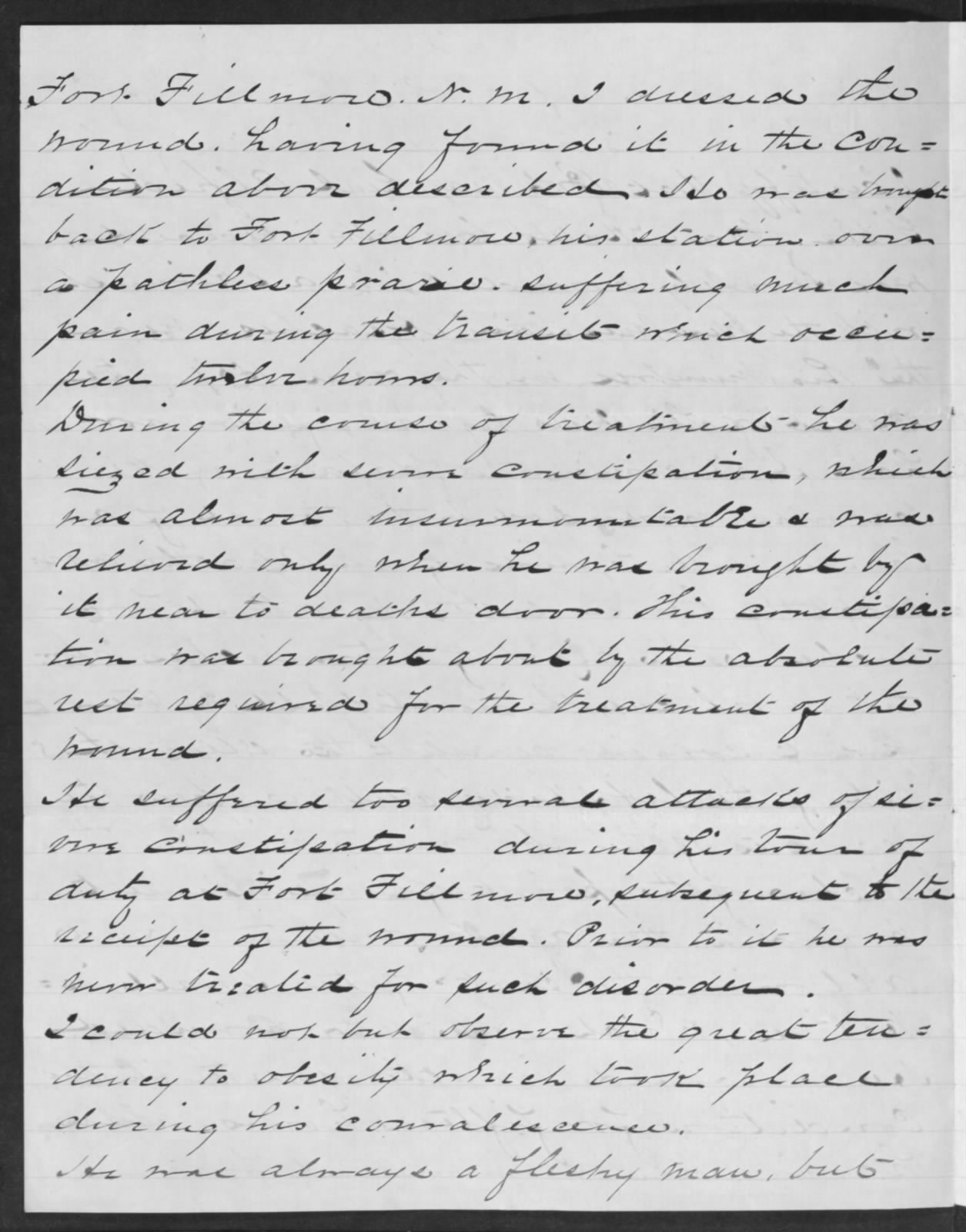
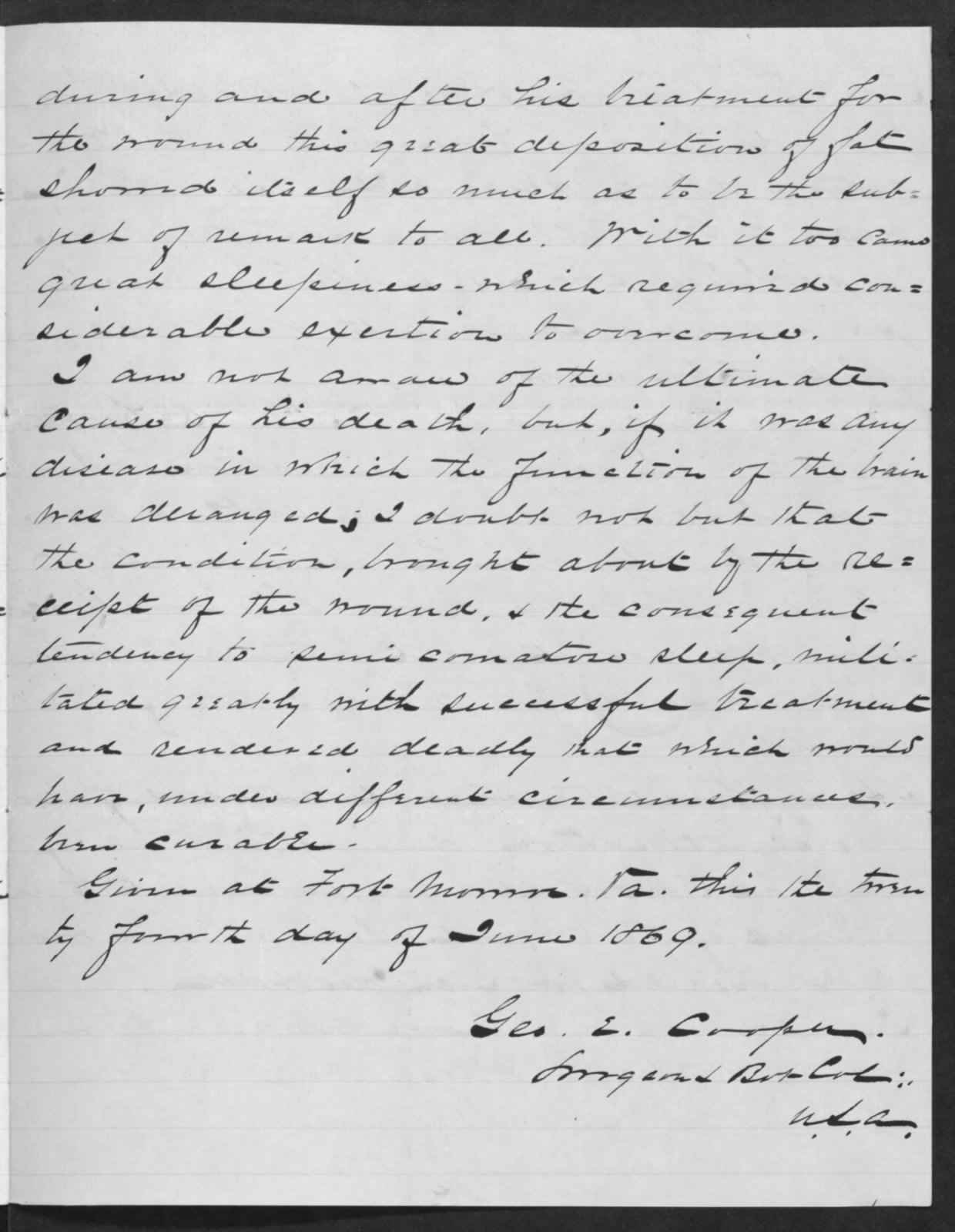
Transcribed exactly as written; the surgeon’s spelling and punctuation are kept. Click any sheet to read the original, or read the whole file, sheet by sheet, on Peggy Gibbs’s page.
I certify that Bvt. Maj: Genl. Alfred Gibbs. Maj: 7th. U.S. Cavalry, deceased, was severely wounded, in a skirmish with the New Mexican Apaches. near the Rio Mimbres in the year 1857 (the exact date I do not remember, nor have I, at command, data to fix it).
He was wounded by the thrust of a lance in the hands of an Apache warrior, the lance entering about four inches to the right of & two inches below the umbilicus, being slipped by the point coming against the eleventh rib of the left side, cutting open the parietes of the abdomen, to within three inches of the point of impingement, wounding the great omentum and allowing the exit of the small intestines, which were not wounded.
He remained, unattended to, in this condition for fifteen hours, when having been summoned from Fort Fillmore. N.M. I dressed the wound, having found it in the condition above described. He was brought back to Fort Fillmore, his station, over a pathless prairie, suffering much pain during the transit which occupied twelve hours.
During the course of treatment he was siezed [sic] with severe constipation, which was almost insurmountable & was relieved only when he was brought by it near to death’s door. This constipation was brought about by the absolute rest required for the treatment of the wound.
He suffered too several attacks of severe constipation during his tour of duty at Fort Fillmore, subsequent to the receipt of the wound. Prior to it he was never treated for such disorder.
I could not but observe the great tendency to obesity which took place during his convalescence. He was always a fleshy man, but during and after his treatment for the wound this great deposition of fat showed itself so much as to be the subject of remark to all. With it too came great sleepiness, which required considerable exertion to overcome.
I am not aware of the ultimate cause of his death, but, if it was any disease in which the function of the brain was deranged, I doubt not but that the condition, brought about by the receipt of the wound, & the consequent tendency to semi comatose sleep, militated greatly with successful treatment and rendered deadly that which would have, under different circumstances, been curable.
Given at Fort Monroe. Va. this the twenty fourth day of June 1869.
Geo. E. Cooper.
Surgeon & Bvt Col.
U.S.A.
Cooper knew this patient better than most. Five months before the fight he had delivered the Gibbses’ first son at Fort Fillmore, and it was to him that the Pension Office turned, twelve years later, for the medical facts. Notice what he does at the end of the certificate: he refuses to name a cause of death he did not witness, and then says plainly that the wound had left Gibbs a man who could not be treated like other men. He has a page of his own on this site.
The lance wound was not an episode. It was a condition Gibbs carried for the remaining eleven years of his life, through the whole of his Civil War service. Benjamin T. Kneeland, surgeon of the First New York Dragoons, examined the scar repeatedly while Gibbs commanded the regiment and the brigade, and swore to what he found in October 1869:
in my opinion during the healing of the wound the intestinal peritoneum became involved in the cicatrix by what is called adhesive inflammation; that in consequence of this condition of cicatrix there was under any violent exertion or strain great danger of rupture of the union of said wound and fatal consequences. I was informed that such rupture had more than once taken place, producing great loss of blood and other dangerous symptoms. I know that during the last twenty months of the war he was compelled to use an India rubber support when on active duty.
When the malarial fevers of the Virginia campaigns struck, Kneeland wrote, the attacks “were far more dangerous on account of this old wound. During such attacks I was obliged to strongly bandage the abdomen to prevent rupture by vomiting.” The wound kept Gibbs from the hard exercise that might have controlled his weight, and it was in that state, on foot and on the run at Trevilian Station on June 11, 1864, that he was sunstruck and fell senseless. Kneeland’s conclusion, sworn under oath: “the effect of the sunstroke and of his lance wound, aggravated by malarious disease contracted in the service were the causes of his death.” The word “probable” had stood before “causes”; he struck it out before he signed.
Dr. W. H. Van Buren of New York, who treated Gibbs near the end of the war “for a wound, from the effects of which he was still suffering,” told him that getting out of malarial country was “an absolute necessity.” The Army did not let him go. Even the historians who have been hardest on Gibbs’s later career concede the point: “Poor health, the result of an Apache lance wound sustained near Cooke’s Spring, N.M., in March 1857, kept him in garrison more than the field” (Barnitz & Barnitz, 1977). Kneeland’s and Van Buren’s sworn statements are reproduced in full among sheets 47 to 53 of the pension file on Peggy Gibbs’s page, and the argument they support is made at length in In Defense of Alfred Gibbs.
The Man Behind the Story
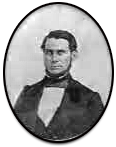
The horses belonged to John Wesley Garretson, deputy surveyor of the territory, who rode in the pursuit himself. His story, and the events of that March day, are drawn from Gibbs’s own report and from the historians who preserved it.
Watch & Listen
Sources & Further Reading
- Primary 1st Lt. Alfred Gibbs’s own report of the action at Cooke’s Spring, March 1857 — quoted verbatim above. Preserved in Edwin R. Sweeney, Mangas Coloradas: Chief of the Chiricahua Apaches (Norman: University of Oklahoma Press, 1998), p. 350: archive.org/details/mangascoloradasc0000swee.
- Primary Surgeon George E. Cooper’s certificate describing the lance wound, Fort Monroe, Va., June 24, 1869, and the affidavits of Surgeon Benjamin T. Kneeland (Nunda, N.Y., October 16, 1869) and Dr. W. H. Van Buren (New York, May 19, 1869), in the widow’s pension file of Peggy F. Gibbs, certificate WC 137,047 (application 176,627), Records of the Department of Veterans Affairs, Record Group 15, National Archives, Washington, D.C.; sheets 40 to 42 and 47 to 53, reproduced and transcribed on Peggy Foushee Blair (Wife & Mother).
- Albert Barnitz and Jennie Barnitz, Life in Custer’s Cavalry: Diaries and Letters of Albert and Jennie Barnitz, 1867–1868, ed. Robert M. Utley (New Haven: Yale University Press, 1977), on the lasting effect of the Cooke’s Spring wound.
- Robert W. Wadsworth, Forgotten Fortress: Fort Millard Fillmore and Antebellum New Mexico, 1851–1862 (Las Cruces: Yucca Tree Press, 2002), p. 186 — on the Fort Fillmore garrison and this action.
- “Battle of Cooke’s Spring,” Wikipedia (overview of the 1857 skirmish, drawn largely from Sweeney): en.wikipedia.org/wiki/Battle_of_Cooke’s_Spring.
- Distinct event On the later and unrelated Cooke’s Canyon fight of July 1861 (the Freeman Thomas party), see Berndt Kuhn, “Siege in Cooke’s Canyon: The Freeman Thomas Fight of 1861” (1997): Khn-SIEGECOOKESCANYON-1997.pdf.
Views: 149
Explore the evidence
View this article’s connected sources and media →
About this page
This article was brought over from AlfredGibbs.com. Its preserved text, media and citations remain available for comparison.