
Home › Special Collections › Surgeon George E. Cooper
Two of the oldest claims on this site rest on one man’s word. That Alfred Gibbs’s elder son was born at Fort Fillmore in October 1856, and that Gibbs survived an Apache lance through the abdomen five months later, are both attested by George E. Cooper, Surgeon, United States Army — and by nobody else. He was the post surgeon there, and he was in the room both times.
Until August 2026 he was a signature at the foot of two affidavits. This page gathers what the record actually says about him.
What He Swore
Widow’s Certificate 137,047 · sworn 1869 and 1875
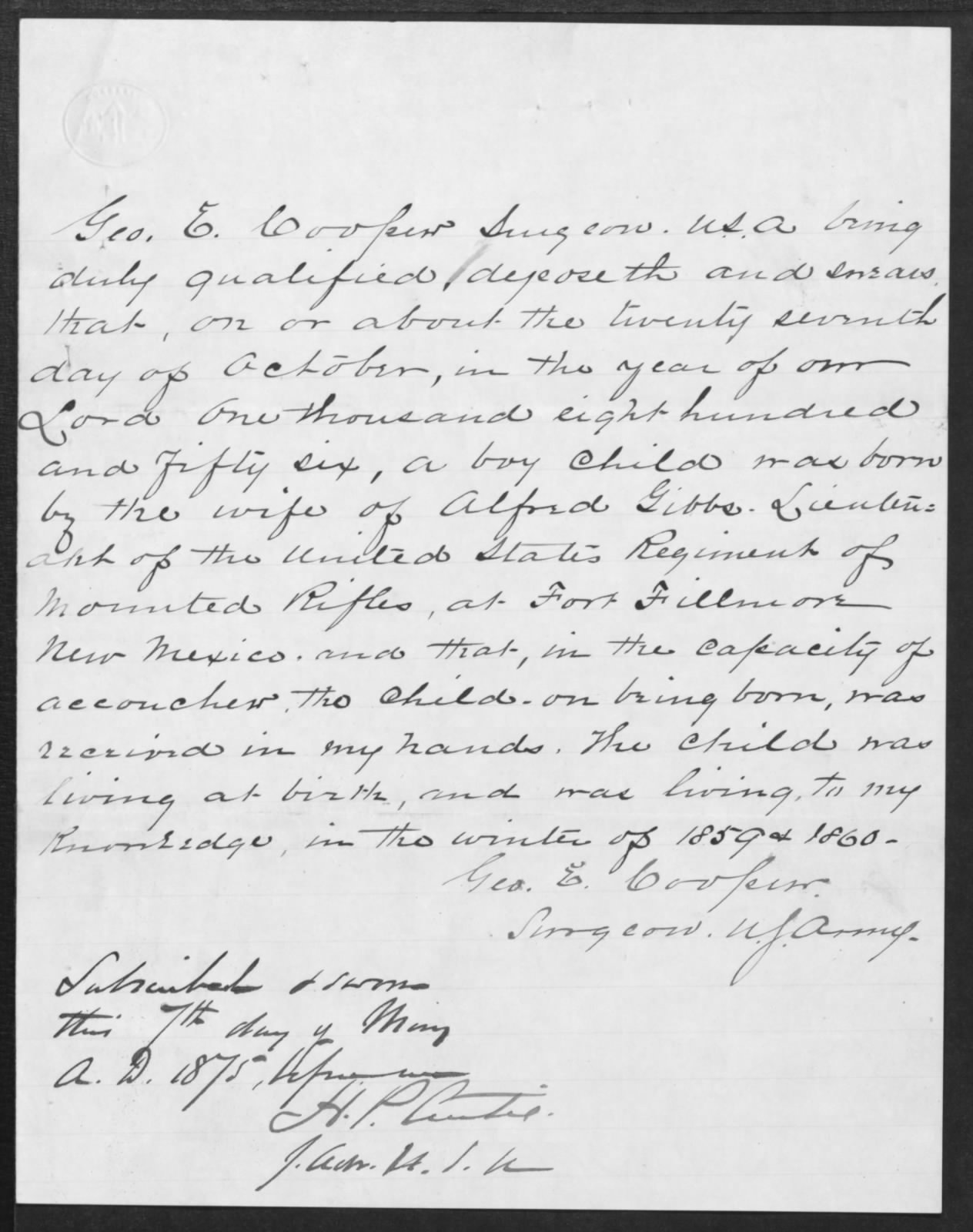
Cooper appears four times in Peggy Gibbs’s widow’s pension file. The first is the birth. He swore it on 7 May 1875, nineteen years after the fact:
“on or about the twenty seventh day of October, in the year of our Lord One thousand eight hundred and fifty six, a boy child was born by the wife of Alfred Gibbs, Lieutenant of the United States Regiment of Mounted Rifles, at Fort Fillmore New Mexico. and that, in the capacity of accoucheur, the child, on being born, was received in my hands. The child was living at birth, and was living, to my knowledge, in the winter of 1859 & 1860.”
Geo. E. Cooper, Surgeon U.S. Army, sworn 7 May 1875 · sheet 19
The child was Alfred Wolcott Gibbs, who grew up to be chief mechanical engineer of the Pennsylvania Railroad.
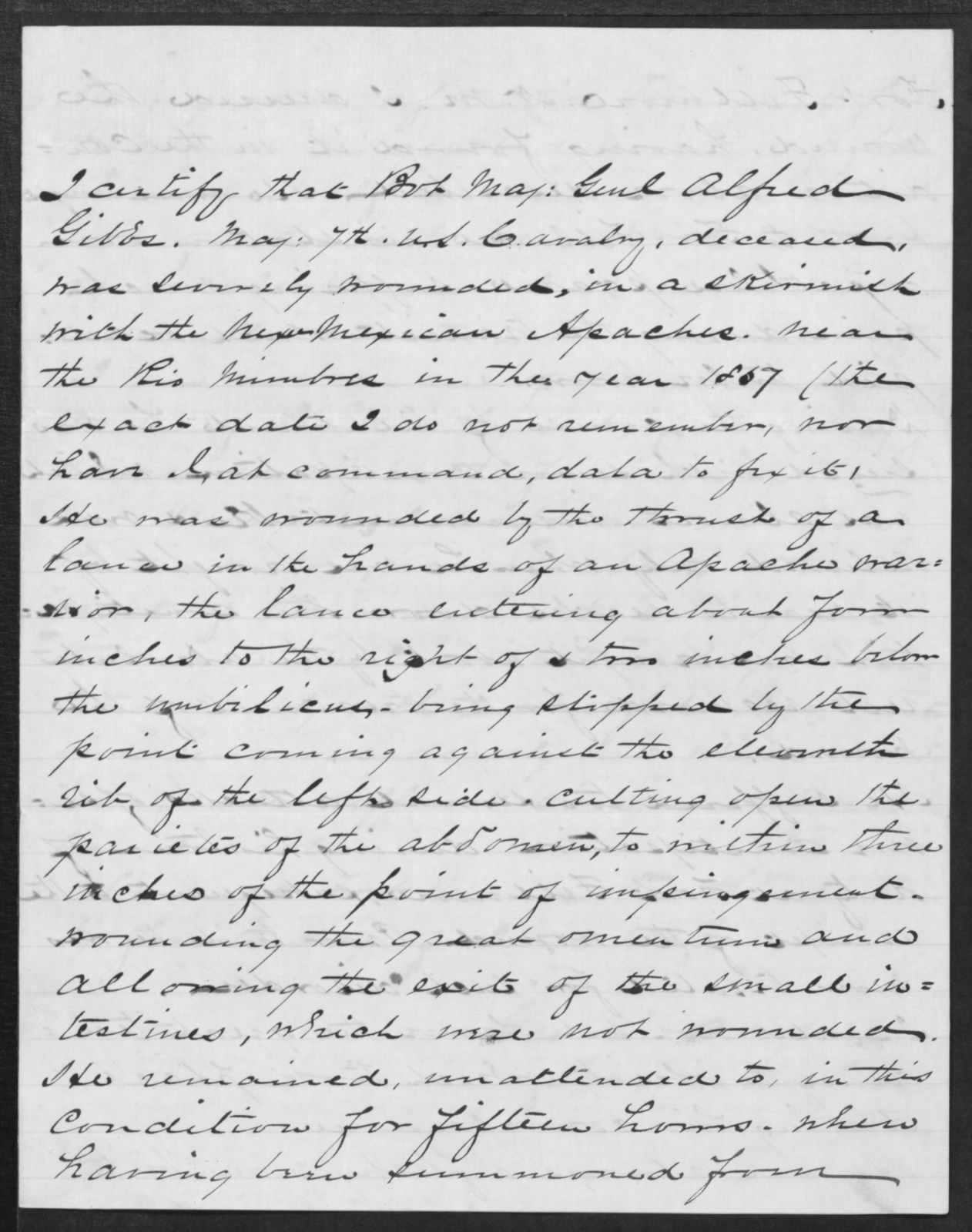
The second is the wound. Writing from Fort Monroe on 24 June 1869, Cooper gave the Pension Office an anatomical account of what an Apache lance had done to Gibbs near the Rio Mimbres on 19 March 1857 — the fight at Cooke’s Spring:
“He was wounded by the thrust of a lance in the hands of an Apache warrior, the lance entering about four inches to the right of & two inches below the umbilicus, being slipped by the point coming against the eleventh rib of the left side, cutting open the parietes of the abdomen … wounding the great omentum and allowing the exit of the small intestines, which were not wounded. He remained, unattended to, in this condition for fifteen hours, when having been summoned from Fort Fillmore. N.M. I dressed the wound.”
Geo. E. Cooper, Surgeon & Bvt Col. U.S.A., Fort Monroe, 24 June 1869 · sheets 40–42
He then had Gibbs carried back to the post “over a pathless prairie, suffering much pain during the transit which occupied twelve hours.” Cooper also recorded what the wound left behind: the enforced rest brought on a constipation that took Gibbs “near to death’s door,” and the convalescence brought “great tendency to obesity” and a heavy sleepiness. That is the origin of the stout, drowsy figure Elizabeth Custer would describe a decade later on the plains.
The Career
Heitman’s official register, quoted verbatim
Cooper, George E. Pa. Pa. Asst surg 28 Aug 1847; maj surg 21 May 1861; col med dir 25 Feb to 30 June 1865; lt col asst med pur 2 Dec 1876; bvt lt col 1 Sept 1864 and col 13 Mar 1865 for fai and mer ser dur the war; died 13 Apr 1881.
Heitman, Historical Register and Dictionary of the United States Army, Vol. 1 (1903)
A Pennsylvanian, commissioned into the Medical Department in 1847 and still serving when he died thirty-four years later.
- 1847 Assistant Surgeon, 28 August.
- c. 1854 Fort Duncan, Texas, on the Rio Grande near Eagle Pass.
- 1856–57Post surgeon, Fort Fillmore, New Mexico. Delivers Gibbs’s son in October 1856; dresses the lance wound in March 1857.
- 1861 Major and Surgeon, 21 May.
- 1864Medical Director, Department of the Cumberland. His campaign report runs from the first week of May to the fall of Atlanta. Brevet lieutenant colonel dated 1 September 1864, the day the city fell.
- 1865 Colonel and Medical Director, February to June. Brevet colonel, 13 March.
- 1866–69Fort Monroe, where he succeeds John J. Craven as Jefferson Davis’s physician, and where he signs the Gibbs lance-wound certificate in 1869.
- 1875 Cited as an authority on hospital railway transport.
- 1876 Lieutenant Colonel and Assistant Medical Purveyor, Philadelphia.
- 1881 Died 13 April.
In His Own Voice, Before Fort Fillmore
The Surgeon General’s Statistical Report, 1856
Before New Mexico he was at Fort Duncan in Texas, and his quarterly report found its way into the Army’s published medical statistics. It is the only place in this archive where he writes about something other than a patient:
“when good and comfortable quarters shall have been erected, this post will be the most healthy, as it is now the most beautiful, post on the Rio Grande.”
Asst. Surgeon George E. Cooper, Fort Duncan, in Statistical Report on the Sickness and Mortality in the Army of the United States (1856)
The compiler adds that his troops “suffered much from alternate exposure to drenching rains and excessive heat,” and that the prevailing diseases were remittent fever and diarrhoea. They are the same complaints he would be treating for the rest of his career, and the same ones that killed Gibbs.
Jefferson Davis’s Physician
Fort Monroe, 1866–67
When Dr. John J. Craven was removed as the imprisoned Davis’s physician — Craven went on to publish Prison Life of Jefferson Davis — the regular army surgeon who replaced him was Cooper.
“Dr. George Cooper, the regular army surgeon who replaced Craven …”
Felicity Allen, Jefferson Davis, Unconquerable Heart (1999)
Allen’s account has him writing weekly reports on his patient, speaking “over and over” of Davis’s debility, prescribing quinine, and arguing that “air and exercise” were what the man needed. It also preserves the remark he made to Varina Davis on her second visit to the prison, which says something about the household he went home to:
“My wife is the damnedest Rebel out, except yourself.”
Dr. Cooper to Varina Davis, in Allen, Jefferson Davis, Unconquerable Heart
A note on the initial
Surgeon General Tebault’s 1910 report to the United Confederate Veterans names Craven’s successor as “Dr. George F. Cooper.” Every other source, including Allen and the Army register, gives E. The weight of the evidence is that Tebault mistyped an initial, and that Gibbs’s surgeon and Davis’s surgeon are the same man. It is recorded here rather than smoothed over.
Two Men He Is Not
James Graham Cooper (1830–1902)
Acting Assistant Surgeon and a well-known ornithologist, the subject of a chapter in Hume’s Ornithologists of the United States Army Medical Corps. Hume records him assigned to Fort Fillmore in 1851, which makes him easy to mistake for ours. Different man.
James Cooper McKee, M.D.
The Fort Fillmore surgeon at the surrender of July 1861, who wrote the narrative this archive reproduces in full. “Cooper” is his middle name. He came to the post years after George E. Cooper left it. See James Cooper McKee, M.D.
What Is Still Open
Wanted
- A birth year. Heitman gives none, and no obituary has yet been found. He was commissioned in 1847, so he was born around 1820–25.
- His exact New Mexico dates. The pension file fixes him at Fort Fillmore in October 1856 and March 1857. The monthly post returns (NARA M617) would give arrival and departure.
- Whether he was at San Augustine Springs. Probably not — he was commissioned major surgeon on 21 May 1861 and McKee was the post surgeon by then — but it should be checked rather than assumed.
- The Fort Monroe records themselves, to put the Davis attendance beyond the reach of a mistyped initial.
Allen, F. (1999). Jefferson Davis, unconquerable heart. University of Missouri Press.
Case file of the approved pension application of Peggy F. Blair Gibbs, widow of Alfred Gibbs. Widow’s Certificate 137,047, Record Group 15, National Archives. Reproduced in full at Peggy Foushee Blair Gibbs.
Heitman, F. B. (1903). Historical register and dictionary of the United States Army (Vol. 1). Government Printing Office.
Otis, G. A. (1875). A report on a plan for transporting wounded soldiers by railway. Government Printing Office.
United States Army, Surgeon General’s Office. (1856). Statistical report on the sickness and mortality in the Army of the United States. A. O. P. Nicholson.
Page created 6 August 2026 from documents in this archive. Where a fact is not yet proven it is marked open above, not asserted.
Views: 13
Explore the evidence
View this article’s connected sources and media →
About this page
This article was brought over from AlfredGibbs.com. Its preserved text, media and citations remain available for comparison.