
Wisconsin manuscript
PRINTED JOURNAL, Science Vol. LVIII No. 1495 · 1923-08-24
lead article "J. Willard Gibbs and His Contribution to Chemistry" by Dr. Frederick H. Getman; Josiah Willard Gibbs born New Haven 11 February 1839; "descended from Robert Gibbs, the fourth son of Sir Henry Gibbs, of Honington, Warwickshire, who came to this country and settled in Boston in 1658"; "No fewer than six of the descendants of this couple have borne the name Josiah Willard Gibbs"
Wisconsin Historical Society, Gibbs Family Papers, U.S. Mss Y, Micro 1117
Reel 3, frames 504, 505, 506, 507, 508, 509, 510
Reel 3, frame 509
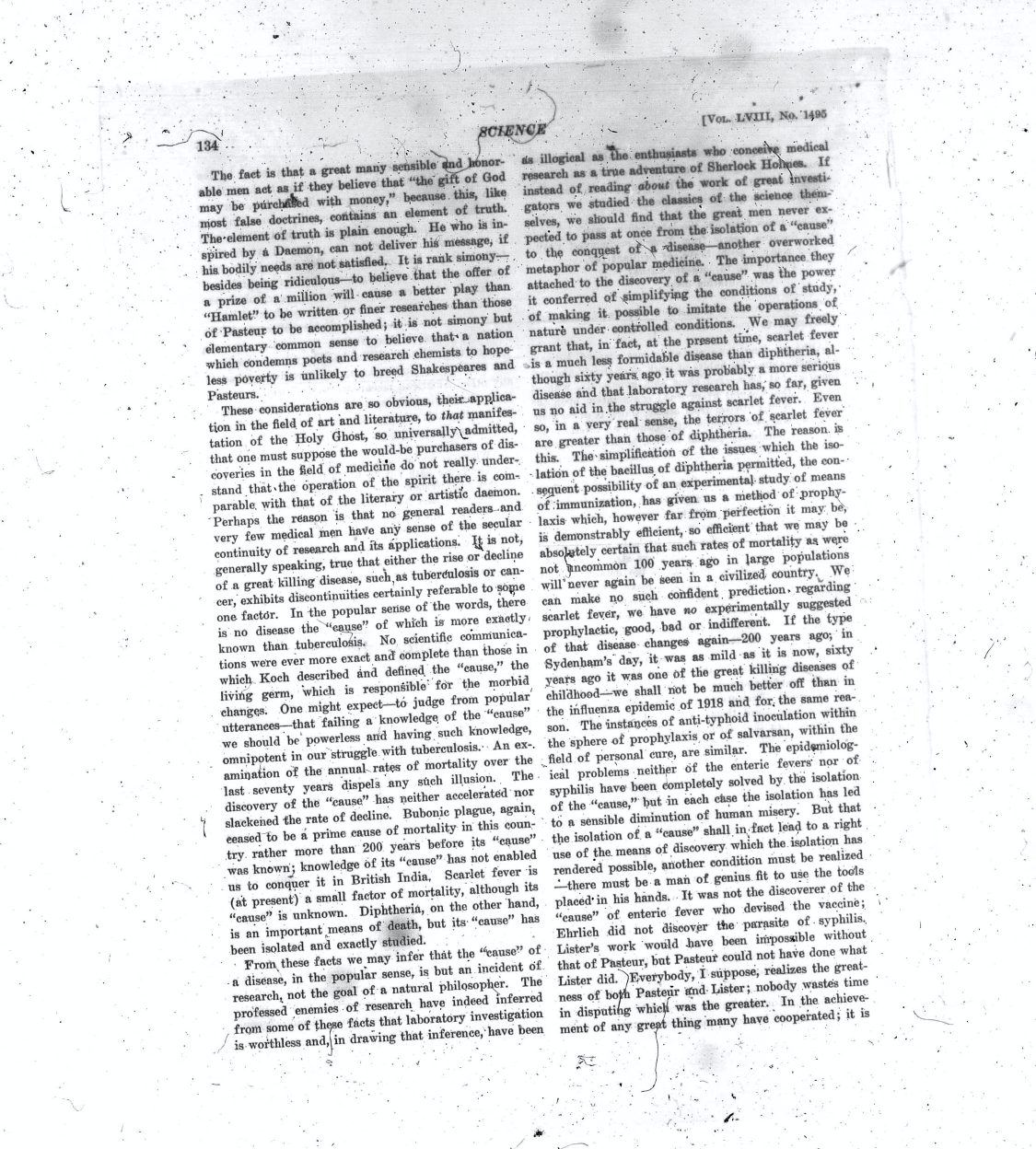
Read beside the scan
AI first transcription from the evidence pack; not independently verified. Compare with the scan.
[printed: running head] 134 SCIENCE [Vol. LVIII, No. 1495
The fact is that a great many sensible and honor-
able men act as if they believe that "the gift of God
may be purchased with money," because this, like
most false doctrines, contains an element of truth.
The element of truth is plain enough. He who is in-
spired by a Daemon, can not deliver his message, if
his bodily needs are not satisfied. It is rank simony—
besides being ridiculous—to believe that the offer of
a prize of a million will cause a better play than
"Hamlet" to be written or finer researches than those
of Pasteur to be accomplished; it is not simony but
elementary common sense to believe that a nation
which condemns poets and research chemists to hope-
less poverty is unlikely to breed Shakespeares and
Pasteurs.
These considerations are so obvious, their applica-
tion in the field of art and literature, to *that* manifes-
tation of the Holy Ghost, so universally admitted,
that one must suppose the would-be purchasers of dis-
coveries in the field of medicine do not really under-
stand that the operation of the spirit there is com-
parable with that of the literary or artistic daemon.
Perhaps the reason is that no general readers and
very few medical men have any sense of the secular
continuity of research and its applications. It is not,
generally speaking, true that either the rise or decline
of a great killing disease, such as tuberculosis or can-
cer, exhibits discontinuities certainly referable to some
one factor. In the popular sense of the words, there
is no disease the "cause" of which is more exactly
known than tuberculosis. No scientific communica-
tions were ever more exact and complete than those in
which Koch described and defined the "cause," the
living germ, which is responsible for the morbid
changes. One might expect—to judge from popular
utterances—that failing a knowledge of the "cause"
we should be powerless and having such knowledge,
omnipotent in our struggle with tuberculosis. An ex-
amination of the annual rates of mortality over the
last seventy years dispels any such illusion. The
discovery of the "cause" has neither accelerated nor
slackened the rate of decline. Bubonic plague, again,
ceased to be a prime cause of mortality in this coun-
try rather more than 200 years before its "cause"
was known; knowledge of its "cause" has not enabled
us to conquer it in British India. Scarlet fever is
(at present) a small factor of mortality, although its
"cause" is unknown. Diphtheria, on the other hand,
is an important means of death, but its "cause" has
been isolated and exactly studied.
From these facts we may infer that the "cause" of
a disease, in the popular sense, is but an incident of
research, not the goal of a natural philosopher. The
professed enemies of research have indeed inferred
from some of these facts that laboratory investigation
is worthless and, in drawing that inference, have been
as illogical as the enthusiasts who conceive medical
research as a true adventure of Sherlock Holmes. If
instead of reading *about* the work of great investi-
gators we studied the classics of the science them-
selves, we should find that the great men never ex-
pected to pass at once from the isolation of a "cause"
to the conquest of a disease—another overworked
metaphor of popular medicine. The importance they
attached to the discovery of a "cause" was the power
it conferred of simplifying the conditions of study,
of making it possible to imitate the operations of
nature under controlled conditions. We may freely
grant that, in fact, at the present time, scarlet fever
is a much less formidable disease than diphtheria, al-
though sixty years ago it was probably a more serious
disease and that laboratory research has, so far, given
us no aid in the struggle against scarlet fever. Even
so, in a very real sense, the terrors of scarlet fever
are greater than those of diphtheria. The reason is
this. The simplification of the issues which the iso-
lation of the bacillus of diphtheria permitted, the con-
sequent possibility of an experimental study of means
of immunization, has given us a method of prophy-
laxis which, however far from perfection it may be,
is demonstrably efficient, so efficient that we may be
absolutely certain that such rates of mortality as were
not uncommon 100 years ago in large populations
will never again be seen in a civilized country. We
can make no such confident prediction regarding
scarlet fever, we have *no* experimentally suggested
prophylactic, good, bad or indifferent. If the type
of that disease changes again—200 years ago, in
Sydenham's day, it was as mild as it is now, sixty
years ago it was one of the great killing diseases of
childhood—we shall not be much better off than in
the influenza epidemic of 1918 and for the same rea-
son. The instances of anti-typhoid inoculation within
the sphere of prophylaxis or of salvarsan, within the
field of personal cure, are similar. The epidemiolog-
ical problems neither of the enteric fevers nor of
syphilis have been completely solved by the isolation
of the "cause," but in each case the isolation has led
to a sensible diminution of human misery. But that
the isolation of a "cause" shall in fact lead to a right
use of the means of discovery which the isolation has
rendered possible, another condition must be realized
—there must be a man of genius fit to use the tools
placed in his hands. It was not the discoverer of the
"cause" of enteric fever who devised the vaccine;
Ehrlich did not discover the parasite of syphilis.
Lister's work would have been impossible without
that of Pasteur, but Pasteur could not have done what
Lister did. Everybody, I suppose, realizes the great-
ness of both Pasteur and Lister; nobody wastes time
in disputing which was the greater. In the achieve-
ment of any great thing many have cooperated; it is
Citation and provenance
[PRINTED JOURNAL, Science Vol. LVIII No. 1495]. (1923, August 24). Gibbs Family Papers, 1763-1918 (U.S. Mss Y, Micro 1117, Reel 3, frames 504-509). Wisconsin Historical Society Archives, Madison, WI, United States.
Citation details need editorial review.
Historical sources retain their individual rights and credits. A scan’s presence here does not establish unrestricted reuse.
People identified in the source catalog
These are catalog labels. Individual identities and relationships have not all been reviewed.
Where the book uses this document
No quotation has yet been assigned directly to this catalog record. Its individual frames may have separate connections.