
Wisconsin manuscript
PRINTED JOURNAL, Science Vol. LVIII No. 1495 · 1923-08-24
lead article "J. Willard Gibbs and His Contribution to Chemistry" by Dr. Frederick H. Getman; Josiah Willard Gibbs born New Haven 11 February 1839; "descended from Robert Gibbs, the fourth son of Sir Henry Gibbs, of Honington, Warwickshire, who came to this country and settled in Boston in 1658"; "No fewer than six of the descendants of this couple have borne the name Josiah Willard Gibbs"
Wisconsin Historical Society, Gibbs Family Papers, U.S. Mss Y, Micro 1117
Reel 3, frames 504, 505, 506, 507, 508, 509, 510
Reel 3, frame 506
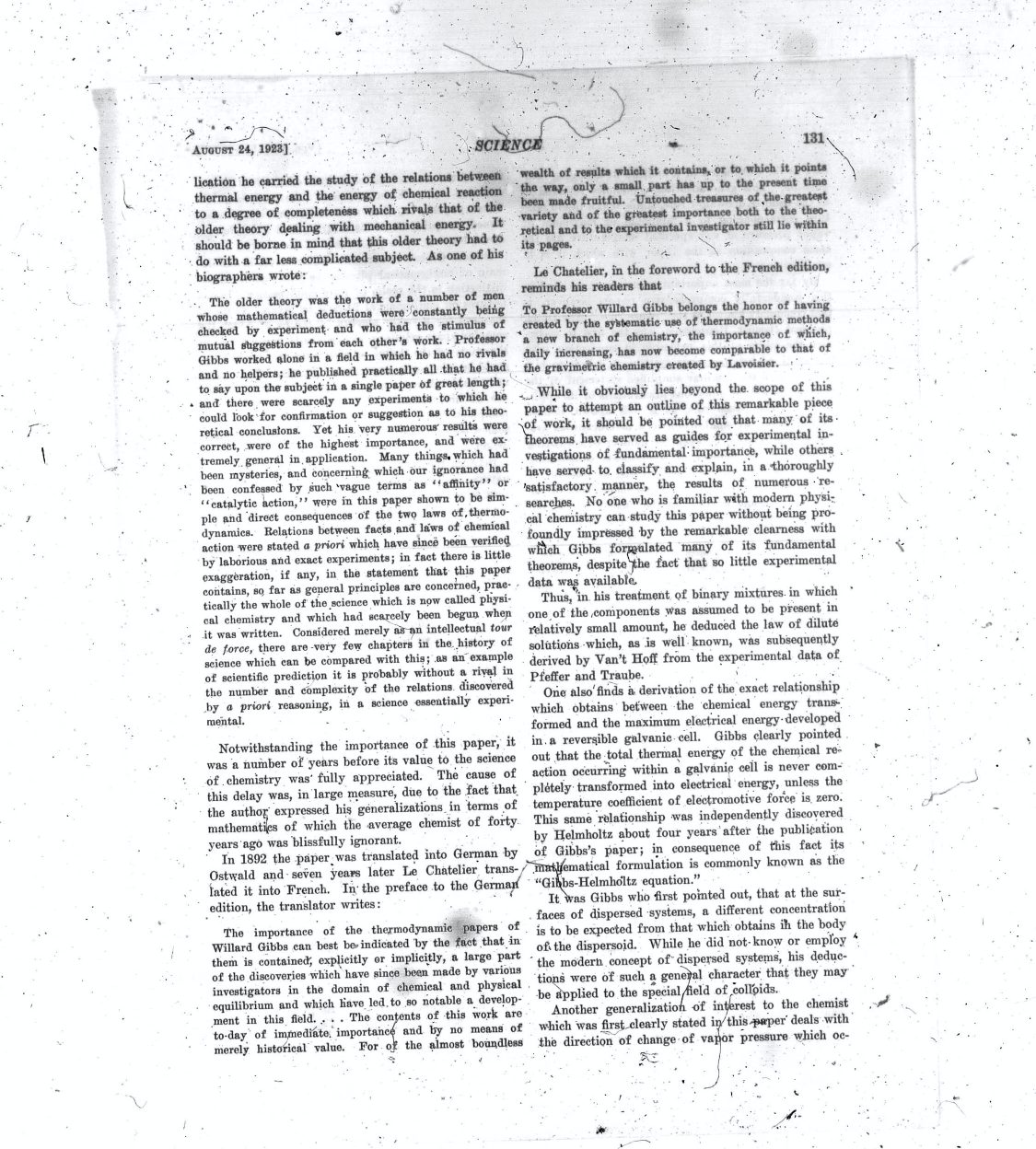
Read beside the scan
AI first transcription from the evidence pack; not independently verified. Compare with the scan.
lication he carried the study of the relations between
thermal energy and the energy of chemical reaction
to a degree of completeness which rivals that of the
older theory dealing with mechanical energy. It
should be borne in mind that this older theory had to
do with a far less complicated subject. As one of his
biographers wrote:
The older theory was the work of a number of men
whose mathematical deductions were constantly being
checked by experiment and who had the stimulus of
mutual suggestions from each other's work. Professor
Gibbs worked alone in a field in which he had no rivals
and no helpers; he published practically all that he had
to say upon the subject in a single paper of great length;
and there were scarcely any experiments to which he
could look for confirmation or suggestion as to his theo-
retical conclusions. Yet his very numerous results were
correct, were of the highest importance, and were ex-
tremely general in application. Many things which had
been mysteries, and concerning which our ignorance had
been confessed by such vague terms as "affinity" or
"catalytic action," were in this paper shown to be sim-
ple and direct consequences of the two laws of thermo-
dynamics. Relations between facts and laws of chemical
action were stated *a priori* which have since been verified
by laborious and exact experiments; in fact there is little
exaggeration, if any, in the statement that this paper
contains, so far as general principles are concerned, prac-
tically the whole of the science which is now called physi-
cal chemistry and which had scarcely been begun when
it was written. Considered merely as an intellectual *tour
de force*, there are very few chapters in the history of
science which can be compared with this; as an example
of scientific prediction it is probably without a rival in
the number and complexity of the relations discovered
by *a priori* reasoning, in a science essentially experi-
mental.
Notwithstanding the importance of this paper, it
was a number of years before its value to the science
of chemistry was fully appreciated. The cause of
this delay was, in large measure, due to the fact that
the author expressed his generalizations in terms of
mathematics of which the average chemist of forty
years ago was blissfully ignorant.
In 1892 the paper was translated into German by
Ostwald and seven years later Le Chatelier trans-
lated it into French. In the preface to the German
edition, the translator writes:
The importance of the thermodynamic papers of
Willard Gibbs can best be indicated by the fact that in
them is contained, explicitly or implicitly, a large part
of the discoveries which have since been made by various
investigators in the domain of chemical and physical
equilibrium and which have led to so notable a develop-
ment in this field. . . . The contents of this work are
to-day of immediate importance and by no means of
merely historical value. For of the almost boundless
wealth of results which it contains, or to which it points
the way, only a small part has up to the present time
been made fruitful. Untouched treasures of the greatest
variety and of the greatest importance both to the theo-
retical and to the experimental investigator still lie within
its pages.
Le Chatelier, in the foreword to the French edition,
reminds his readers that
To Professor Willard Gibbs belongs the honor of having
created by the systematic use of thermodynamic methods
a new branch of chemistry, the importance of which,
daily increasing, has now become comparable to that of
the gravimetric chemistry created by Lavoisier.
While it obviously lies beyond the scope of this
paper to attempt an outline of this remarkable piece
of work, it should be pointed out that many of its
theorems have served as guides for experimental in-
vestigations of fundamental importance, while others
have served to classify and explain, in a thoroughly
satisfactory manner, the results of numerous re-
searches. No one who is familiar with modern physi-
cal chemistry can study this paper without being pro-
foundly impressed by the remarkable clearness with
which Gibbs formulated many of its fundamental
theorems, despite the fact that so little experimental
data was available.
Thus, in his treatment of binary mixtures in which
one of the components was assumed to be present in
relatively small amount, he deduced the law of dilute
solutions which, as is well known, was subsequently
derived by Van't Hoff from the experimental data of
Pfeffer and Traube.
One also finds a derivation of the exact relationship
which obtains between the chemical energy trans-
formed and the maximum electrical energy developed
in a reversible galvanic cell. Gibbs clearly pointed
out that the total thermal energy of the chemical re-
action occurring within a galvanic cell is never com-
pletely transformed into electrical energy, unless the
temperature coefficient of electromotive force is zero.
This same relationship was independently discovered
by Helmholtz about four years after the publication
of Gibbs's paper; in consequence of this fact its
mathematical formulation is commonly known as the
"Gibbs-Helmholtz equation."
It was Gibbs who first pointed out, that at the sur-
faces of dispersed systems, a different concentration
is to be expected from that which obtains in the body
of the dispersoid. While he did not know or employ
the modern concept of dispersed systems, his deduc-
tions were of such a general character that they may
be applied to the special field of colloids.
Another generalization of interest to the chemist
which was first clearly stated in this paper deals with
the direction of change of vapor pressure which oc-
Citation and provenance
[PRINTED JOURNAL, Science Vol. LVIII No. 1495]. (1923, August 24). Gibbs Family Papers, 1763-1918 (U.S. Mss Y, Micro 1117, Reel 3, frames 504-509). Wisconsin Historical Society Archives, Madison, WI, United States.
Citation details need editorial review.
Historical sources retain their individual rights and credits. A scan’s presence here does not establish unrestricted reuse.
People identified in the source catalog
These are catalog labels. Individual identities and relationships have not all been reviewed.
Where the book uses this document
No quotation has yet been assigned directly to this catalog record. Its individual frames may have separate connections.