The book is finished.GIBBS: The Forgotten Warrior of the First New York Dragoons, by Garland H. Green Jr. How to order is coming soon; you can reserve a copy now. Reserve a copy →
FROM LEVI D. GREEN TO DEAR PARENTS — AUGUST 13, 1862
Garland’s introduction, letter transcript and notes are preserved together. This website reader does not establish a new primary-source identification.
Garland H. Green Jr.’s published research page
Full letter transcript as published; original manuscript image not established by this reader
Garland H. Green Jr.’s research
About this Letter
Levi Davis Green wrote this letter in the late summer of 1862 from Camp Barry, an artillery camp of instruction near Washington, when he was barely twenty-one and barely a soldier. The 130th New York had only just been organized at Portage, and Levi was moving south with it toward Virginia, still close enough to home that home was most of what he thought about. He does not describe a battle, because he had not seen one. He writes about a pistol he is mailing back to the farm.
The regiment he had joined was still finding its feet. Within weeks it would be sent to Suffolk, west of Norfolk, into Gen. John Peck’s command under Col. Alfred Gibbs, and its work would become the monthly armed marches toward the Confederate lines on the Blackwater River. None of that had happened yet. In the larger war that autumn the armies would collide at Antietam on September 17 and President Lincoln would issue the preliminary Emancipation Proclamation on September 22, but from Camp Barry that future was invisible. Levi was a new man in a new regiment, packing a box for home.
The pistol is the whole letter. “In this box you will find a navy pistol witch I want you to take good care of for me,” he tells his parents, “there is five loads in it tell pa to put it together and shoot it of.” He is anxious that it stay in the family: “I don’t want you to let any one take it at all this from your son.” It is the note of a young man who still measures the war by what he can send back to the people he left, careful over five loads and a gun that must not fall into a stranger’s hand.
He was sending a weapon home while soldiering was still half an adventure. Within a year the 130th would be remade into the 1st New York Dragoons and turned into cavalry; Levi would ride through the Overland Campaign and the raids below Petersburg, be captured near Nottoway Court House on June 23, 1864, and die that fall at the Camp Lawton prison in Georgia. The pistol he mailed home in 1862 would outlast the son who sent it. His service record and the finding of his grave are gathered on Levi’s own page. The pages below are the family typescript prepared by Marjorie Kuski; the transcription keeps his spelling exactly as he set it down.
Preserved from Garland’s full research page. This introduction is the author’s explanation, distinct from the letter below.
The Letter
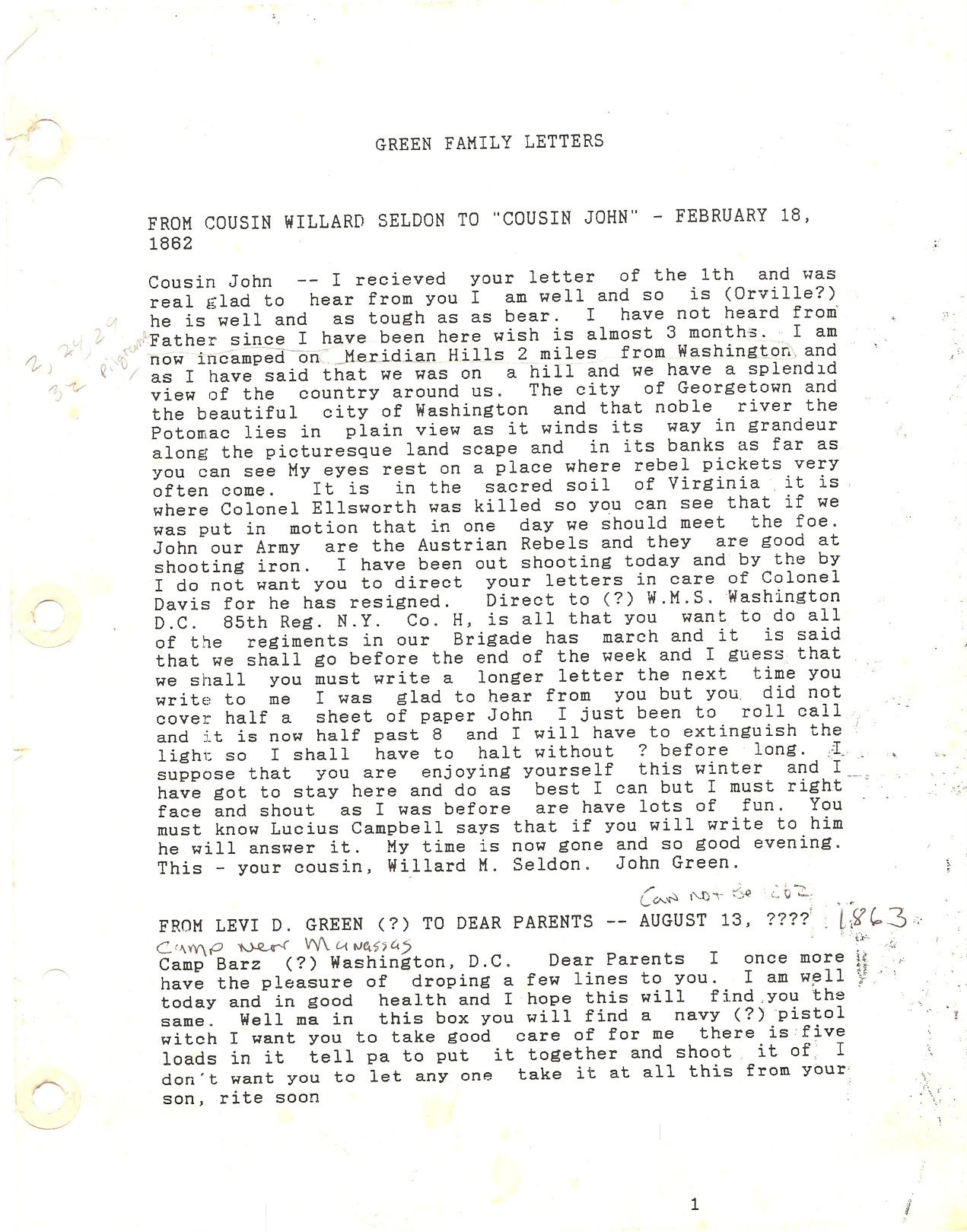
Family typescript pages. These are images of the preserved transcription, not scans of the handwritten originals.
Typescript page 1 (click to enlarge).. Open the image for a larger view.
Full letter transcription
Transcribed from Marjorie Kuski’s family typescript, preserving the original spelling and punctuation.
Dear Parents I once more If ‘.,,. have the pleasure of droping a few lines to you. I am well y ‘ today and in good health and I hope this will find .you the same. Well ma in this box you will find a navy (?) pistol witch I want you to take good care of for me there is five loads in it tell pa to put it together and shoot it of I don’t want you to let any one take it at all this from your son, rite soon
Citation and provenance
Green, G. H., Jr. (n.d.). FROM LEVI D. GREEN TO DEAR PARENTS — AUGUST 13, 1862. The Alfred Gibbs Project. https://alfredgibbs.com/from-levi-d-green-to-dear-parents-august-13-1862/
Citation details need editorial review.
Historical sources retain their individual rights and credits. A scan’s presence here does not establish unrestricted reuse.
Catalog quotation assignments for this letter
These are the catalog’s assignments. A warning below identifies wording found in another preserved letter; the assignment itself is not silently rewritten.
No quotation has yet been assigned directly to this catalog record. Its individual frames may have separate connections.