The book is finished.GIBBS: The Forgotten Warrior of the First New York Dragoons, by Garland H. Green Jr. How to order is coming soon; you can reserve a copy now. Reserve a copy →
You came from “We have moved about one mile on the other side of the city in a more healthy place and better water than we used to have.”. Keep that passage in view as you compare this record. Return to the quotation.
Green family letter
Levi D. Green to Dear Brother, December 10, 1862
Original letters held by the extended Green family; transcripts given to Garland H. Green Jr.; one letter is a photocopy held by the National Archives
Green family letters (transcripts of the originals, which are in family hands)
Garland H. Green Jr.’s research
About this Letter
Levi Davis Green wrote this from Camp Thorp at Suffolk on December 10, 1862, to a brother still at home, three days before the armies of the Potomac and Northern Virginia would tear into each other at Fredericksburg. Levi knew nothing of that yet. He writes about a healthier camp, a skirmish at the Blackwater, and how fat his brother Marvin has grown, the small news of men who are, for the moment, all right.
The regiment had just shifted its ground. “We have moved about one mile on the other side of the city in a more healthy place and better water than we used to have,” Levi reports. He assumes his brother has read of the recent fighting on the Blackwater River, one of the 130th’s regular reconnaissances out of Suffolk, and gives the soldier’s version: “our Regament was down there at the time of the fight but did not go into action for the Rebels skedaddled so we could not get a chance to try our silver.” He passes on the camp rumor and then doubts it in the same breath: “we took 22 prisoners 9 horses 50 of them was killed but we heard that it is not so.”
Mostly the letter is well and hearty. Marvin “is as fat as a hog he has gained 9 pounds he weigh 169 pounds,” camped not a hundred rods off. Levi names the boys from home he sees every day, notes the rabbits they scare up on fatigue duty, and encloses two rings Marvin had made. It is a letter written by a young man who believes the worst of the war is other people’s news.
The brother reading it would not stay out of the war. John Sterns Green would enlist in the 93rd New York and be wounded at the Wilderness on May 5, 1864, and survive it. Marvin, fat and healthy in this letter, would come home too. Only Levi, captured that same June after the regiment became the 1st New York Dragoons, would not, dying at Camp Lawton prison in Georgia that fall. His service record and the finding of his grave are gathered on Levi’s own page. The pages below are the family typescript prepared by Marjorie Kuski; the transcription keeps his spelling exactly as he set it down.
Preserved from Garland’s full research page. This introduction is the author’s explanation, distinct from the letter below.
Watch & listen
Explore the video accompanying this letter, then continue into the complete transcript and Garland’s research below.
Family typescript pages. These are images of the preserved transcription, not scans of the handwritten originals.
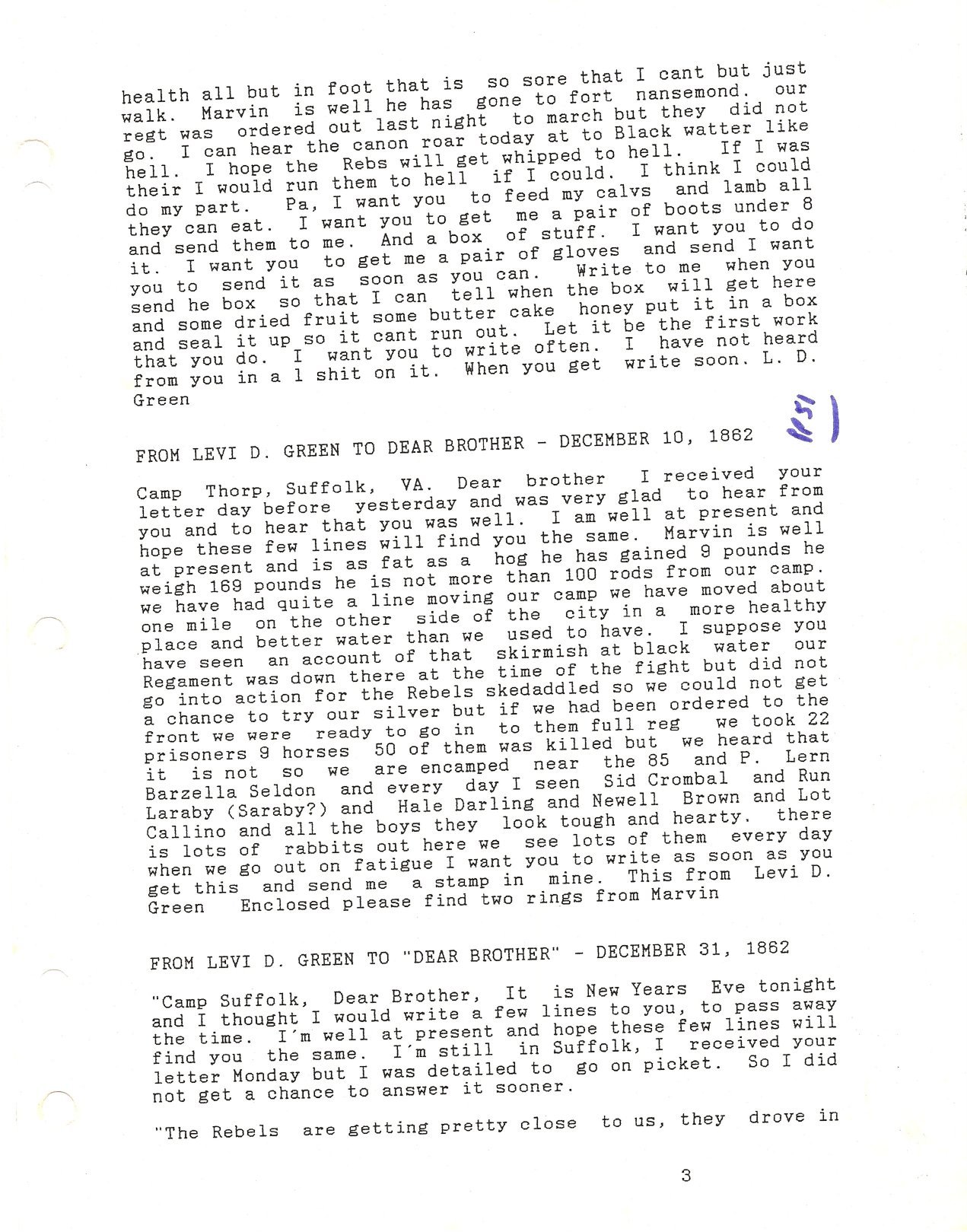
Typescript page 3 (click to enlarge).. Open the image for a larger view.
Full letter transcription
Transcribed from Marjorie Kuski’s family typescript, preserving the original spelling and punctuation.
Camp Thorp, Suffolk, VA. Dear brother I received your letter day before yesterday and was very glad to hear from you and to hear that you was well. I am well at present and hope these few lines will find you the same. Marvin is well at present and is as fat as a hog he has gained 9 pounds he weigh 169 pounds he is not more than 100 rods from our camp, we have had quite a line moving our camp we have moved about one mile on the other side of the city in a more healthy place and better water than we used to have. I suppose you have seen an account of that skirmish at black water our Regament was down there at the time of the fight but did not go into action for the Rebels skedaddled so we could not get a chance to try our silver but if we had been ordered to the front we were ready to go in to them full reg we took 22 prisoners 9 horses 50 of them was killed but we heard that it is not so we are encamped near the 85 and P. Lern Barzella Seldon and every day I seen Sid Crombal and Run Laraby (Saraby?) and Hale Darling and Newell Brown and Lot Callino and all the boys they look tough and hearty. there is lots of rabbits out here we see lots of them every day when we go out on fatigue I want you to write as soon as you get this and send me a stamp in mine. This from Levi D. Green Enclosed please find two rings from Marvin
Researcher’s Notes
EDITOR'S NOTE: Fort Nanesemond was a square redoubt. This fort was a type of fortification typically used during the Civil War era and other periods of military history. It refers to a defensive structure with a square or rectangular shape designed to provide protection and a strategic vantage point for military forces. During the Civil War, redoubts were often constructed as part of a larger fortification system to defend key positions or critical areas. They were typically built using earthworks, including trenches, berms, and parapets, reinforced with logs or other materials. The purpose of a redoubt was to create a fortified stronghold where defending troops could take cover, repel attacks, and provide supporting fire to nearby positions. The square shape of a redoubt allowed for a wide field of fire in all directions, making it difficult for enemy forces to approach without facing significant resistance. Redoubts were commonly used to protect important locations, such as supply depots, river crossings, or high ground. They played a significant role in the defensive strategies employed by both Union and Confederate forces during the Civil War. The color red, as in "redoubt," does not necessarily denote the color of the fortification itself but rather refers to the term "redoubt" used in military terminology. The actual appearance of a Civil War redoubt would depend on the construction materials and techniques used by the forces involved and any subsequent modifications or adaptations made over time.
Kuski typescript, page 3
Kuski typescript, page 3. Select the image to inspect the full scan.
Read beside the scan
Scan of the Marjorie Kuski typescript of the Green family letters. The quotation's words were found on this page.
No transcription has yet been connected. The quotation itself is not a substitute for the document’s transcription.
Citation and provenance
Green, L. D. (1862, December 10). [Letter addressed "Dear Brother, December 10"]. Green family letters (typescript of the originals, held by the extended Green family; transcripts given to Garland H. Green Jr.).
Historical sources retain their individual rights and credits. A scan’s presence here does not establish unrestricted reuse.
Catalog quotation assignments for this letter
These are the catalog’s assignments. A warning below identifies wording found in another preserved letter; the assignment itself is not silently rewritten.