The book is finished.GIBBS: The Forgotten Warrior of the First New York Dragoons, by Garland H. Green Jr. How to order is coming soon; you can reserve a copy now. Reserve a copy →
You are exploring Suffolk, Virginia in The Men of Allegany. Compare the words used in the book with the source and the context around them.
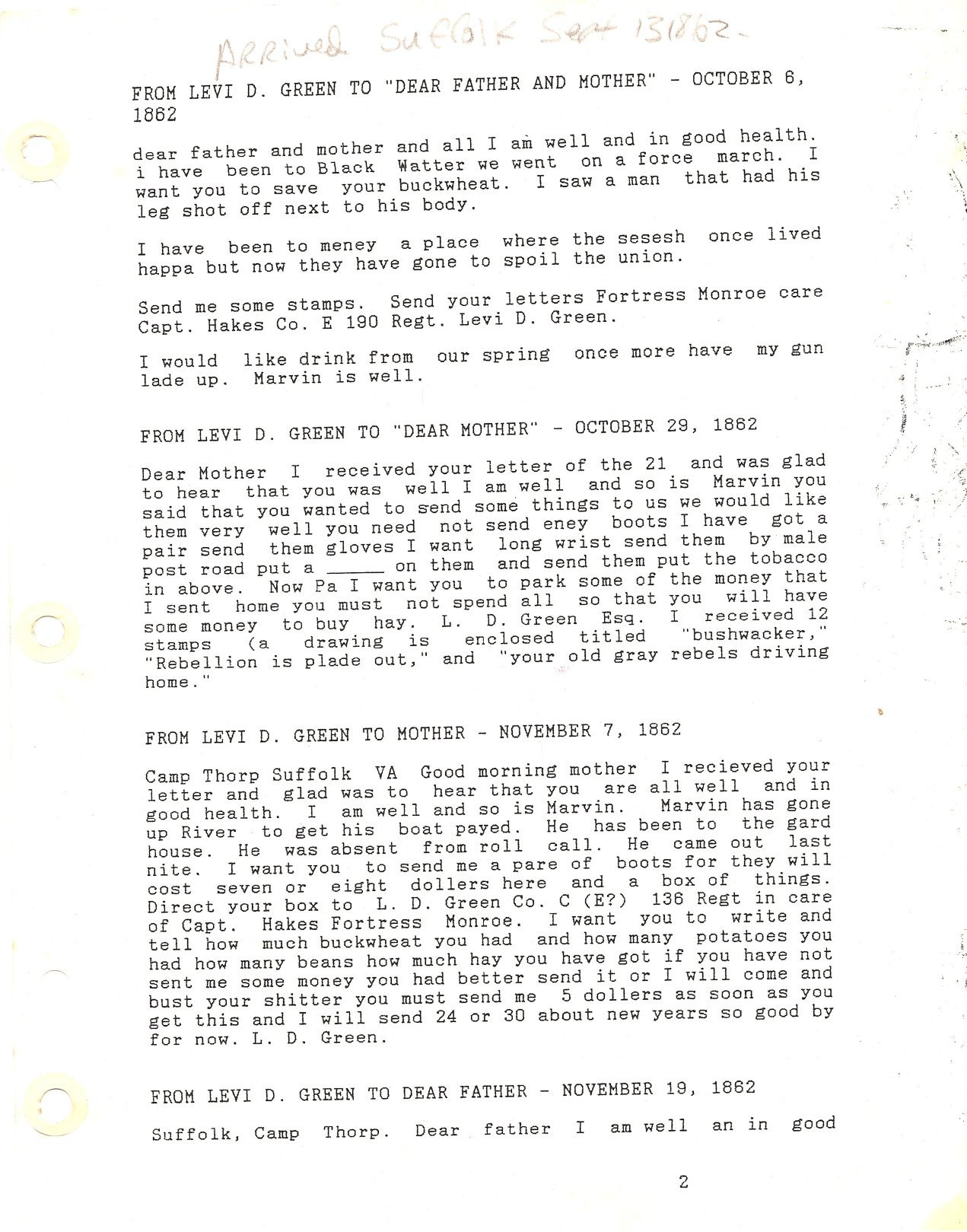
I have been to meney a place where the sesesh once lived happa but now they have gone to spoil the union.
Source inferred, check against scan
See how the book uses these words
He did not stop to say more about it. "I have been to meney a place where the sesesh once lived happa but now they have gone to spoil the union." He asked for stamps. He gave them the address: Fortress Monroe, in care
of Captain Hakes, Company E. And at the end, he wrote down what he wanted. "I would like drink from our spring once more have my gun lade up. Marvin is well."
Book context excerpt, up to 400 characters. This is not the full chapter.
Garland H. Green Jr.’s research
About this Letter
By the first week of October 1862 Levi Davis Green had seen what a soldier is sent south to see. The 130th New York had reached Suffolk, Virginia, in September, joined Gen. John Peck’s command under Col. Alfred Gibbs, and on October 3 had made its first armed march toward the Blackwater River, roughly fifty miles out and back. This letter is written in the days just after that march, and the march is in every line of it.
It was barely three weeks since Antietam and the preliminary Emancipation Proclamation of September 22, and the regiment’s own war had settled into the pattern it would keep all winter: reconnaissances out of Suffolk toward the Confederate positions across the Blackwater, through a countryside the fighting had already emptied. Levi passed through that country and wrote it down plainly. “I have been to meney a place where the sesesh once lived happa but now they have gone to spoil the union,” he tells his parents.
Then he sets down the thing he could not stop seeing. “I have been to Black Watter we went on a force march,” he writes, and a few words later, “I saw a man that had his leg shot off next to his body.” The horror sits in the same paragraph as buckwheat and postage stamps and one small ache of homesickness: “I would like drink from our spring once more.” He signs off telling them Marvin, his brother in the same company, is well.
He wanted one more drink from the spring on the home place, and he would not get it. Less than two years on, after the regiment had become the 1st New York Dragoons, Levi would be captured in June 1864 and die at Camp Lawton prison that fall. Marvin, well in this letter, would live through the war and carry it for decades afterward. His service record and the finding of his grave are gathered on Levi’s own page. The pages below are the family typescript prepared by Marjorie Kuski; the transcription keeps his spelling exactly as he set it down.
Preserved from Garland’s full research page. This introduction is the author’s explanation, distinct from the letter below.
The connected source
Levi D. Green to Dear Father And Mother, October 6, 1862
Green family letter · Green family letters (transcripts of the originals, which are in family hands)
placed by its position on the page that transcribes it (check against the scan). A text match or page placement does not establish that the scan has been reviewed.
Questions to bring to the source
Who wrote this, and who was meant to read it? Is the writer describing an event they witnessed, reporting news from someone else, or remembering it later? Read the surrounding lines and compare dates, names and uncertain words.
Begin with the source page
Kuski typescript, page 2
Read beside the scan
Scan of the Marjorie Kuski typescript of the Green family letters. The quotation's words were found on this page.
A transcription has not yet been connected to this scan.
The book catalog explicitly points to these preserved site pages. Read the account and follow its reproduced documents and citations. A research account is an intermediary, not automatically the original evidence.
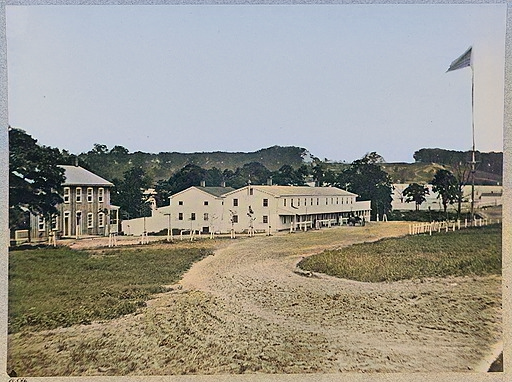
Camp Barry Washington DC · Research-page preview; original-image and enhancement credits remain on that page.