
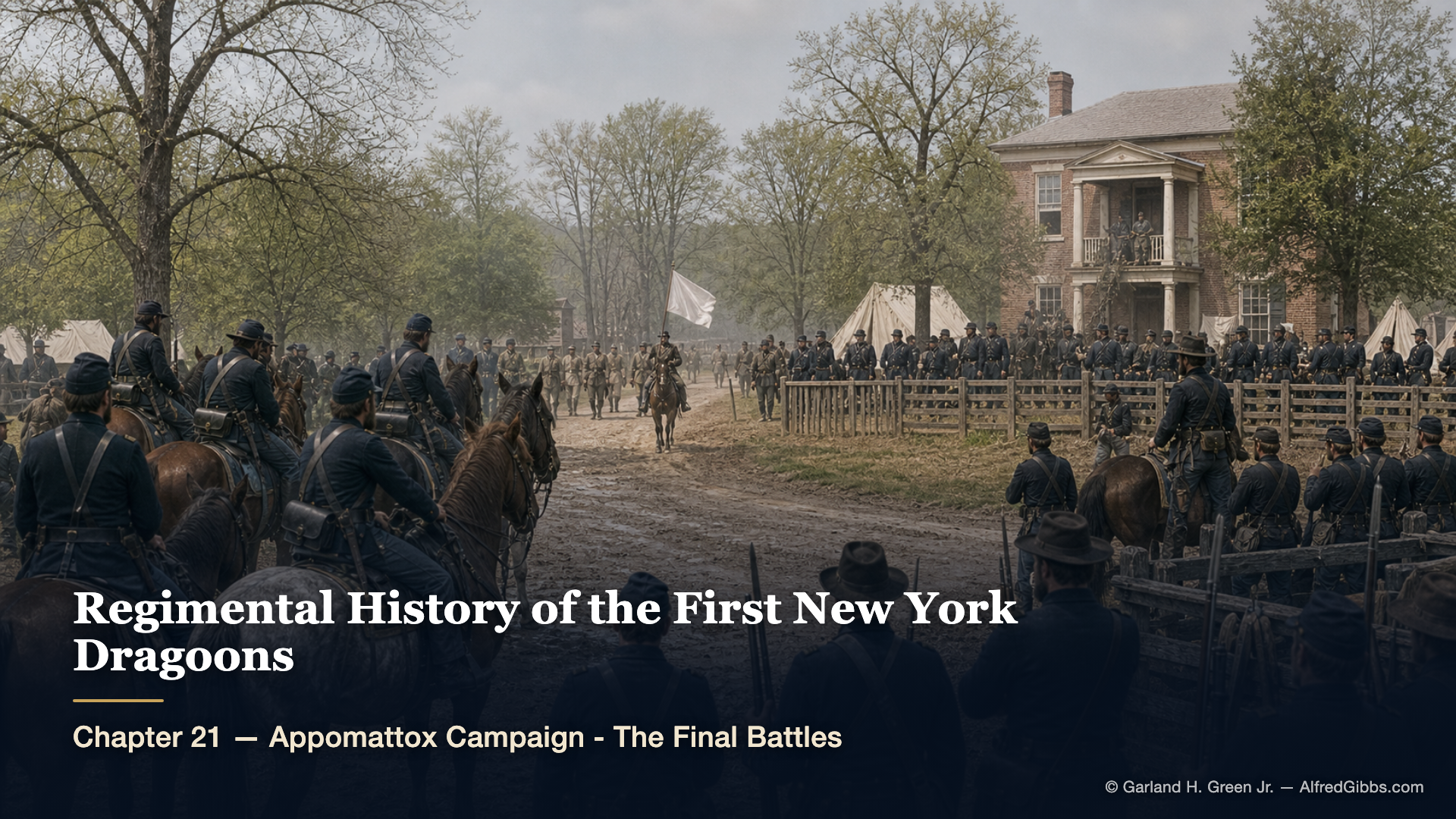
The Battle of Five Forks, fought April 1, 1865, southwest of Petersburg, Virginia, was the decisive engagement of the opening Appomattox Campaign. Maj. Gen. Philip H. Sheridan, combining his cavalry with the infantry of the Fifth Corps, crushed the Confederate force under Maj. Gen. George E. Pickett at the Five Forks road junction. The victory severed Lee’s last open supply line and made the Confederate positions at Petersburg untenable. The First New York Dragoons, in Col. Charles L. Fitzhugh’s brigade, took a conspicuous part in the cavalry assault that carried the Confederate works.
Background
After the fighting at Dinwiddie Court House on March 31, Pickett withdrew his overextended command to the entrenchments at Five Forks, the junction controlling access to the South Side Railroad. Lee ordered him to “hold Five Forks at all hazards.” Sheridan, reinforced by Maj. Gen. Gouverneur K. Warren’s Fifth Corps, moved up to attack.
The Dragoons served in the Second Brigade of the First Cavalry Division. By this stage Brig. Gen. Thomas C. Devin had moved up to command the division, Col. Charles L. Fitzhugh led the brigade (Devin’s old command), and Major Smith led the regiment, with Maj. Gen. Wesley Merritt as chief of cavalry and Sheridan directing the whole. On March 31 Bowen’s regiment, dismounted, helped hold off Pickett’s and Johnson’s divisions — an enemy that “outnumber[ed] us three to one” — buying the time for the infantry to come up for the decisive blow the next day.
The Battle
Sheridan’s plan used his dismounted cavalry to fix and press the Confederate front while Warren’s entire Fifth Corps — three infantry divisions — swung wide to strike the exposed Confederate left flank. The attack opened in the afternoon. As the Fifth Corps rolled up the flank, the cavalry stormed the works in front; the Confederate line, surprised and overlapped, collapsed within a few hours.
Pickett himself was absent at the crucial moment. He and cavalry commander Fitzhugh Lee had ridden behind the lines to a shad bake — a riverside fish roast — when the Union assault struck, and an acoustic shadow cast by the woods kept them from hearing it. Pickett reached the field only as his command was breaking apart. He was neither wounded nor captured; he escaped. The Union took a large haul of prisoners, with sourced estimates ranging from about 2,400 to 4,500, along with several guns and numerous battle flags; Confederate killed and wounded exceeded 1,000 (American Battlefield Trust; NPS).
The First New York Dragoons
Bowen records that on the morning of April 1 Devin’s cavalry advanced toward Five Forks and met the enemy at Chamberlain’s swamp. There “the entire second brigade was dismounted, and ordered to charge across the swamp, and gain a position on the opposite side,” a movement “gallantly effected under a heavy fire,” while “the other two brigades, mounted, held our right and left flanks” (Bowen, Regimental History of the First New York Dragoons, 1900). The dismounted Dragoons drove the Confederate skirmishers back into their fortifications by “a succession of rushes,” then joined the assault that carried the works as the Fifth Corps came down on the enemy’s flank.
Bowen singles out Merritt’s official report, which named the brigade’s part directly: “The attack was prosecuted and crowned with success, Fitzhugh’s brigade mounting the works in the face of the enemy, tearing down their colors, planting the brigade standard over their artillery, and capturing one thousand prisoners” (Merritt, quoted in Bowen, 1900). Bowen adds that in this action the Dragoons “bore a conspicuous part.” He reckons the whole brigade’s and corps’ captures for the day at “six guns, thirteen battle flags, and nearly six thousand prisoners.”
“All this time the Fifth Corps, hidden by dense woods from the rebels, had been curling around their left flank. … [Pickett] beheld the cavalry in his front advancing upon his breastworks in a charge; but greater astonishment awaited him, when at the same moment he discovered the gallant boys of the Fifth Corps bearing down like an avalanche upon his left flank. … It must have almost broken Picket’s heart to see his gallant division, which made that magnificent charge at Gettysburg, go to pieces so badly at Five Forks.”— Lieutenant Flint, First New York Dragoons, recounting the assault, quoted in Bowen’s regimental history.
Casualties
Bowen reports the regiment’s loss as light relative to the result: “The regiment lost fifteen in killed and wounded, Major Smith, Captain Leach, and Marvin Lindsley were among the wounded” (Bowen, 1900). He gives Sheridan’s entire loss in killed and wounded as “about eight hundred,” consistent with sourced estimates of roughly 800–830 Union casualties (American Battlefield Trust).
- Major Smith — wounded (commanding the regiment)
- Captain Leach — wounded
- Marvin Lindsley — wounded
Aftermath
Five Forks was the decisive blow. With the junction taken and the South Side Railroad — Lee’s last supply and escape route west — now severed, the Confederate Petersburg defenses could no longer be held. Grant ordered a general assault along the lines on April 2; Petersburg and Richmond were evacuated that night. The campaign that began at Dinwiddie ran on through Sailor’s Creek and Appomattox Station to Lee’s surrender at Appomattox Court House on April 9, 1865.
A footnote of the battle still debated by historians: Sheridan relieved Warren of command of the Fifth Corps during the fight; a court of inquiry exonerated Warren in 1879. An eminent historian, Bowen notes, pronounced Sheridan’s victory at Five Forks “one of the most brilliant military feats of the war.”
Sources & Further Reading
- Primary James R. Bowen, Regimental History of the First New York Dragoons (originally the 130th N.Y. Vol. Infantry) (1900), ch. XXI, “Appomattox Campaign — The Final Battles,” pp. 282–290 — the regiment’s own historian, weaving together the accounts of Captain Leach, Lieut. Flint, Lieut. Aldrich and others, and quoting Merritt’s official report. Full text: archive.org/details/regimentalhistor00bowe.
- Primary Maj. Gen. Wesley Merritt, official report of the Five Forks operations, and related cavalry and Fifth Corps reports, in U.S. War Dept., The War of the Rebellion: Official Records of the Union and Confederate Armies, Series I, Vol. XLVI, Pt. 1 (Bowen cites these “Official Records” directly for the Sheridan–Warren controversy).
- American Battlefield Trust — Battle of Five Forks: battlefields.org/learn/civil-war/battles/five-forks.
- National Park Service / CWSAC — The Battle of Five Forks (Petersburg / Dinwiddie County): nps.gov/articles/000/battle-of-five-forks.htm.
- Encyclopedia Virginia — Five Forks, Battle of: encyclopediavirginia.org/entries/five-forks-battle-of.
The Shenandoah Valley Campaign · Trevilian Station · The Audiobook
Views: 45
Explore the evidence
View this article’s connected sources and media →
About this page
This article was brought over from AlfredGibbs.com. Its preserved text, media and citations remain available for comparison.