
When the Army of the Potomac broke its lines at Petersburg on March 29, 1865, Brigadier-General Alfred Gibbs rode out at the head of the Cavalry Reserve Brigade, the old Regulars: the First, Fifth, and Sixth United States Cavalry and the Second Massachusetts, a hard-worn command of just 437 enlisted men and 20 officers. In the twelve days that followed they fought at Dinwiddie Court-House and Five Forks, chased Lee’s army west through Sailor’s Creek, and were drawn up for one last mounted charge at Appomattox when a flag of truce ended the war. This page does not summarize that story secondhand. It gives you Gibbs’s own after-action report, written six days after the surrender, word for word.
The Document Itself
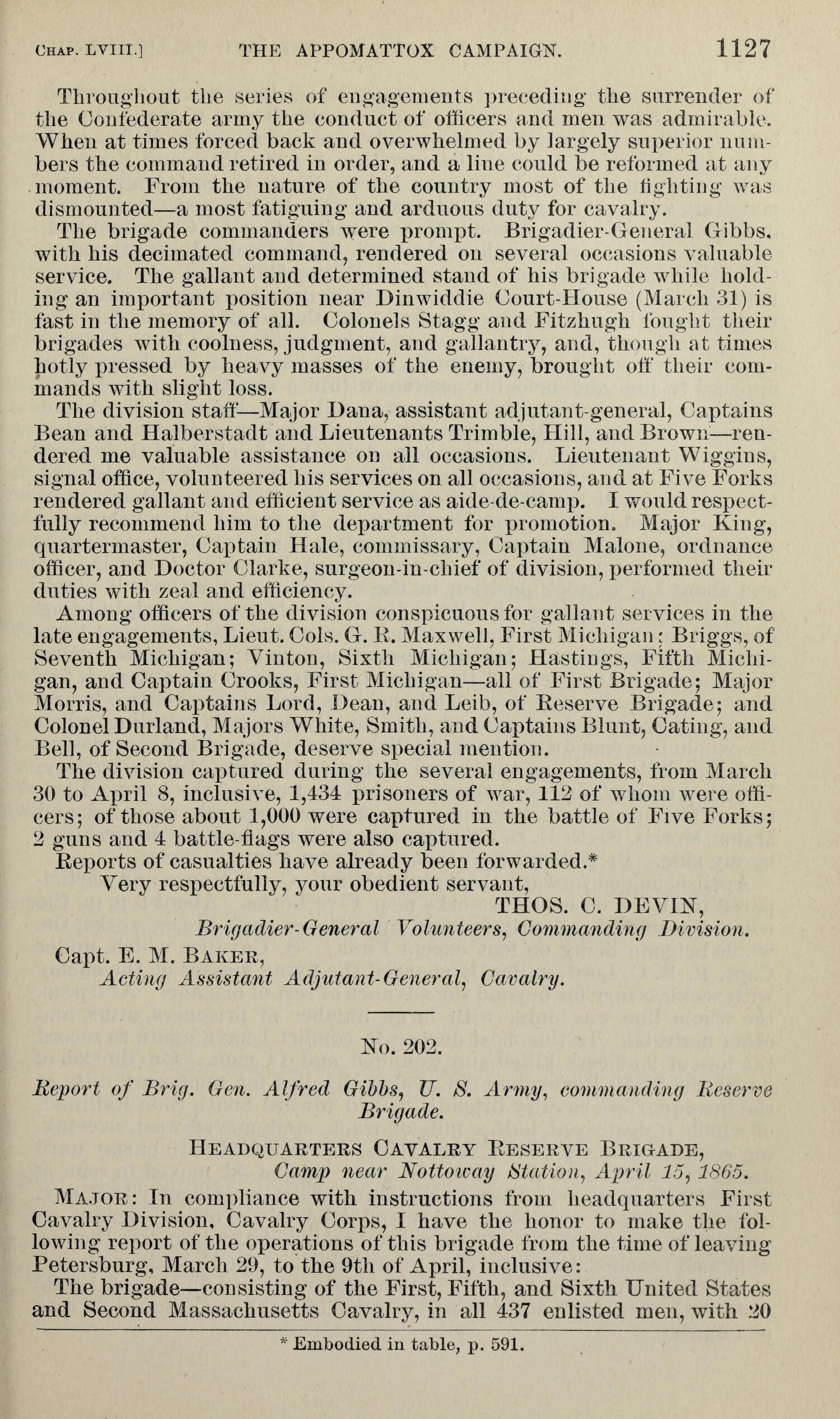
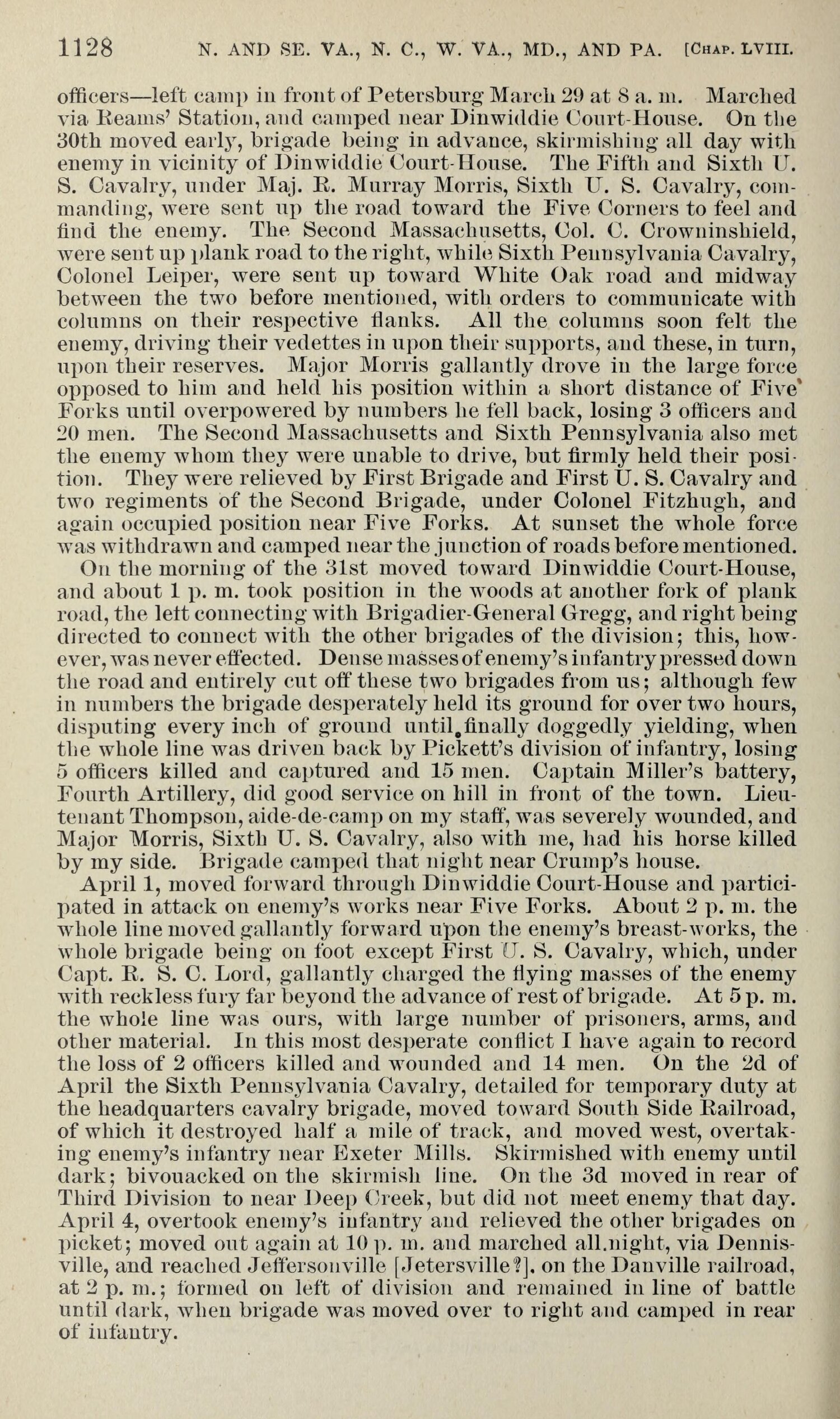
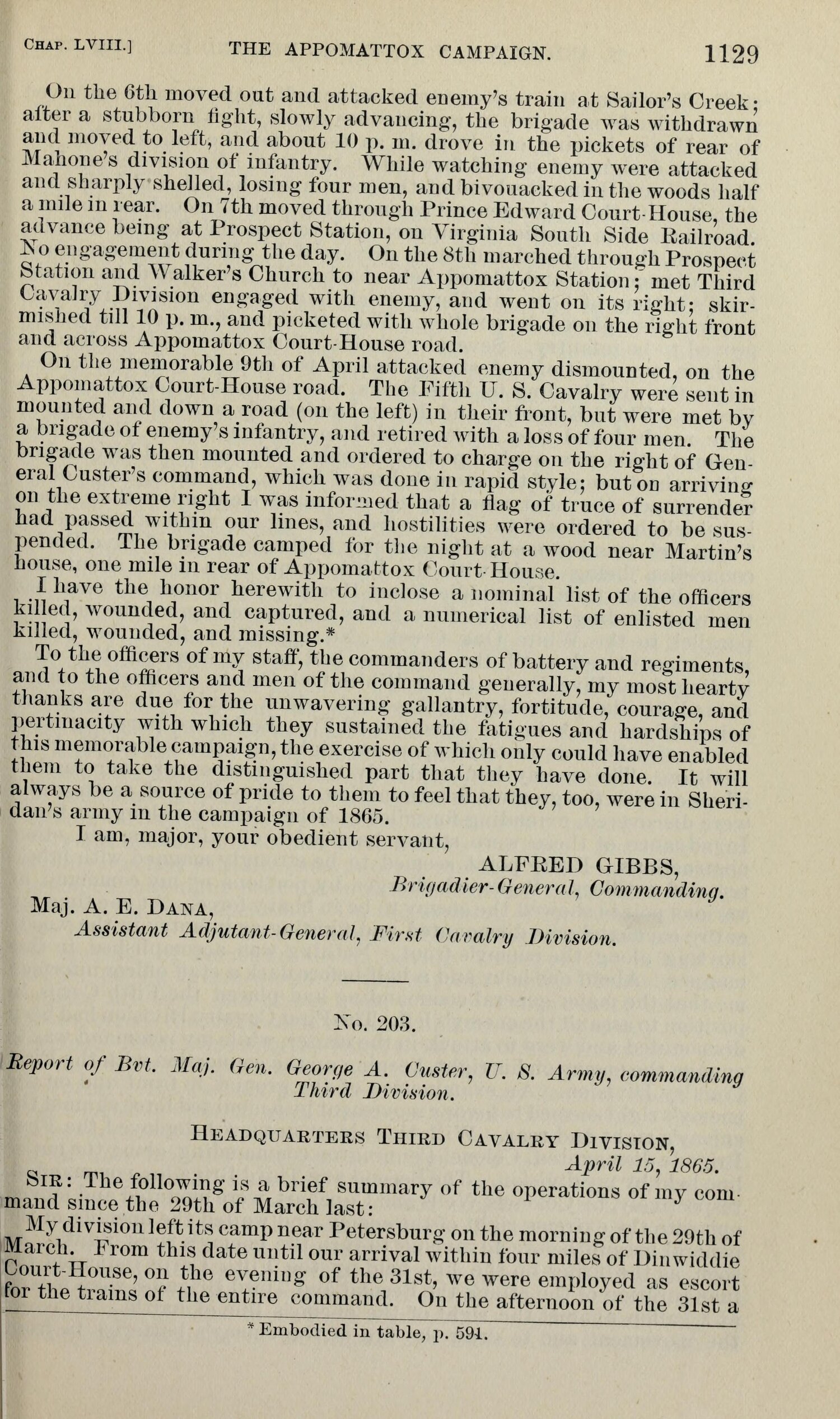
Report No. 202, Official Records, Series I, Vol. XLVI, Part 1, pp. 1127-1129 (Government Printing Office). Click any page to enlarge; the full-resolution scans are hosted here on this site.
In His Own Hand
General Gibbs’s Report of the Campaign
Filed from “Camp near Nottoway Station” on April 15, 1865, and printed in the Official Records, this is Gibbs describing his brigade’s part in the campaign that ended the Civil War: the two-hour stand against Pickett’s infantry at Dinwiddie, the First Cavalry’s charge “with reckless fury” at Five Forks, Major Morris’s horse killed at his side, and the aborted final charge at Appomattox.
“They, too, were in Sheridan’s army in the campaign of 1865.”
Report of Brig. Gen. Alfred Gibbs, Cavalry Reserve Brigade, operations March 29 to April 9, 1865
Verbatim transcription
No. 202. Report of Brigadier-General Alfred Gibbs, U. S. Army, commanding Reserve Brigade.
Headquarters Cavalry Reserve Brigade, Camp near Nottoway Station, April 15, 1865.
Major: In compliance with instructions from headquarters First Cavalry Division, Cavalry Corps, I have the honor to make the following report of the operations of this brigade from the time of leaving Petersburg, March 29, to the 9th of April, inclusive:
The brigade — consisting of the First, Fifth, and Sixth United States and Second Massachusetts Cavalry, in all 437 enlisted men, with 20 officers — left camp in front of Petersburg March 29 at 8 a.m. Marched via Reams’ Station, and camped near Dinwiddie Court-House. On the 30th moved early, brigade being in advance, skirmishing all day with enemy in vicinity of Dinwiddie Court-House. The Fifth and Sixth U. S. Cavalry, under Major R. Murray Morris, Sixth U. S. Cavalry, commanding, were sent up the road toward the Five Corners to feel and find the enemy. The Second Massachusetts, Colonel C. Crowninshield, were sent up plank road to the right, while Sixth Pennsylvania Cavalry, Colonel Leiper, were sent up toward White Oak road and midway between the two before mentioned, with orders to communicate with columns on their respective flanks. All the columns soon felt the enemy, driving their vedettes in upon their supports, and these, in turn, upon their reserves. Major Morris gallantly drove in the large force opposed to him and held his position within a short distance of Five Forks until overpowered by numbers he fell back, losing 3 officers and 20 men. The Second Massachusetts and Sixth Pennsylvania also met the enemy whom they were unable to drive, but firmly held their position. They were relieved by First Brigade and First U. S. Cavalry and two regiments of the Second Brigade, under Colonel Fitzhugh, and again occupied position near Five Forks. At sunset the whole force was withdrawn and camped near the junction of roads before mentioned.
On the morning of the 31st moved toward Dinwiddie Court-House, and about 1 p.m. took position in the woods at another fork of plank road, the left connecting with Brigadier-General Gregg, and right being directed to connect with the other brigades of the division; this, however, was never effected. Dense masses of enemy’s infantry pressed down the road and entirely cut off these two brigades from us; although few in numbers the brigade desperately held its ground for over two hours, disputing every inch of ground until finally doggedly yielding, when the whole line was driven back by Pickett’s division of infantry, losing 5 officers killed and captured and 15 men. Captain Miller’s battery, Fourth Artillery, did good service on hill in front of the town. Lieutenant Thompson, aide-de-camp on my staff, was severely wounded, and Major Morris, Sixth U. S. Cavalry, also with me, had his horse killed by my side. Brigade camped that night near Crump’s house.
April 1, moved forward through Dinwiddie Court-House and participated in attack on enemy’s works near Five Forks. About 2 p.m. the whole line moved gallantly forward upon the enemy’s breast-works, the whole brigade being on foot except First U. S. Cavalry, which, under Captain R. S. C. Lord, gallantly charged the flying masses of the enemy with reckless fury far beyond the advance of rest of brigade. At 5 p.m. the whole line was ours, with large number of prisoners, arms, and other material. In this most desperate conflict I have again to record the loss of 2 officers killed and wounded and 14 men.
On the 2nd of April the Sixth Pennsylvania Cavalry, detailed for temporary duty at the headquarters cavalry brigade, moved toward South Side Railroad, of which it destroyed half a mile of track, and moved west, overtaking enemy’s infantry near Exeter Mills. Skirmished with enemy until dark; bivouacked on the skirmish line. On the 3rd moved in rear of Third Division to near Deep Creek, but did not meet enemy that day. April 4, overtook enemy’s infantry and relieved the other brigades on picket; moved out again at 10 p.m. and marched all night, via Dennisville, and reached Jetersville, on the Danville railroad, at 2 p.m.; formed on left of division and remained in line of battle until dark, when brigade was moved over to right and camped in rear of infantry.
On the 6th moved out and attacked enemy’s train at Sailor’s Creek; after a stubborn fight, slowly advancing, the brigade was withdrawn and moved to left, and about 10 p.m. drove in the pickets of rear of Mahone’s division of infantry. While watching enemy were attacked and sharply shelled, losing four men, and bivouacked in the woods half a mile in rear. On 7th moved through Prince Edward Court-House, the advance being at Prospect Station, on Virginia South Side Railroad. No engagement during the day. On the 8th marched through Prospect Station and Walker’s Church to near Appomattox Station; met Third Cavalry Division, engaged with enemy, and went on its right; skirmished till 10 p.m., and picketed with whole brigade on the right front and across Appomattox Court-House road.
On the memorable 9th of April attacked enemy dismounted, on the Appomattox Court-House road. The Fifth U. S. Cavalry were sent in mounted and down a road (on the left) in their front, but were met by a brigade of enemy’s infantry, and retired with a loss of four men. The brigade was then mounted and ordered to charge on the right of General Custer’s command, which was done in rapid style; but on arriving on the extreme right I was informed that a flag of truce of surrender had passed within our lines, and hostilities were ordered to be suspended. The brigade camped for the night at a wood near Martin’s house, one mile in rear of Appomattox Court-House.
I have the honor herewith to inclose a nominal list of the officers killed, wounded, and captured, and a numerical list of enlisted men killed, wounded, and missing. To the officers of my staff, the commanders of battery and regiments, and to the officers and men of the command generally, my most hearty thanks are due for the unwavering gallantry, fortitude, courage, and pertinacity with which they sustained the fatigues and hardships of this memorable campaign, the exercise of which only could have enabled them to take the distinguished part that they have done. It will always be a source of pride to them to feel that they, too, were in Sheridan’s army in the campaign of 1865.
I am, Major, your obedient servant,
Alfred Gibbs, Brigadier-General, Commanding.
Gibbs, A. (1865). Report of Brig. Gen. Alfred Gibbs, U. S. Army, commanding Reserve Brigade [No. 202]. In The War of the Rebellion: A Compilation of the Official Records of the Union and Confederate Armies (Series I, Vol. XLVI, Part 1, pp. 1127-1129). U.S. Government Printing Office.
Three Months Earlier
A Winter Dispatch from the Valley
Gibbs’s voice in the record is not confined to the great battles. Here he is in the quiet of the Shenandoah in January 1865, then temporarily commanding the whole First Cavalry Division, reporting a routine reconnaissance toward Strasburg: the daily texture of a cavalry command in winter quarters.
“We found nothing there … the party returned safely last night.”
Dispatch of Brig. Gen. Alfred Gibbs to the Cavalry Corps, January 13, 1865
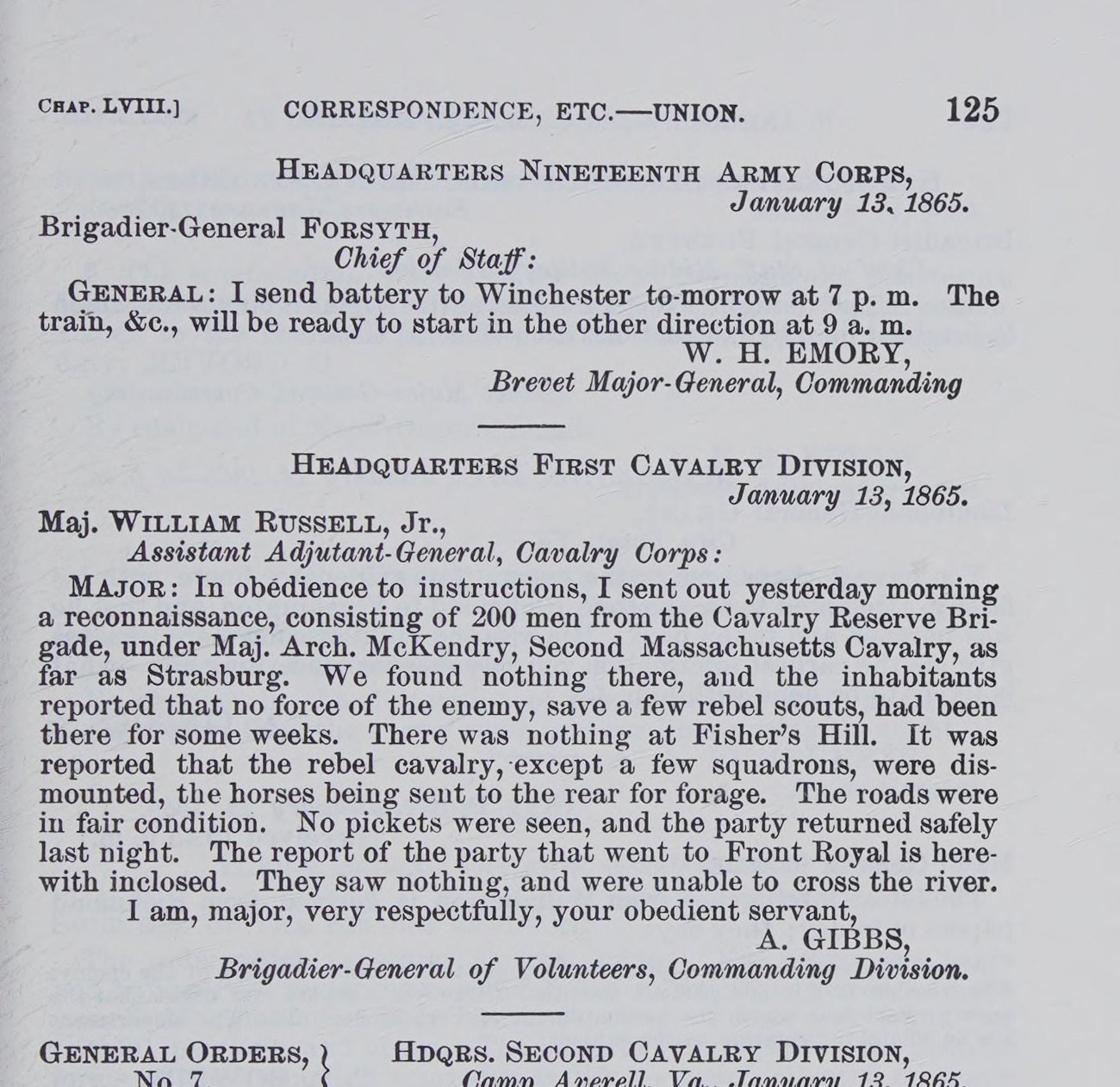
The document itself: the dispatch as printed in the Official Records, Vol. XLVI, Pt. 2, p. 125 (click to enlarge)
Verbatim transcription
Headquarters First Cavalry Division, January 13, 1865.
Maj. William Russell, Jr., Assistant Adjutant-General, Cavalry Corps:
Major: In obedience to instructions, I sent out yesterday morning a reconnaissance, consisting of 200 men from the Cavalry Reserve Brigade, under Maj. Arch. McKendry, Second Massachusetts Cavalry, as far as Strasburg. We found nothing there, and the inhabitants reported that no force of the enemy, save a few rebel scouts, had been there for some weeks. There was nothing at Fisher’s Hill. It was reported that the rebel cavalry, except a few squadrons, were dismounted, the horses being sent to the rear for forage. The roads were in fair condition. No pickets were seen, and the party returned safely last night. The report of the party that went to Front Royal is herewith inclosed. They saw nothing, and were unable to cross the river.
I am, Major, very respectfully, your obedient servant,
A. Gibbs, Brigadier-General of Volunteers, Commanding Division.
Gibbs, A. (1865, January 13). [Dispatch reporting a reconnaissance to Strasburg]. In The War of the Rebellion… Official Records (Series I, Vol. XLVI, Part 2, p. 125). U.S. Government Printing Office.
A note on this page
Every quotation above is transcribed from Gibbs’s own words as printed in the Official Records of the War of the Rebellion, the standard published compilation of the armies’ wartime papers. Where the printed text is defective, that is marked in brackets rather than silently “fixed.” No part of this account is paraphrase presented as quotation. The next step is to locate and reproduce Gibbs’s original manuscript report in the National Archives (Records of the Adjutant General’s Office); when it is found, the scan will be added here beside the transcription.
References & Further Reading
Gibbs, A. (1865). Reports and dispatches [Nos. 202 & correspondence]. In The War of the Rebellion: A Compilation of the Official Records of the Union and Confederate Armies (Series I, Vol. XLVI, Parts 1-2). U.S. Government Printing Office. Transcription verified against the printed volume.
Sheridan, P. H. (1865). Report of operations of the Cavalry, March 26-April 9, 1865 [No. 199, in which Gibbs is recommended for promotion]. In Official Records (Series I, Vol. XLVI, Part 1). U.S. Government Printing Office.
» The Battle of Five Forks, April 1, 1865 · » Sheridan’s Valley Victories, Sep-Oct 1864
Views: 58
Explore the evidence
View this article’s connected sources and media →
About this page
This article was brought over from AlfredGibbs.com. Its preserved text, media and citations remain available for comparison.