
Her photograph
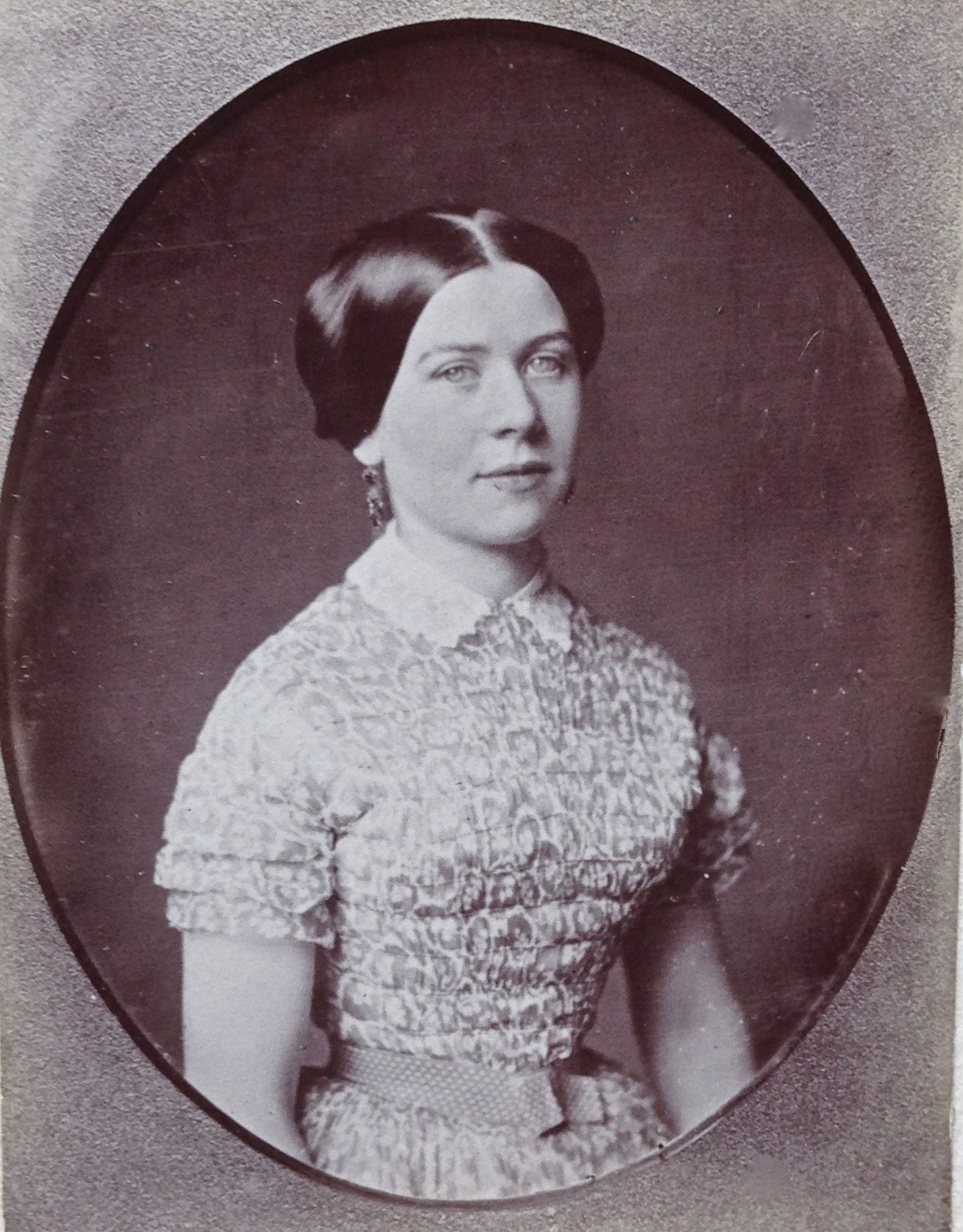
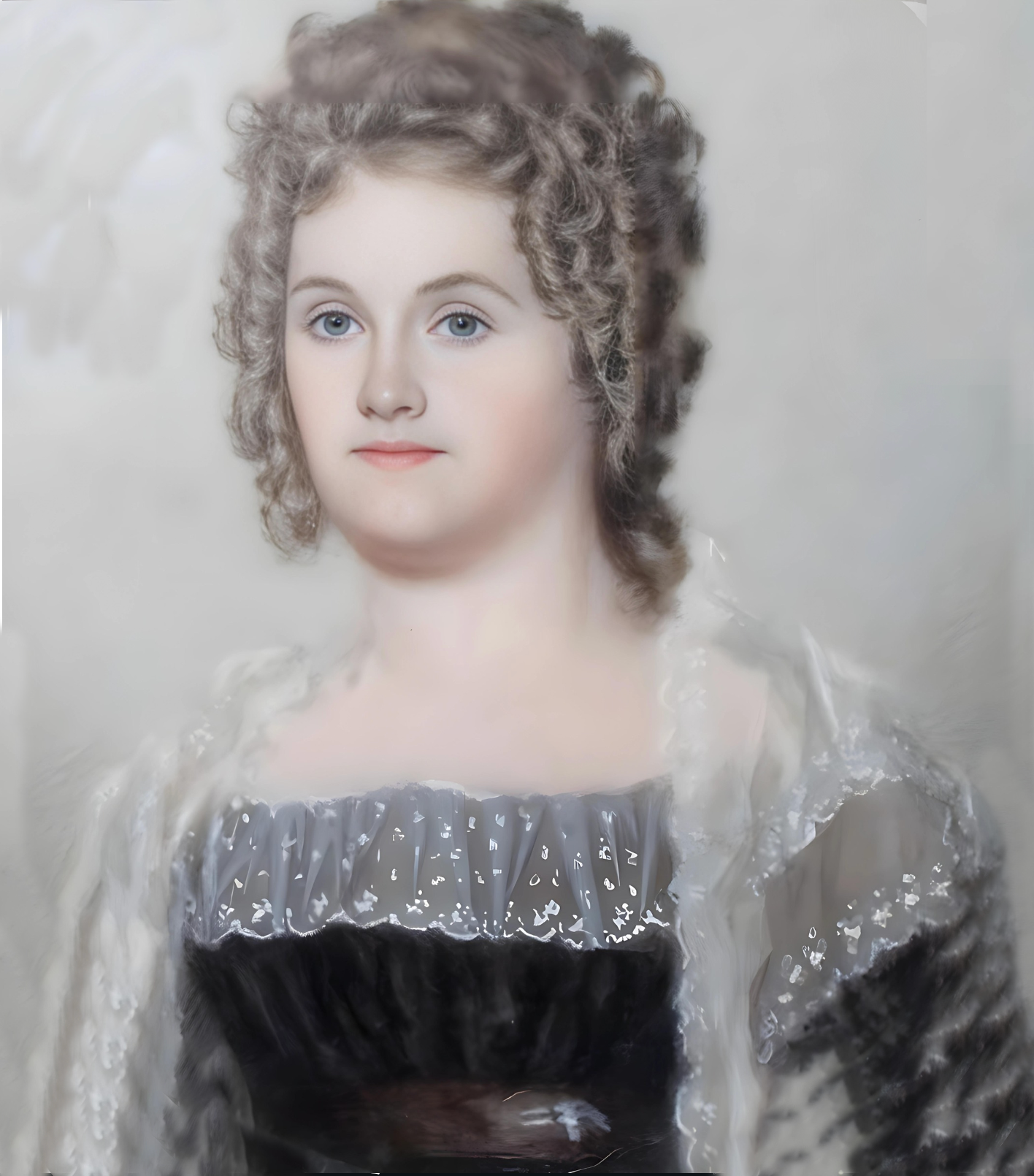
Note on attribution, settled August 12, 2026. The caption on the painted portrait formerly read that the picture had been estimated at 1820 to 1830, which cannot show the general’s sister as an adult because she was born in 1827, and that either the portrait was later than that or the sitter was her mother. That question is now answered. Deb Dodge, an Official Contributor to AlfredGibbs.com, supplied the photograph above, an undated print of Laura herself held by the Newport Historical Society in Newport, Rhode Island, writing of it simply: “Photo - undated of Laura Gibbs d’O. This is from the Newport Historical Society.” Two things follow. It is the first secure likeness of Laura Wolcott Gibbs d’Oremieulx to appear on this site, and it now heads this page. And the painted portrait is not a picture of her; its costume is of about 1800 to 1815, so its sitter belongs to her mother’s generation, and her mother and namesake, Laura Wolcott Gibbs (1794 – 1870), remains the likeliest candidate. A photograph of that Laura, taken about 1858 with her grandson Leon, is now on her own page; it shows her in her middle sixties and cannot by itself settle a miniature painted half a century earlier. That identification is not yet documented, so the painting is kept on this page, recaptioned rather than removed, and this note will be updated if the sitter is named. The photograph itself carries no date. The center parted hair drawn smoothly over the ears, the short tiered oversleeves and the wide belt are of the 1850s, the decade of her marriage to Theophile Marie d’Oremieulx in 1853 and of their years at West Point, and the mount and oval vignette suggest a later copy print of an earlier original. No catalog number for it has been traced online; it will be added here when the Newport Historical Society supplies one.

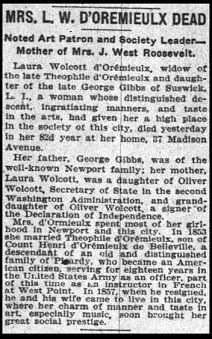
He was a very popular man with the Army, counting many of the Generals and higher officers among his friends. In 1853 occurred his marriage to Miss Laura Wolcott Gibbs. When he brought his bride to the West Point Academy a dinner was given in their honor by Colonel Robert E. Lee, then superintendent.As he handed Mrs. d’Oremieulx to her seat beside him she exclaimed at the sight of four silver jardinieres on the table, which were very familiar to her, as her grandfather, Oliver Wolcott, Secretary of the Treasury under Washington, had left one exactly like them to her mother. “These four,” said Colonel Lee, “are of a set of six; they are really wine-coolers, meant for two bottles each. I inherited four and the other two Washington presented, one to General Hamilton, the other to Governor Wolcott!”
At a large reception in New York given to General Philip Sheridan after the War, Sheridan, as he caught sight of d’Oremieulx, exclaimed, “Well, Dorry, I taught you a lot of English, but I’ll be hanged if you could ever teach me any French!” Dorry, was described as a fine-looking old man, with a handsome face and courteous manner. His hobby was work with the microscope.
Laura, was an accomplished linguist and musician – in fact, one of the best amateur pianists in New York – a remarkable daughter of a remarkable mother. When the Civil War broke out she joined Miss Louisa Lee Schuyler, Miss Ellen Collins, Mrs. Wm. Preston Griffin and Mrs. Wm. B. Rice in forming the Woman’s Central Relief Association, which became the central source of medical and surgical supplies for the whole country.
During her whole life she was greatly interested in hospital work and helped start the Bellevue Training School for Nurses, modelled upon the work of Florence Nightingale in England; this was the first attempt in the young country to train women for the profession of nursing, a movement which, at the start, met with much vigorous opposition from the doctors of that day.
She also helped Miss Schuyler in her efforts to alleviate the condition of the insane in the State of New York. Until her death at age 81 she was alert and active, keeping up her interest in public affairs, in music, and in her very large circle of friends.
A son, Leon Francisque, was born November 13, 1854, and died at Oyster Bay, July 28, 1899. He married Helen L. H. Granbery, leaving no children.
A daughter, Laura Henriette d’Oremieulx, born January 7, 1858, married Dr. J. West Roosevelt, February 26, 1884. He died April 10, 1898. They had six children: Lorraine, born January 1 , 1887, married Langdon Warner May 10, 1910; Oliver Wolcott, born November 27, 1891; married Grace Temple Olmstead; his second wife is Mary de Verdery Akin, of Atlanta, Ga. Nicholas, the younger son was born June 12 , 1893, and is now U. S. Minister to Hungary. Laura Roosevelt, a worthy daughter of her talented mother, a charming woman, and a fine musician and linguist. There are many letters from Laura d’Oremieulx Roosevelt captured in posterity at the Theodore Roosevelt Center linked here.
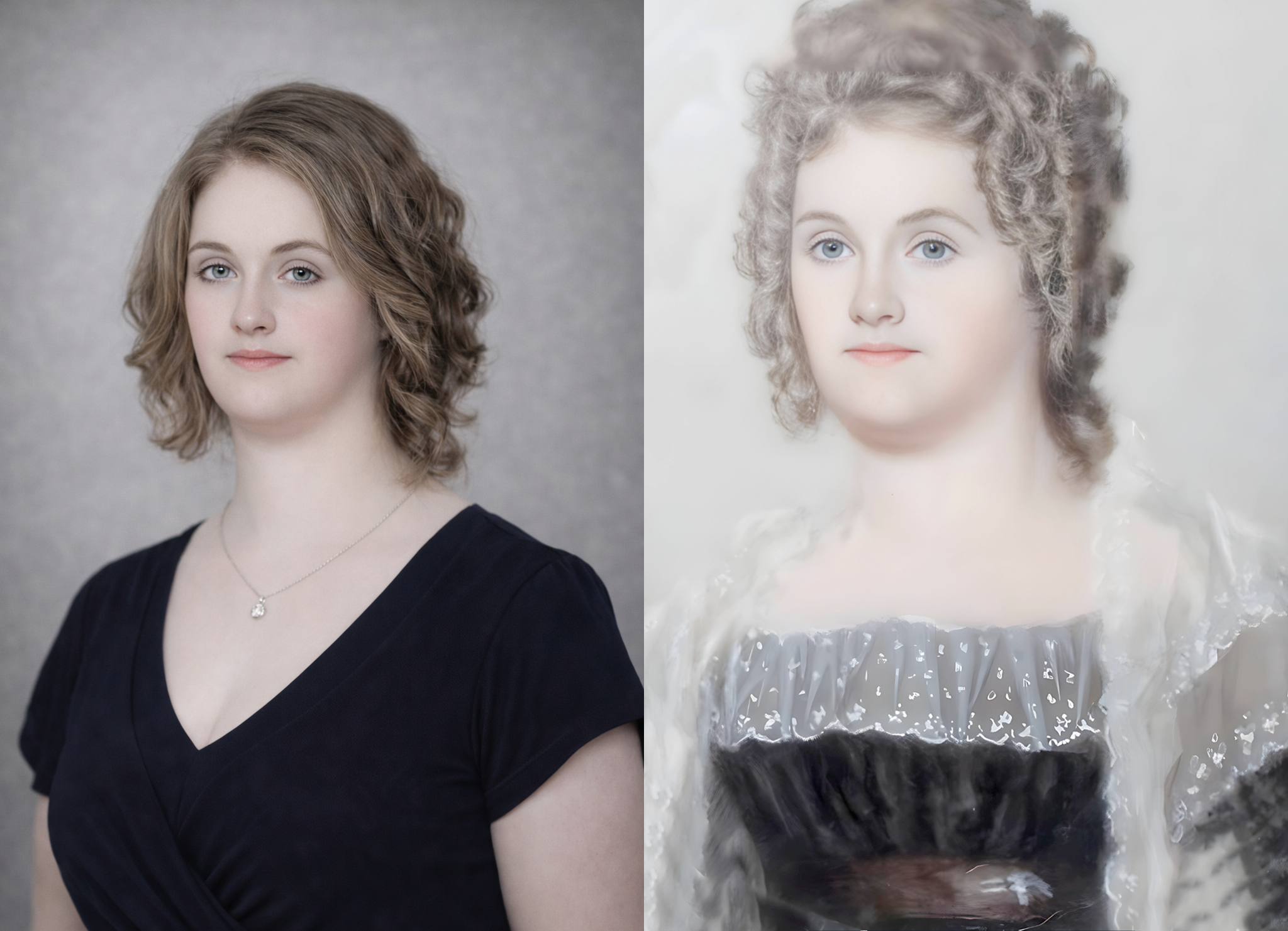
Why this image exists. It is mine, built with CGI tools from the photographs on this page. Dressing her in what a reader today would call modern clothes is deliberate. My goal is humanizing: to lift the woman out of the stiffness of nineteenth century studio portraiture and set her in a context a modern researcher can more easily make a connection with. For the same reason the grooming has been brought closer to present day styles. It is not a photograph and it should not be cited as one. It is an interpretation, offered to make the acquaintance easier, and the genuine photographs sit above it with their unaltered originals a click away. — Garland H. Green Jr.
Laura Wolcott Gibbs [d’Oremieulx] CGI rendition of what she would look like in 2025
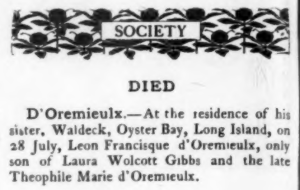
RESEARCHER’S NOTE: The image below is a death announcement of “D’Oremieux. – At the residence of his sister, Waldeck, Oyster Bay, Long Island, on 28 July, Leon Francisque d’Oremieux, only son of Laura Wolcott Gibbs and the late Theophile Marie d’Oremieux.” The image is linked to the original document.
Her War: The Woman’s Central, in Its Own Words
Section added July 13, 2026, and expanded July 13 and 14, 2026 as new records surfaced. The exhibits run in date order, 1861 to 1867.
The family Record says that when the war broke out Laura joined Louisa Lee Schuyler, Ellen Collins and others in forming the Woman’s Central Association of Relief. The association’s own first printed report, made to the United States Sanitary Commission on October 12, 1861 and reproduced below from the National Library of Medicine’s copy, confirms it three times over, and in far stronger terms than the family remembered.
The story it tells begins at the New York Infirmary for Women on April 25, 1861, twelve days after Fort Sumter, where “the providential suggestion of attempting to organize the whole benevolence of the women of the country into a general and central association was ripened into a plan.” An appeal, “To the Women of New York,” ran in the city papers, and on Monday morning, April 29, 1861, the great hall of the Cooper Institute was “completely filled in every part.” David Dudley Field took the chair; the Rev. Dr. Bellows, the Gibbs family’s own pastor at All Souls’, gave the principal address; and Vice President Hannibal Hamlin, unexpectedly present, rose to shouts of applause. Out of that meeting came the Woman’s Central Association of Relief, the organization whose petition to Washington produced the United States Sanitary Commission itself six weeks later, and whose rooms at Cooper Union registered and trained the nurses and channeled the supplies of the whole country. Laura, then thirty four, wife of the West Point professor and daughter of the widow of Winthrop Place, was in it from the first hour.
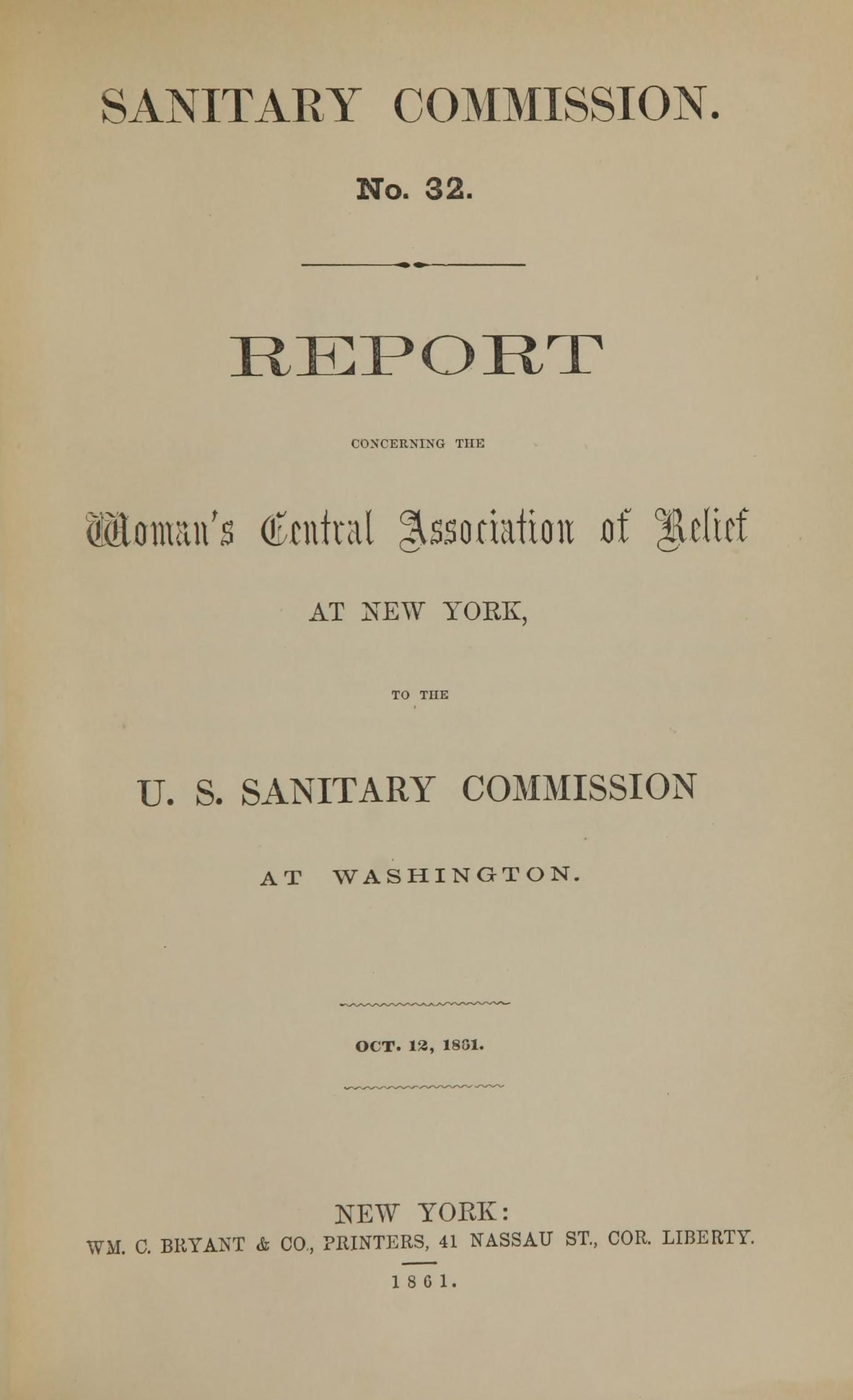
Complete transcription: title page
SANITARY COMMISSION. No. 32. REPORT concerning the Woman’s Central Association of Relief at New York, to the U. S. Sanitary Commission at Washington. Oct. 12, 1861. New York: Wm. C. Bryant & Co., Printers, 41 Nassau St., cor. Liberty. 1861.
Exhibit 1. The Board of Managers: “Mrs. d’Oremieulx”
Article X of the plan adopted at the Cooper Institute placed the association under a board of twelve ladies and twelve gentlemen. Laura stands among the twelve women, between Mrs. G. L. Schuyler and Mrs. Dr. Bayard, in company with Dr. Elizabeth Blackwell, the first woman in America to hold a medical degree. Among the twelve men: Frederick Law Olmsted and Dr. Bellows.
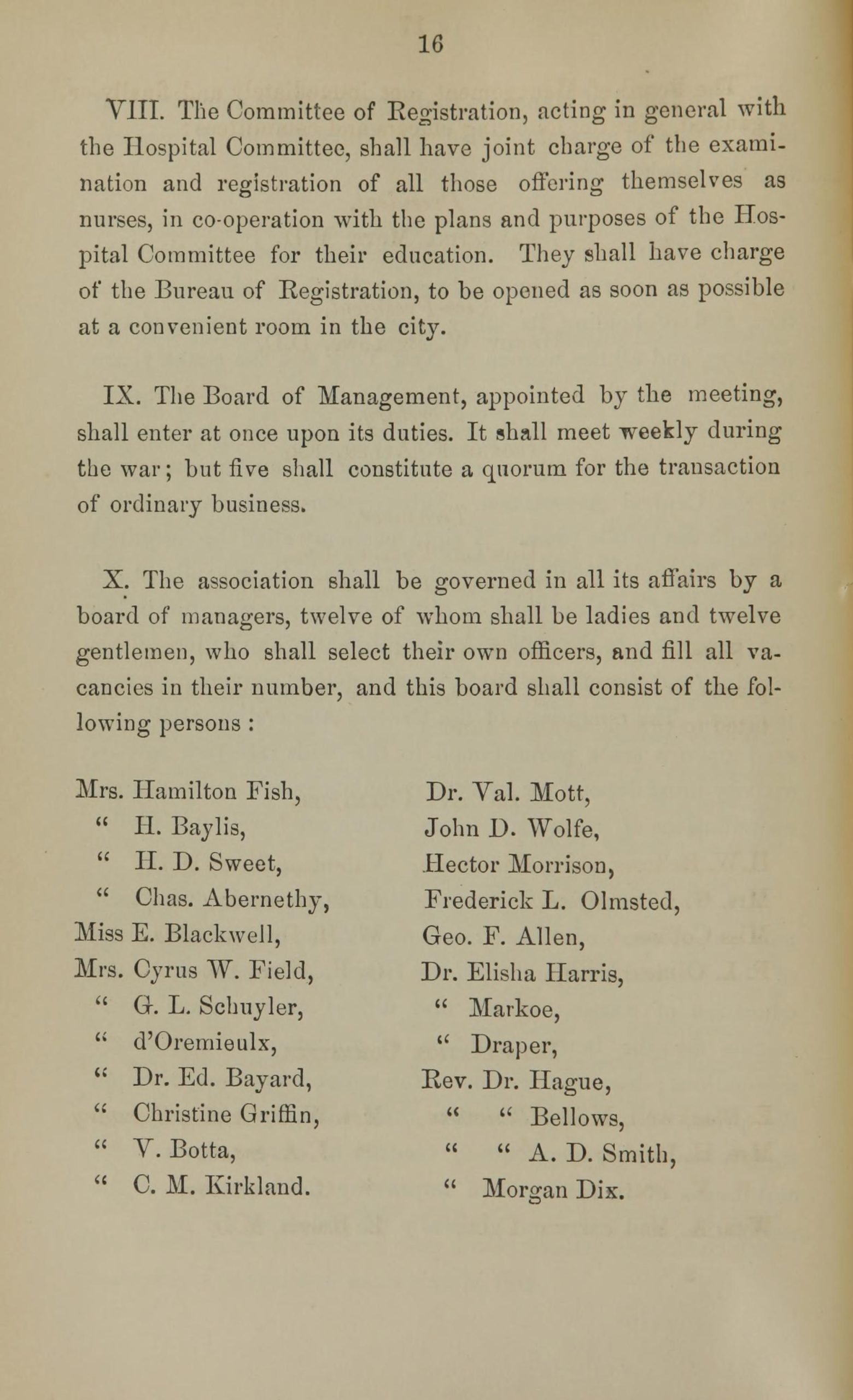
Complete transcription: page 16
IX. The Board of Management, appointed by the meeting, shall enter at once upon its duties. It shall meet weekly during the war; but five shall constitute a quorum for the transaction of ordinary business.
X. The association shall be governed in all its affairs by a board of managers, twelve of whom shall be ladies and twelve gentlemen, who shall select their own officers, and fill all vacancies in their number, and this board shall consist of the following persons:
[First column:] Mrs. Hamilton Fish, ” H. Baylis, ” H. D. Sweet, ” Chas. Abernethy, Miss E. Blackwell, Mrs. Cyrus W. Field, ” G. L. Schuyler, ” d’Oremieulx, ” Dr. Ed. Bayard, ” Christine Griffin, ” V. Botta, ” C. M. Kirkland.
[Second column:] Dr. Val. Mott, John D. Wolfe, Hector Morrison, Frederick L. Olmsted, Geo. F. Allen, Dr. Elisha Harris, ” Markoe, ” Draper, Rev. Dr. Hague, ” ” Bellows, ” ” A. D. Smith, ” Morgan Dix. (The ditto marks carry “Mrs.,” “Dr.” and “Rev. Dr.” down each column.)
Exhibit 2. The Executive Committee, chaired by Dr. Bellows
When the board organized, it elected Dr. Valentine Mott president and Bellows vice president, and constituted an Executive Committee of eight. The list reads like the future high command of wartime relief: Bellows in the chair, Schuyler, Collins, Olmsted, and “T. d’Oremieulx.” The printed form gives only the initial, which was the usage of the day for a married woman styled by her husband’s name; that the d’Oremieulx of this committee was Laura is fixed by the report itself, which speaks on page 32 of “one of the ladies of this Committee, Mrs. d’Oremieulx,” and by the family Record, which places her precisely in this company, with Schuyler and Collins.
A note on the names in this list. The “Mrs. G. L. Schuyler” of the Executive Committee is Mrs. George Lee Schuyler, born Eliza Hamilton, a granddaughter of Alexander Hamilton; her daughter, Miss Louisa Lee Schuyler, then twenty three, served as the association’s corresponding secretary at Cooper Union and after the war founded the Bellevue Training School for Nurses with Laura’s help. “Miss Collins” is Ellen Collins, who ran the supply service and later pioneered housing reform in New York. Which means this committee of eight seated, side by side, two women whose grandfathers were the first and second Secretaries of the Treasury: Hamilton’s granddaughter and Wolcott’s. The bond was older than the war. Laura’s mother painted the miniature of Hamilton shown on the Winthrop Place page, and the Washington wine coolers of the family story came from a single set, one given to Hamilton, the other to Governor Wolcott. It is worth pausing on the company. Nearly every name in this small circle now carries its own place in the histories: Blackwell, Olmsted, Bellows, Schuyler, Collins. That Laura Gibbs d’Oremieulx sat among them as an equal, on the eight member executive of the association that supplied the Union armies, and was the one member its first report singled out by name for thanks, marks her not as a helper in the movement but as one of its leaders.
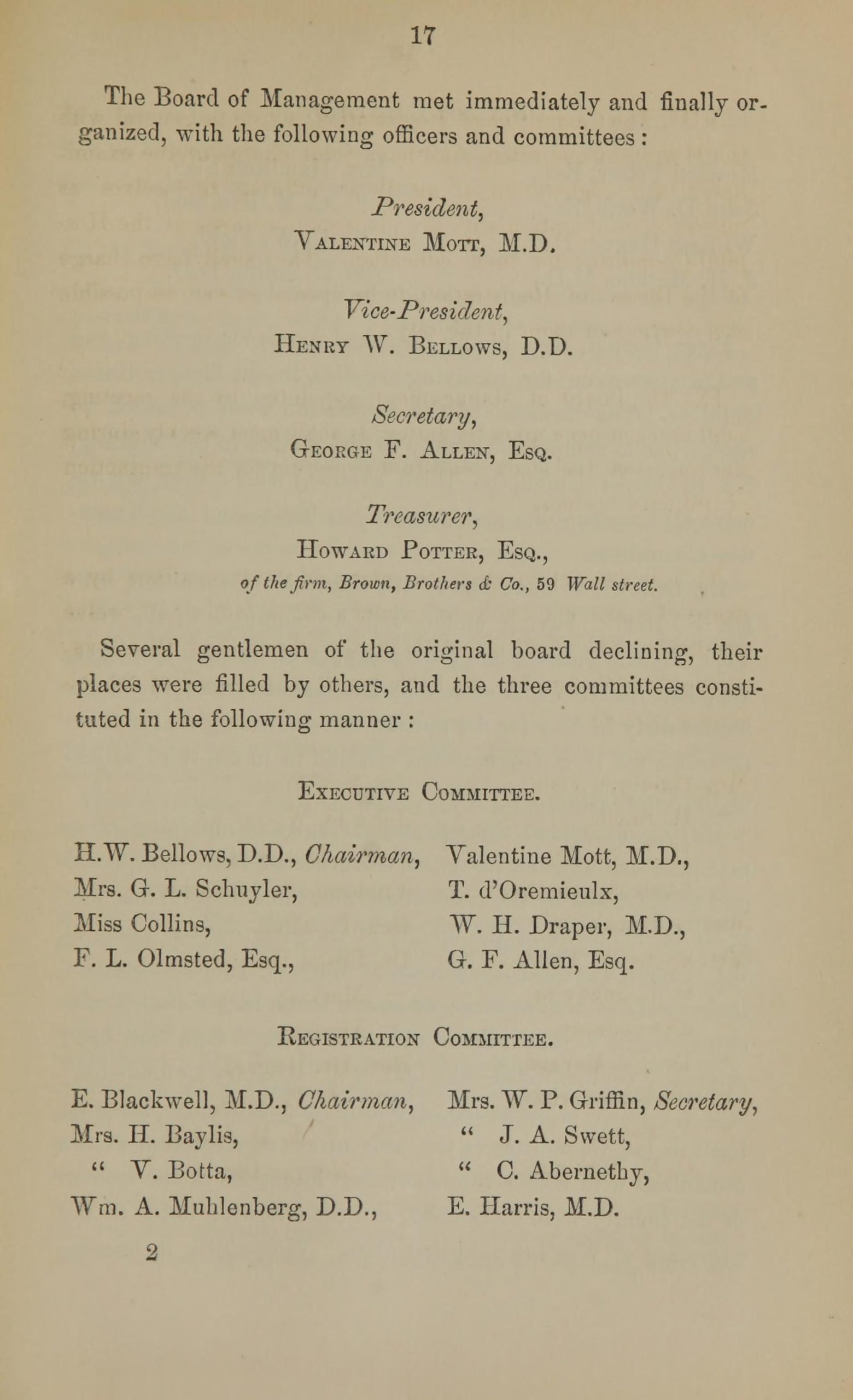
Complete transcription: page 17
The Board of Management met immediately and finally organized, with the following officers and committees: President, Valentine Mott, M.D. Vice-President, Henry W. Bellows, D.D. Secretary, George F. Allen, Esq. Treasurer, Howard Potter, Esq., of the firm, Brown, Brothers & Co., 59 Wall street.
Several gentlemen of the original board declining, their places were filled by others, and the three committees constituted in the following manner:
Executive Committee. H. W. Bellows, D.D., Chairman, Mrs. G. L. Schuyler, Miss Collins, F. L. Olmsted, Esq., Valentine Mott, M.D., T. d’Oremieulx, W. H. Draper, M.D., G. F. Allen, Esq.
Exhibit 3. The tribute: “a most vital start”
Deep in the report’s account of the supply service, six months of garments, bedding and stores shipped free by the express companies to Washington and St. Louis, the writers stop to thank exactly one member by name. She was abroad by then, which by the courtesy of the day made it proper to praise her in print.
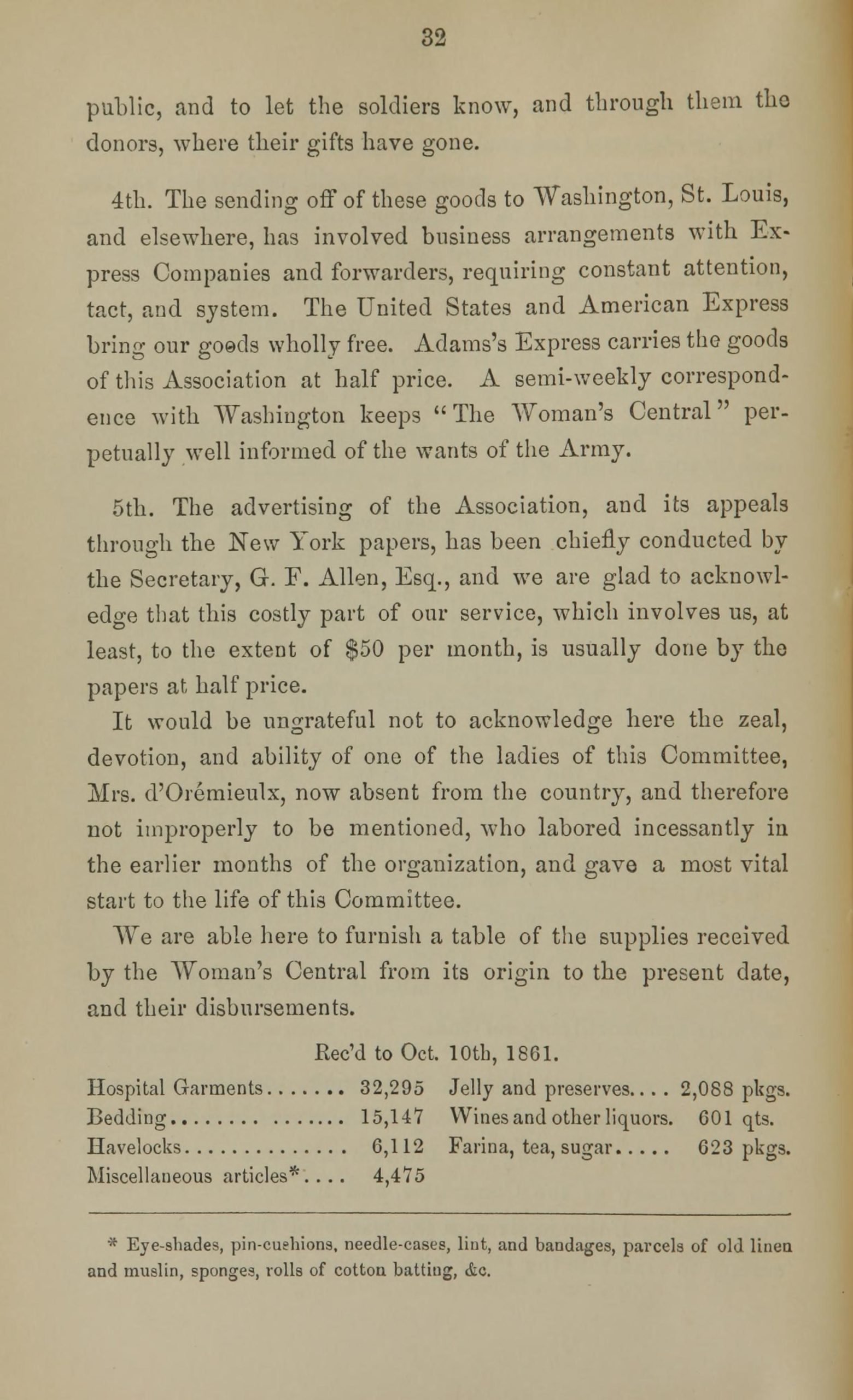
Complete transcription: page 32
public, and to let the soldiers know, and through them the donors, where their gifts have gone.
4th. The sending off of these goods to Washington, St. Louis, and elsewhere, has involved business arrangements with Express Companies and forwarders, requiring constant attention, tact, and system. The United States and American Express bring our goods wholly free. Adams’s Express carries the goods of this Association at half price. A semi-weekly correspondence with Washington keeps “The Woman’s Central” perpetually well informed of the wants of the Army.
5th. The advertising of the Association, and its appeals through the New York papers, has been chiefly conducted by the Secretary, G. F. Allen, Esq., and we are glad to acknowledge that this costly part of our service, which involves us, at least, to the extent of $50 per month, is usually done by the papers at half price.
It would be ungrateful not to acknowledge here the zeal, devotion, and ability of one of the ladies of this Committee, Mrs. d’Oremieulx, now absent from the country, and therefore not improperly to be mentioned, who labored incessantly in the earlier months of the organization, and gave a most vital start to the life of this Committee.
We are able here to furnish a table of the supplies received by the Woman’s Central from its origin to the present date, and their disbursements. Rec’d to Oct. 10th, 1861. Hospital Garments, 32,295. Bedding, 15,147. Havelocks, 6,112. Miscellaneous articles*, 4,475. Jelly and preserves, 2,088 pkgs. Wines and other liquors, 601 qts. Farina, tea, sugar, 623 pkgs. *Eye-shades, pin-cushions, needle-cases, lint, and bandages, parcels of old linen and muslin, sponges, rolls of cotton batting, &c.
Exhibit 4. Back at the table: November 1, 1862
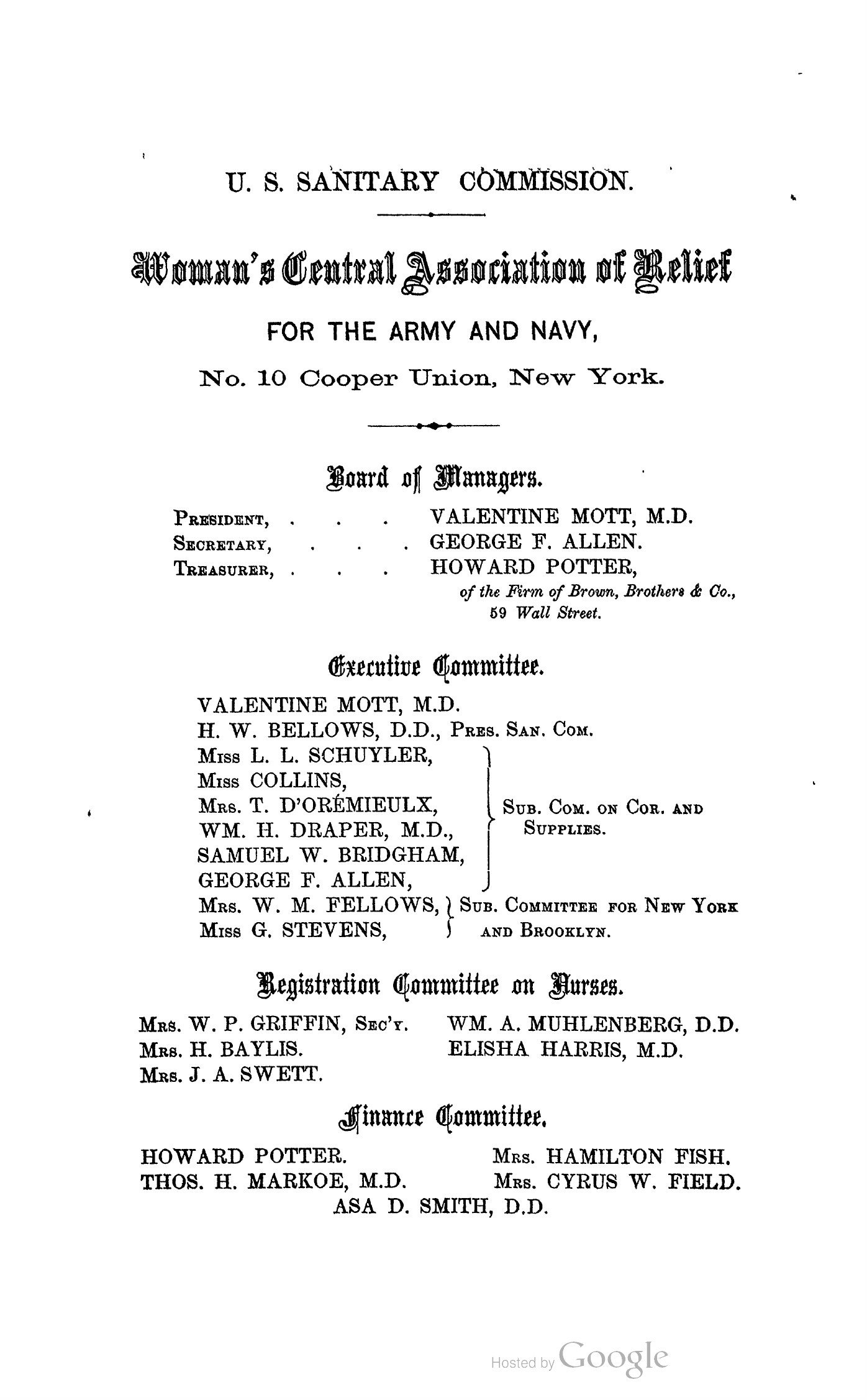
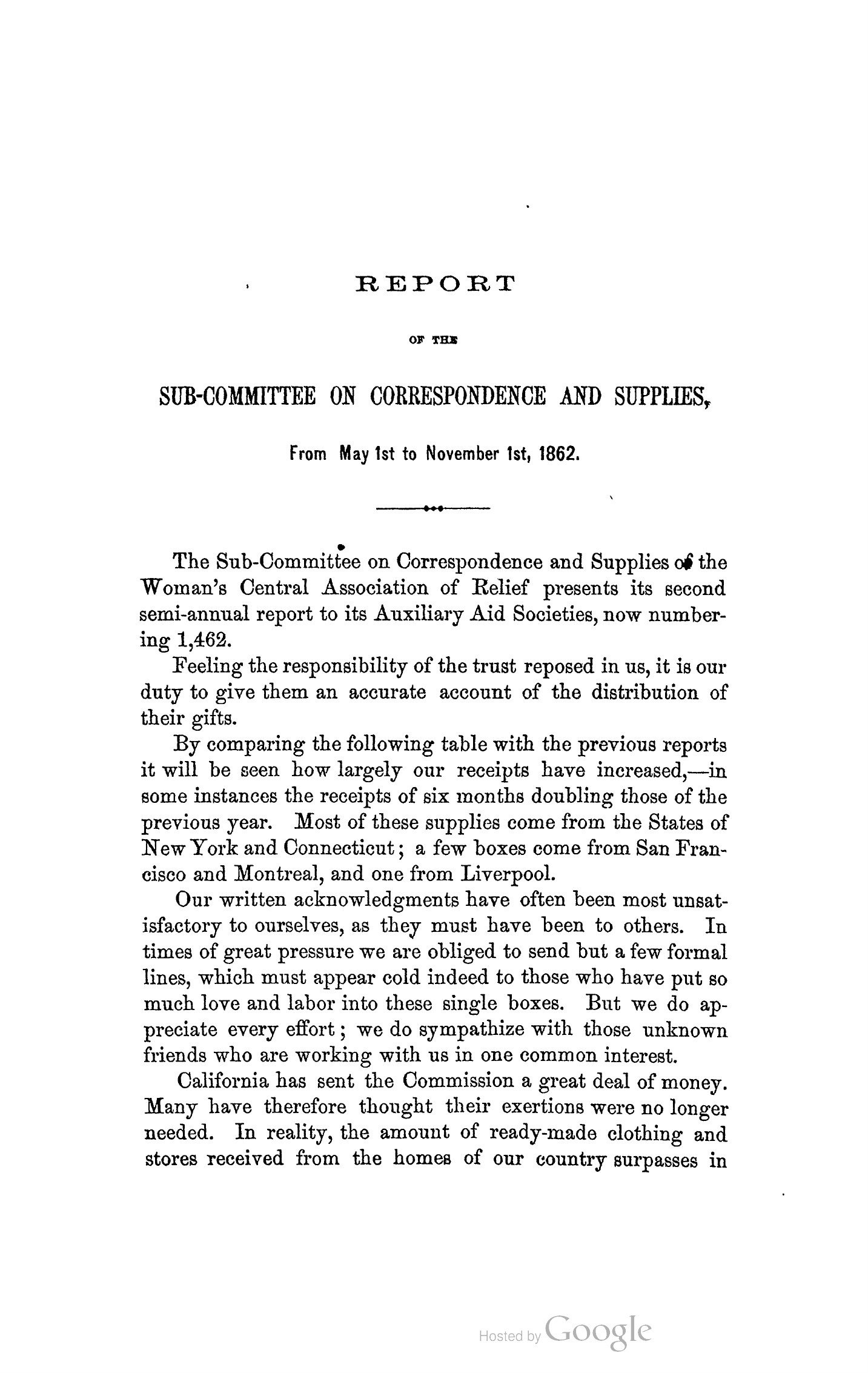
Brockett’s 1867 history, shown in Exhibit 9 below, says she resumed her duties after a year abroad. The association’s own printing fixes the date. Its Second Semi-Annual Report, issued from 10 Cooper Union on November 1, 1862, opens with the roster, and there she is, restored to the Executive Committee, with a printed brace binding six of its members, Schuyler, Collins, d’Oremieulx, Draper, Bridgham and Allen, into the Sub-Committee on Correspondence and Supplies. The sub-committee’s own half-year report follows in the same pamphlet, addressed to a network that had grown to 1,462 auxiliary aid societies. The copy shown is the University of Michigan’s, from a bound set of the association’s reports digitized by Google.
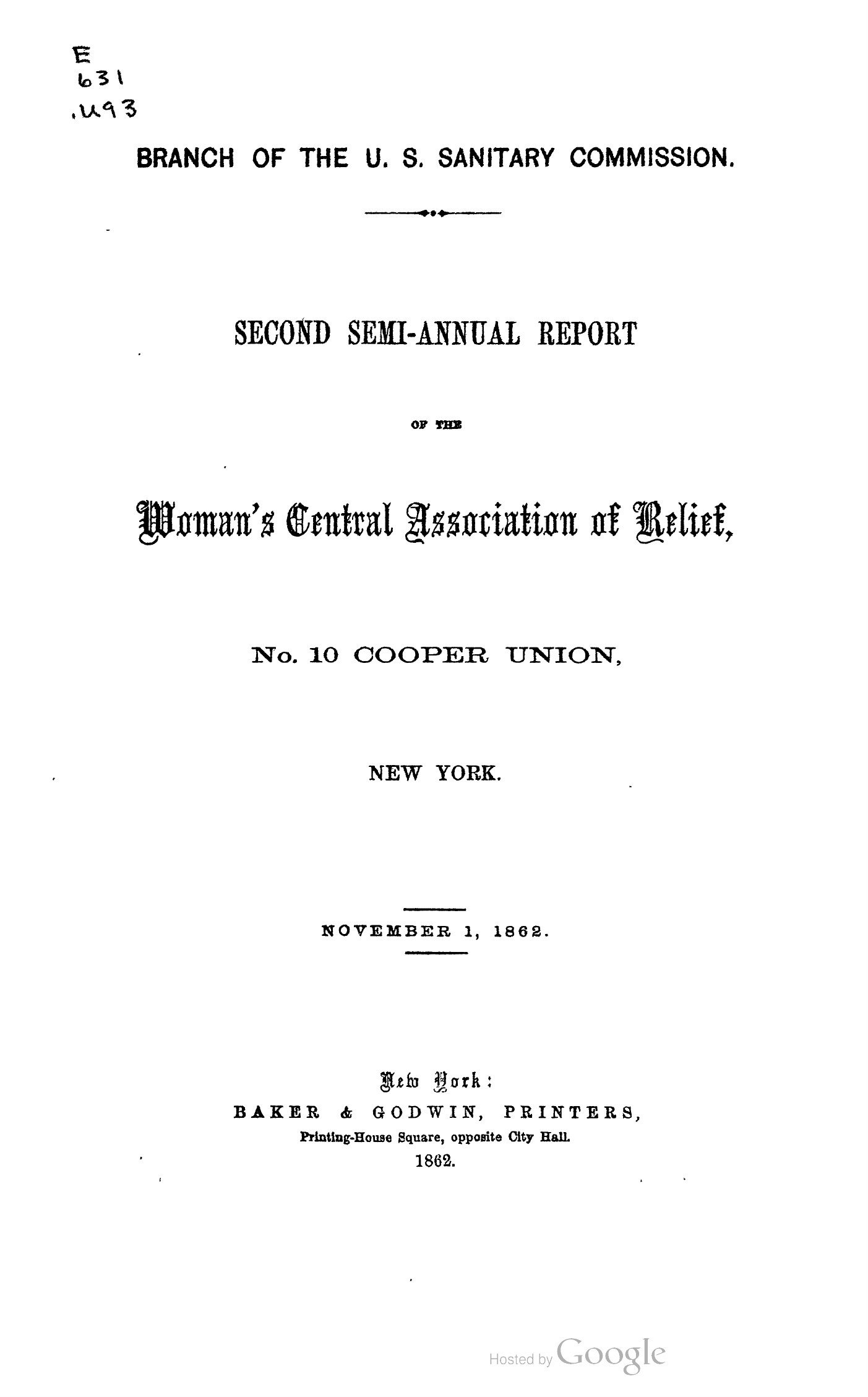
Complete transcription: the title page
BRANCH OF THE U. S. SANITARY COMMISSION. SECOND SEMI-ANNUAL REPORT OF THE Woman’s Central Association of Relief, No. 10 COOPER UNION, NEW YORK. NOVEMBER 1, 1862. New York: BAKER & GODWIN, PRINTERS, Printing-House Square, opposite City Hall. 1862. [Penciled at the head: the library shelf mark E 631 .U93.]
Complete transcription: the officers page
U. S. SANITARY COMMISSION. Woman’s Central Association of Relief FOR THE ARMY AND NAVY, No. 10 Cooper Union, New York.
Board of Managers. PRESIDENT, VALENTINE MOTT, M.D. SECRETARY, GEORGE F. ALLEN. TREASURER, HOWARD POTTER, of the Firm of Brown, Brothers & Co., 59 Wall Street.
Executive Committee. VALENTINE MOTT, M.D. H. W. BELLOWS, D.D., PRES. SAN. COM. Miss L. L. SCHUYLER, Miss COLLINS, Mrs. T. D’ORÉMIEULX, WM. H. DRAPER, M.D., SAMUEL W. BRIDGHAM, GEORGE F. ALLEN, [the six names joined by a printed brace] SUB. COM. ON COR. AND SUPPLIES. Mrs. W. M. FELLOWS, Miss G. STEVENS, [braced] SUB. COMMITTEE FOR NEW YORK AND BROOKLYN.
Finance Committee. HOWARD POTTER. THOS. H. MARKOE, M.D. ASA D. SMITH, D.D. Mrs. HAMILTON FISH. Mrs. CYRUS W. FIELD.
Complete transcription: the report’s first page
REPORT OF THE SUB-COMMITTEE ON CORRESPONDENCE AND SUPPLIES, From May 1st to November 1st, 1862.
The Sub-Committee on Correspondence and Supplies of the Woman’s Central Association of Relief presents its second semi-annual report to its Auxiliary Aid Societies, now numbering 1,462.
Feeling the responsibility of the trust reposed in us, it is our duty to give them an accurate account of the distribution of their gifts.
By comparing the following table with the previous reports it will be seen how largely our receipts have increased, — in some instances the receipts of six months doubling those of the previous year. Most of these supplies come from the States of New York and Connecticut; a few boxes come from San Francisco and Montreal, and one from Liverpool.
Our written acknowledgments have often been most unsatisfactory to ourselves, as they must have been to others. In times of great pressure we are obliged to send but a few formal lines, which must appear cold indeed to those who have put so much love and labor into these single boxes. But we do appreciate every effort; we do sympathize with those unknown friends who are working with us in one common interest.
California has sent the Commission a great deal of money. Many have therefore thought their exertions were no longer needed. In reality, the amount of ready-made clothing and stores received from the homes of our country surpasses in [the sentence continues on the next page of the pamphlet]
Exhibit 5. Back at her post: the circular of January 13, 1863
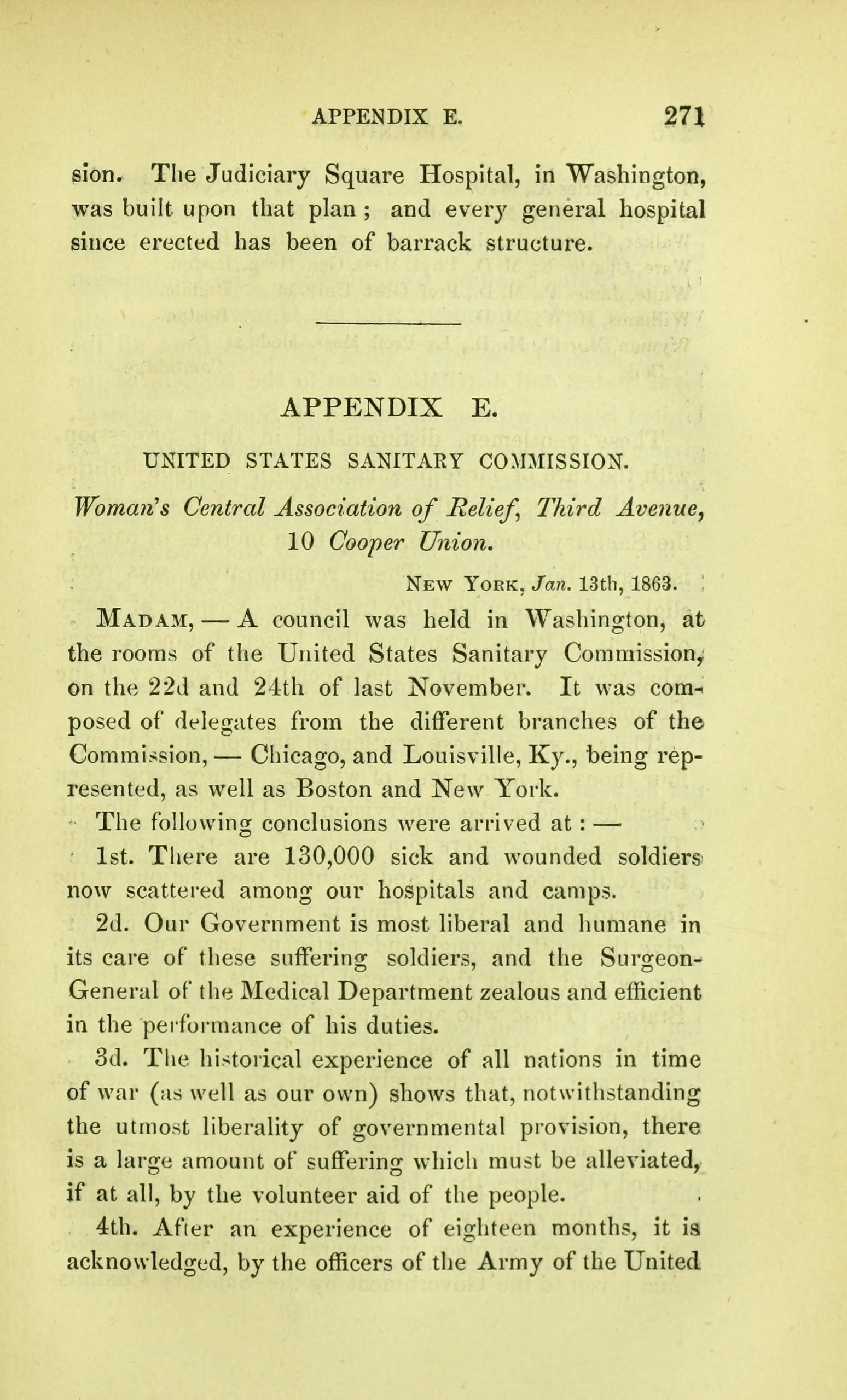
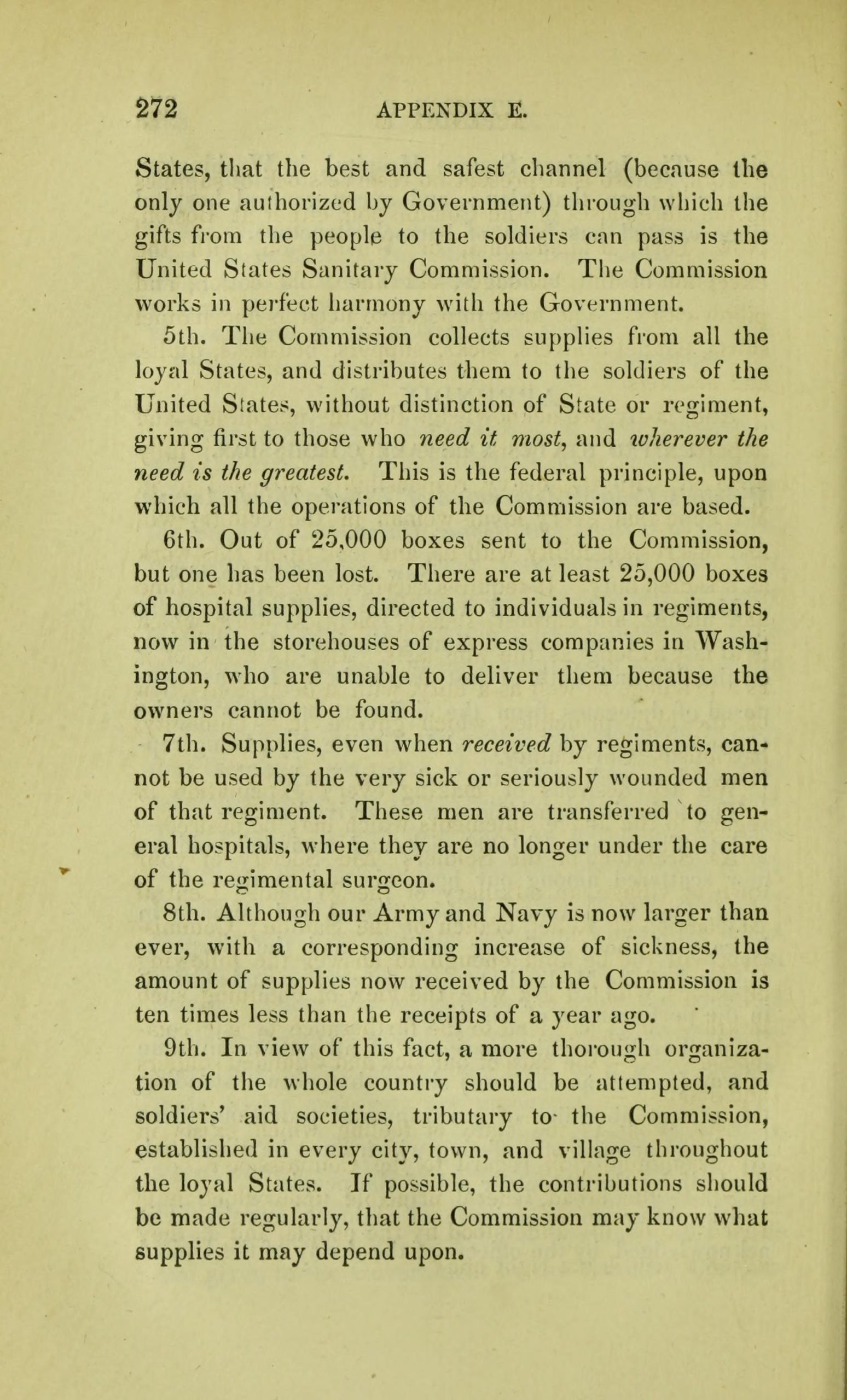
The tribute in Exhibit 3 was written in her absence; Exhibit 4 above shows her back at the table. In November 1862 the Sanitary Commission called a council in Washington of delegates from its principal branches, and two months later the Woman’s Central mailed a printed circular to the secretary of every auxiliary aid society in its territory. It carries the conclusions of that council, a frank confession that the supply rooms stood empty after Antietam and Fredericksburg, and seven questions whose answers came back in two hundred and thirty five letters. Six names stand at its foot as the Committee on Correspondence and Supplies, the committee that conducted the association’s entire correspondence with its network of aid societies, and the third of them is Mrs. T. d’Oremieulx. The Sanitary Commission reprinted the circular that same year as Appendix E of its book A Sketch of Its Purposes and Its Work, which is the copy shown here. The committee also issued the circular, with the analysis of the 235 replies, as its own pamphlet from 10 Cooper Union; the National Library of Medicine’s copy of that original printing is digitized at archive.org.
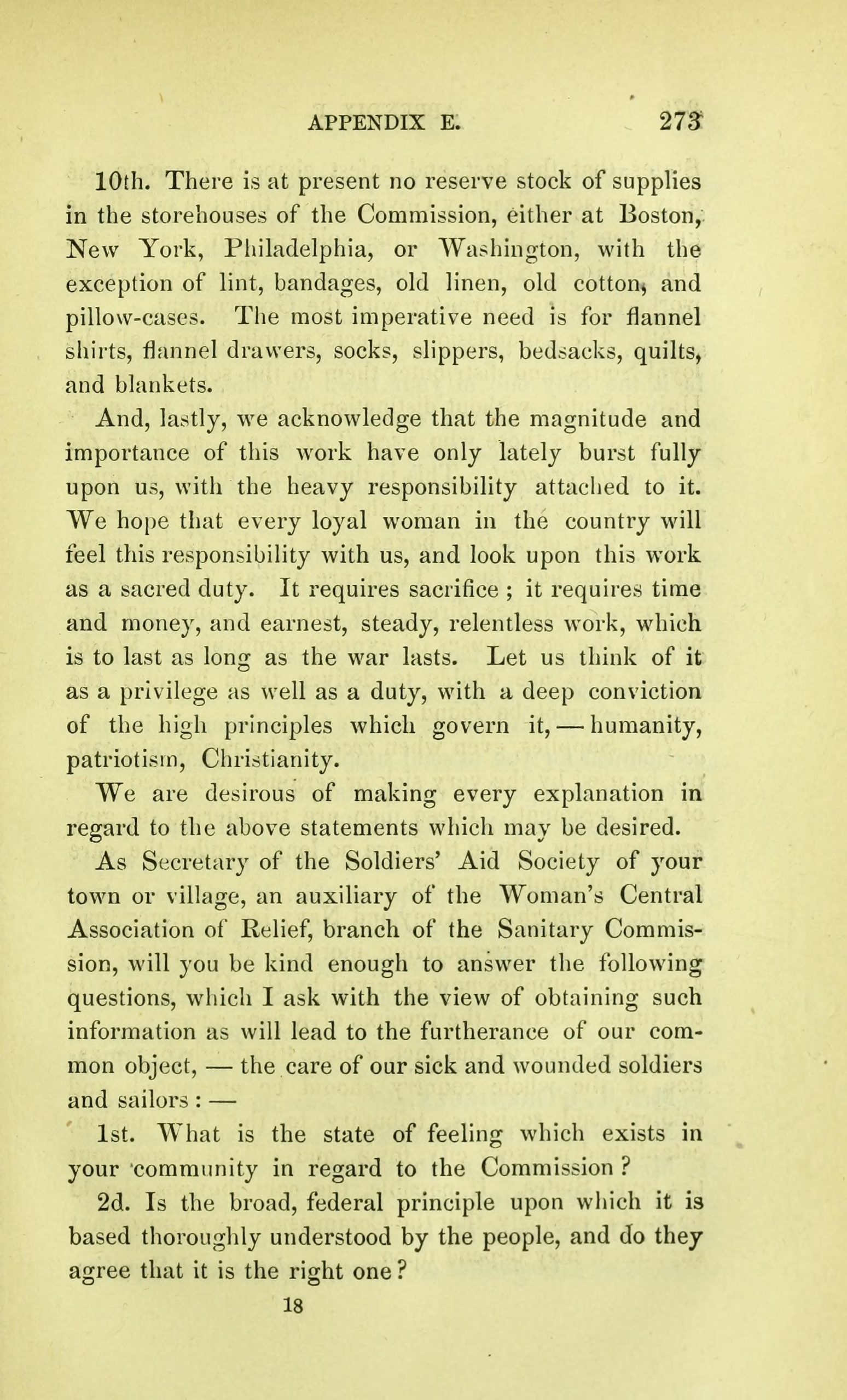
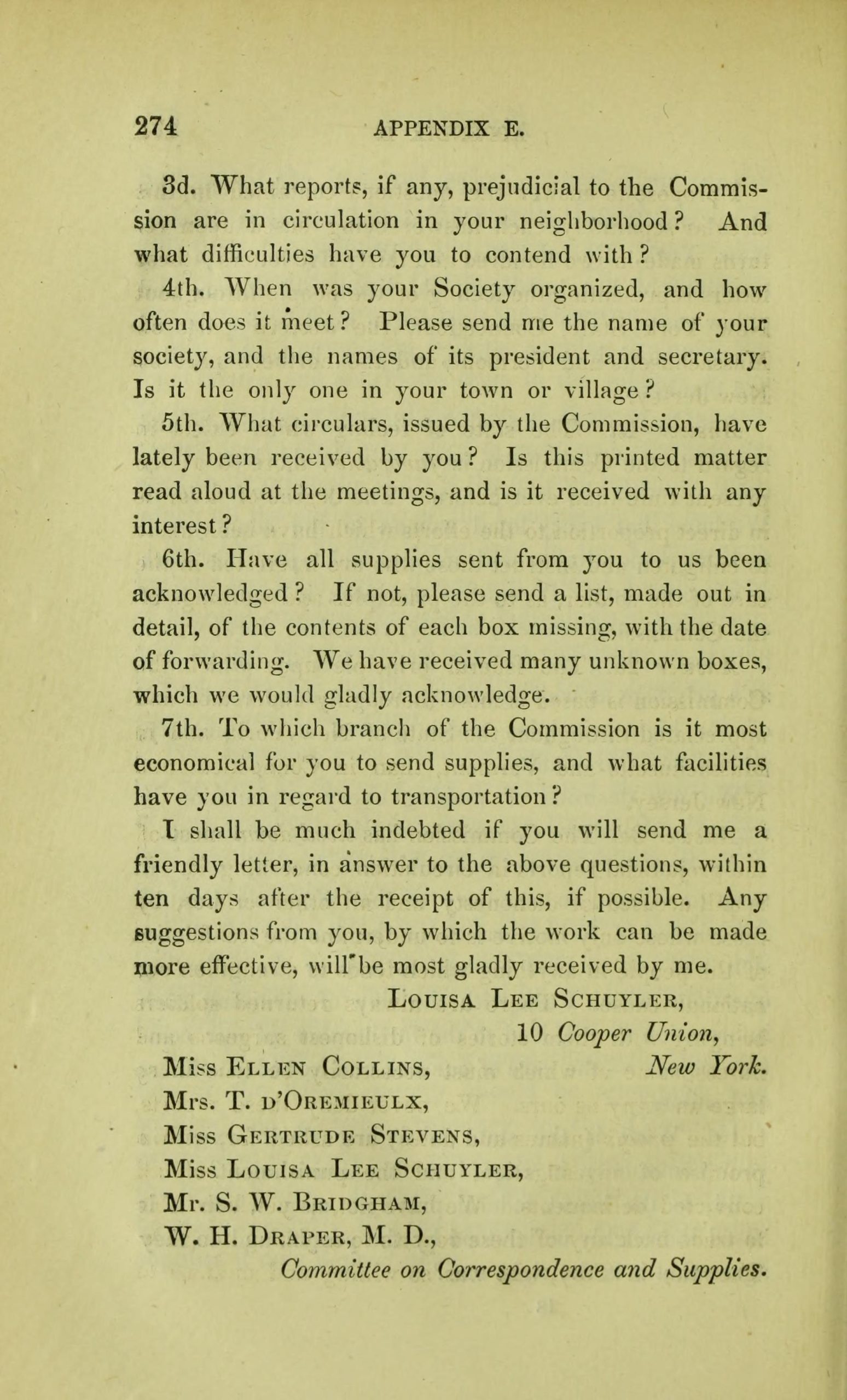
Complete transcription: the circular, pages 271 to 274
APPENDIX E. UNITED STATES SANITARY COMMISSION. Woman’s Central Association of Relief, Third Avenue, 10 Cooper Union. New York, Jan. 13th, 1863.
Madam, — A council was held in Washington, at the rooms of the United States Sanitary Commission, on the 22d and 24th of last November. It was composed of delegates from the different branches of the Commission, — Chicago, and Louisville, Ky., being represented, as well as Boston and New York.
The following conclusions were arrived at: —
1st. There are 130,000 sick and wounded soldiers now scattered among our hospitals and camps.
2d. Our Government is most liberal and humane in its care of these suffering soldiers, and the Surgeon-General of the Medical Department zealous and efficient in the performance of his duties.
3d. The historical experience of all nations in time of war (as well as our own) shows that, notwithstanding the utmost liberality of governmental provision, there is a large amount of suffering which must be alleviated, if at all, by the volunteer aid of the people.
4th. After an experience of eighteen months, it is acknowledged, by the officers of the Army of the United States, that the best and safest channel (because the only one authorized by Government) through which the gifts from the people to the soldiers can pass is the United States Sanitary Commission. The Commission works in perfect harmony with the Government.
5th. The Commission collects supplies from all the loyal States, and distributes them to the soldiers of the United States, without distinction of State or regiment, giving first to those who need it most, and wherever the need is the greatest. This is the federal principle, upon which all the operations of the Commission are based.
6th. Out of 25,000 boxes sent to the Commission, but one has been lost. There are at least 25,000 boxes of hospital supplies, directed to individuals in regiments, now in the storehouses of express companies in Washington, who are unable to deliver them because the owners cannot be found.
7th. Supplies, even when received by regiments, cannot be used by the very sick or seriously wounded men of that regiment. These men are transferred to general hospitals, where they are no longer under the care of the regimental surgeon.
8th. Although our Army and Navy is now larger than ever, with a corresponding increase of sickness, the amount of supplies now received by the Commission is ten times less than the receipts of a year ago.
9th. In view of this fact, a more thorough organization of the whole country should be attempted, and soldiers’ aid societies, tributary to the Commission, established in every city, town, and village throughout the loyal States. If possible, the contributions should be made regularly, that the Commission may know what supplies it may depend upon.
10th. There is at present no reserve stock of supplies in the storehouses of the Commission, either at Boston, New York, Philadelphia, or Washington, with the exception of lint, bandages, old linen, old cotton, and pillow-cases. The most imperative need is for flannel shirts, flannel drawers, socks, slippers, bedsacks, quilts, and blankets.
And, lastly, we acknowledge that the magnitude and importance of this work have only lately burst fully upon us, with the heavy responsibility attached to it. We hope that every loyal woman in the country will feel this responsibility with us, and look upon this work as a sacred duty. It requires sacrifice; it requires time and money, and earnest, steady, relentless work, which is to last as long as the war lasts. Let us think of it as a privilege as well as a duty, with a deep conviction of the high principles which govern it, — humanity, patriotism, Christianity.
We are desirous of making every explanation in regard to the above statements which may be desired.
As Secretary of the Soldiers’ Aid Society of your town or village, an auxiliary of the Woman’s Central Association of Relief, branch of the Sanitary Commission, will you be kind enough to answer the following questions, which I ask with the view of obtaining such information as will lead to the furtherance of our common object, — the care of our sick and wounded soldiers and sailors: —
1st. What is the state of feeling which exists in your community in regard to the Commission?
2d. Is the broad, federal principle upon which it is based thoroughly understood by the people, and do they agree that it is the right one?
3d. What reports, if any, prejudicial to the Commission are in circulation in your neighborhood? And what difficulties have you to contend with?
4th. When was your Society organized, and how often does it meet? Please send me the name of your society, and the names of its president and secretary. Is it the only one in your town or village?
5th. What circulars, issued by the Commission, have lately been received by you? Is this printed matter read aloud at the meetings, and is it received with any interest?
6th. Have all supplies sent from you to us been acknowledged? If not, please send a list, made out in detail, of the contents of each box missing, with the date of forwarding. We have received many unknown boxes, which we would gladly acknowledge.
7th. To which branch of the Commission is it most economical for you to send supplies, and what facilities have you in regard to transportation?
I shall be much indebted if you will send me a friendly letter, in answer to the above questions, within ten days after the receipt of this, if possible. Any suggestions from you, by which the work can be made more effective, will be most gladly received by me.
Louisa Lee Schuyler, 10 Cooper Union, New York.
Miss Ellen Collins,
Mrs. T. d’Oremieulx,
Miss Gertrude Stevens,
Miss Louisa Lee Schuyler,
Mr. S. W. Bridgham,
W. H. Draper, M. D.,
Committee on Correspondence and Supplies.
Exhibit 6. The Second Annual Report, May 1, 1863
The report that closed the association’s second year prints her on the fourteen-member Executive Committee, in the right-hand column between Miss Schuyler and Mrs. Curtis. A note on copies, in fairness to the record: the National Library of Medicine’s scan of this report, the only one we had on July 13, carries a pasted library slip square across this page, hiding every name in that right-hand column, hers among them. The University of Michigan’s copy, found the next day through HathiTrust and Google Books, shows the page whole.
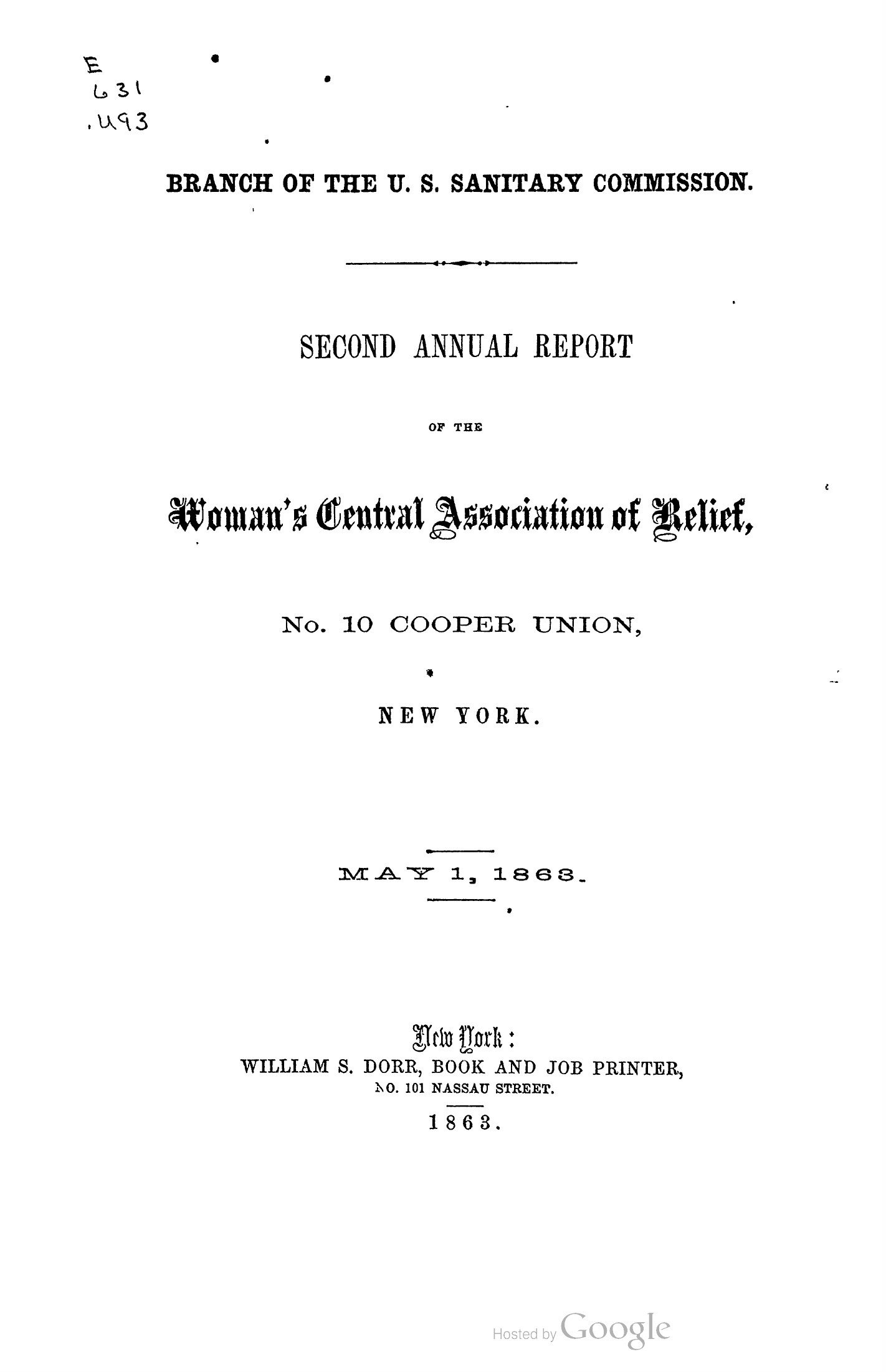
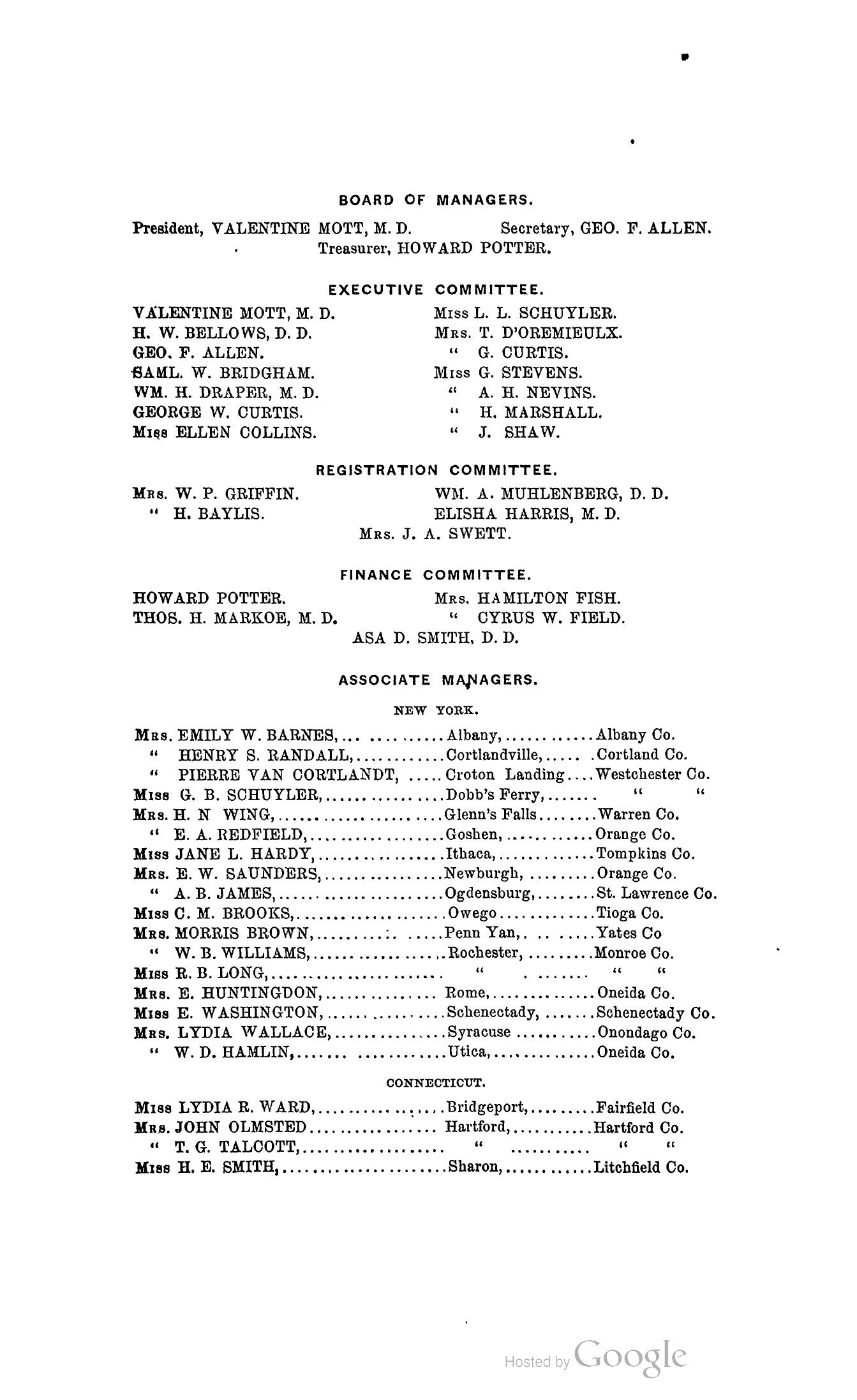
Complete transcription: the title page
BRANCH OF THE U. S. SANITARY COMMISSION. SECOND ANNUAL REPORT OF THE Woman’s Central Association of Relief, No. 10 COOPER UNION, NEW YORK. MAY 1, 1863. New York: WILLIAM S. DORR, BOOK AND JOB PRINTER, No. 101 NASSAU STREET. 1863.
Complete transcription: the Board of Managers page
BOARD OF MANAGERS. President, VALENTINE MOTT, M. D. Secretary, GEO. F. ALLEN. Treasurer, HOWARD POTTER.
EXECUTIVE COMMITTEE. VALENTINE MOTT, M. D. H. W. BELLOWS, D. D. GEO. F. ALLEN. SAML. W. BRIDGHAM. WM. H. DRAPER, M. D. GEORGE W. CURTIS. Miss ELLEN COLLINS. Miss L. L. SCHUYLER. Mrs. T. D’OREMIEULX. Mrs. G. CURTIS. Miss G. STEVENS. Mrs. A. H. NEVINS. Mrs. H. MARSHALL. Mrs. J. SHAW.
FINANCE COMMITTEE. HOWARD POTTER. THOS. H. MARKOE, M. D. ASA D. SMITH, D. D. Mrs. HAMILTON FISH. Mrs. CYRUS W. FIELD.
ASSOCIATE MANAGERS. NEW YORK. Mrs. EMILY W. BARNES, Albany, Albany Co. Mrs. HENRY S. RANDALL, Cortlandville, Cortland Co. Mrs. PIERRE VAN CORTLANDT, Croton Landing, Westchester Co. Miss G. B. SCHUYLER, Dobb’s Ferry, Westchester Co. Mrs. H. N. WING, Glenn’s Falls, Warren Co. Mrs. E. A. REDFIELD, Goshen, Orange Co. Miss JANE L. HARDY, Ithaca, Tompkins Co. Mrs. E. W. SAUNDERS, Newburgh, Orange Co. Mrs. A. B. JAMES, Ogdensburg, St. Lawrence Co. Miss C. M. BROOKS, Owego, Tioga Co. Mrs. MORRIS BROWN, Penn Yan, Yates Co. Mrs. W. B. WILLIAMS, Rochester, Monroe Co. Miss R. B. LONG, Rochester, Monroe Co. Mrs. E. HUNTINGDON, Rome, Oneida Co. Miss E. WASHINGTON, Schenectady, Schenectady Co. Mrs. LYDIA WALLACE, Syracuse, Onondago Co. Mrs. W. D. HAMLIN, Utica, Oneida Co.
CONNECTICUT. Miss LYDIA R. WARD, Bridgeport, Fairfield Co. Mrs. JOHN OLMSTED, Hartford, Hartford Co. Mrs. T. G. TALCOTT, Hartford, Hartford Co. Miss H. E. SMITH, Sharon, Litchfield Co.
Exhibit 7. The Third Annual Report, May 1, 1864
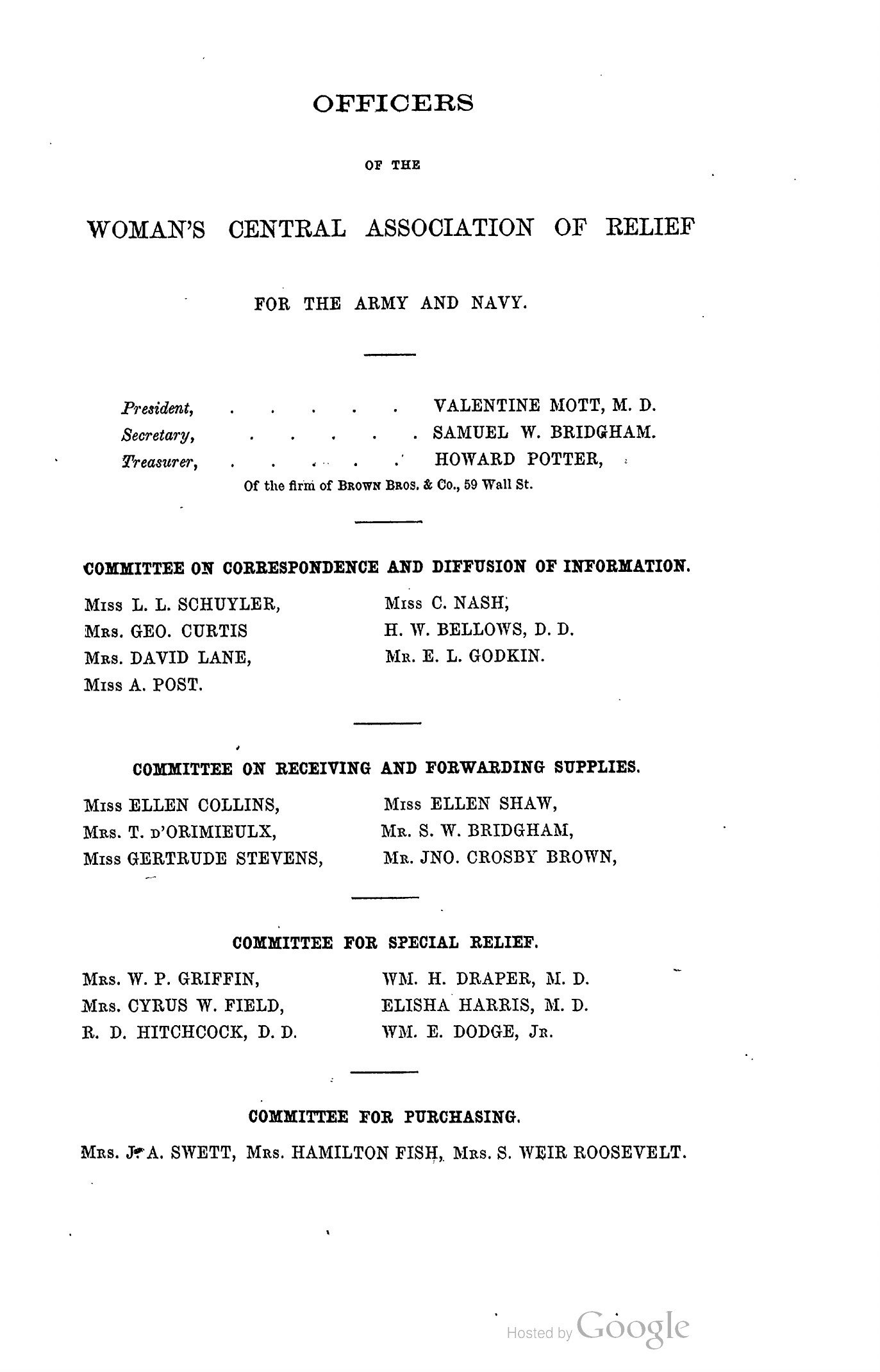
By the third year the standing committees had taken their final shape, and she appears where she would remain to the end: on the Committee on Receiving and Forwarding Supplies, directly after Ellen Collins, beside Gertrude Stevens, Ellen Shaw, Mr. Bridgham, and John Crosby Brown of the banking house. On the sister committee for correspondence sits Mr. E. L. Godkin, soon to found The Nation, and on the purchasing committee Mrs. S. Weir Roosevelt, of the family her daughter would marry into twenty years later. The printer this year set her name “d’Orimieulx”; the 1865 report, in Exhibit 8, spells it correctly. The report was issued as No. 9 in the association’s document series, from its enlarged rooms at Nos. 7, 10 and 11 Cooper Union.
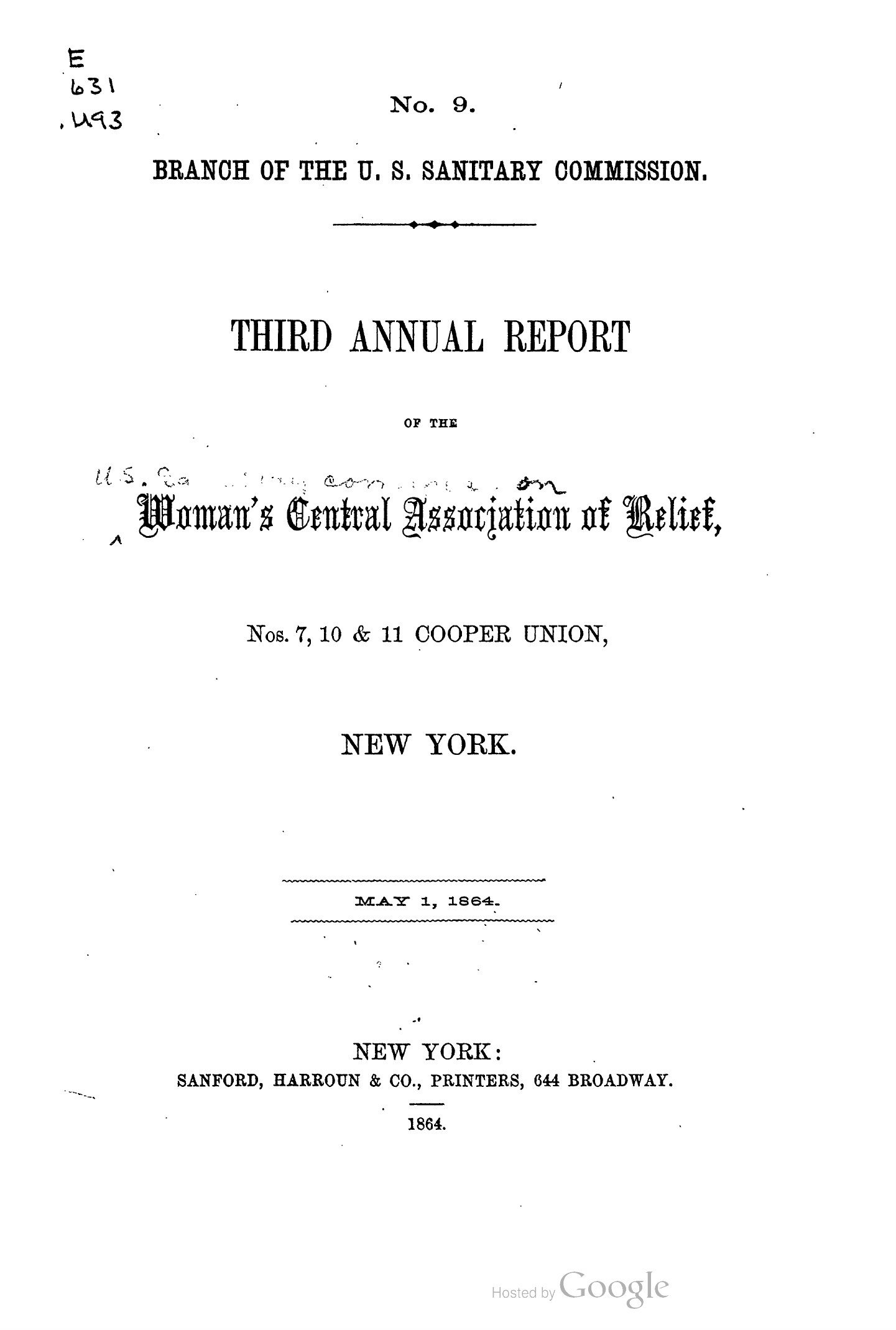
Complete transcription: the title page
No. 9. BRANCH OF THE U. S. SANITARY COMMISSION. THIRD ANNUAL REPORT OF THE Woman’s Central Association of Relief, Nos. 7, 10 & 11 COOPER UNION, NEW YORK. MAY 1, 1864. NEW YORK: SANFORD, HARROUN & CO., PRINTERS, 644 BROADWAY. 1864. [A reader has penciled “U.S. Sanitary Commission” above the association’s name.]
Complete transcription: the officers page
OFFICERS OF THE WOMAN’S CENTRAL ASSOCIATION OF RELIEF FOR THE ARMY AND NAVY. President, VALENTINE MOTT, M. D. Secretary, SAMUEL W. BRIDGHAM. Treasurer, HOWARD POTTER, Of the firm of BROWN BROS. & Co., 59 Wall St.
COMMITTEE ON CORRESPONDENCE AND DIFFUSION OF INFORMATION. Miss L. L. SCHUYLER, Mrs. GEO. CURTIS, Mrs. DAVID LANE, Miss A. POST. Miss C. NASH, H. W. BELLOWS, D. D., Mr. E. L. GODKIN.
COMMITTEE ON RECEIVING AND FORWARDING SUPPLIES. Miss ELLEN COLLINS, Mrs. T. D’ORIMIEULX, Miss GERTRUDE STEVENS, Miss ELLEN SHAW, Mr. S. W. BRIDGHAM, Mr. JNO. CROSBY BROWN.
COMMITTEE FOR SPECIAL RELIEF. Mrs. W. P. GRIFFIN, Mrs. CYRUS W. FIELD, R. D. HITCHCOCK, D. D., WM. H. DRAPER, M. D., ELISHA HARRIS, M. D., WM. E. DODGE, JR.
COMMITTEE FOR PURCHASING. Mrs. J. A. SWETT, Mrs. HAMILTON FISH, Mrs. S. WEIR ROOSEVELT.
Exhibit 8. To the war’s last day: the Fourth Annual Report, July 7, 1865
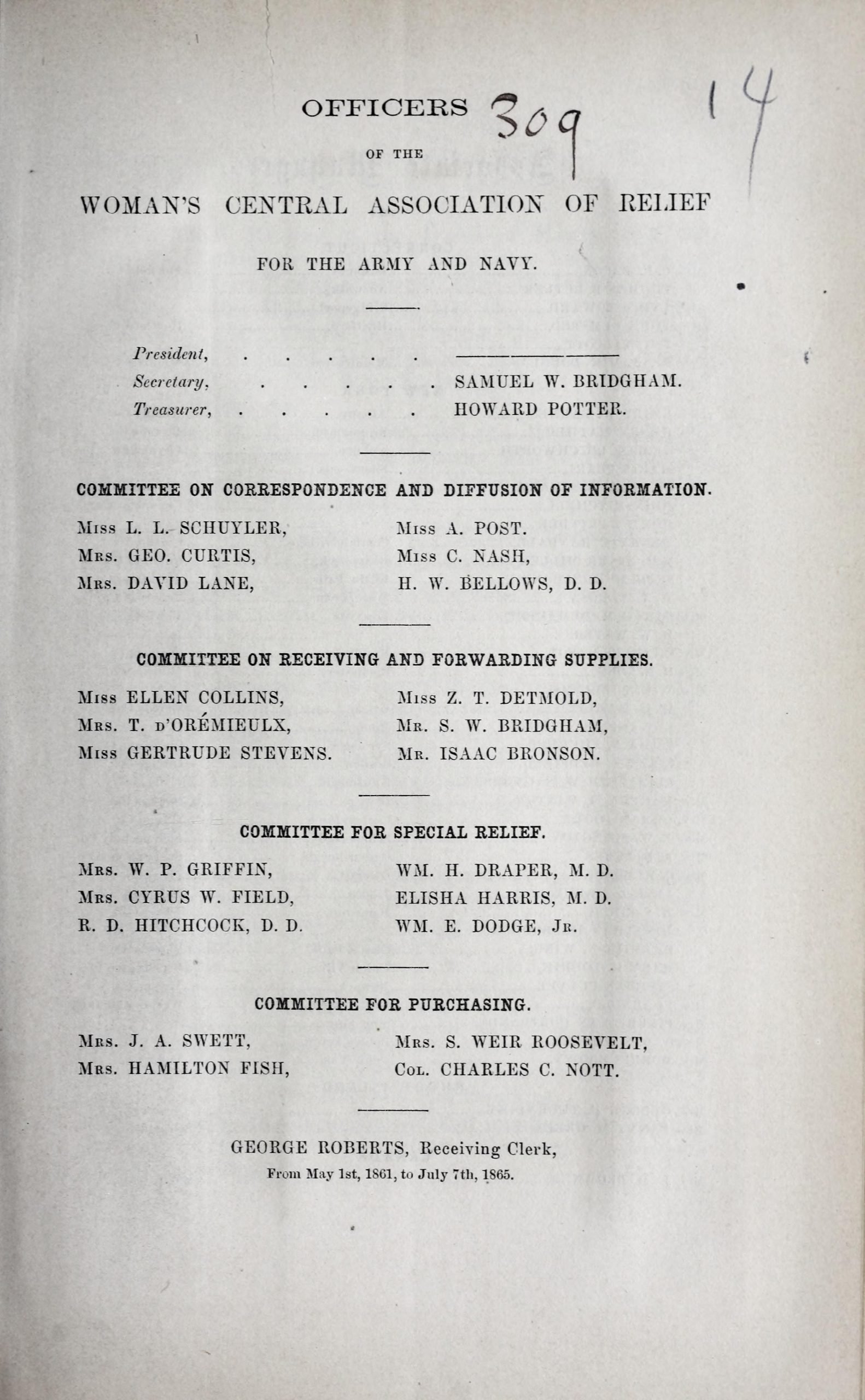
Complete transcription: the officers page
OFFICERS OF THE WOMAN’S CENTRAL ASSOCIATION OF RELIEF FOR THE ARMY AND NAVY.
President, . . . . . [the line is printed blank]
Secretary, . . . . . SAMUEL W. BRIDGHAM.
Treasurer, . . . . . HOWARD POTTER.
COMMITTEE ON CORRESPONDENCE AND DIFFUSION OF INFORMATION. Miss L. L. SCHUYLER, Mrs. GEO. CURTIS, Mrs. DAVID LANE, Miss A. POST, Miss C. NASH, H. W. BELLOWS, D. D.
COMMITTEE ON RECEIVING AND FORWARDING SUPPLIES. Miss ELLEN COLLINS, Mrs. T. d’ORÉMIEULX, Miss GERTRUDE STEVENS, Miss Z. T. DETMOLD, Mr. S. W. BRIDGHAM, Mr. ISAAC BRONSON.
COMMITTEE FOR SPECIAL RELIEF. Mrs. W. P. GRIFFIN, Mrs. CYRUS W. FIELD, R. D. HITCHCOCK, D. D., WM. H. DRAPER, M. D., ELISHA HARRIS, M. D., WM. E. DODGE, Jr.
COMMITTEE FOR PURCHASING. Mrs. J. A. SWETT, Mrs. HAMILTON FISH, Mrs. S. WEIR ROOSEVELT, Col. CHARLES C. NOTT.
GEORGE ROBERTS, Receiving Clerk, From May 1st, 1861, to July 7th, 1865.
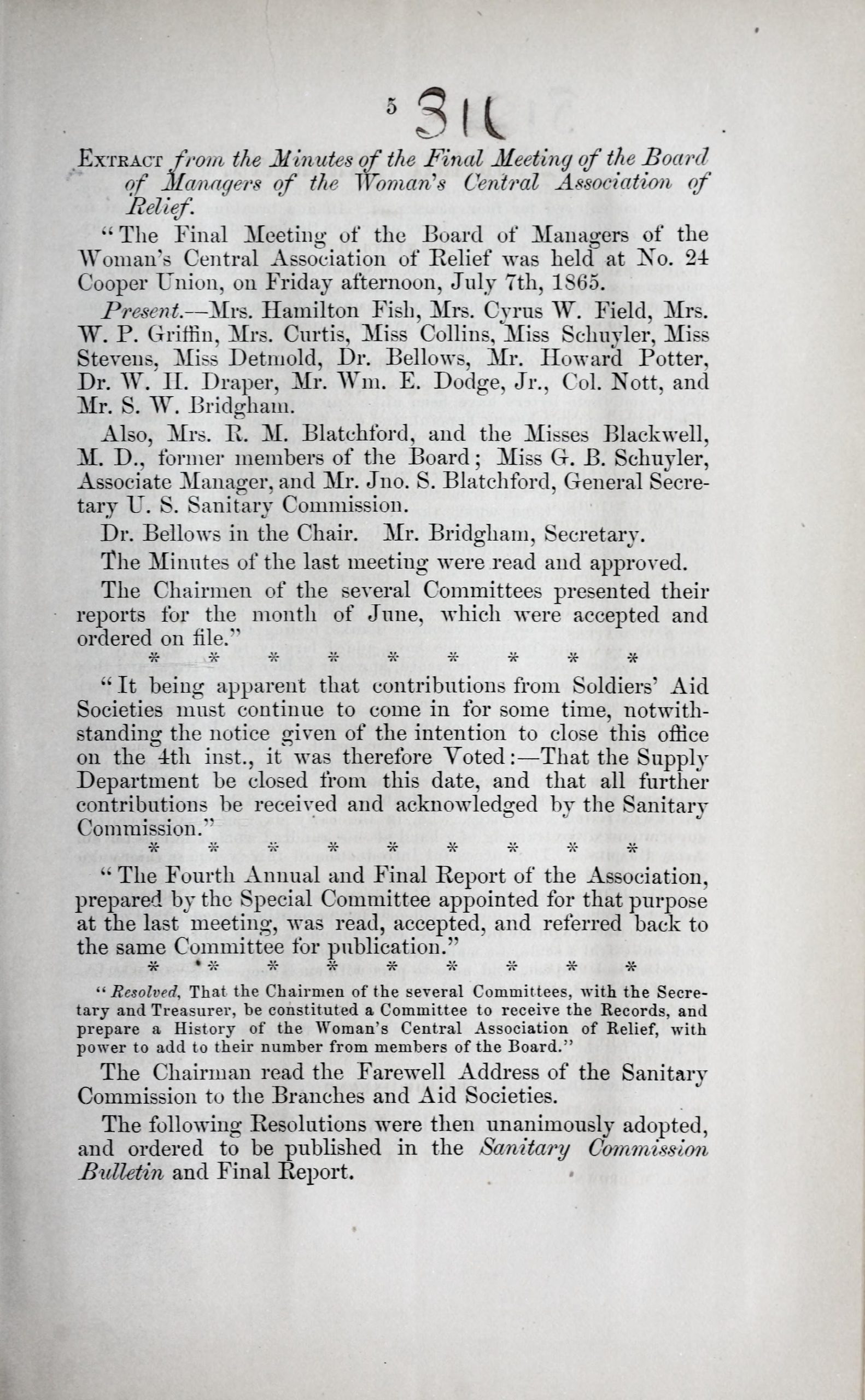
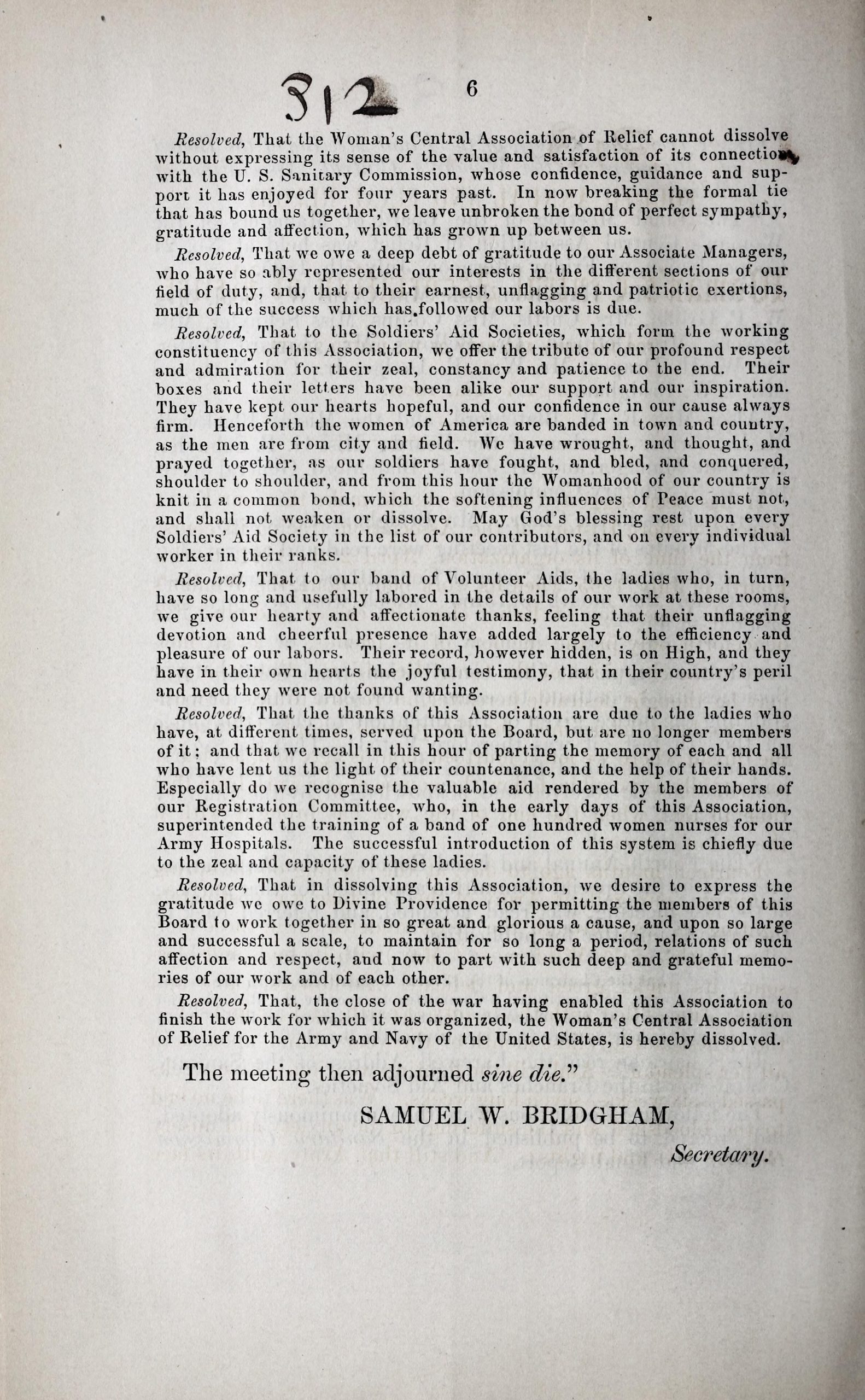
Complete transcription: page 5, the final meeting
EXTRACT from the Minutes of the Final Meeting of the Board of Managers of the Woman’s Central Association of Relief.
“The Final Meeting of the Board of Managers of the Woman’s Central Association of Relief was held at No. 24 Cooper Union, on Friday afternoon, July 7th, 1865.
Present. — Mrs. Hamilton Fish, Mrs. Cyrus W. Field, Mrs. W. P. Griffin, Mrs. Curtis, Miss Collins, Miss Schuyler, Miss Stevens, Miss Detmold, Dr. Bellows, Mr. Howard Potter, Dr. W. H. Draper, Mr. Wm. E. Dodge, Jr., Col. Nott, and Mr. S. W. Bridgham.
Also, Mrs. R. M. Blatchford, and the Misses Blackwell, M. D., former members of the Board; Miss G. B. Schuyler, Associate Manager, and Mr. Jno. S. Blatchford, General Secretary U. S. Sanitary Commission.
Dr. Bellows in the Chair. Mr. Bridgham, Secretary.
The Minutes of the last meeting were read and approved.
The Chairmen of the several Committees presented their reports for the month of June, which were accepted and ordered on file.” * * *
“It being apparent that contributions from Soldiers’ Aid Societies must continue to come in for some time, notwithstanding the notice given of the intention to close this office on the 4th inst., it was therefore Voted: — That the Supply Department be closed from this date, and that all further contributions be received and acknowledged by the Sanitary Commission.” * * *
“The Fourth Annual and Final Report of the Association, prepared by the Special Committee appointed for that purpose at the last meeting, was read, accepted, and referred back to the same Committee for publication.” * * *
“Resolved, That the Chairmen of the several Committees, with the Secretary and Treasurer, be constituted a Committee to receive the Records, and prepare a History of the Woman’s Central Association of Relief, with power to add to their number from members of the Board.”
The Chairman read the Farewell Address of the Sanitary Commission to the Branches and Aid Societies.
The following Resolutions were then unanimously adopted, and ordered to be published in the Sanitary Commission Bulletin and Final Report.
Complete transcription: page 6, the resolutions
Resolved, That the Woman’s Central Association of Relief cannot dissolve without expressing its sense of the value and satisfaction of its connection with the U. S. Sanitary Commission, whose confidence, guidance and support it has enjoyed for four years past. In now breaking the formal tie that has bound us together, we leave unbroken the bond of perfect sympathy, gratitude and affection, which has grown up between us.
Resolved, That we owe a deep debt of gratitude to our Associate Managers, who have so ably represented our interests in the different sections of our field of duty, and, that to their earnest, unflagging and patriotic exertions, much of the success which has followed our labors is due.
Resolved, That to the Soldiers’ Aid Societies, which form the working constituency of this Association, we offer the tribute of our profound respect and admiration for their zeal, constancy and patience to the end. Their boxes and their letters have been alike our support and our inspiration. They have kept our hearts hopeful, and our confidence in our cause always firm. Henceforth the women of America are banded in town and country, as the men are from city and field. We have wrought, and thought, and prayed together, as our soldiers have fought, and bled, and conquered, shoulder to shoulder, and from this hour the Womanhood of our country is knit in a common bond, which the softening influences of Peace must not, and shall not weaken or dissolve. May God’s blessing rest upon every Soldiers’ Aid Society in the list of our contributors, and on every individual worker in their ranks.
Resolved, That to our band of Volunteer Aids, the ladies who, in turn, have so long and usefully labored in the details of our work at these rooms, we give our hearty and affectionate thanks, feeling that their unflagging devotion and cheerful presence have added largely to the efficiency and pleasure of our labors. Their record, however hidden, is on High, and they have in their own hearts the joyful testimony, that in their country’s peril and need they were not found wanting.
Resolved, That in dissolving this Association, we desire to express the gratitude we owe to Divine Providence for permitting the members of this Board to work together in so great and glorious a cause, and upon so large and successful a scale, to maintain for so long a period, relations of such affection and respect, and now to part with such deep and grateful memories of our work and of each other.
Resolved, That, the close of the war having enabled this Association to finish the work for which it was organized, the Woman’s Central Association of Relief for the Army and Navy of the United States, is hereby dissolved.
The meeting then adjourned sine die.” SAMUEL W. BRIDGHAM, Secretary.
Exhibit 9. The historians’ verdict, 1867
Two years after the war, Brockett and Vaughan’s Woman’s Work in the Civil War told the story of the Woman’s Central and settled two questions this page could not otherwise answer. It names Dr. Bellows, her own pastor, as the author of the tribute shown in Exhibit 3. And it gives the full arc of her service: she left for Europe in June 1861, the association counting her departure “a great loss”; she “resumed her duties after a year’s absence”; and she “continued her characteristic force and persistency up to the close.” That single sentence is the bridge between the tribute of 1861 and her committee seats of 1862 through 1865 in the exhibits above.
Complete transcription: page 530
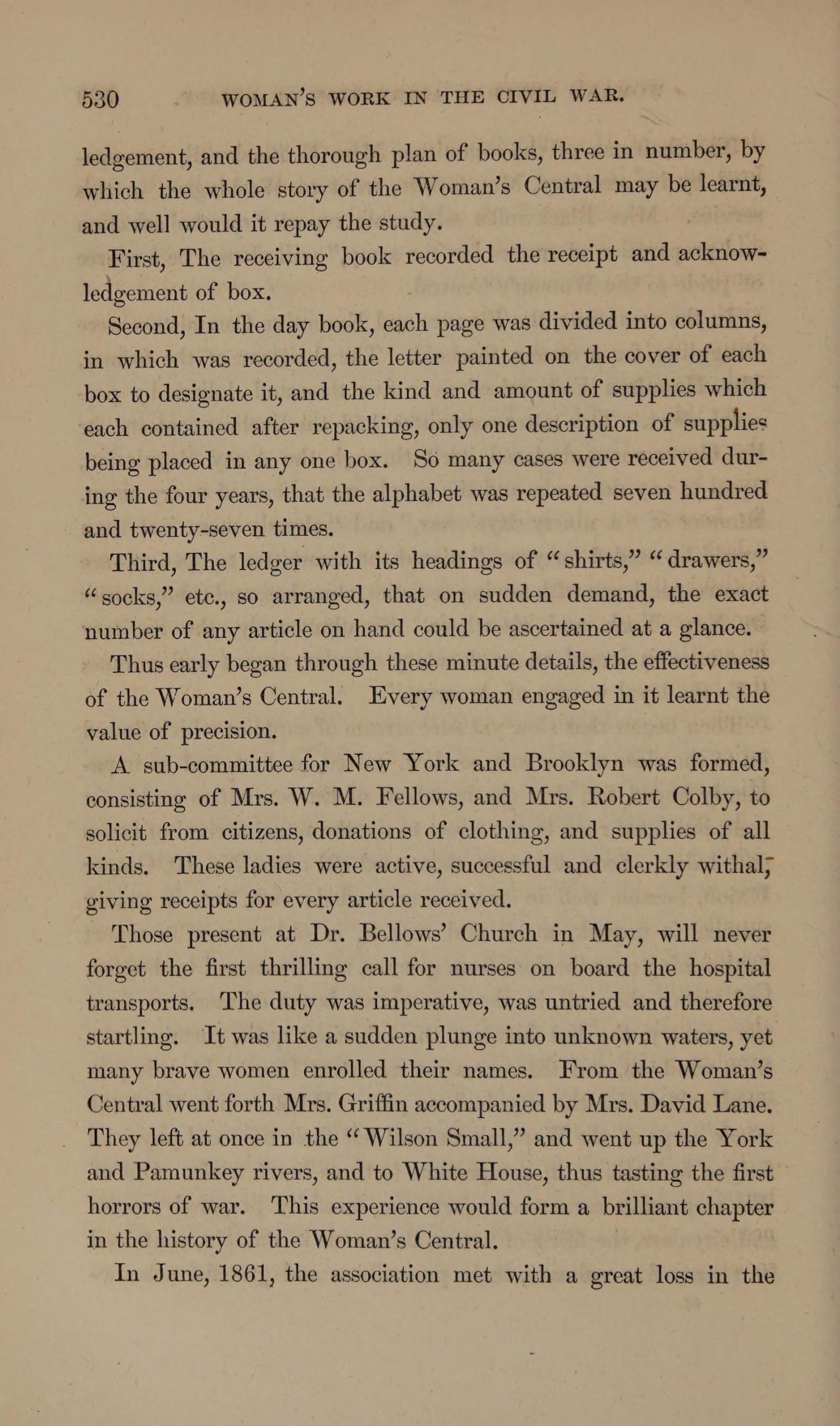
ledgement, and the thorough plan of books, three in number, by which the whole story of the Woman’s Central may be learnt, and well would it repay the study.
First, The receiving book recorded the receipt and acknowledgement of box.
Second, In the day book, each page was divided into columns, in which was recorded, the letter painted on the cover of each box to designate it, and the kind and amount of supplies which each contained after repacking, only one description of supplies being placed in any one box. So many cases were received during the four years, that the alphabet was repeated seven hundred and twenty-seven times.
Third, The ledger with its headings of “shirts,” “drawers,” “socks,” etc., so arranged, that on sudden demand, the exact number of any article on hand could be ascertained at a glance.
Thus early began through these minute details, the effectiveness of the Woman’s Central. Every woman engaged in it learnt the value of precision.
A sub-committee for New York and Brooklyn was formed, consisting of Mrs. W. M. Fellows, and Mrs. Robert Colby, to solicit from citizens, donations of clothing, and supplies of all kinds. These ladies were active, successful and clerkly withal, giving receipts for every article received.
Those present at Dr. Bellows’ Church in May, will never forget the first thrilling call for nurses on board the hospital transports. The duty was imperative, was untried and therefore startling. It was like a sudden plunge into unknown waters, yet many brave women enrolled their names. From the Woman’s Central went forth Mrs. Griffin accompanied by Mrs. David Lane. They left at once in the “Wilson Small,” and went up the York and Pamunkey rivers, and to White House, thus tasting the first horrors of war. This experience would form a brilliant chapter in the history of the Woman’s Central.
In June, 1861, the association met with a great loss in the
Complete transcription: page 531
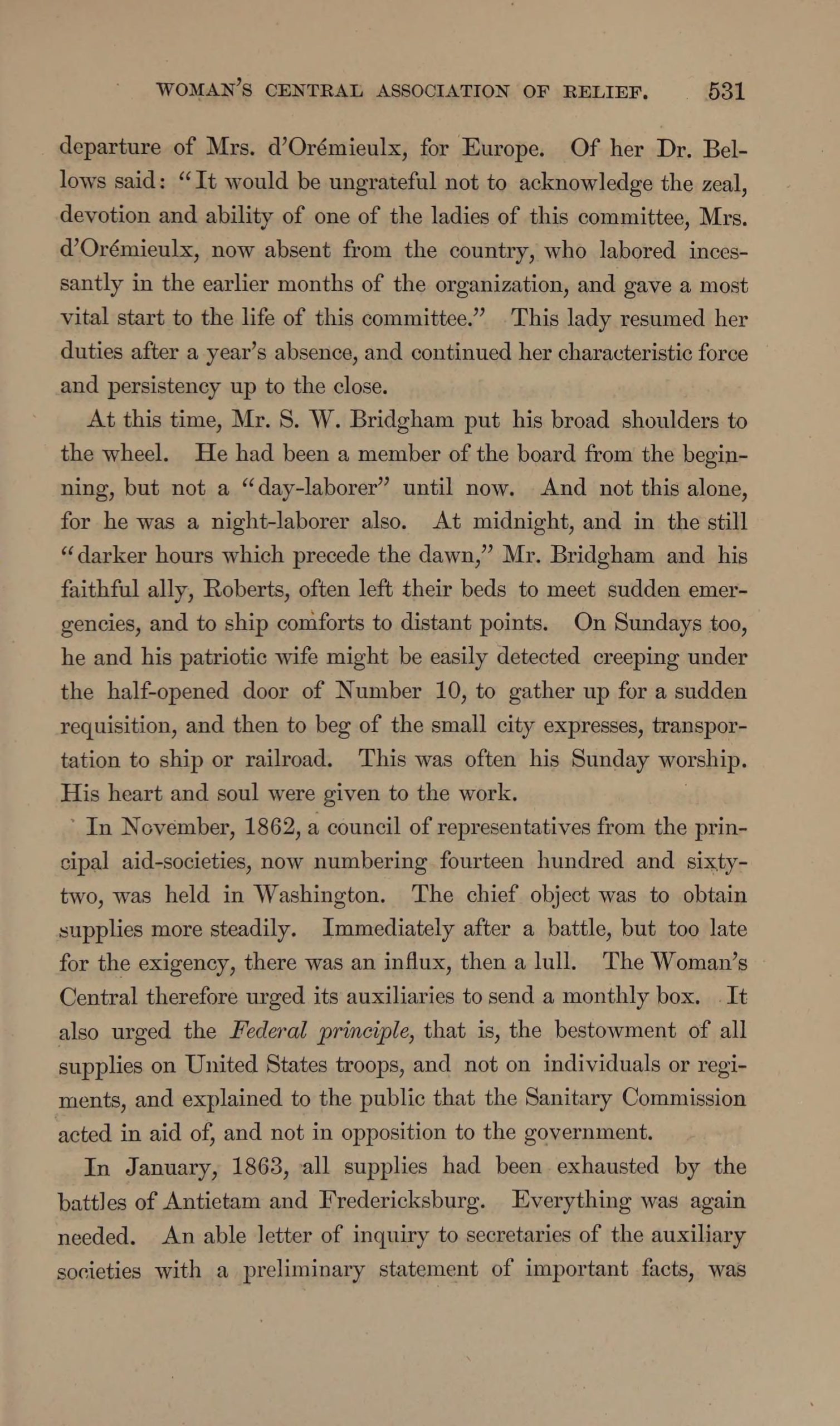
departure of Mrs. d’Orémieulx, for Europe. Of her Dr. Bellows said: “It would be ungrateful not to acknowledge the zeal, devotion and ability of one of the ladies of this committee, Mrs. d’Orémieulx, now absent from the country, who labored incessantly in the earlier months of the organization, and gave a most vital start to the life of this committee.” This lady resumed her duties after a year’s absence, and continued her characteristic force and persistency up to the close.
At this time, Mr. S. W. Bridgham put his broad shoulders to the wheel. He had been a member of the board from the beginning, but not a “day-laborer” until now. And not this alone, for he was a night-laborer also. At midnight, and in the still “darker hours which precede the dawn,” Mr. Bridgham and his faithful ally, Roberts, often left their beds to meet sudden emergencies, and to ship comforts to distant points. On Sundays too, he and his patriotic wife might be easily detected creeping under the half-opened door of Number 10, to gather up for a sudden requisition, and then to beg of the small city expresses, transportation to ship or railroad. This was often his Sunday worship. His heart and soul were given to the work.
In November, 1862, a council of representatives from the principal aid-societies, now numbering fourteen hundred and sixty-two, was held in Washington. The chief object was to obtain supplies more steadily. Immediately after a battle, but too late for the exigency, there was an influx, then a lull. The Woman’s Central therefore urged its auxiliaries to send a monthly box. It also urged the Federal principle, that is, the bestowment of all supplies on United States troops, and not on individuals or regiments, and explained to the public that the Sanitary Commission acted in aid of, and not in opposition to the government.
In January, 1863, all supplies had been exhausted by the battles of Antietam and Fredericksburg. Everything was again needed. An able letter of inquiry to secretaries of the auxiliary societies with a preliminary statement of important facts, was
Researcher’s note: the chapter’s own chronology is loose. The hospital transport service it describes belongs to 1862, yet it is narrated before the June 1861 departure. The facts that matter here, the date of her departure, the authorship of the tribute, and her return to the work until the close, are stated plainly and agree with the association’s printed records in Exhibits 3 through 8. The letter of inquiry named in the last line is the very circular of January 13, 1863 shown in Exhibit 5.
Two threads carry the story onward. Her brother Wolcott sat through the whole war on the Sanitary Commission’s five man Standing Committee beside Dr. Bellows, and the whole family worked the great Metropolitan Fair of 1864; that side of the story is told in The House on Winthrop Place. And after the war Laura returned to the cause, helping to establish the Bellevue Training School for Nurses, the first in America on the Nightingale model, alongside her old Woman’s Central colleague Louisa Lee Schuyler. The association’s working papers survive in the United States Sanitary Commission records at the New York Public Library.
Sources: Report concerning the Woman’s Central Association of Relief at New York, to the U.S. Sanitary Commission at Washington, Oct. 12, 1861 (Sanitary Commission Document No. 32; New York: Wm. C. Bryant & Co., 1861), title page and pp. 16, 17, 25, 32; digitized copy of the National Library of Medicine at archive.org. New-York Daily Tribune, April 30, 1861 (reprinted in the Report, pp. 10-12). United States Sanitary Commission records, Woman’s Central Association of Relief archives, 1861-1865, New York Public Library, archives.nypl.org/mss/22266. The Gibbs Family of Rhode Island (1933), reproduced on this site. The United States Sanitary Commission: A Sketch of Its Purposes and Its Work (Boston: Little, Brown and Company, 1863), Appendix E, pp. 271-274; digitized copy of the Wellcome Library at archive.org. Fourth Annual Report of the Woman’s Central Association of Relief, Branch of the U. S. Sanitary Commission (New York, July 7, 1865), officers page and pp. 5-6; digitized at archive.org. Second Semi-Annual Report (Nov. 1, 1862), Second Annual Report (May 1, 1863) and Third Annual Report (May 1, 1864) of the Woman’s Central Association of Relief; bound set of the University of Michigan, digitized by Google Books (volume OWCnCqTetooC; also at HathiTrust, catalog 000079330). National Library of Medicine copies of the 1863 reports at archive.org/101181516 and archive.org/101181515. Brockett, L. P., & Vaughan, M. C. (1867). Woman’s Work in the Civil War: A Record of Heroism, Patriotism and Patience. Zeigler, McCurdy & Co., pp. 528-531; digitized at archive.org.
A biography page of the Gibbs family series on AlfredGibbs.com. Text drawn from the family Record (The Gibbs Family of Rhode Island) and the sources linked above; images enhanced and colorized by Garland H. Green Jr., each linked to its original where one exists. This page was restyled July 10, 2026 with all original content preserved.
Update, August 12, 2026: A photograph of Laura herself has been added. It is an undated print in the collections of the Newport Historical Society, Newport, Rhode Island, contributed to this site by Deb Dodge, an Official Contributor to AlfredGibbs.com. A colorized and enhanced version of it now heads the page, linked to the unaltered original, and the original is shown in full above under “Her photograph.” It replaces the painted portrait that headed the page before. That painting has not been removed. It has been moved down beside the photograph and recaptioned, and the standing NOTE ON ATTRIBUTION it carried, which asked whether the picture showed Laura or her mother, is answered in the note that follows the two plates.
Views: 400
Explore the evidence
View this article’s connected sources and media →
About this page
This article was brought over from AlfredGibbs.com. Its preserved text, media and citations remain available for comparison.