
IThe House and the Witness
When Col. George Gibbs died in 1833 and Sunswick was sold, his widow Laura moved the family to 261 Greene Street in New York, on the block later renamed Winthrop Place. She kept the house, in her grandson’s words, “upon the footing on which her husband left it,” for nearly forty years, until her death there on December 10, 1870. Her funeral was held at All Souls’ Church on December 13, and her pastor, the Rev. Henry W. Bellows, president of the United States Sanitary Commission during the war, delivered the address that the family history quotes at length: the widow as “a piece of the original granite on which the nation was built.”
That address was printed as a pamphlet in New York in 1871. It has never been digitized; twenty-seven libraries hold copies, among them the Redwood Library at Newport, on the family’s home ground (WorldCat OCLC 13693890). The passages on this site come through the 1933 family history, whose author, George Gibbs V, grew up in the house.
The same 1933 chapter closes with an inventory of what hung on the walls and what lay in the cabinets. An inventory in a family memoir is a claim like any other, and this site’s rule is to test claims against the record. The result, documented below with each institution’s own words, is that the inventory checks out with remarkable fidelity.
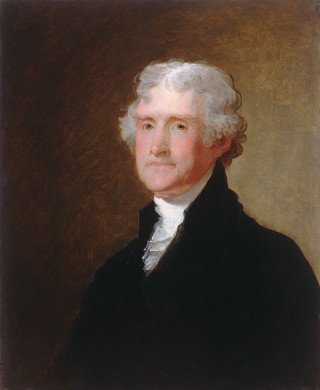
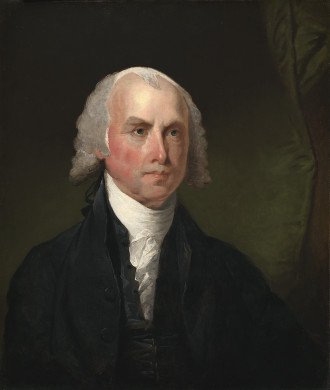
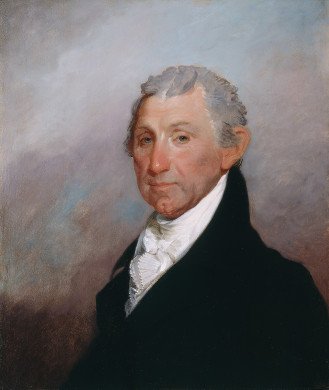
IIThe Drawing Room: Stuart’s Five Presidents
“In the drawing-room hung one of the two sets of Stuart portraits of the first five presidents of the United States.” — The Gibbs Family of Rhode Island (1933)
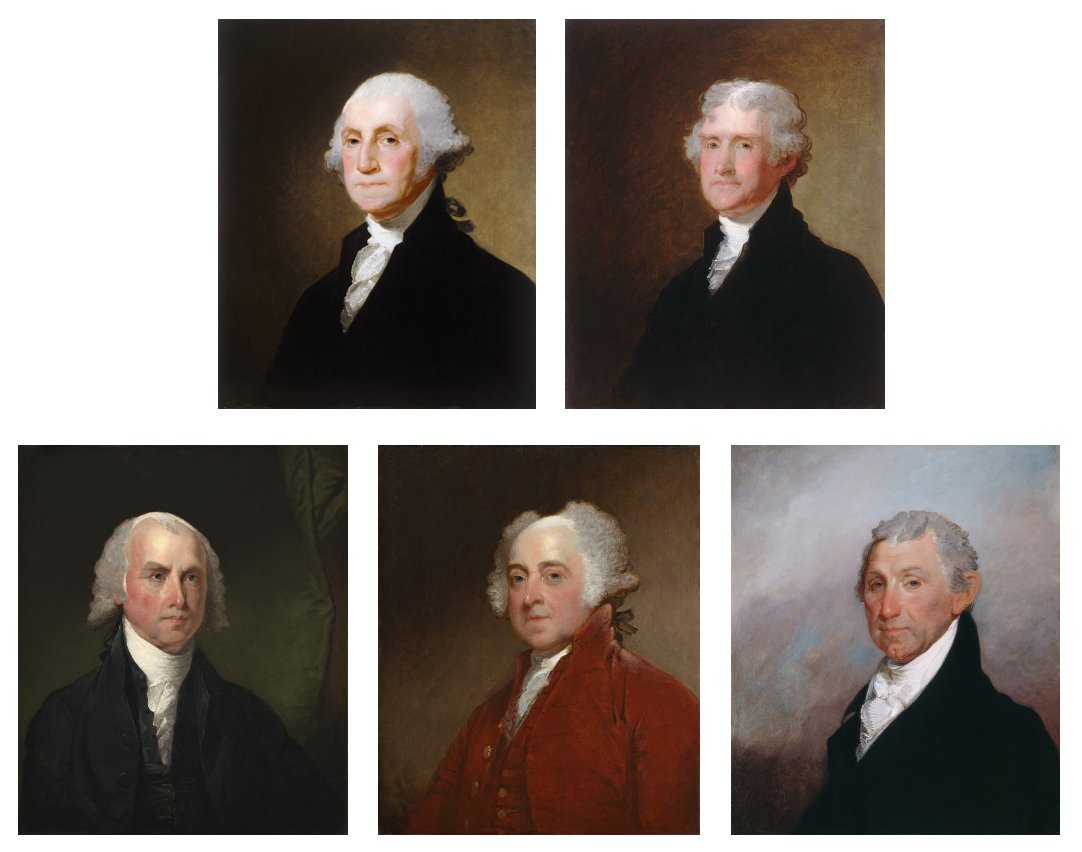
This is the set known to art history as the Gibbs-Coolidge set, commissioned from Gilbert Stuart by Col. George Gibbs himself, and it is the only complete set of Stuart’s first five presidents that survives anywhere. All five portraits hang today in the National Gallery of Art in Washington. The Gallery’s published provenance begins in this family:
“Colonel George Gibbs [1776-1833], ‘Sunswick Farm,’ Astoria, New York; his widow, Laura Wolcott Gibbs [1794-1870], New York; sold through (Jacob Hart Lazarus [1822-1891], New York) in 1872 to Thomas Jefferson Coolidge [1831-1920], Boston… sold 1979 to NGA.”National Gallery of Art, published provenance for the Gibbs-Coolidge portraits
The Gallery’s curatorial files preserve copies of letters written to Mrs. Gibbs in the 1850s certifying that the portraits were painted by Stuart for the Colonel, and the NGA maintains a provenance page in Laura’s own name. Its bibliography cites the 1933 family history. The one refinement the record makes to the family account: the set was not dispersed among descendants. Laura’s heirs sold it intact in 1872, two years after her death, through the painter Jacob Hart Lazarus to Thomas Jefferson Coolidge of Boston, in whose family it stayed for four generations, on loan to the Museum of Fine Arts, Boston from 1921 to 1959, before coming to the nation.
“One of the two sets” is likewise exact. Stuart painted only one other, for the Boston gilder John Doggett, and its Washington, Adams, and Jefferson burned in the Library of Congress fire of December 24, 1851. Even in 1933 the Gibbs set was the only complete one in existence.
IIIThe Dining Room, Object by Object
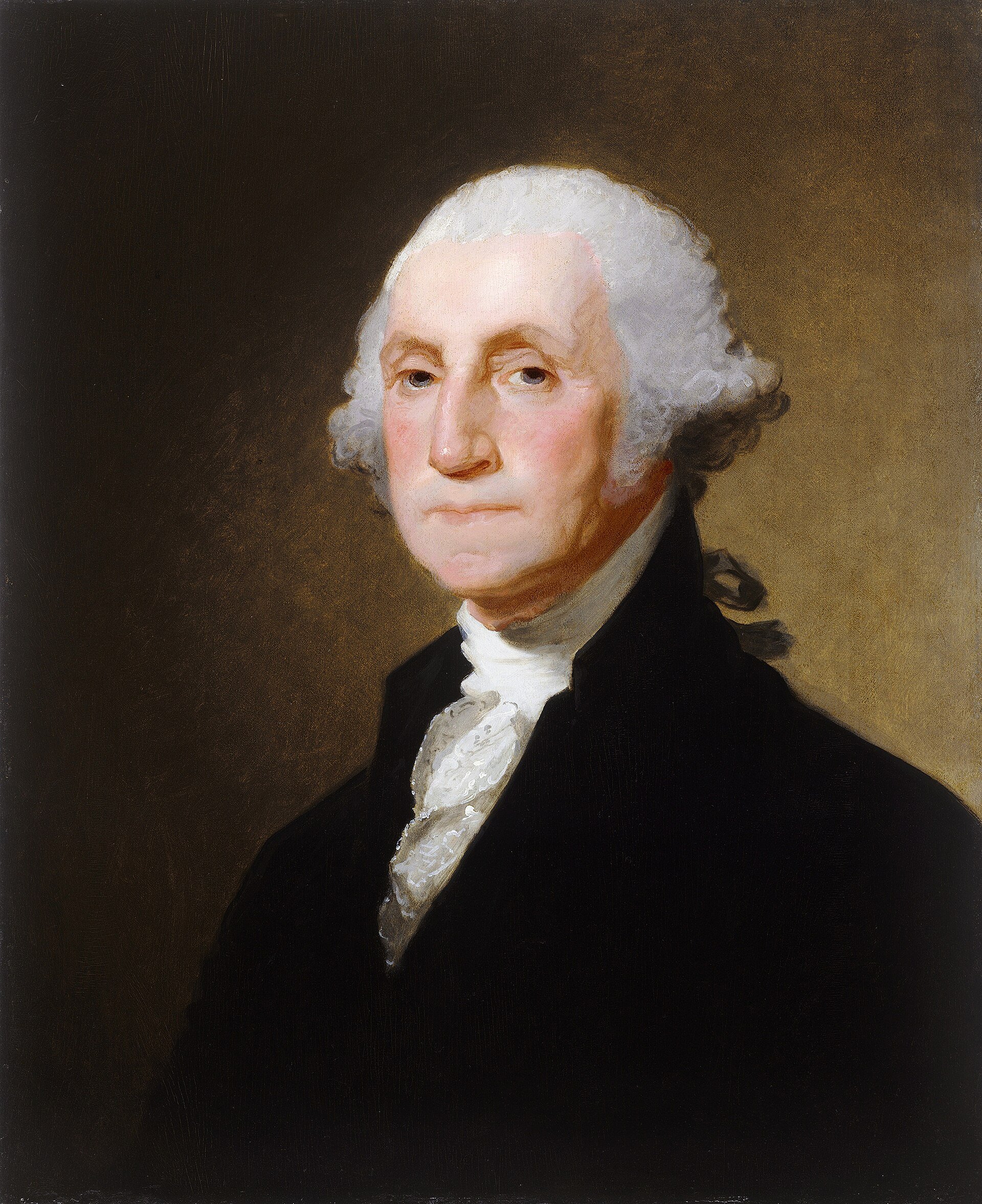
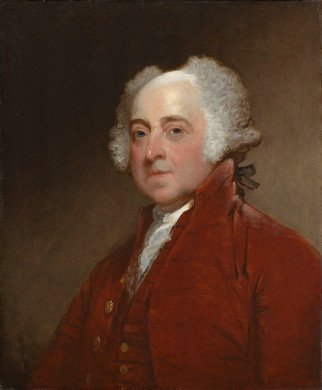
Four Gilbert Stuarts, three Trumbulls, and a bust; every one of them traceable. The backbone sources are Lawrence Park’s 1926 catalogue of Stuart’s works, which found the Gibbs pictures still with Gibbs-Tuckerman descendants, and Ellen G. Miles’s 1998 study of the Wolcott family portraits.
George Gibbs the Second (1735–1803)
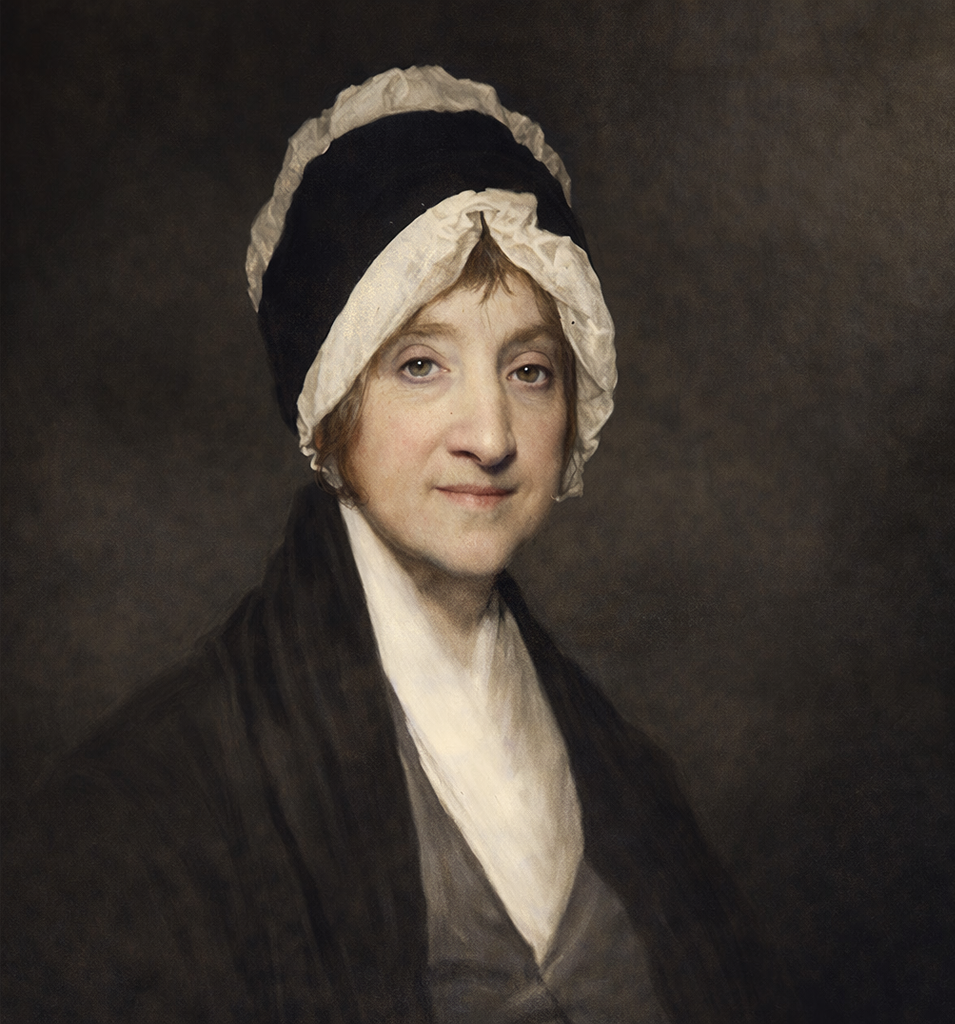
Stuart’s portrait of the Newport merchant, the General’s grandfather, painted about 1798. Park traced it from Col. George Gibbs to Laura’s son Professor Oliver Wolcott Gibbs, then to Elizabeth Wolcott Gibbs Tuckerman and her son Paul Tuckerman, its owner in 1926. The enhanced photograph of this portrait is the hero image of his biography hub on this site.
Where it is now: offered, as a pair with its companion of Mary Channing, by Bernard & S. Dean Levy Galleries, New York (by descent through the family).
Mary Channing, Mrs. George Gibbs (1747–1824)
The companion portrait of the General’s grandmother, painted about 1803, with the same Tuckerman descent. It is the portrait on her hub.
Where it is now: with the Levy Galleries pair, above.
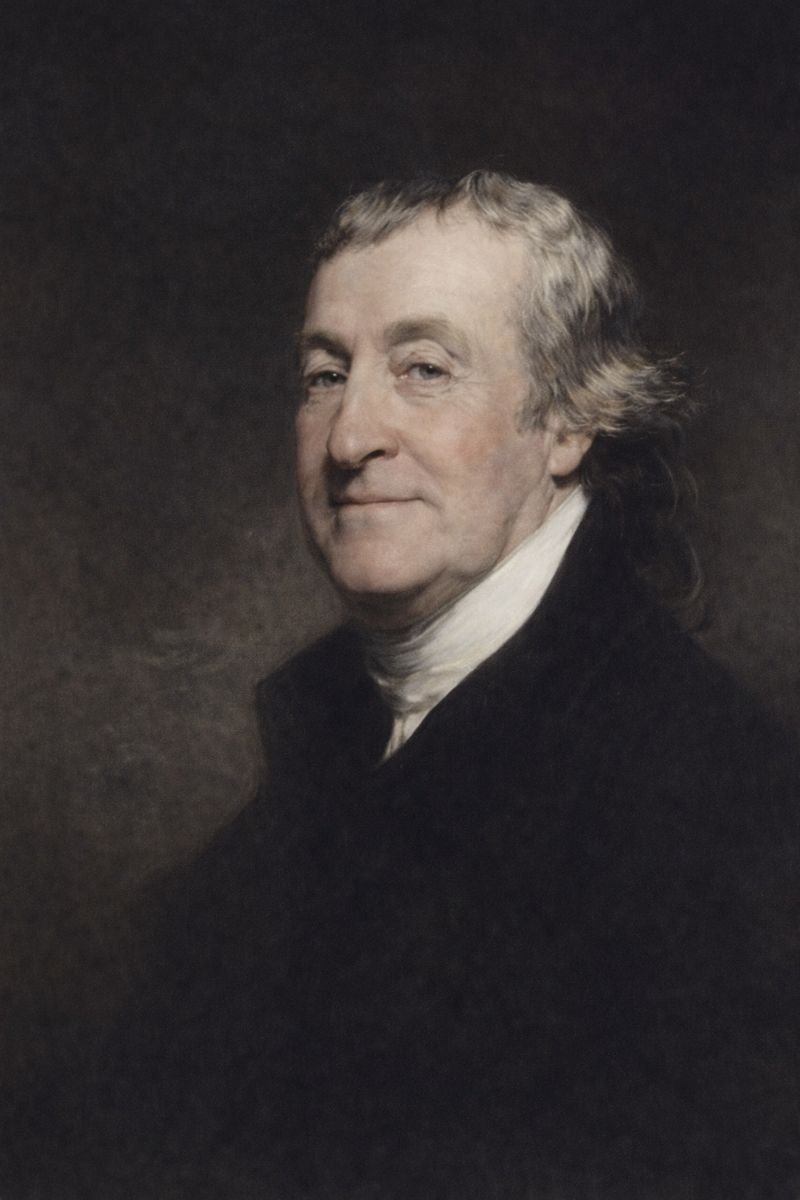
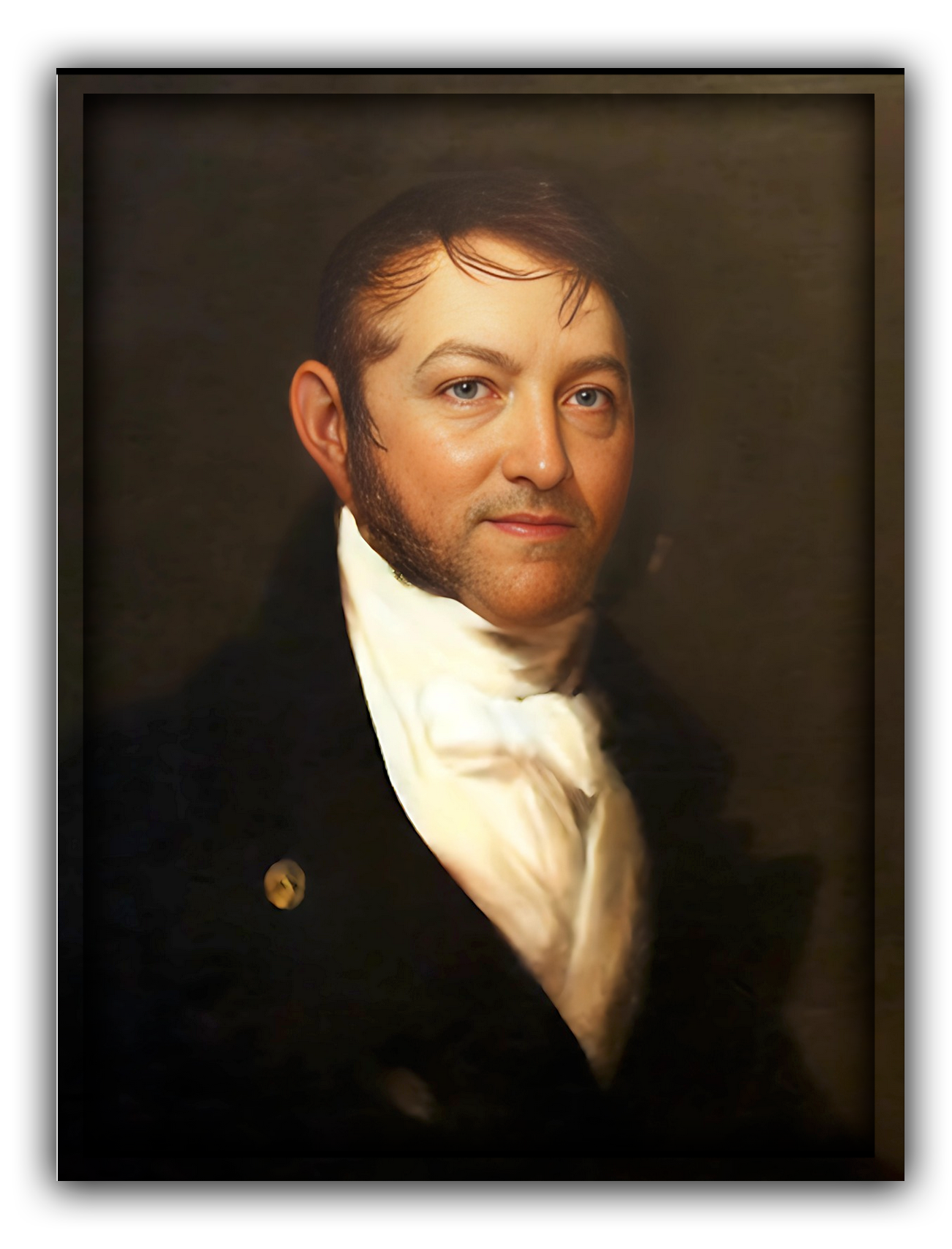
Colonel George Gibbs (1776–1833)
Stuart painted the mineralogist at Boston in 1825–27, in the same years the two men were corresponding over the Yale cabinet sale documented on his page. Park found the panel with Bayard Tuckerman Jr. in 1926; a Fogg Museum loan label survives on the back.
Where it is now: sold at Grogan & Co., Boston, November 15, 2020 (lot 184, “by descent within the family of George Gibbs”), $46,875; the buyer was not disclosed.
Captain Joseph Anthony (1738–1798)
“His partner Captain Anthony” of the 1933 list was Gibbs & Channing’s Philadelphia correspondent and, not incidentally, Gilbert Stuart’s own uncle; Stuart painted him at Philadelphia in 1795. Laura’s son Professor Oliver Wolcott Gibbs bequeathed the portrait to a public museum at his death, and there it has hung ever since, the one dining-room picture whose wall label still carries the family’s name.
Where it is now: Pennsylvania Academy of the Fine Arts, accession 1909.11, “Bequest of Oliver Wolcott Gibbs.”
Laura Wolcott herself, 1810
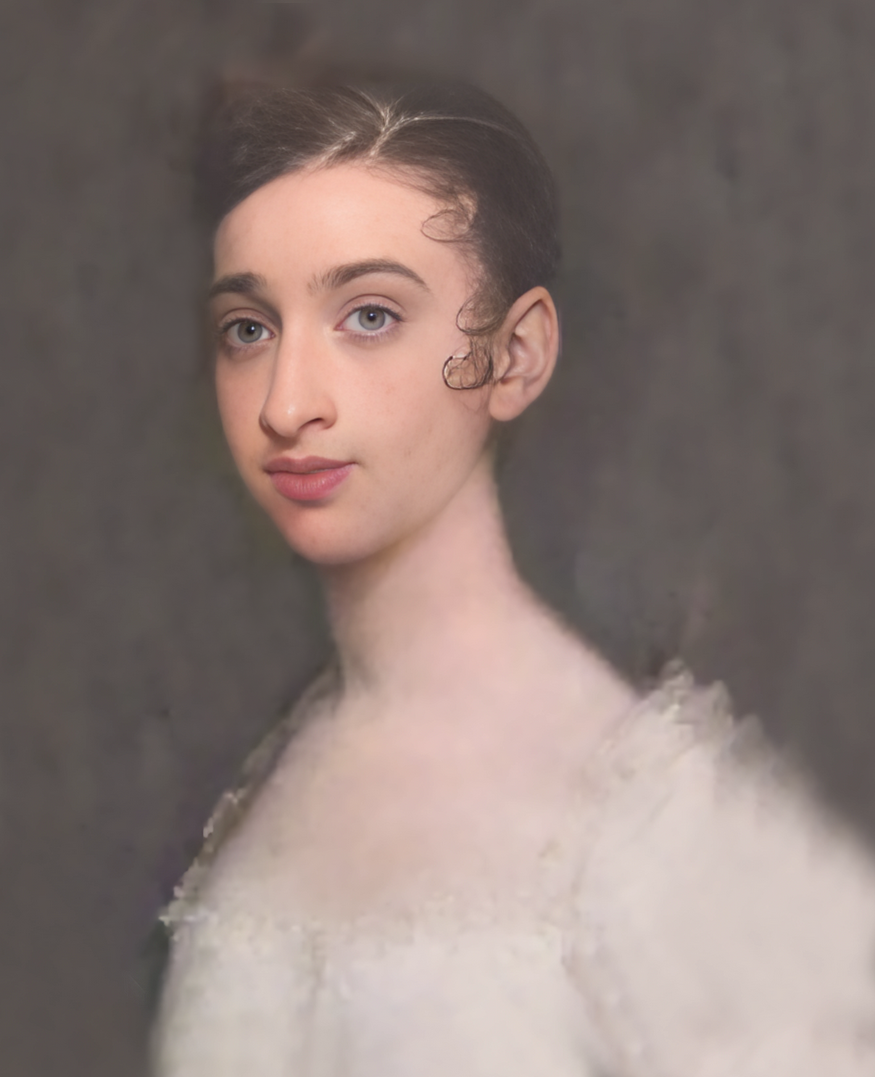
The oval portrait of Laura at about the time of her marriage, the image at the head of this page, is a Stuart by family attribution only: Park omitted it from his catalogue, and the tradition holds that Laura, displeased with her ears and neck, cut the panel down herself. It descended to her granddaughter Mrs. J. West Roosevelt and then to Nicholas Roosevelt, and has not been publicly located since.
Where it is now: unlocated; private Roosevelt-line descent. The attribution should be treated as family tradition.
The Wolcott portraits and Mrs. Gracie
The Trumbull of Oliver Wolcott Jr. that hung here was the 1806 Josiah Quincy commission, bequeathed by Quincy to Oliver Wolcott Gibbs; with Trumbull’s 1804 portrait of Mrs. Wolcott it remained in the Roosevelt branch of the family as of Miles’s 1998 study. The Trumbull of Laura’s sister Elizabeth Wolcott Gracie is now public.
Where it is now: Wolcott pair: private, Roosevelt line. Mrs. Gracie: New-York Historical Society, accession 1940.486.
The bust of Oliver Wolcott Jr.
Commissioned by Col. George Gibbs from the sculptor Clevenger, working from the 1833 death cast; the Colonel’s estate paid the $250 fee in 1842. The intended marble was never made, and every known example is plaster.
Where it is now: casts at Yale University Art Gallery (1900.27, the family’s gift through Benjamin Silliman), the New-York Historical Society (gift of George Gibbs Jr.), and the Connecticut Historical Society.
IVThe Washington Relics
Three objects tied the house directly to the first president: a lock of his hair, his gift of silver, and the parchment that made Laura’s father his Secretary of the Treasury.
The gold locket with Washington’s hair
The 1933 book says Martha Washington cut the lock herself in 1797 for Mrs. Oliver Wolcott, and that the locket “descended to George Gibbs (V.).” The object confirms every word. It survives at Mount Vernon, inscribed on the back: “Hair of George Washington, cut by Martha Washington, 1797, for Mrs. Oliver Wolcott, great-grandmother of George Gibbs V.” Its credit line reads “Bequest of George Gibbs V, 1940”: the author of the family history gave the relic to Washington’s own house seven years after describing it. The companion locks from the same cutting, which passed down another Wolcott line, sold at auction in September 2024 for $53,125.
Where it is now: George Washington’s Mount Vernon, object W-1150.
The silver wine cooler
Washington ordered a dozen Sheffield silver-on-copper wine coolers in 1789 and, on retiring, gave the double coolers to three members of his cabinet. The gift is documented in his own hand, in a letter to James McHenry of August 14, 1797, who presented them:
“Not for the value of the thing, but as a token of my friendship, and as a remembrancer of it, I ask you, Colonel Pickering & Mr Wolcott to accept, each, one of the two bottle Coolers.”George Washington to James McHenry, Mount Vernon, August 14, 1797 (Founders Online)
Wolcott’s cooler descended in the family and appears in Mount Vernon’s census of the surviving coolers as on loan there. Its fellows suggest what the family kept on the sideboard: Pickering’s is in the State Department’s Diplomatic Reception Rooms, and Hamilton’s four-bottle cooler brought $782,500 at Christie’s in 2012.
Where it is now: descended in the Wolcott family; recorded on loan to Mount Vernon (private ownership).
The Treasury commission
“Wolcott’s commission as Secretary of the Treasury, signed by Washington and Randolph” is exactly what a February 1795 commission would bear; Edmund Randolph, as Secretary of State, countersigned and transmitted such documents, and his letter of February 3, 1795 sending Wolcott the commission survives at the New York Public Library, catalogued with the note that the commission itself is no longer enclosed. The parchment was plausibly still in the family in 1933; it has not been traced since. The collection that holds the Randolph letter is itself a family monument: the George Gibbs collection of Oliver Wolcott correspondence, the papers Laura’s son George assembled to write the 1846 Memoirs of the Administrations of Washington and John Adams, deposited at the library by Nicholas Roosevelt.
Where it is now: the commission: untraced. The transmittal letter and the Wolcott archive: New York Public Library, MssCol 3368.
V“L. W. Gibbs, Pinxit”: Her Hamilton
The 1933 book claims Laura painted a watercolor of Alexander Hamilton that, engraved, became one of the most widely used portraits of him. The claim is true, and the proof hangs in two places.
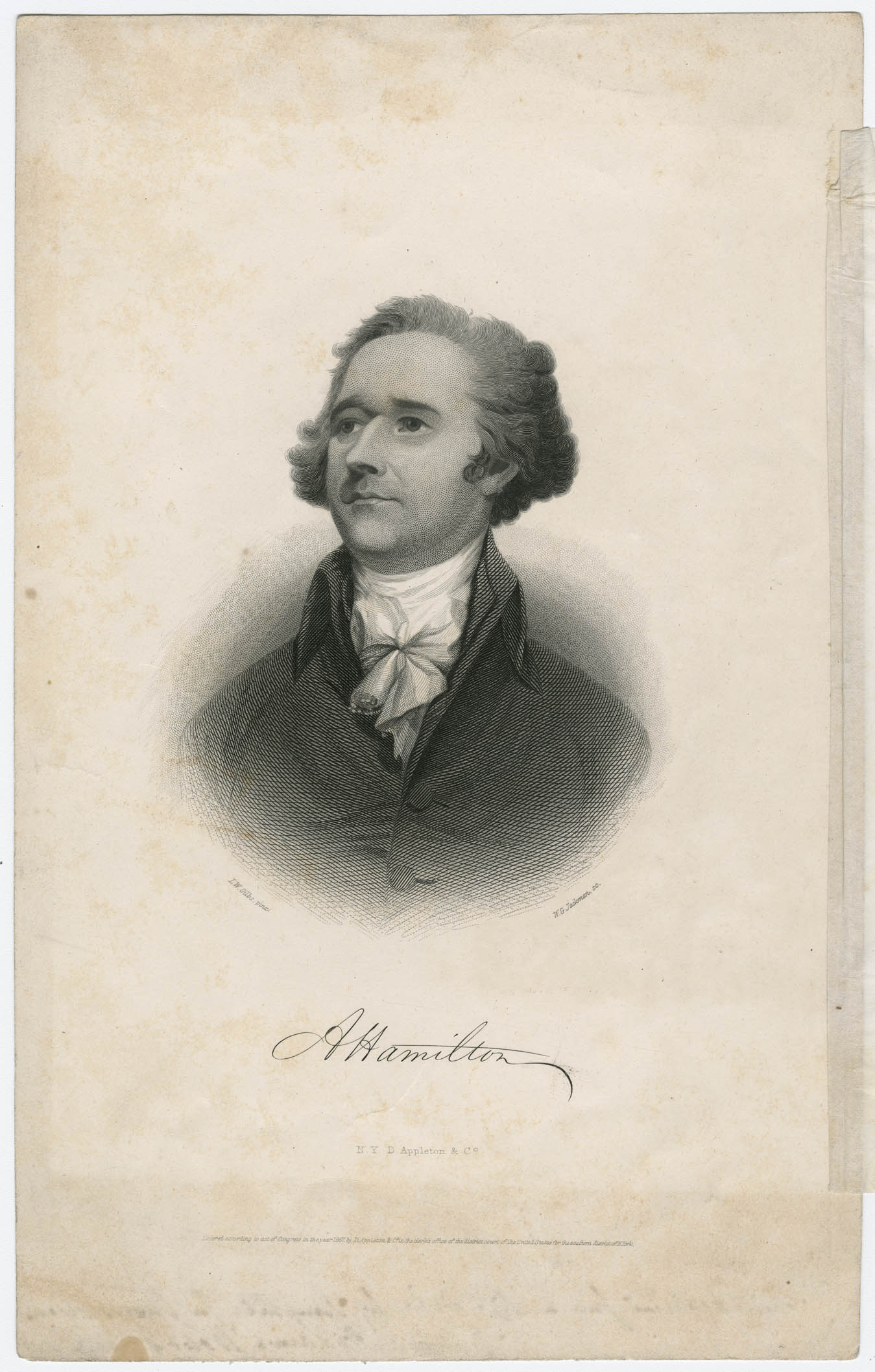
The engraving exists in at least two plates: William G. Jackman’s steel engraving for D. Appleton & Co., copyrighted 1867 and issued with the Hamilton family’s publications, lettered plainly “L.W. Gibbs, pinx.”; and an 1877 etching by H. B. Hall Jr. carrying the same credit. Two engravers working from one original is precisely the career of a stock book illustration, as the family history says.
That L. W. Gibbs is Laura is settled by an object the family history’s author never saw catalogued: in 2022 the Litchfield Historical Society acquired a watercolor-on-ivory miniature of Hamilton by Laura Wolcott Gibbs, inscribed on its backing in her husband’s hand, “A. Hamilton, copied & reduced from Trumbull’s painting by Mrs. L.W. Gibbs.” Her training is on this very site: the postscript of her 1809 letter exhibited on her biography page names her French drawing master, Louis Binsse. The original watercolor behind the engraving remains unlocated, and the book’s statement that she worked “partly from memory” rests on family tradition; she was ten years old when Hamilton died.
VIWhat Remains Tradition
Two claims in the 1933 account cannot yet be corroborated outside the family, and this site’s rule is to say so plainly.
The fugitive-slave cellar. The book states that Laura “was a strong abolitionist and used to hide negro slaves in her cellar at 261 Greene Street,” and that she would go out at night to rub away the chalk crosses marking suspected houses. The author gives his source honestly: “the recollections of members of the family.” Dr. Bellows’s funeral address, which dwells on her war patriotism, says nothing of it; her son’s scientific memoirists say nothing; and the story appears nowhere in the scholarship on the Underground Railroad in New York. It is chronologically plausible, and it is family tradition, first printed in 1933.
“Partly from memory.” The Hamilton watercolor’s surviving relative at Litchfield is inscribed simply as a copy from Trumbull.
The Bellows funeral address of December 13, 1870, printed 1871, has never been digitized. The Redwood Library at Newport holds a copy. When a scan is secured, the complete address will be published on this site verbatim.
References
Bellows, H. W. (1871). Address at the funeral of Mrs. Laura Wolcott Gibbs, widow of George Gibbs, Esq., at All Souls’ Church, New York, Dec. 13, 1870. New York. (WorldCat OCLC 13693890)
Bride, M. M. (2021). George Washington’s wine coolers [Master’s thesis, Harvard University Extension School]. Harvard DASH. https://dash.harvard.edu/
Gibbs, G. (1846). Memoirs of the administrations of Washington and John Adams (2 vols.). New York.
Gibbs, G. (1933). The Gibbs family of Rhode Island and some related families. New York. (Reproduced in part on this site.)
George Washington’s Mount Vernon. (n.d.). Locket with hair of George Washington (W-1150). https://emuseum.mountvernon.org/objects/2391/
Litchfield Historical Society. (2022). Miniature of Alexander Hamilton by Laura Wolcott Gibbs (2022-44-1). https://ledger.litchfieldhistoricalsociety.org/ledger/materials/957
Massachusetts Historical Society. (n.d.). Alexander Hamilton, engraving by W. G. Jackman after L. W. Gibbs. https://www.masshist.org/database/viewer.php?item_id=4184
Miles, E. G. (1998). “Memorials of great & good men who were my friends”: Portraits in the life of Oliver Wolcott, Jr. Proceedings of the American Antiquarian Society, 107(1). https://www.americanantiquarian.org/proceedings/44525133.pdf
Miles, E. G. (2007, Spring). Presidents by Stuart. Colonial Williamsburg Journal. https://research.colonialwilliamsburg.org/Foundation/journal/Spring07/portraits.cfm
National Gallery of Art. (n.d.). The Gibbs-Coolidge portraits: provenance. https://www.nga.gov/artworks/provenance/23002-laura-wolcott-gibbs
New York Public Library. (n.d.). George Gibbs collection of Oliver Wolcott correspondence (MssCol 3368). https://archives.nypl.org/mss/3368
Park, L. (1926). Gilbert Stuart: An illustrated descriptive list of his works (4 vols.). New York: William Edwin Rudge. https://archive.org/details/gilbertst01park
Washington, G. (1797, August 14). Letter to James McHenry. In The Papers of George Washington, Retirement Series (Vol. 1, pp. 299–300). Founders Online. https://founders.archives.gov/documents/Washington/06-01-02-0261
A provenance investigation of the Gibbs Archive on AlfredGibbs.com, published July 13, 2026. Research from the collections and catalogues cited above; the museum images on this page are open-access or public-domain reproductions hosted on this site, each linked to its source record. Related: Laura Wolcott Gibbs · Laura’s War · Col. George Gibbs and the Reel 1 Papers · Chapter VIII: Family Portraits (1933).
Views: 4
Explore the evidence
View this article’s connected sources and media →
About this page
This article was brought over from AlfredGibbs.com. Its preserved text, media and citations remain available for comparison.