
He is remembered on this site as the husband of Alfred Gibbs’s sister, Laura Wolcott Gibbs — a courtly “Captain” of family tradition, a teacher of French, the man who once wrote to Victor Hugo. The federal record tells a stranger and finer story. Théophile d’Oremieulx was never a captain. He was offered the rank in 1850 and turned it down — because he had given his word, when the Army first commissioned him, that he would ask for nothing but the desk where he taught cadets to speak French.
Théophile d’Oremieulx
- Born Paris, 1815/16; son of a banished French general
- Recruited to West Point to teach French, 1838–40
- First Lieutenant, U.S. Army — declined a captaincy, 1850
- Married Laura Wolcott Gibbs, 1853
- Left the Academy c. 1856; died 1881
Alfred Gibbs
- Born New York, 1823; West Point class of 1846
- Cadet at the Academy while d’Oremieulx taught there
- Brevetted for gallantry, Mexican War; wounded
- Gained a brother-in-law when d’Oremieulx married Laura
- Union cavalry general; died 1868
The file assembles, in one place, every document the War Department could find on d’Oremieulx’s unusual commission: the letters that created it, the 1850 captaincy he refused, and the 1855 crisis in which his whole life at West Point briefly hung on a Secretary of War’s pen. Read them in three acts. Click any page to read the full transcription beside the scan.
The Recruitment, 1838–1840
★ How a Frenchman Came to Wear the Uniform
Gouverneur Kemble to Secretary of War Jefferson Davis · Cold Spring, N.Y., 18 July 1855
The man who recruited him tells the story. As a Congressman in 1838–39, Kemble was asked by Secretary of War Poinsett to find a qualified Frenchman to mend West Point’s French instruction. After “diligent search” he recommended d’Oremieulx — “the son of an old French general officer, who had been banished from France by the Bourbons” — on a verbal, honor-bound agreement to abide by a lieutenant’s rank.
Why the Army Made Him an Officer
Maj. Richard Delafield to Gen. Joseph G. Totten, Chief Engineer · Paris, 19 May 1855
The former Superintendent of West Point explains from Europe that the only lawful way to secure a qualified French teacher was to give him an Army commission — a step taken under Secretary Poinsett around 1840, with the understanding that d’Oremieulx would never perform other military duty.
The Captaincy He Refused, 1850
★ The Regiment’s Objection
Bvt. Lt. Col. J. Morris, 1st Infantry, to the Adjutant General · Fort Duncan, Texas, 2 December 1850
When Major Scott’s death put d’Oremieulx first in line for a captaincy, the officers of his paper regiment protested: he had “been more than ten years in the service” yet “not yet done a day’s duty with the Regiment.”
His Refusal, in His Own Hand
1st Lt. Théophile d’Oremieulx to the Adjutant General · West Point, 11 December 1850
Four sentences that settle the “Captain” question forever: “Having heard unofficially of the death of Maj. Scott, I would respectfully beg leave to decline the promotion consequent upon it.”
The Army Lets the Promotion Pass
Adjutant General R. Jones to Secretary of War C. M. Conrad, with Conrad’s approval · Washington, 20 December 1850
His name is withdrawn from the promotion list before the Senate and the captaincy passes to the next senior officer, Lt. James N. Caldwell — the paperwork that carried out his wish.
A Professor Pleads to Keep Him
Prof. Hyacinth R. Agnel to Superintendent Capt. H. Brewerton · West Point, 25 November 1850
The head of the French Department argues that d’Oremieulx’s place “could not without much difficulty be supplied, if indeed it could be so at all,” and that his commission ought to be treated “as one of exception.”
The Crisis and the Reprieve, 1855
‘To Fulfil My Part of the Contract’
1st Lt. d’Oremieulx to Secretary of War Jefferson Davis · Washington, 20 July 1855
Summoned to explain himself, he tells Davis he declined the captaincy because promotion “would have defeated the object of my appointment; besides its having been clearly understood that I would lay no claim to such promotion.”
One Minute to Change a Life
1st Lt. d’Oremieulx to Secretary of War Jefferson Davis · New York, 24 July 1855
With his post at West Point suddenly in doubt, he appeals for a decision: it “may happen to be such as to change in one minute, at this comparatively late period of my life, the whole of my plans and prospects,” forcing him into “duties for which ‘I was desired not to qualify myself.’”
★ The Secretary of War Decides
Engineer Department summary, endorsed by Secretary of War Jefferson Davis · War Department, 31 July 1855
Jefferson Davis settles it in his own hand: “On account of the peculiarity of the case, Lt d’Oremieux will not be relieved from duty at the Academy until further orders.” The reprieve that let him finish his years at West Point.
Afterward: The Letter to Victor Hugo
Two decades later, during the Civil War, d’Oremieulx turned his French connections to the Union cause. This passage — found by Garland H. Green Jr. in an October 1902 issue of Brush and Pencil — records it.
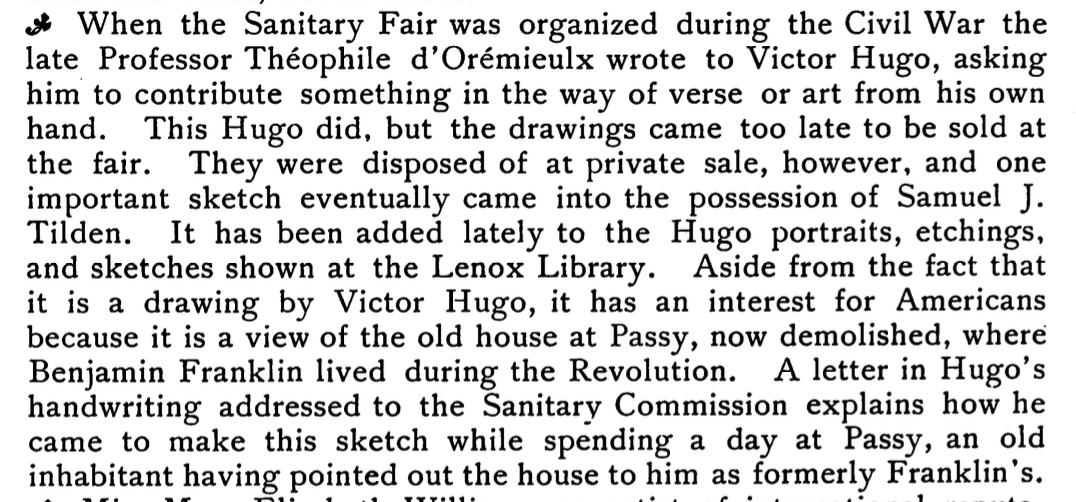
“When the Sanitary Fair was organized during the Civil War the late Professor Théophile d’Orémieulx wrote to Victor Hugo, asking him to contribute something in the way of verse or art from his own hand. This Hugo did, but the drawings came too late to be sold at the fair. They were disposed of at private sale, however, and one important sketch eventually came into the possession of Samuel J. Tilden. It has been added lately to the Hugo portraits, etchings, and sketches shown at the Lenox Library. Aside from the fact that it is a drawing by Victor Hugo, it has an interest for Americans because it is a view of the old house at Passy, now demolished, where Benjamin Franklin lived during the Revolution. A letter in Hugo’s handwriting addressed to the Sanitary Commission explains how he came to make this sketch while spending a day at Passy, an old inhabitant having pointed out the house to him as formerly Franklin’s.”
The Obituaries
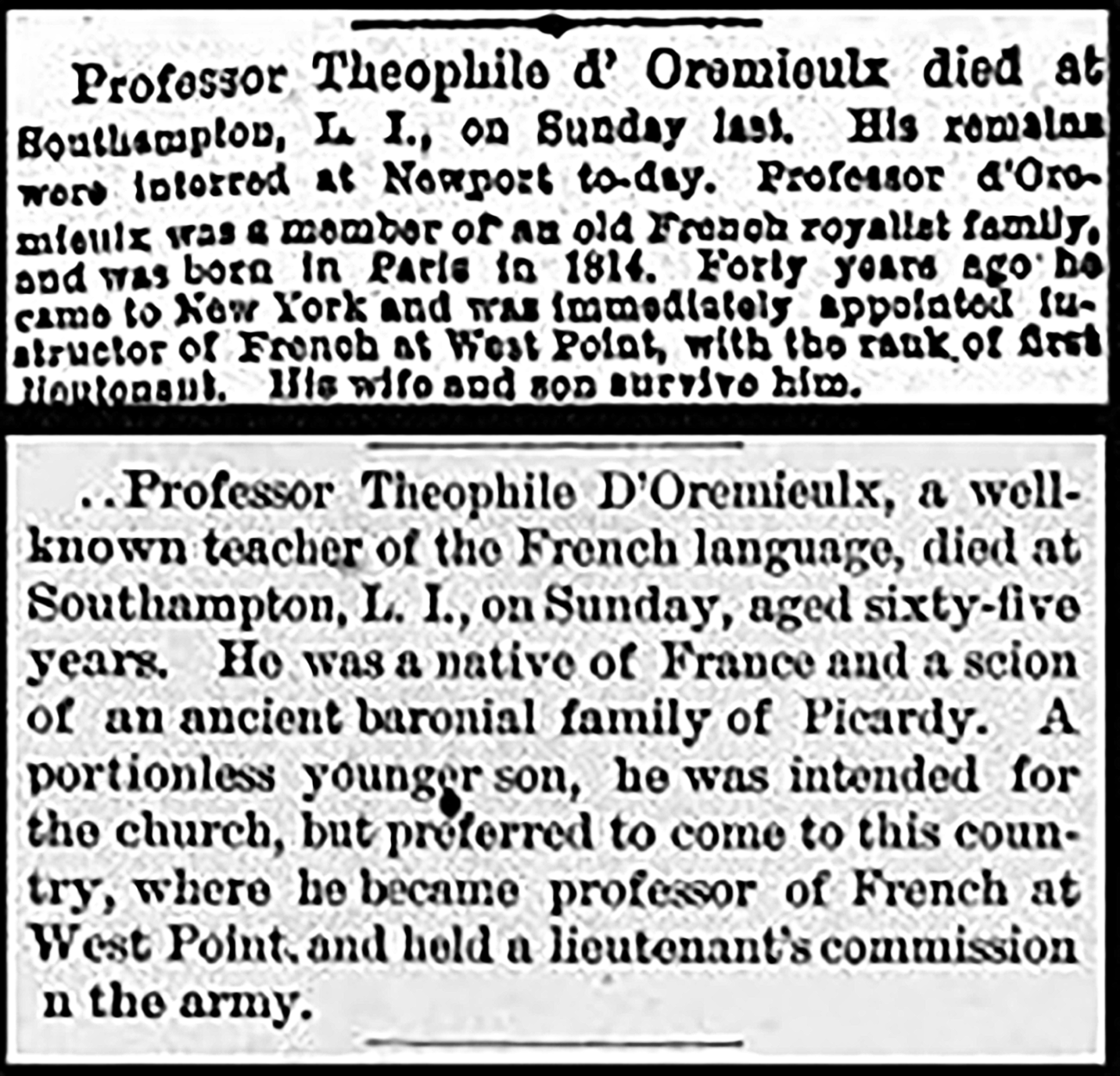
Professor [Marie] Theophile d’Oremieux died at Southampton, L. I., on Sunday last. His remains were interred at Newport today. Professor d’Oremieux was a member of an old French royalist family and was born in Paris in 1816. Forty years ago he came to New York and was immediately appointed instructor of French at West Point, with the rank of first lieutenant. His wife and son survive him.
Professor Theophile d’Oremieux, a well-known teacher of the French language, died at Southampton, L. I., on Sunday, aged sixty-five years. He was a native of France and a scion of an ancient baronial family of Picardy. A portionless younger son, he was intended for the church, but preferred to come to this country, where he became professor of French at West Point and held a lieutenant’s commission in the army.
A Life in Brief
- 1815/16Born in Paris
Son of a French general officer banished under the Bourbon Restoration. - 1838–39Recruited
Gouverneur Kemble, for Secretary of War Poinsett, finds him in New York to teach French at West Point. - 1840Commissioned
Made a Second Lieutenant — solely to serve as Assistant Professor of French, on his honor never to claim other rank. - Dec 1850Declines a captaincy
On Major Scott’s death he stands first for promotion and refuses it; his name is withdrawn and passes to Lt. Caldwell. - 28 Jun 1853Marries Laura Wolcott Gibbs
Sister of the future Gen. Alfred Gibbs; Col. R. E. Lee hosts the newlyweds at West Point. - 31 Jul 1855Reprieved
Secretary of War Jefferson Davis rules he shall not be relieved from the Academy “until further orders.” - c. 1856Leaves West Point
After some sixteen years teaching French to the Corps of Cadets. - 1864Writes to Victor Hugo
For the U.S. Sanitary Fair; Hugo sends drawings, including a view of Franklin’s house at Passy. - 3 Jul 1881Dies at Southampton, L.I.
Buried at Newport, Rhode Island; his wife and son survive him.
Where to Go Next
References
Agnel, H. R. (1850, November 25). [Letter to Capt. H. Brewerton, Superintendent, U.S. Military Academy]. File D-257, 1855, Letters Received by the Adjutant General (Microfilm M567), Record Group 94, National Archives, Washington, DC.
Davis, J. (1855, July 31). [Endorsement on the case of 1st Lt. T. d’Oremieulx]. File D-257, 1855, Letters Received by the Adjutant General (M567), RG 94, National Archives, Washington, DC.
Delafield, R. (1855, May 19). [Letter to Gen. J. G. Totten, Chief Engineer]. File D-257, 1855, Letters Received by the Adjutant General (M567), RG 94, National Archives, Washington, DC.
d’Oremieulx, T. (1850, December 11). [Letter declining promotion, to Adjutant General R. Jones]. File D-257, 1855, Letters Received by the Adjutant General (M567), RG 94, National Archives, Washington, DC.
d’Oremieulx, T. (1855, July 20 & July 24). [Letters to Secretary of War Jefferson Davis]. File D-257, 1855, Letters Received by the Adjutant General (M567), RG 94, National Archives, Washington, DC.
Jones, R. (1850, December 20). [Letter to Secretary of War C. M. Conrad, with Conrad’s approval]. File D-257, 1855, Letters Received by the Adjutant General (M567), RG 94, National Archives, Washington, DC.
Kemble, G. (1855, July 18). [Letter to Secretary of War Jefferson Davis]. File D-257, 1855, Letters Received by the Adjutant General (M567), RG 94, National Archives, Washington, DC.
Morris, J. (1850, December 2). [Letter to Adjutant General R. Jones, Head Quarters 1st Infantry, Fort Duncan, Texas]. File D-257, 1855, Letters Received by the Adjutant General (M567), RG 94, National Archives, Washington, DC.
Gleanings from American art centers. (1902, October). Brush and Pencil, 11(1).
Views: 48
Explore the evidence
View this article’s connected sources and media →
About this page
This article was brought over from AlfredGibbs.com. Its preserved text, media and citations remain available for comparison.