
Wisconsin manuscript
George Gibbs IV (manuscript volume, n.p.) · 1856 (Olympia) and later additions
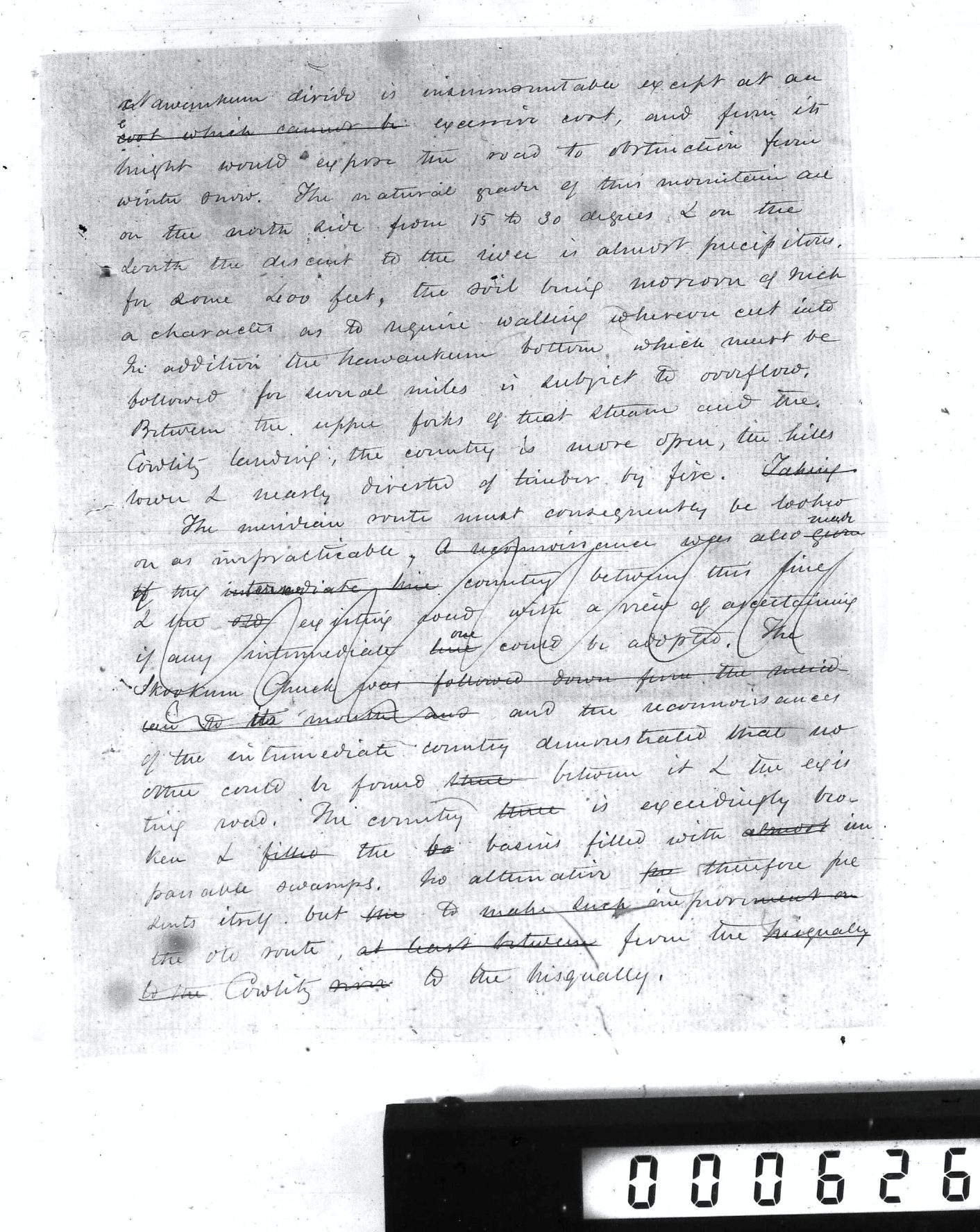
The Nawaukum divide; the meridian route declared impracticable; fall back on the old route. "Nawaukum divide is insurmountable except at an excessive cost, and from its height would expose the road to obstruction from winter snow. The natural grades of this mountain are on the north side from 15 to 30 degrees & on the south the descent to the river is almost precipitous for some 200 feet, the soil being moreover of such a character as to require walling wherever cut into." "In addition the Nawaukum bottom which must be followed for several miles is subject to overflow." Between the upper forks and "Cowlitz landing" the country is "more open, the hills lower & nearly divested of timber by fire." "The meridian route must consequently be looked on as impracticable." The Skookum Chuck was followed down and the reconnoissances "demonstrated that no other could be found between it & the existing road. The country is exceedingly broken & filled ... basins filled with impassable swamps. No alternative therefore presents itself, but to make such improvement on the old route, ... from the Cowlitz to the Nisqually."
Wisconsin Historical Society, Gibbs Family Papers, U.S. Mss Y, Micro 1117
Reel 2, frames 3977
Reel 2, frame 3977
Read beside the scan
AI first transcription from the evidence pack; not independently verified. Compare with the scan.
[struck: cost which cannot be] [inserted: e] excessive cost, and from its
height would expose the road to obstruction from
winter snow. The natural grades of this mountain are
on the north side from 15 to 30 degrees & on the
South the descent to the river is almost precipitous.
for some 200 feet, the soil being moreover of such
a character as to require walling wherever cut into
In addition the Nawaukum bottom which must be
followed for several miles is subject to overflow.
Between the upper forks of that stream and the
Cowlitz landing, the country is more open, the hills
lower & nearly divested of timber by fire. [struck: Taking]
The meridian route must consequently be looked
on as impracticable, [struck: A reconnoissance] was also [struck: given] [inserted: made]
[struck: of] the [struck: intermediate line] country between this line
& the [struck: old] existing road with a view of ascertaining
if any intermediate [struck: line] [inserted: one] could be adopted. The
Skookum Chuck was [struck: followed down from the mid-
dle[?] to the mouth and] and the reconnoissances
of the intermediate country demonstrated that no
other could be found [struck: there] between it & the exis-
ting road. The country [struck: there] is exceedingly bro-
ken & [struck: filled] the [struck: ba] basins filled with [struck: almost] im-
passable swamps. No alternative [struck: pr] therefore pre-
sents itself but [struck: the] to [struck: make such improvement on]
the old route, [struck: at least between] from the [struck: Nisqually
to the] Cowlitz [struck: river] to the Nisqually.
Citation and provenance
Gibbs, G., IV. (1856). [Manuscript volume, n.p.]. Gibbs Family Papers, 1763-1918 (U.S. Mss Y, Micro 1117, Reel 2, frame 3977). Wisconsin Historical Society Archives, Madison, WI, United States.
Citation details need editorial review.
Historical sources retain their individual rights and credits. A scan’s presence here does not establish unrestricted reuse.
People identified in the source catalog
These are catalog labels. Individual identities and relationships have not all been reviewed.
Where the book uses this document
No quotation has yet been assigned directly to this catalog record. Its individual frames may have separate connections.