
Wisconsin manuscript
George Gibbs IV (manuscript volume, ms p. 2) · 1856 (Olympia) and later additions
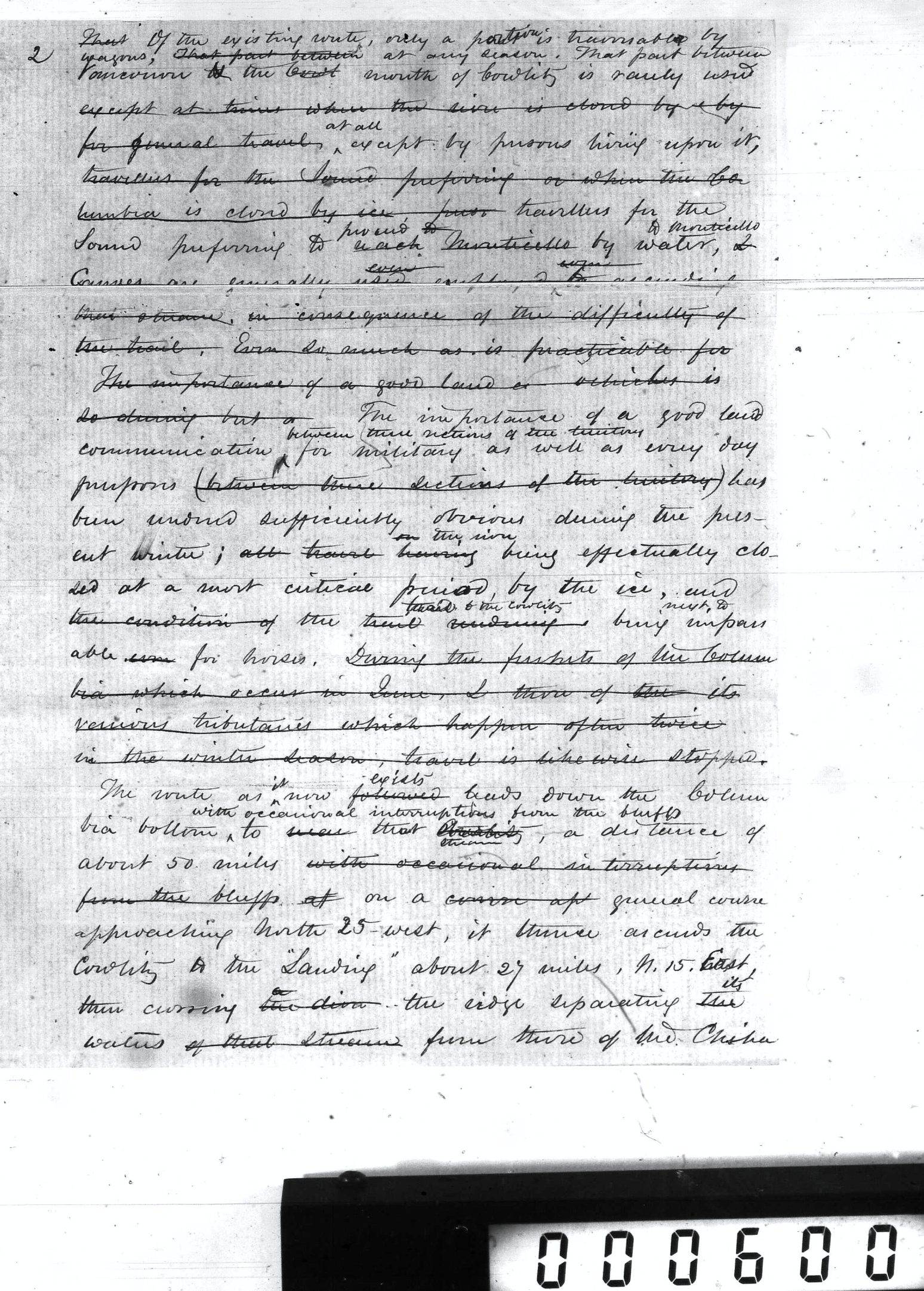
Memoir p. 2 (exposure 000600). "Of the existing route, only a portion is traversable by wagons at any season." The part between Vancouver and the mouth of Cowlitz "is rarely used ... at all, except by persons living upon it," travellers for the Sound proceeding to Monticello by water; canoes generally used. "The importance of a good land communication between these sections of the territory for military as well as every day purposes has been rendered sufficiently obvious during the present winter; all travel on the river being effectually closed at a most critical period, by the ice, and the trail to the Cowlitz being next to impassable for horses." Freshets of the Columbia "occur in June" and of its tributaries "often twice in the winter season," stopping travel. The route "leads down the Columbia bottom, with occasional interruptions from the bluffs, a distance of about 50 miles on a general course approaching North 25 west, it thence ascends the Cowlitz to the 'Landing' about 27 miles, N. 15 East, then crossing the ridge separating its waters from those of the Chiha[lis]".
Wisconsin Historical Society, Gibbs Family Papers, U.S. Mss Y, Micro 1117
Reel 2, frames 3951
Reel 2, frame 3951
Read beside the scan
AI first transcription from the evidence pack; not independently verified. Compare with the scan.
wagons, [struck: That part between] at any season. That part between
Vancouver [struck: &] the [struck: Cowl] mouth of Cowlitz is rarely used
[struck: except at times when the river is closed by a by]
[struck: for general travel,] [inserted: at all] except by persons living upon it,
[struck: travellers for the Sound preferring or when the Co-]
[struck: lumbia is closed by ice pass] travellers for the
Sound preferring to [inserted: proceed to] reach Monticello [inserted: to Monticello] by water, &
Canoes are generally [struck: used] [inserted: even] employed [struck: to] [inserted: upon] ascending
[struck: that stream] in consequence of the difficulty of
[struck: the trail. Even so much as is practicable for]
[struck: The importance of a good land or vehicles is]
[struck: so during but a] The importance of a good land
communication [inserted: between these sections of the territory] for military as well as every day
purposes ([struck: between these sections of the territory]) has
been rendered sufficiently obvious during the pres-
ent winter; [struck: all travel having] [inserted: on the river] being effectually clo-
sed at a most critical period, by the ice, and
[struck: the condition] of the trail [inserted: & the Cowlitz] [struck: rendering] [inserted: next to] being impass
able [struck: even] for horses. [struck: During the freshets of the Colum
bia which occur in June, & those of the its
various tributaries which happen often twice
in the winter season, travel is likewise stopped.]
The route as [inserted: it] now [struck: followed] [inserted: exists] leads down the Colum
bia bottom [inserted: with occasional interruptions from the bluffs] to [struck: near] that [struck: Cowlitz] [inserted: stream], a distance of
about 50 miles [struck: with occasional interruptions
from the bluffs at] on a [struck: comm apt] general course
approaching North 25 west, it thence ascends the
Cowlitz to the "Landing" about 27 miles, N. 15. East,
then crossing [struck: the divi] [inserted: a] the ridge separating [struck: the] [inserted: its]
waters [struck: of that stream] from those of the Chiha[lis?]
Citation and provenance
Gibbs, G., IV. (1856). [Manuscript volume, ms p. 2]. Gibbs Family Papers, 1763-1918 (U.S. Mss Y, Micro 1117, Reel 2, frame 3951). Wisconsin Historical Society Archives, Madison, WI, United States.
Citation details need editorial review.
Historical sources retain their individual rights and credits. A scan’s presence here does not establish unrestricted reuse.
People identified in the source catalog
These are catalog labels. Individual identities and relationships have not all been reviewed.
Where the book uses this document
No quotation has yet been assigned directly to this catalog record. Its individual frames may have separate connections.