
Wisconsin manuscript
George Gibbs IV (manuscript volume, n.p.) · 1856 (Olympia) and later additions
Tale of the child found by the old woman (Samuel Tsak'ailni), continued. Boy demands "A marrow bone"; camp struck, only his grandmother stays; the child "to deceive those who had gone on made caribou tracks"; grandmother sets a hook in the bay and "took a large pike with the hook"; "With a cloak wrongside out he is come to us, and with an old worn out caribou skin"; snowshoes put on him; he touches "the mouth of a caribou" and kills many; gives his grandmother "the ends of the tongues" of all the caribou he killed; roasting of the caribou head
Wisconsin Historical Society, Gibbs Family Papers, U.S. Mss Y, Micro 1117
Reel 2, frames 3924
Reel 2, frame 3924
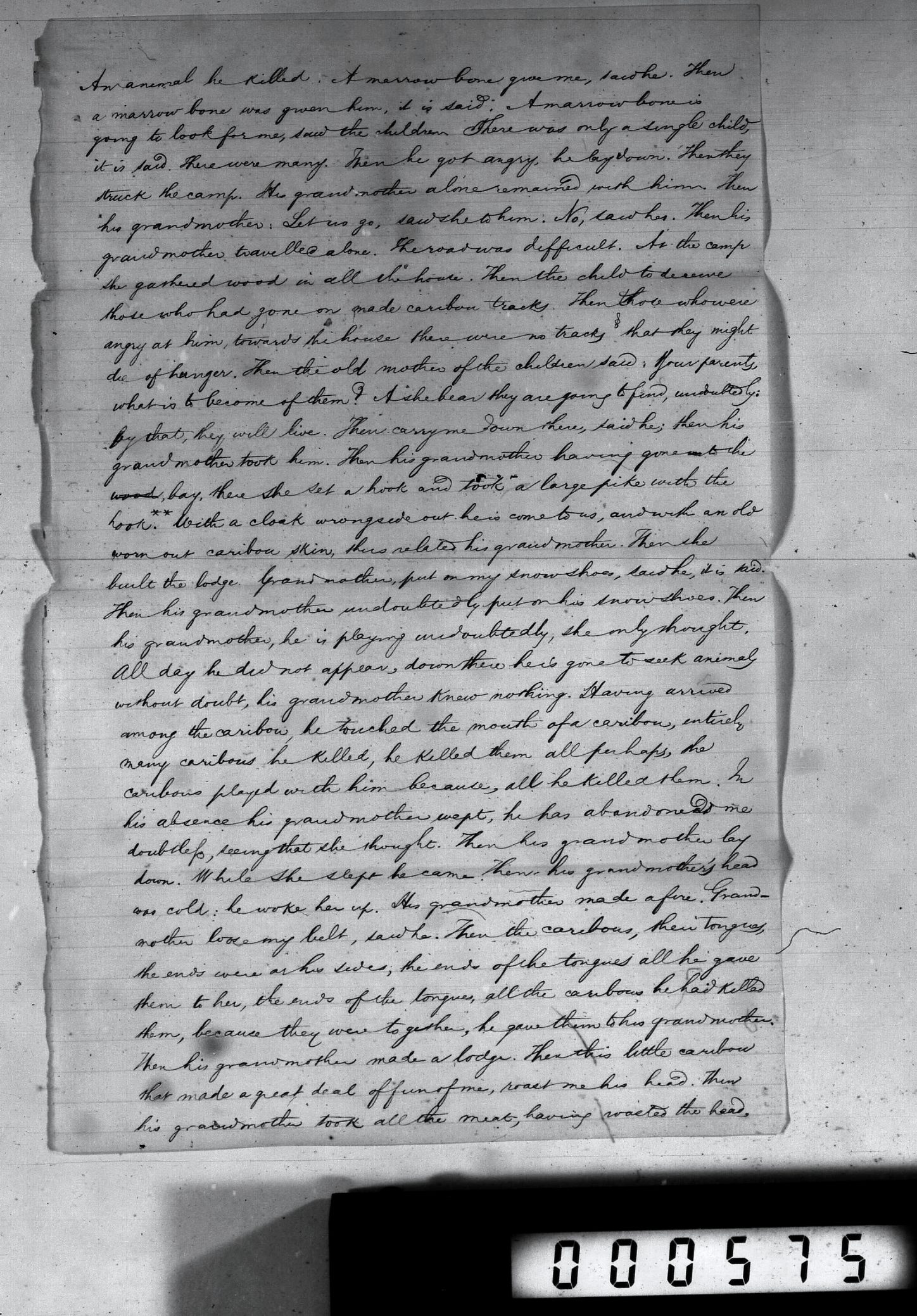
Read beside the scan
AI first transcription from the evidence pack; not independently verified. Compare with the scan.
a marrow bone was given him, it is said. A marrow bone is
going to look for me, said the children. There was only a single child,
it is said. There were many. Then he got angry, he lay down. Then they
struck the camp. His grandmother alone remained with him. Then
his grandmother: Let us go, said she to him. No, said he. Then his
grandmother travelled alone. The road was difficult. At the camp
she gathered wood in all the house. Then the child to deceive
those who had gone on made caribou tracks. Then those who were
angry at him, towards the house there were no tracks§[?] that they might
die of hunger. Then the old mother of the children said: Your parents,
what is to become of them? A she bear they are going to find, undoubtedly:
by that, they will live. Then carry me down there, said he; then his
grandmother took him. Then his grandmother having gone to the
[struck: wood], bay, there she set a hook and took* a large pike with the
hook.** With a cloak wrongside out he is come to us, and with an old
worn out caribou skin, thus relates his grandmother. Then she
built the lodge. Grandmother, put on my snowshoes, said he, it is said.
Then his grandmother undoubtedly put on his snowshoes. Then
his grandmother, he is playing undoubtedly, she only thought.
All day he did not appear, down there he is gone to seek animals
without doubt, his grandmother knew nothing. Having arrived
among the caribou, he touched the mouth of a caribou, entirely
many caribous he killed, he killed them all perhaps, the
caribous played with him because, all he killed them. In
his absence his grandmother wept, he has abandoned[?] me
doubtless, seeing that she thought. Then his grandmother lay
down. While she slept he came there. his grandmother's head
was cold: he woke her up. His grandmother made a fire. Grand-
mother loose my belt, said he. Then the caribous, their tongues,
the ends were at his sides; the ends of the tongues all he gave
them to her, the ends of the tongues, all the caribous he had killed
them, because they were together, he gave them to his grandmother.
Then his grandmother made a lodge. Then this little caribou
that made a great deal of fun of me, roast me his head. Then
his grandmother took all the meat, having roasted the head,
Citation and provenance
Gibbs, G., IV. (1856). [Manuscript volume, n.p.]. Gibbs Family Papers, 1763-1918 (U.S. Mss Y, Micro 1117, Reel 2, frame 3924). Wisconsin Historical Society Archives, Madison, WI, United States.
Citation details need editorial review.
Historical sources retain their individual rights and credits. A scan’s presence here does not establish unrestricted reuse.
People identified in the source catalog
These are catalog labels. Individual identities and relationships have not all been reviewed.
Where the book uses this document
No quotation has yet been assigned directly to this catalog record. Its individual frames may have separate connections.