
Wisconsin manuscript
George Gibbs IV (manuscript volume, ms p. n.p. (top center: "No 6")) · 1856 (Olympia) and later additions
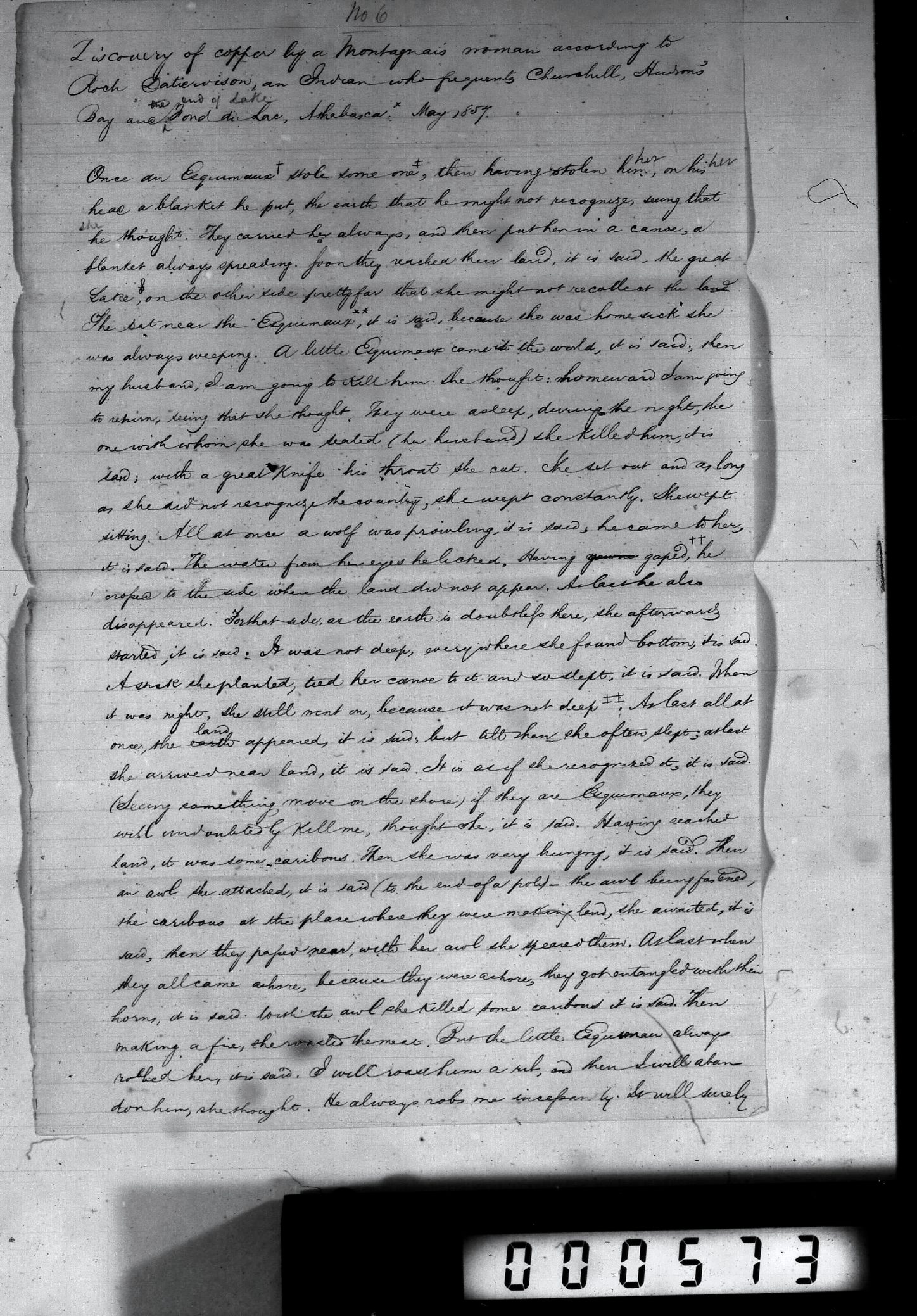
English translation of Montagnais/Chipewyan tale No. 6. Titled "Discovery of copper by a Montagnais woman according to Roch Datsiwison (?), an Indian who frequents Churchill, Hudson's Bay and Fond du Lac, the end of Lake Athabasca [inserted above the line], May 1857."; "Once an Esquimaux stole some one" - woman carried off with "a blanket he put" over her head, taken by canoe across "the great Lake"; she cuts her husband's throat "with a great Knife"; a wolf licks the water from her eyes and "gaped"; she poles her canoe over shallow water, plants a stake and ties her canoe to it; kills caribou with "an awl" lashed to a pole; roasts meat; resolves to abandon the little Esquimaux child; interlinear corrections and footnote marks (*, dagger, double-dagger, section, **, ++) throughout
Wisconsin Historical Society, Gibbs Family Papers, U.S. Mss Y, Micro 1117
Reel 2, frames 3922
Reel 2, frame 3922
Read beside the scan
AI first transcription from the evidence pack; not independently verified. Compare with the scan.
Discovery of copper by a Montagnais woman according to
Roch Datierwison[?], an Indian who frequents Churchill, Hudson's
Bay and [inserted: the end of Lake] Fond di Lac, Athabasca.* May 1857.
Once an Esquimaux† stole some one‡, then having stolen him [inserted: her], on his [inserted: her]
head a blanket he put, the earth that he might not recognize, seeing that
[inserted: she] he thought. They carried her always, and then put her in a canoe, a
blanket always spreading. Soon they reached their land, it is said, the great
Lake§, on the other side pretty far that she might not recollect the land.
She sat near the Esquimaux**, it is said, because she was home sick she
was always weeping. A little Esquimaux came to the world, it is said; then
my husband, I am going to kill him she thought: homeward I am going
to return, seeing that she thought. They were asleep, during the night, the
one with whom she was seated (her husband) she killed him, it is
said; with a great knife his throat she cut. She set out and as long
as she did not recognize the country, she wept constantly. She wept
sitting. All at once a wolf was prowling, it is said; he came to her,
it is said. The water from her eyes he licked, Having [struck: yawn[?]] gaped,†† he
crossed to the side where the land did not appear. At last he also
disappeared. For that side, as the earth is doubtless there, she afterwards
started, it is said: It was not deep, every where she found bottom, it is said.
A stick she planted, tied her canoe to it and so slept, it is said. When
it was night, she still went on, because it was not deep‡‡. At last all at
once, the [struck: earth] [inserted: land] appeared, it is said: but till then she often slept; at last
she arrived near land, it is said. It is as if she recognized it, it is said.
(Seeing something move on the shore) if they are Esquimaux, they
will undoubtedly kill me, thought she, it is said. Having reached
land, it was some caribous. Then she was very hungry, it is said. Then
an awl she attached, it is said (to the end of a pole) - the awl being fastened,
the caribous at the place where they were making land, she awaited, it is
said, then they passed near, with her awl she speared them. At last when
they all came ashore, because they were ashore, they got entangled with their
horns, it is said. With the awl she killed some caribous it is said. Then
making a fire, she roasted the meat. But the little Esquimaux always
robbed her, it is said. I will roast him a rib, and then I will aban
don him, she thought. He always robs me incessantly. It will surely
Citation and provenance
[George Gibbs IV (manuscript volume, ms p. n.p. (top center: "No 6"))]. (1856). Gibbs Family Papers, 1763-1918 (U.S. Mss Y, Micro 1117, Reel 2, frame 3922). Wisconsin Historical Society Archives, Madison, WI, United States.
Citation details need editorial review.
Historical sources retain their individual rights and credits. A scan’s presence here does not establish unrestricted reuse.
People identified in the source catalog
These are catalog labels. Individual identities and relationships have not all been reviewed.
Where the book uses this document
No quotation has yet been assigned directly to this catalog record. Its individual frames may have separate connections.