
Wisconsin manuscript
George Gibbs IV (manuscript volume, n.p.) · 1856 (Olympia) and later additions
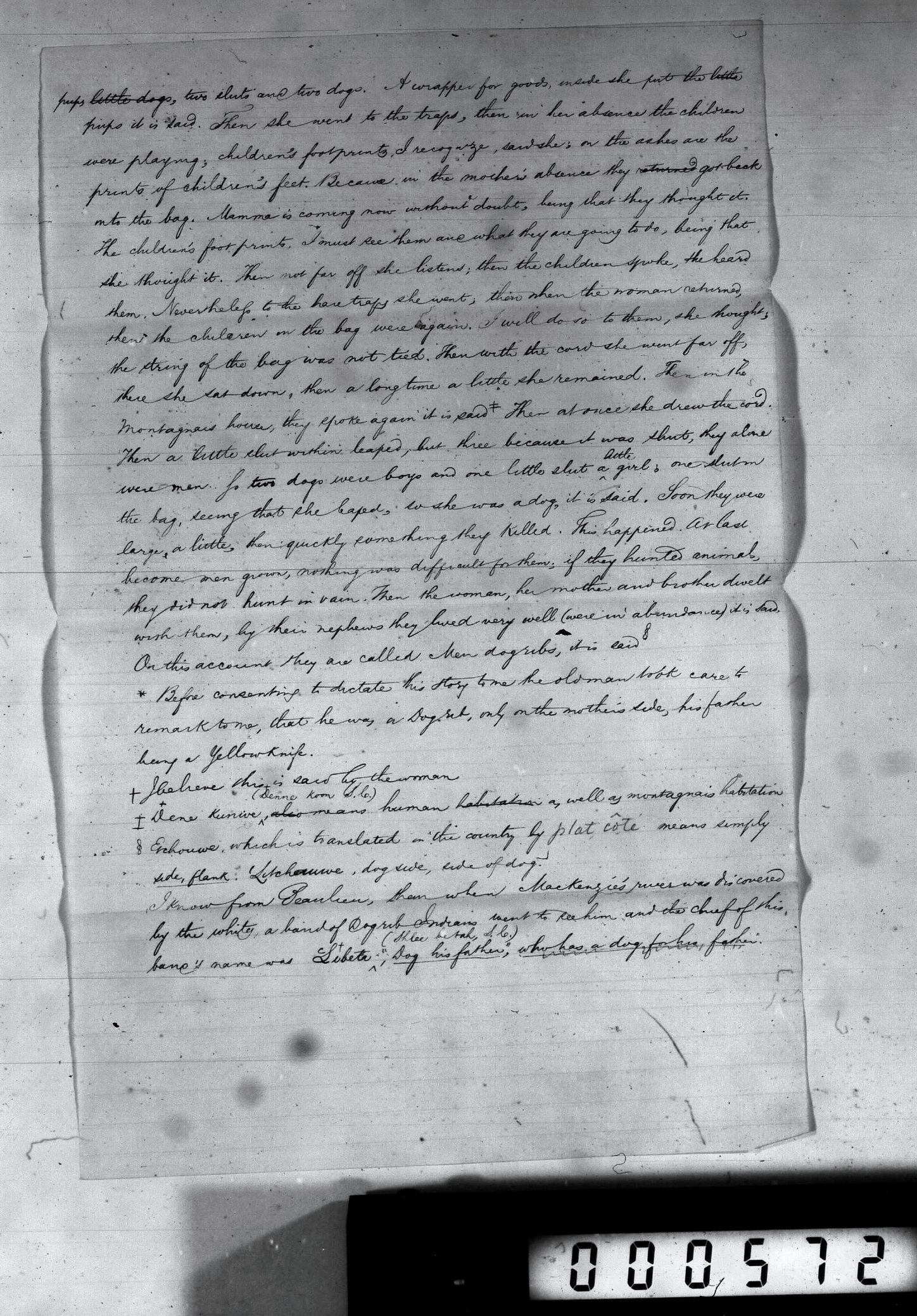
Loose manuscript: end of "No. 5" Dogrib origin story, with linguistic and historical footnotes. Conclusion: she wraps the pups in a bag; "children's footprints, I recognize, said she; on the ashes are the prints of children's feet"; she goes to the traps with the bag cord in hand, draws it shut, "then a little slut within leaped, but three because it was shut, they alone were men. So two dogs were boys and one little slut a little girl"; the sons grow to be tireless hunters and "her mother and brother dwelt with them, by their nephews they lived very well (were in abundance) it is said. On this account they are called Men dogribs, it is said." Footnotes: "* Before consenting to dictate this story to me the old man took care to remark to me, that he was a Dogrib, only on the mother's side, his father being a Yellowknife."; "† I believe this is said by the woman"; "‡ Dene Kunive (Denne koon, l.c.) means human habitation as well as montagnais habitation"; "§ Etchouwe, which is translated in the country by plat côté means simply side, flank: Litchaouwe, dog side, side of dog."; and a historical note: "I know from Beaulieu, then when Mackenzie's river was discovered by the whites, a band of Dogrib Indians went to see him and the chief of this band's name was Libeta (Thlee betah, l.c.), dog his father, who has a dog for his father." Frame counter 000572.
Wisconsin Historical Society, Gibbs Family Papers, U.S. Mss Y, Micro 1117
Reel 2, frames 3921
Reel 2, frame 3921
Read beside the scan
AI first transcription from the evidence pack; not independently verified. Compare with the scan.
pups it is said. Then she went to the traps, then in her absence the children
were playing; children's footprints, I recognize, said she; on the ashes are the
prints of children's feet. Because in the mother's absence they [struck: returned] got back
into the bag. Mamma is coming now without doubt, being that they thought it.
The children's foot prints. +I must see them and what they are going to do, being that
she thought it. Then not far off she listens; then the children spoke, she heard
them. Nevertheless to the hare traps she went; then when the woman returned,
then the children on the bag were again. I will do so to them, she thought;
the string of the bag was not tied. Then with the cord she went far off,
there she sat down, then a long time a little she remained. Then in the
Montagnais house, they spoke again it is said‡ Then at once she drew the cord.
Then a little slut within leaped, but three because it was shut, they alone
were men. So two dogs were boys and one little slut a [inserted: little] girl; one slut in
the bag, seeing that she leaped, so she was a dog, it is said. Soon they were
large, a little, then quickly something they killed. This happened. At last
become men grown, nothing was difficult for them; if they hunted animals,
they did not hunt in vain. Then the woman, her mother and brother dwelt
with them, by their nephews they lived very well (were in abundance) it is said.
On this account they are called Men dogribs, it is said§
* Before consenting to dictate this story to me the old man took care to
remark to me, that he was a Dog Rib, only on the mother's side, his father
being a Yellow Knife.
+ I believe this is said by the woman
‡ Dene Kunive, [inserted: (Denne koon S.C.)] [struck: also] means human [struck: habitation] a, well as montagnais habitation
§ Etchouwe, which is translated in the country by plat côté means simply
side, flank. Litchouwe, dog side, side of dog.
I know from Beaulieu, that[?] when Mackenzie's river was discovered
by the whites, a band of Dogrib Indians went to see him and the chief of this
band's name was Libeta [inserted: (Shlee be tah, S.C.)] "Dog his father"; who has a dog [struck: for his father][?].
Citation and provenance
Gibbs, G., IV. (1856). [Manuscript volume, n.p.]. Gibbs Family Papers, 1763-1918 (U.S. Mss Y, Micro 1117, Reel 2, frame 3921). Wisconsin Historical Society Archives, Madison, WI, United States.
Citation details need editorial review.
Historical sources retain their individual rights and credits. A scan’s presence here does not establish unrestricted reuse.
People identified in the source catalog
These are catalog labels. Individual identities and relationships have not all been reviewed.
Where the book uses this document
No quotation has yet been assigned directly to this catalog record. Its individual frames may have separate connections.