
Wisconsin manuscript
George Gibbs IV (manuscript volume, ms p. 244) · 1856 (Olympia) and later additions
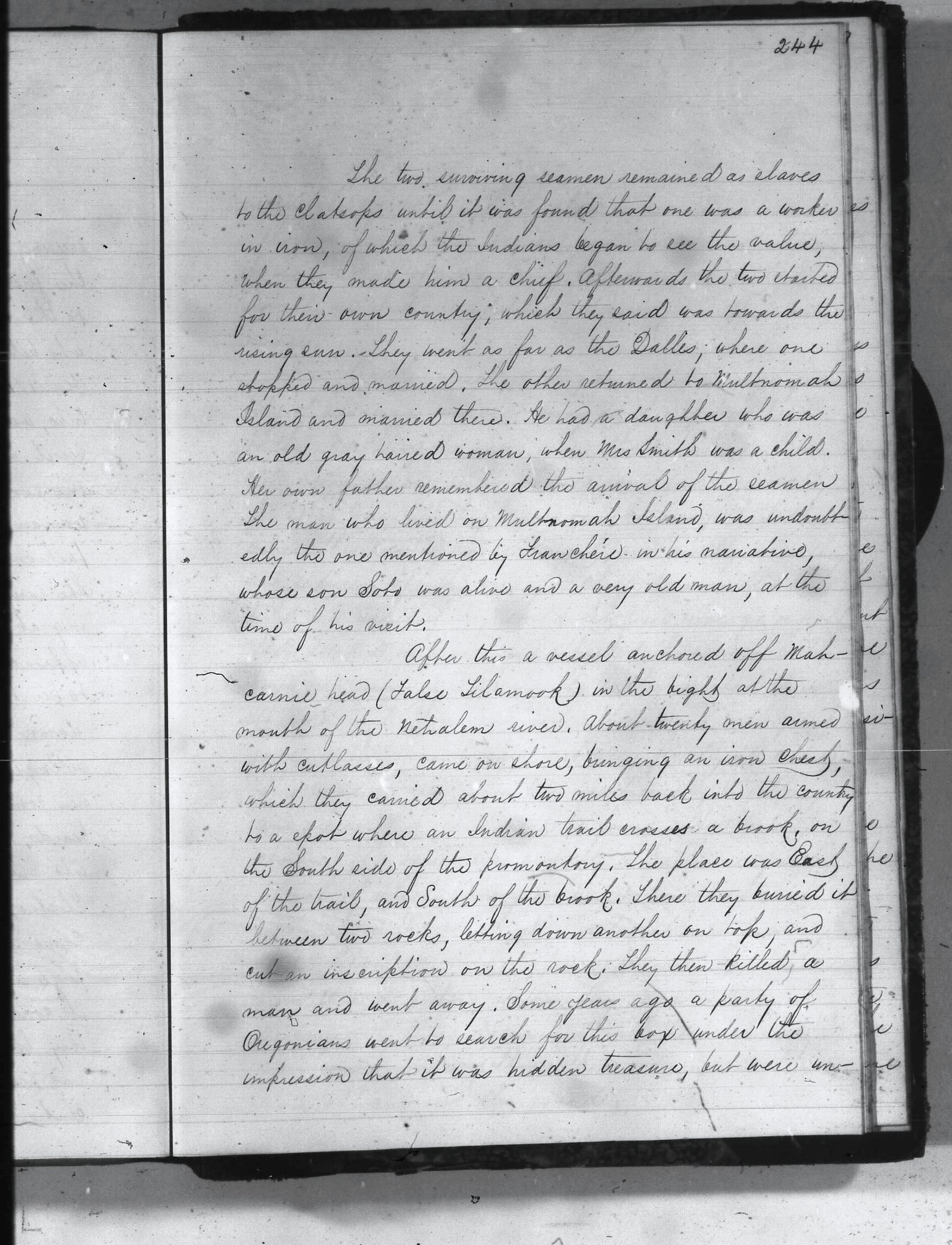
Early Visits of White Men.. The two surviving seamen held "as slaves to the Clatsops" until one proved "a worker in iron" and was made a chief; both then started east "towards the rising sun," one stopping and marrying at the Dalles, the other returning to "Multnomah Island," whose descendant Gibbs identifies with the man Franchere mentions, "whose son Soto was alive and a very old man"; second tradition: a vessel anchored off "Mah-carnie head (False Tilamook)" at the mouth of the "Netvalem" (?) river, about twenty men with cutlasses carrying an iron chest two miles inland, burying it between two rocks east of an Indian trail and south of a brook, cutting "an inscription on the rock," then killing a man; Oregonians later searched for it as treasure. No sketch or table.
Wisconsin Historical Society, Gibbs Family Papers, U.S. Mss Y, Micro 1117
Reel 2, frames 3896
Reel 2, frame 3896
Read beside the scan
AI first transcription from the evidence pack; not independently verified. Compare with the scan.
The two surviving seamen remained as slaves
to the Clatsops until it was found that one was a worker
in iron, of which the Indians began to see the value,
when they made him a chief. Afterwards the two started
for their own country; which they said was towards the
rising sun. They went as far as the Dalles, where one
stopped and married. The other returned to Multnomah
Island and married there. He had a daughter who was
an old gray haired woman, when Mrs Smith was a child.
Her own father remembered the arrival of the seamen
The man who lived on Multnomah Island, was undoubt-
edly the one mentioned by Franchére[?] in his narrative,
whose son Soto[?] was alive and a very old man, at the
time of his visit.
After this a vessel anchored off Mah-
carnie head (False Tilamook) in the bight at the
mouth of the Nehalem river. About twenty men armed
with cutlasses, came on shore, bringing an iron chest,
which they carried about two miles back into the country
to a spot where an Indian trail crosses a brook, on
the South side of the promontory. The place was East
of the trail, and South of the brook. There they buried it
between two rocks, letting down another on top, and
cut an inscription on the rock. They then killed, a
man and went away. Some years ago a party of
Oregonians went to search for this box under the
impression that it was hidden treasure, but were un-
Citation and provenance
Gibbs, G., IV. (1856). [Manuscript volume, ms p. 244]. Gibbs Family Papers, 1763-1918 (U.S. Mss Y, Micro 1117, Reel 2, frame 3896). Wisconsin Historical Society Archives, Madison, WI, United States.
Citation details need editorial review.
Historical sources retain their individual rights and credits. A scan’s presence here does not establish unrestricted reuse.
People identified in the source catalog
These are catalog labels. Individual identities and relationships have not all been reviewed.
Where the book uses this document
No quotation has yet been assigned directly to this catalog record. Its individual frames may have separate connections.