
Wisconsin manuscript
George Gibbs IV (manuscript volume, ms p. 243) · 1856 (Olympia) and later additions
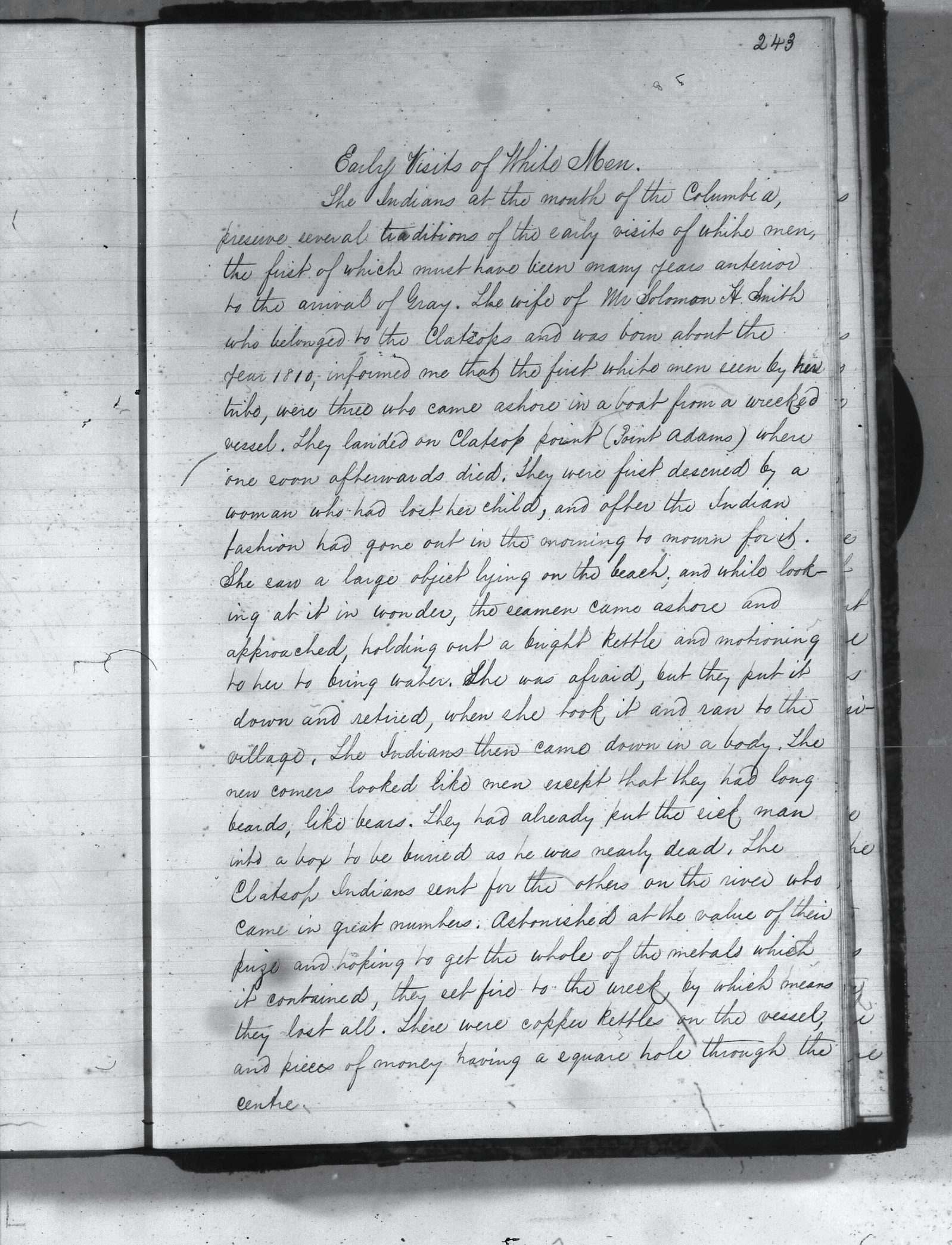
Early Visits of White Men.. Section heading "Early Visits of White Men." Traditions of the first white men at the mouth of the Columbia, before Gray's arrival, told to Gibbs by "The wife of Mr Solomon H. Smith who belonged to the Clatsops and was born about the year 1810": three men came ashore from a wrecked vessel and landed on "Clatsop point (Point Adams)," where one soon died; first seen by a woman who had gone out at morning to mourn a lost child; the seamen held out "a bright kettle" motioning for water; the newcomers "looked like men except that they had long beards, like bears"; Indians burned the wreck to get the metals and "lost all"; copper kettles and "pieces of money having a square hole through the centre." No sketch or table.
Wisconsin Historical Society, Gibbs Family Papers, U.S. Mss Y, Micro 1117
Reel 2, frames 3895
Reel 2, frame 3895
Read beside the scan
AI first transcription from the evidence pack; not independently verified. Compare with the scan.
Early Visits of White Men.
The Indians at the mouth of the Columbia,
preserve several traditions of the early visits of white men,
the first of which must have been many years anterior
to the arrival of Gray. The wife of Mr Solomon H. Smith
who belonged to the Clatsops and was born about the
year 1810, informed me that the first white men seen by her
tribe, were three who came ashore in a boat from a wrecked
vessel. They landed on Clatsop point (Point Adams) where
one soon afterwards died. They were first descried[?] by a
woman who had lost her child, and after the Indian
fashion had gone out in the morning to mourn for it.
She saw a large object lying on the beach; and while look-
ing at it in wonder, the seamen came ashore and
approached, holding out a bright kettle and motioning
to her to bring water. She was afraid, but they put it
down and retired, when she took it and ran to the
village. The Indians then came down in a body. The
new comers looked like men except that they had long
beards, like bears. They had already put the sick man
into a box to be buried as he was nearly dead. The
Clatsop Indians sent for the others on the river who
came in great numbers. Astonished at the value of their
prize and hoping to get the whole of the metals which
it contained, they set fire to the wreck, by which means
they lost all. There were copper kettles on the vessel,
and pieces of money having a square hole through the
centre.
Citation and provenance
Gibbs, G., IV. (1856). [Manuscript volume, ms p. 243]. Gibbs Family Papers, 1763-1918 (U.S. Mss Y, Micro 1117, Reel 2, frame 3895). Wisconsin Historical Society Archives, Madison, WI, United States.
Citation details need editorial review.
Historical sources retain their individual rights and credits. A scan’s presence here does not establish unrestricted reuse.
People identified in the source catalog
These are catalog labels. Individual identities and relationships have not all been reviewed.
Where the book uses this document
No quotation has yet been assigned directly to this catalog record. Its individual frames may have separate connections.