
Wisconsin manuscript
George Gibbs IV (manuscript volume, ms p. 215) · 1856 (Olympia) and later additions
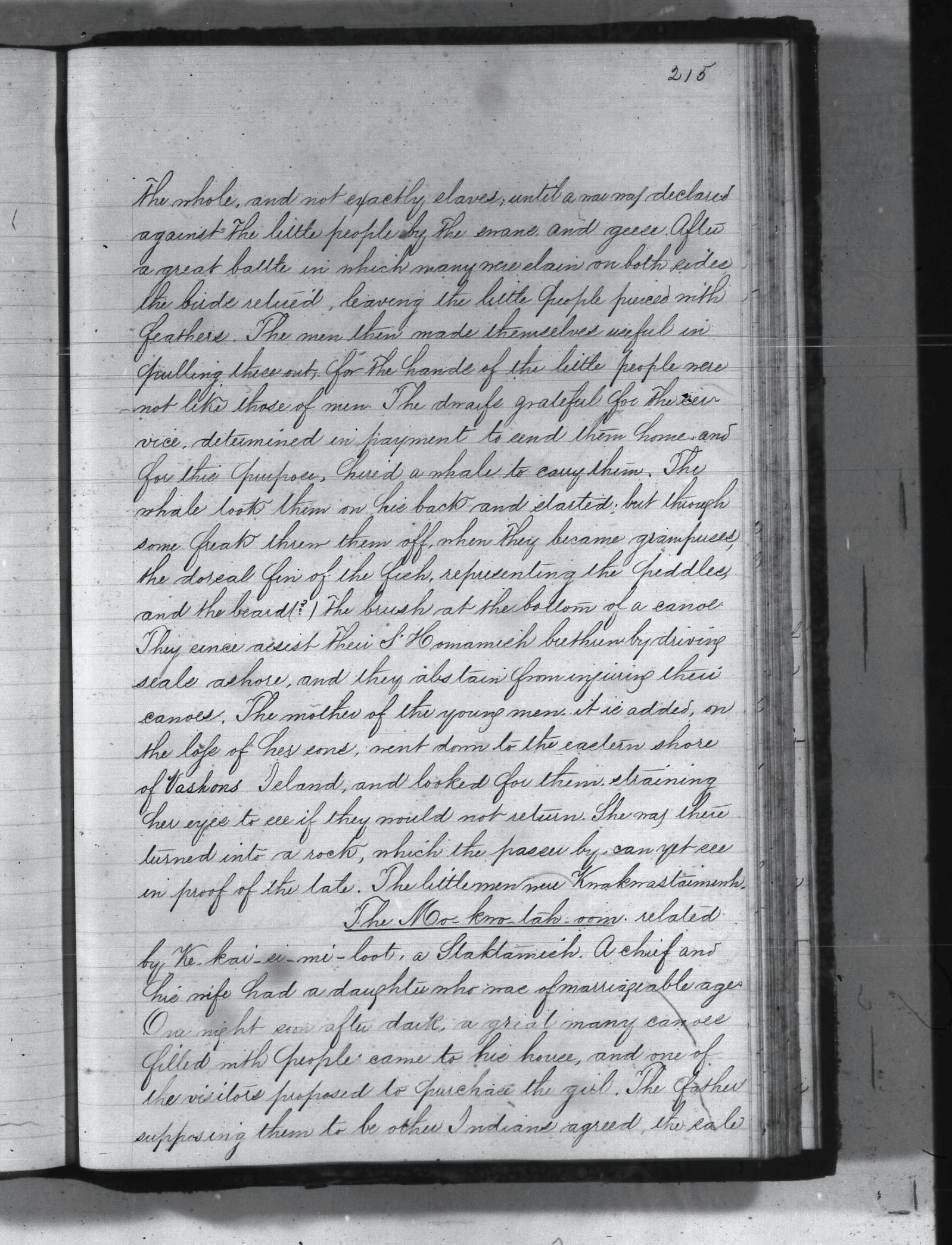
End of "The Seal Hunters"; new titled tale "The Mo-kwo-tah-oon". War "declared against the little people by the swans. and geese"; the birds retire "leaving the little people pierced with feathers", which the men pull out "for the hands of the little people were not like those of men"; the grateful dwarfs "hired a whale to carry them"; thrown off by a freak of the whale "they became grampuses, the dorsal fin of the fish, representing the paddles, and the beard(?) The brush at the bottom of a canoe"; the grampuses "since assist their S'Homamish brethren by driving seals ashore, and they abstain from injuring their canoes"; the mother "went down to the eastern shore of Vashons Island, and looked for them" and "was there turned into a rock, which the passer by can yet see in proof of the tale"; "The little men were Kwakwastaimenh." Then the titled tale "The Mo-kwo-tah-oon. related by Ke-kai-si-mi-loot(?), a Staktamish": a chief's daughter of marriageable age; canoes arrive after dark and a visitor proposes to purchase the girl
Wisconsin Historical Society, Gibbs Family Papers, U.S. Mss Y, Micro 1117
Reel 2, frames 3866
Reel 2, frame 3866
Read beside the scan
AI first transcription from the evidence pack; not independently verified. Compare with the scan.
the whole, and not exactly slaves; until a war was declared
against the little people by the swans and geese. After
a great battle in which many were slain on both sides
the birds retired, leaving the little people pierced with
feathers. The men then made themselves useful in
pulling these out, for the hands of the little people were
not like those of men. The dwarfs grateful for the ser-
vice, determined in payment to send them home, and
for this purpose, hired a whale to carry them. The
whale took them on his back and started, but through
some freak threw them off, when they became grampuses,
the dorsal fin of the fish, representing the paddles,
and the beard(?) the brush at the bottom of a canoe
They since assist their S'Homamish brethren by driving
seals ashore, and they abstain from injuring their
canoes. The mother of the young men, it is added, on
the loss of her sons, went down to the eastern shore
of Vashons Island, and looked for them, straining
her eyes to see if they would not return. She was there
turned into a rock, which the passer by, can yet see
in proof of the tale. The little men were Knakwastaimish[?].
The Mo-kwo-tah-oom[?] related
by Ke-kai-e-mi-loot[?], a Staktamish[?]. A chief and
his wife had a daughter who was of marriageable age
One night soon after dark, a great many canoes
filled with people came to his house, and one of
the visitors proposed to purchase the girl. The father
supposing them to be other Indians agreed, the sale
Citation and provenance
Gibbs, G., IV. (1856). [Manuscript volume, ms p. 215]. Gibbs Family Papers, 1763-1918 (U.S. Mss Y, Micro 1117, Reel 2, frame 3866). Wisconsin Historical Society Archives, Madison, WI, United States.
Citation details need editorial review.
Historical sources retain their individual rights and credits. A scan’s presence here does not establish unrestricted reuse.
People identified in the source catalog
These are catalog labels. Individual identities and relationships have not all been reviewed.
Where the book uses this document
No quotation has yet been assigned directly to this catalog record. Its individual frames may have separate connections.