
Wisconsin manuscript
George Gibbs IV (manuscript volume, ms p. 213) · 1856 (Olympia) and later additions
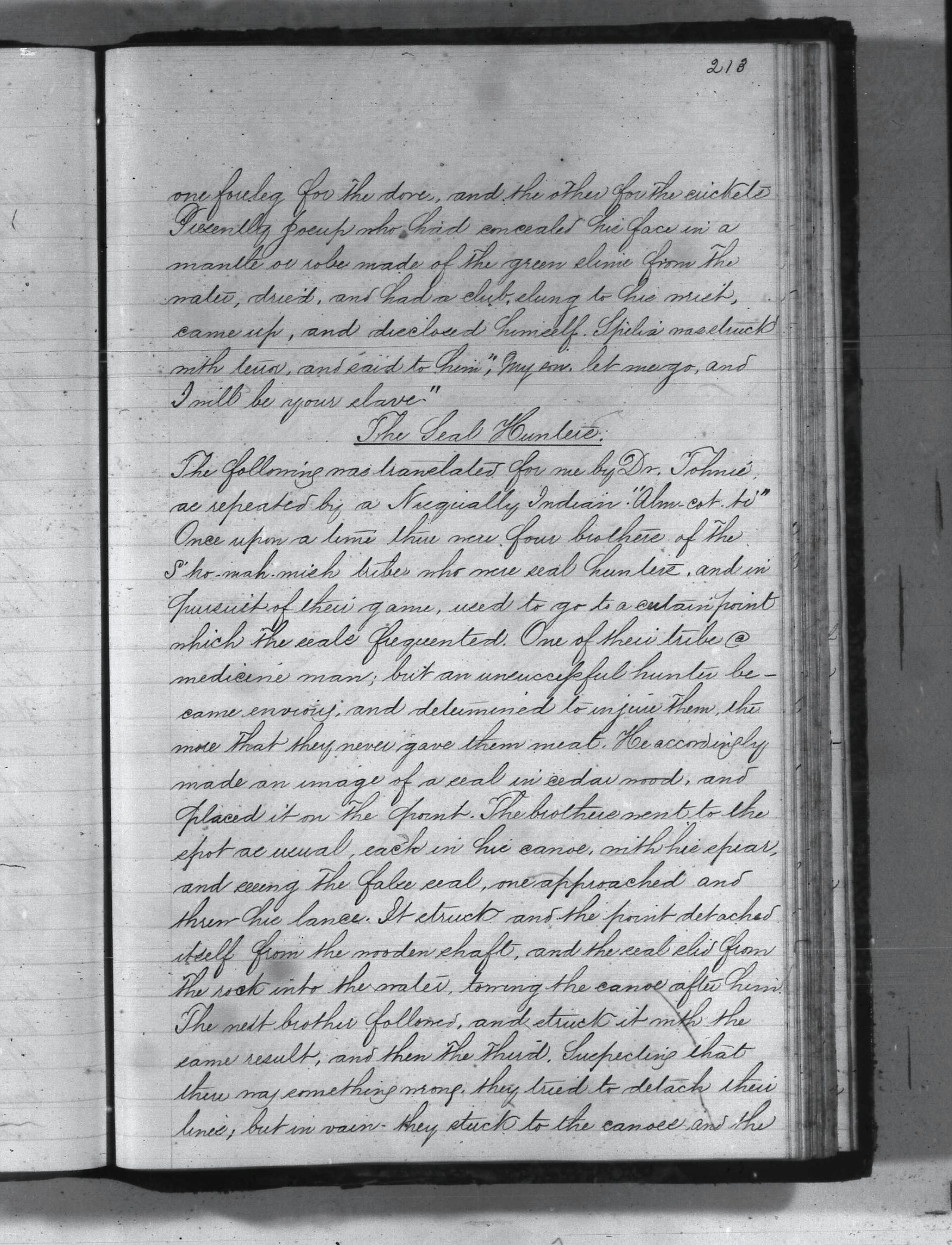
End of "The Story of Josup"; new titled tale "The Seal Hunters:". Spilyai leaves "one foreleg for the dove, and the other for the crickets"; Josup appears "who had concealed his face in a mantle or robe made of the green slime from the water, dried, and had a club, slung to his wrist"; "Spilia was struck with terror, and said to him," My son. let me go, and I will be your slave."" Then the titled tale "The Seal Hunters:" with named translator and informant: "The following was translated for me by Dr. Tolmie. as repeated by a Nisqually Indian "Alm-cot-tŭ""; "four brothers of the S'ho-mah-mish tribe who were seal hunters"; an envious medicine man "made an image of a seal in cedar wood, and placed it on the point"; each lance strikes and "the point detached itself from the wooden shaft, and the seal slid from the rock into the water, towing the canoe after him"
Wisconsin Historical Society, Gibbs Family Papers, U.S. Mss Y, Micro 1117
Reel 2, frames 3864
Reel 2, frame 3864
Read beside the scan
AI first transcription from the evidence pack; not independently verified. Compare with the scan.
one foreleg for the dove[?], and the other for the crickets
Presently Joeup[?] who had concealed his face in a
mantle or robe made of the green slime from the
water, dried, and had a club, slung to his neck,
came up, and disclosed himself. Spilia was struck
with terror, and said to him; "My son. let me go, and
I will be your slave"
The Seal Hunters.
The following was translated for me by Dr. Tolmie,
as repeated by a Nsqually[?] Indian "Ulm-cot-to"[?]
Once upon a time there were four brothers of the
S'ho-mah-mish tribe who were seal hunters, and in
pursuit of their game, used to go to a certain point
which the seals frequented. One of their tribe a
medicine man; but an unsuccessful hunter be-
came envious, and determined to injure them, the
more that they never gave them meat. He accordingly
made an image of a seal in cedar wood, and
placed it on the point. The brothers went to the
spot as usual, each in his canoe, with his spear,
and seeing the false seal, one approached and
threw his lance. It struck and the point detached
itself from the wooden shaft, and the seal slid from
the rock into the water, towing the canoe after him.
The next brother followed, and struck it with the
same result, and then the third. Suspecting that
there was something wrong, they tried to detach their
lines, but in vain- they stuck to the canoes and the
Citation and provenance
Gibbs, G., IV. (1856). [Manuscript volume, ms p. 213]. Gibbs Family Papers, 1763-1918 (U.S. Mss Y, Micro 1117, Reel 2, frame 3864). Wisconsin Historical Society Archives, Madison, WI, United States.
Citation details need editorial review.
Historical sources retain their individual rights and credits. A scan’s presence here does not establish unrestricted reuse.
People identified in the source catalog
These are catalog labels. Individual identities and relationships have not all been reviewed.
Where the book uses this document
No quotation has yet been assigned directly to this catalog record. Its individual frames may have separate connections.