
Wisconsin manuscript
George Gibbs IV (manuscript volume, ms p. 202) · 1856 (Olympia) and later additions
TALE: "The Snow Peaks" (cont.) — the severed heads become Mt. Adams and a peak in the Winatshapum country. The head "flew over, and fell on the other side of the mountains, and became Tahoma, or Mt. Adams. Weeiet then stamped on his neck, and rounded it off, as it now is Pahtoo was not killed. His heart remained strong"; Weeiet then goes to "Wacheum" — "My youngest brother, Why are you always behaving so badly to your people, taking their women to sleep with?" — and Wacheum thinks "Where has he been to see me? I have not seen him any where"; "Pahtoo then struck Wacheum's head off. which flew and lit in the Winatshapum country, at the head of the river, and he stamped on his neck in the same way as had been done to himself" (the manuscript here names Pahtoo, not Weeiet, as the striker); Pahtoo afterwards "made a bow and twenty arrows, straight and strong. He took these and his knife, and went to Weeiet," who "after cutting his brother's head off, had stolen his son and taken him with him. He forms the elevation or shoulder of the old crater on the south side"; Pahtoo "dissembled and addressed Weeish(?), another(?) old subject of binding the head" [text continues on the next page]. No sketch or table.
Wisconsin Historical Society, Gibbs Family Papers, U.S. Mss Y, Micro 1117
Reel 2, frames 3851
Reel 2, frame 3851
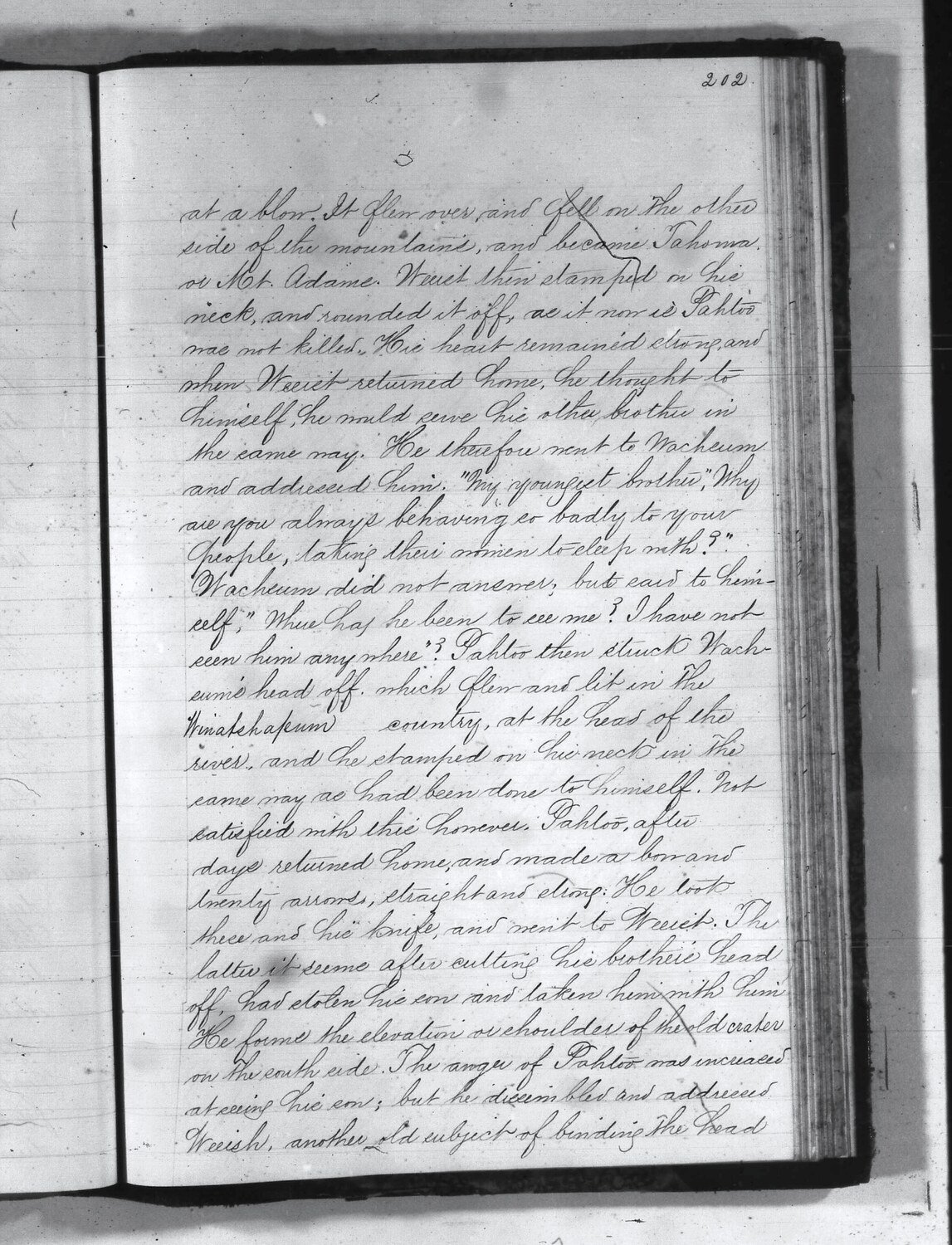
Read beside the scan
AI first transcription from the evidence pack; not independently verified. Compare with the scan.
at a blow. It flew over, and fell on the other
side of the mountains, and became Tahoma.
or Mt. Adams. Weeist[?] then stamped on his
neck, and rounded it off, as it now is Pahtoo
was not killed. His heart remained strong, and
when Weeist[?] returned home, he thought to
himself, he would serve his other brother in
the same way. He therefore went to Wacheum[?]
and addressed him: "My youngest brother," Why
are you always behaving so badly to your
People, taking their women to sleep with?"
Wacheum[?] did not answer, but said to him-
self," Where has he been to see me? I have not
seen him any where"? Pahtoo then struck Wach-
eum's[?] head off. which flew and lit in the
Winatshapum[?] country, at the head of the
river, and he stamped on his neck in the
same way as had been done to himself. Not
satisfied with this however. Pahtoo, after
days returned home, and made a bow and
twenty arrows, straight and strong. He took
these and his knife, and went to Weeist[?]. The
latter it seems after cutting his brothers[?] head
off, had stolen his son and taken him with him
He forms the elevation or shoulder of the old crater
on the south side. The anger of Pahtoo was increased
at seeing his son; but he dissembled and addressed
Weeish[?], another old subject of binding the head
Citation and provenance
Gibbs, G., IV. (1856). [Manuscript volume, ms p. 202]. Gibbs Family Papers, 1763-1918 (U.S. Mss Y, Micro 1117, Reel 2, frame 3851). Wisconsin Historical Society Archives, Madison, WI, United States.
Citation details need editorial review.
Historical sources retain their individual rights and credits. A scan’s presence here does not establish unrestricted reuse.
People identified in the source catalog
These are catalog labels. Individual identities and relationships have not all been reviewed.
Where the book uses this document
No quotation has yet been assigned directly to this catalog record. Its individual frames may have separate connections.