
Wisconsin manuscript
George Gibbs IV (manuscript volume, ms p. 196) · 1856 (Olympia) and later additions
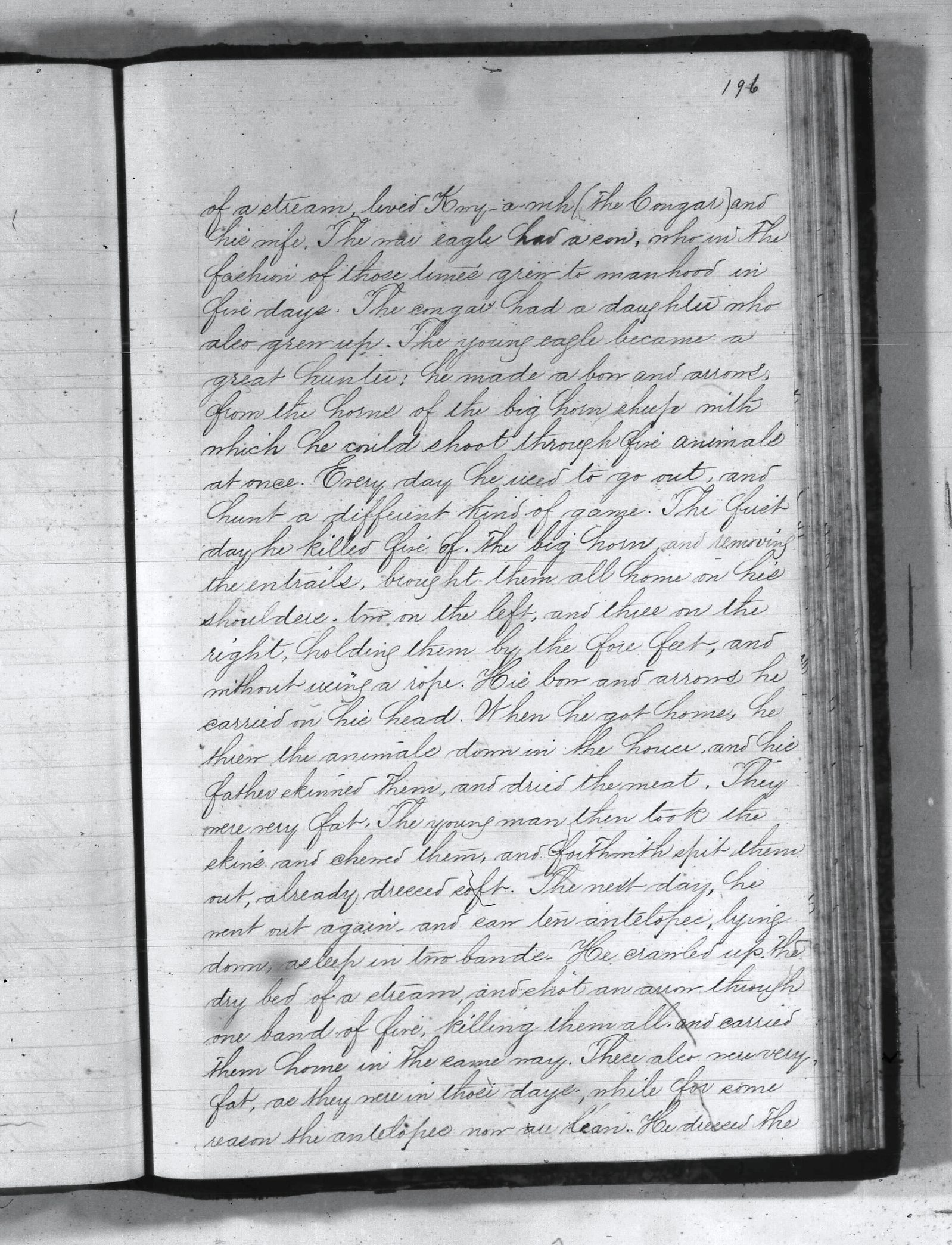
TALE: "The Story of Why-ei-ma" (cont.) — the cougar's household; the young eagle's hunts. "of a stream, lived Kwy-a-wh(?) (The Cougar) and his wife"; the war eagle's son "in the fashion of those times grew to manhood in five days"; the cougar's daughter also grew up; the young eagle "made a bow and arrows from the horns of the big horn sheep with which he could shoot through five animals at once"; day one he "killed five of the big horn," carried them home on his shoulders "two on the left, and three on the right, holding them by the fore feet, and without using a rope. His bow and arrows he carried on his head"; his father skinned them and dried the meat; "The young man then took the skins and chewed them, and forthwith spit them out, already dressed soft"; day two "ten antelopes, lying down asleep in two bands," stalked up "the dry bed of a stream, and shot an arrow through one band of five, killing them all"; "These also were very fat, as they were in those days, while for some reason the antelopes now are lean." No sketch or table.
Wisconsin Historical Society, Gibbs Family Papers, U.S. Mss Y, Micro 1117
Reel 2, frames 3845
Reel 2, frame 3845
Read beside the scan
AI first transcription from the evidence pack; not independently verified. Compare with the scan.
of a stream, lived Kuy-a-mh[?] (the Cougar) and
his wife. The war eagle had a son, who in the
fashion of those times grew to manhood in
five days. The cougar had a daughter who
also grew up. The young eagle became a
great hunter; he made a bow and arrows
from the horns of the big horn sheep with
which he could shoot through five animals
at once. Every day he used to go out, and
hunt a different kind of game. The first
day he killed five of the big horn, and removing
the entrails, brought them all home on his
shoulders. two on the left, and three on the
right, holding them by the fore feet, and
without using a rope. His bow and arrows he
carried on his head. When he got homes[?], he
threw the animals down in the house, and his
father skinned them, and dried the meat. They
were very fat. The young man then took the
skins and chewed them, and forthwith spit them
out, already dressed soft. The next day, he
went out again and saw ten antelopes, lying
down, asleep in two bands. He crawled up the
dry bed of a stream, and shot an arrow through
one band of five, killing them all, and carried
them home in the same way. These also were very
fat, as they were in those days, while for some
reason the antelopes now are lean. He dressed the
Citation and provenance
Gibbs, G., IV. (1856). [Manuscript volume, ms p. 196]. Gibbs Family Papers, 1763-1918 (U.S. Mss Y, Micro 1117, Reel 2, frame 3845). Wisconsin Historical Society Archives, Madison, WI, United States.
Citation details need editorial review.
Historical sources retain their individual rights and credits. A scan’s presence here does not establish unrestricted reuse.
People identified in the source catalog
These are catalog labels. Individual identities and relationships have not all been reviewed.
Where the book uses this document
No quotation has yet been assigned directly to this catalog record. Its individual frames may have separate connections.