
Wisconsin manuscript
George Gibbs IV (manuscript volume, ms p. 195) · 1856 (Olympia) and later additions
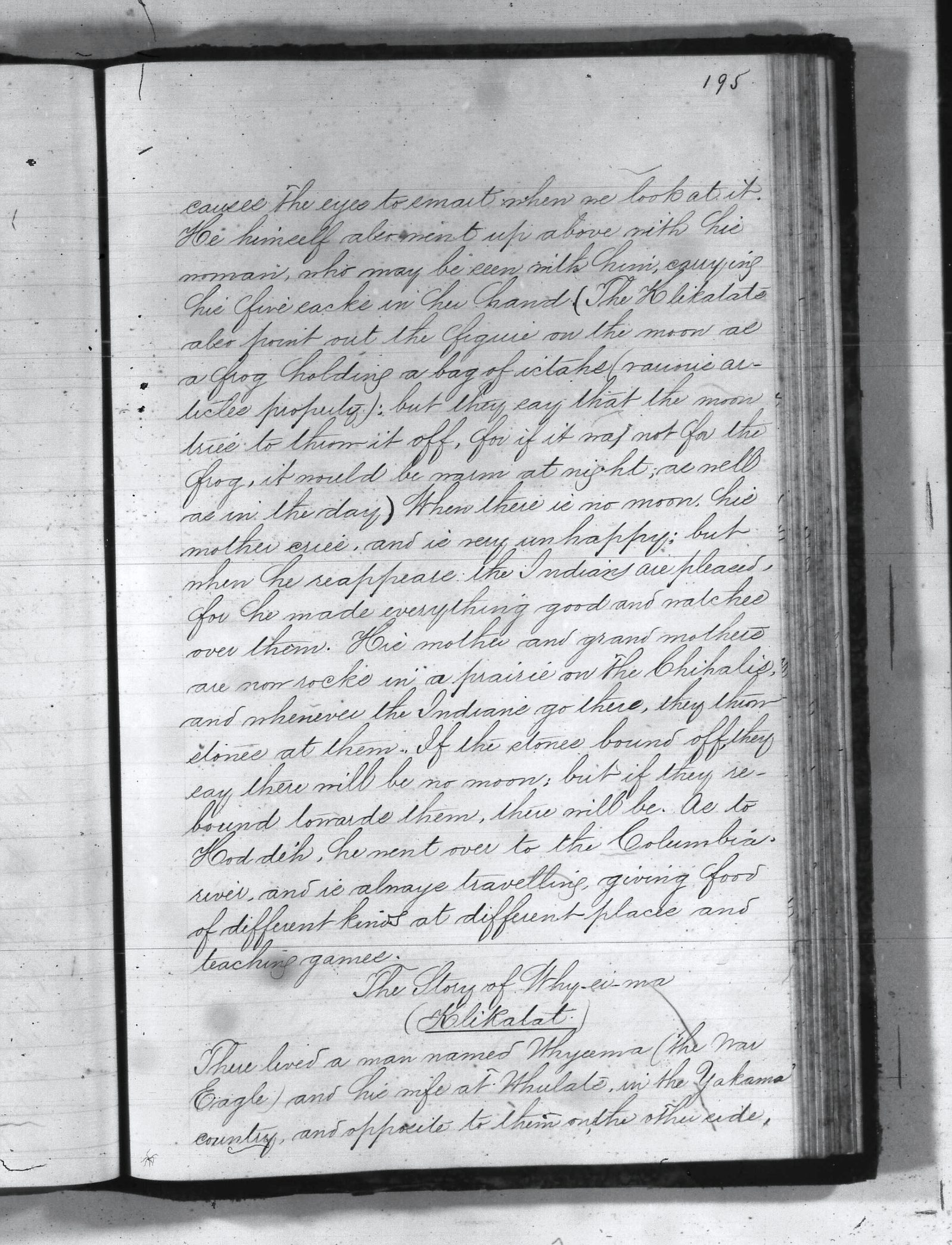
end of "The story of Sloqualm"; then TALE, headed "The Story of Why-ei-ma" / "(Klikatat.)". The urine of which the sun was made "causes the eyes to smart when we look at it"; Sloqualm "went up above with his woman, who may be seen with him, carrying his five sacks in her hand"; parenthetical: "(The Klikatats also point out the figure on the moon as a frog holding a bag of ictahs (various articles, property); but they say that the moon tries to throw it off, for if it was not for the frog, it would be warm at night, as well as in the day.)"; when there is no moon "his mother cries, and is very unhappy"; "His mother and grand mother are now rocks in a prairie on the Chihalis, and whenever the Indians go there, they throw stones at them. If the stones bound off, they say there will be no moon; but if they rebound towards them, there will be"; "As to Hoddeh, he went over to the Columbia river, and is always travelling, giving food of different kinds at different places and teaching games." New tale opens: "There lived a man named Whyeema (the War Eagle) and his wife at Whulate(?), in the Yakama country, and opposite to them on the other side," No sketch or table.
Wisconsin Historical Society, Gibbs Family Papers, U.S. Mss Y, Micro 1117
Reel 2, frames 3844
Reel 2, frame 3844
Read beside the scan
AI first transcription from the evidence pack; not independently verified. Compare with the scan.
causes the eyes to smart when we look at it.
He himself also went up above with his
woman, who may be seen with him, carrying
his fire sacks[?] in her hand. (The Klikatats
also point out the figure on the moon as
a frog holding a bag of iktahs (various ar-
ticles property): but they say that the moon
tries to throw it off, for if it was not for the
frog, it would be warm at night, as well
as in the day) When there is no moon his
mother cries, and is very unhappy; but
when he reappears the Indians are pleased,
for he made everything good and watches
over them. His mother and grand mothers
are now rocks in a prairie on the Chihalis,
and whenever the Indians go there, they throw
stones at them. If the stones bound off they
say there will be no moon; but if they re-
bound towards them, there will be. As to
Hod-deh[?], he went over to the Columbia
river, and is always travelling, giving food
of different kinds at different places and
teaching games.
The Story of Why-ee-ma
(Klikatat)
There lived a man named Whyeema (the War
Eagle) and his wife at Whulats[?], in the Yakama
country, and opposite to them on the other side,
Citation and provenance
Gibbs, G., IV. (1856). [Manuscript volume, ms p. 195]. Gibbs Family Papers, 1763-1918 (U.S. Mss Y, Micro 1117, Reel 2, frame 3844). Wisconsin Historical Society Archives, Madison, WI, United States.
Citation details need editorial review.
Historical sources retain their individual rights and credits. A scan’s presence here does not establish unrestricted reuse.
People identified in the source catalog
These are catalog labels. Individual identities and relationships have not all been reviewed.
Where the book uses this document
No quotation has yet been assigned directly to this catalog record. Its individual frames may have separate connections.