
Wisconsin manuscript
George Gibbs IV (manuscript volume, ms p. 193) · 1856 (Olympia) and later additions
TALE: "The story of Sloqualm" (cont.) — Sloqualm as culture hero; the five houses and the sixth woman. "Sloqualm put it out, and ordained that when men wanted to warm themselves, they should make a small one. He changed the earth, and made every thing good"; finding Indians chilled standing in a stream to intercept salmon, "he built a fire to warm them, and constructed a weir"; "They had before then used their hands for a wedge in splitting wood and their heads as a mallet; but he showed them to use tools"; "The crow had defiled them as they stood in the water, and he turned him black"; "He came to the beaver and called him, 'My grandfather', and gave him his blanket of fur, and taught him to build a house," the beaver answering "Oh! Chief, I have no house. take pity on me! Thank you."; he killed an elk and dried the meat; at "five houses, with five nice young women" none could lift his load; "There was a sixth woman, all dirty and foul. She was poor and a common person, while the others were high born (Seahb chiefs)" — she took up the load and followed him. No sketch or table.
Wisconsin Historical Society, Gibbs Family Papers, U.S. Mss Y, Micro 1117
Reel 2, frames 3841
Reel 2, frame 3841
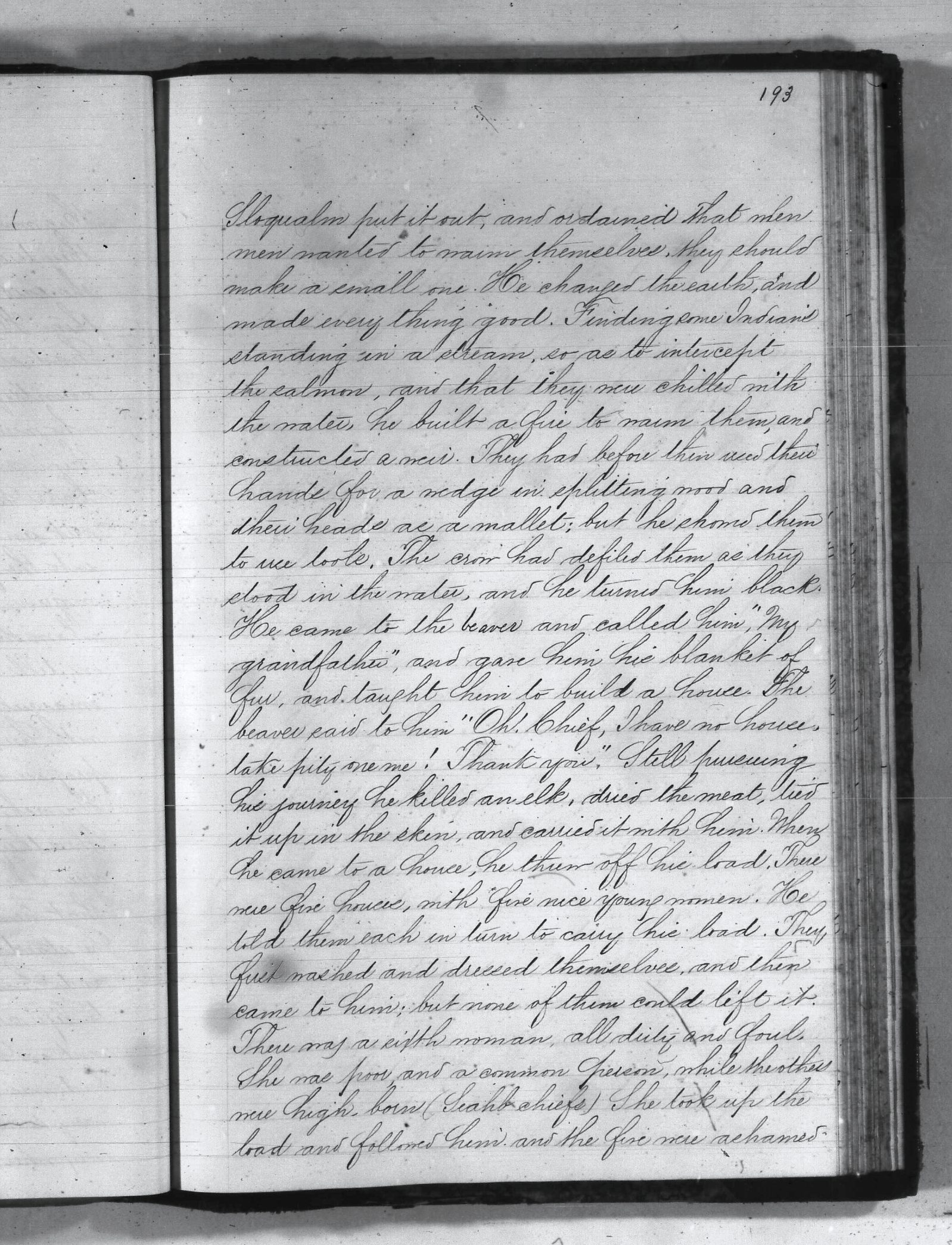
Read beside the scan
AI first transcription from the evidence pack; not independently verified. Compare with the scan.
Sloqualm put it out, and ordained that when
men wanted to warm themselves, they should
make a small one. He changed the earth, and
made every thing good. Finding some Indians
standing in a stream, so as to intercept
the salmon, and that they were chilled with
the water, he built a fire to warm them, and
constructed a weir. They had before then used their
hands for a wedge in splitting wood and
their heads as a mallet; but he showed them
to use tools. The crow had defiled them as they
stood in the water, and he turned him black.
He came to the beaver and called him, "My
grandfather", and gave him his blanket of
fur, and taught him to build a house. The
beaver said to him "Oh! Chief, I have no house,
take pity on me! Thank you." Still pursuing
his journey he killed an elk, dried the meat, tied
it up in the skin, and carried it with him. When
he came to a house, he threw off his load. There
were five houses, with five nice young women. He
told them each in turn to carry this load. They
first washed and dressed themselves, and then
came to him; but none of them could lift it.
There was a sixth[?] woman, all dirty and foul.
She was poor, and a common person, while the others
were high born (Seahb chiefs) She took up the
load and followed him. and the five were ashamed.
Citation and provenance
Gibbs, G., IV. (1856). [Manuscript volume, ms p. 193]. Gibbs Family Papers, 1763-1918 (U.S. Mss Y, Micro 1117, Reel 2, frame 3841). Wisconsin Historical Society Archives, Madison, WI, United States.
Citation details need editorial review.
Historical sources retain their individual rights and credits. A scan’s presence here does not establish unrestricted reuse.
People identified in the source catalog
These are catalog labels. Individual identities and relationships have not all been reviewed.
Where the book uses this document
No quotation has yet been assigned directly to this catalog record. Its individual frames may have separate connections.