
Wisconsin manuscript
George Gibbs IV (manuscript volume, ms p. 189) · 1856 (Olympia) and later additions
TALE: "The Wattetash" (concl.); NAMED INFORMANT; author's footnote on the name. The old man cries "there was a skookoom in the water that wished to eat him"; Wattetash spears the fish and says "See, it is not a skookoom but a fish. When you are hungry and cannot get the other kind, eat this"; reaching his father's house there "was great rejoicing, and the young man then made tamahnous five days, washing himself and at the end of the dance, put on his blanket"; the Skookoom sisters follow, claim "there is our child," and when he refuses "they changed him into a loon"; "According to this account Spilyai himself turned all the skookooms into animals, stones &c."; Gibbs adds that "The version given below, received from a Staktaiaish, or upper Chihalis woman named Kekai-si-mi-loot, is the more popular one." Footnote at foot: "In the absence of the article it is difficult to ascertain through the imperfect medium of the jargon whether this is an individual name, or one of a race, a wattetash. I am [continues p.190]". No sketch or table.
Wisconsin Historical Society, Gibbs Family Papers, U.S. Mss Y, Micro 1117
Reel 2, frames 3837
Reel 2, frame 3837
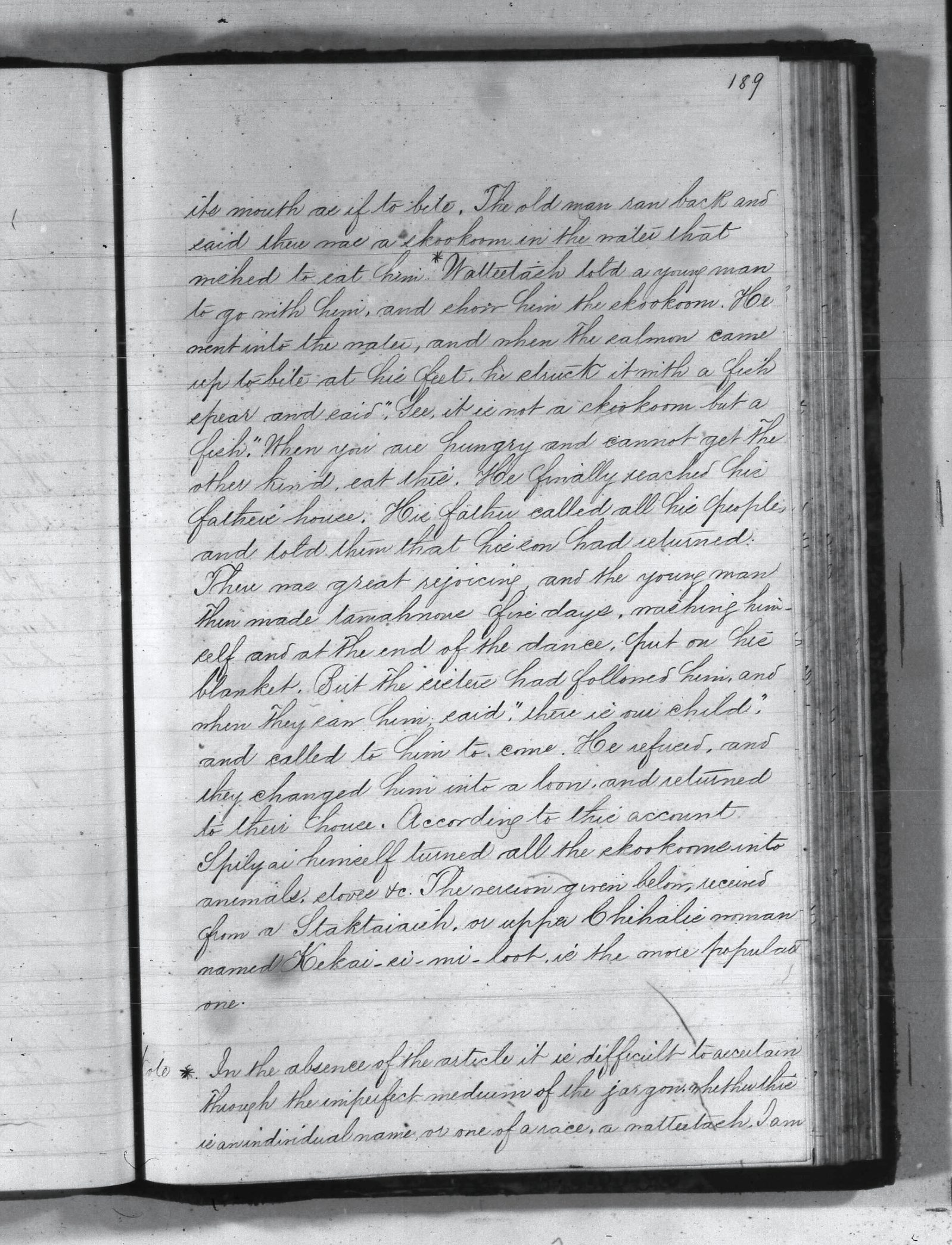
Read beside the scan
AI first transcription from the evidence pack; not independently verified. Compare with the scan.
its mouth as if to bite. The old man ran back and
said there was a skookoom in the water that
wished to eat him.* Watteetach[?] told a young man
to go with him, and show him the skookoom. He
went into the water, and when the salmon came
up to bite at his feet, he struck it with a fish
spear and said; "See, it is not a skookoom but a
fish." When you are hungry and cannot get the
other kind, eat this. He finally reached his
fathers house. His father called all his peoples[?]
and told them that his son had returned.
There was great rejoicing, and the young man
then made tamahnous[?] five days, washing him-
self and at the end of the dance, put on his
blanket. But the sisters had followed him, and
when they saw him, said; "there is our child";
and called to him to come. He refused, and
they changed him into a loon, and returned
to their house. According to this account
Spilyai himself turned all the skookooms into
animals, stones &c. The version given below, received
from a Staktaiach[?], or upper Chihalis woman
named Kekai-si-mi-loot[?], is the more popular
one.
[N]ote * In the absence of the article it is difficult to ascertain
through the imperfect medium of the jargon whether this
is an individual name, or one of a race, a watteetach. I am
Citation and provenance
Gibbs, G., IV. (1856). [Manuscript volume, ms p. 189]. Gibbs Family Papers, 1763-1918 (U.S. Mss Y, Micro 1117, Reel 2, frame 3837). Wisconsin Historical Society Archives, Madison, WI, United States.
Citation details need editorial review.
Historical sources retain their individual rights and credits. A scan’s presence here does not establish unrestricted reuse.
People identified in the source catalog
These are catalog labels. Individual identities and relationships have not all been reviewed.
Where the book uses this document
No quotation has yet been assigned directly to this catalog record. Its individual frames may have separate connections.