
Wisconsin manuscript
George Gibbs IV (manuscript volume, ms p. 187) · 1856 (Olympia) and later additions
TALE, headed "The Wattetash." / "(Klikatat.)". Titled tale in full: "Wattetash had a son born to him and his wife invited every one to come to a feast, and had a great deal of singing and dancing"; among the guests "five Skookoom women from beyond the sea (or where the surf breaks.)"; one says to the mother, "See, my breast is sick, it is so full of milk, lend me your child to suckle and I will give it back to you"; the sisters steal the child, who grows to manhood in their house "fed him on frogs, which were their food"; he asks "how is it, that I am different from these people. They are black, and I am white"; while "making arrow heads, the blue jay came to him and stood talking"; struck in the eye by a chip, the jay says "Why do you treat me so, when I come to talk to you, and tell you about your relations"? "Take the stone out of my eye and I will tell you all about them"; the jay reveals the theft and that "the haiqua which he had on at the time" was hidden. No sketch or table.
Wisconsin Historical Society, Gibbs Family Papers, U.S. Mss Y, Micro 1117
Reel 2, frames 3835
Reel 2, frame 3835
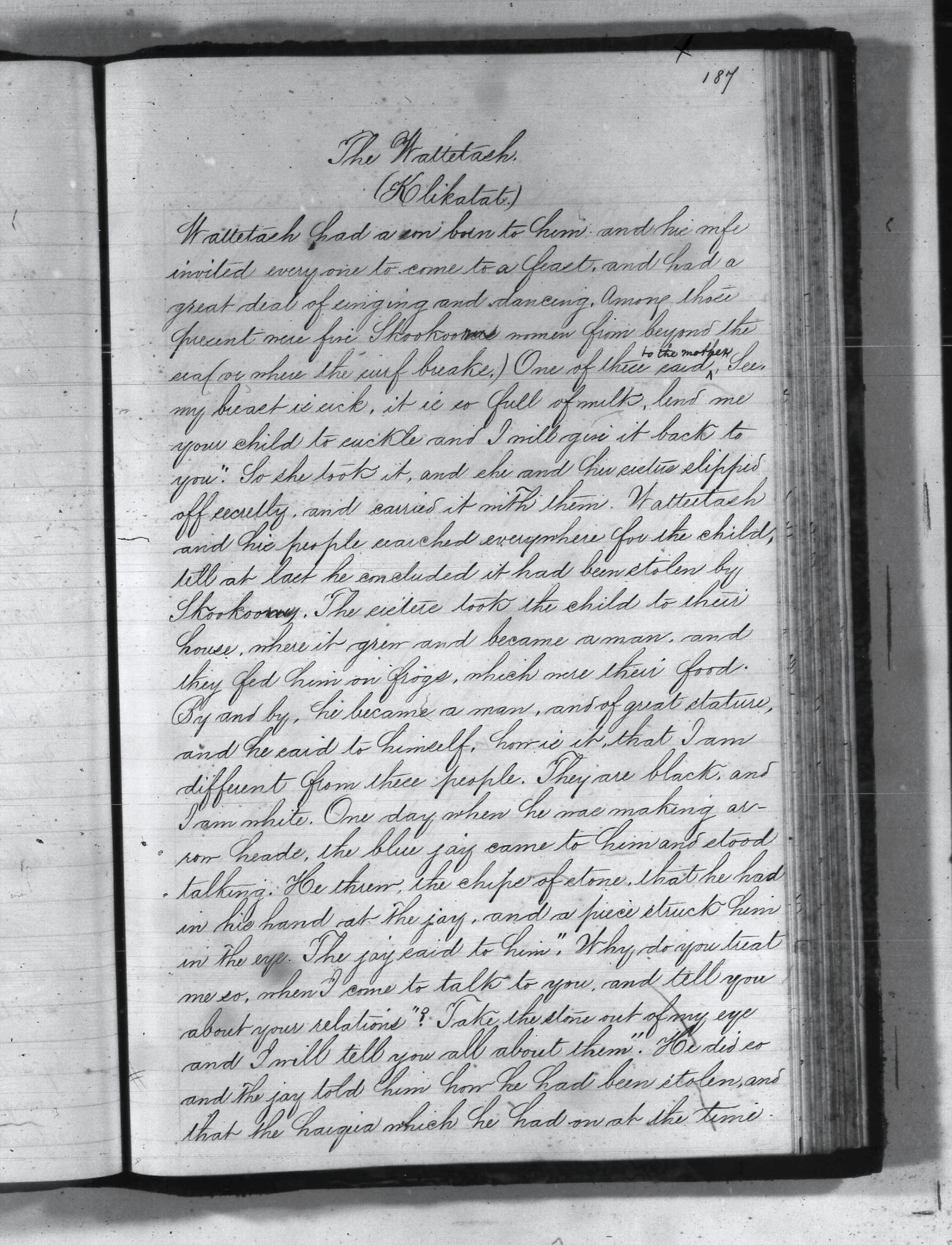
Read beside the scan
AI first transcription from the evidence pack; not independently verified. Compare with the scan.
The Wattetach.
(Klikatat.)
Wattetach had a son born to him. and his wife
invited every one to come to a feast. and had a
great deal of singing and dancing. Among those
present were five Skookooms[?] women from beyond the
seas (or where the surf breaks.) One of these [inserted: to the mother] said, "See
my breast is sick, it is so full of milk, lend me
your child to suckle and I will give it back to
you". So she took it, and she and her sisters slipped
off secretly. and carried it with them. Watteetach[?]
and his people searched everywhere for the child,
till at last he concluded it had been stolen by
Skookoomy[?]. The sisters took the child to their
house. where it grew and became a man. and
they fed him on frogs. which were their food.
By and by, he became a man, and of great stature,
and he said to himself, how is it, that I am
different from these people. They are black. and
I am white. One day when he was making ar-
row heads, the blue jay came to him and stood
talking. He threw, the chips of stone. that he had
in his hand at the jay. and a piece struck him
in the eye. The jay said to him, "Why do you treat
me so, when I come to talk to you. and tell you
about your relations"? Take the stone out of my eye
and I will tell you all about them". He did so
and the jay told him how he had been stolen, and
that the haiqua which he had on at the time
Citation and provenance
Gibbs, G., IV. (1856). [Manuscript volume, ms p. 187]. Gibbs Family Papers, 1763-1918 (U.S. Mss Y, Micro 1117, Reel 2, frame 3835). Wisconsin Historical Society Archives, Madison, WI, United States.
Citation details need editorial review.
Historical sources retain their individual rights and credits. A scan’s presence here does not establish unrestricted reuse.
People identified in the source catalog
These are catalog labels. Individual identities and relationships have not all been reviewed.
Where the book uses this document
No quotation has yet been assigned directly to this catalog record. Its individual frames may have separate connections.