
Wisconsin manuscript
George Gibbs IV (manuscript volume, ms p. 174) · 1856 (Olympia) and later additions
Haunted lakes; Klikatat tamahnous. The magician tale ends: the old woman made him swell up, opened him with a knife "as he sat on Scarboroughs hill" and "converted him and his brother into rock". Lakes in the prairies between the Nisqually and the Puyallup "were formerly all haunted", the resort of young men seeking "the inspiration of the Shonahn"; a lake five miles back of Fort Nisqually called "Nis-jug-wa (jug-wa is a fright or monster)"; another above Steilacoom "called the lake of the Black Hand, because from it a gigantic sable hand was seen to arise". The Klikatats seek the tamahnous wandering in the mountains until they meet a bird or deer "that has formerly been a Skookoom"; the doctor's samahnous names the disease and its seat, sought out "in the shape of a small object, which is black, green, red &c according to its nature".
Wisconsin Historical Society, Gibbs Family Papers, U.S. Mss Y, Micro 1117
Reel 2, frames 3823
Reel 2, frame 3823
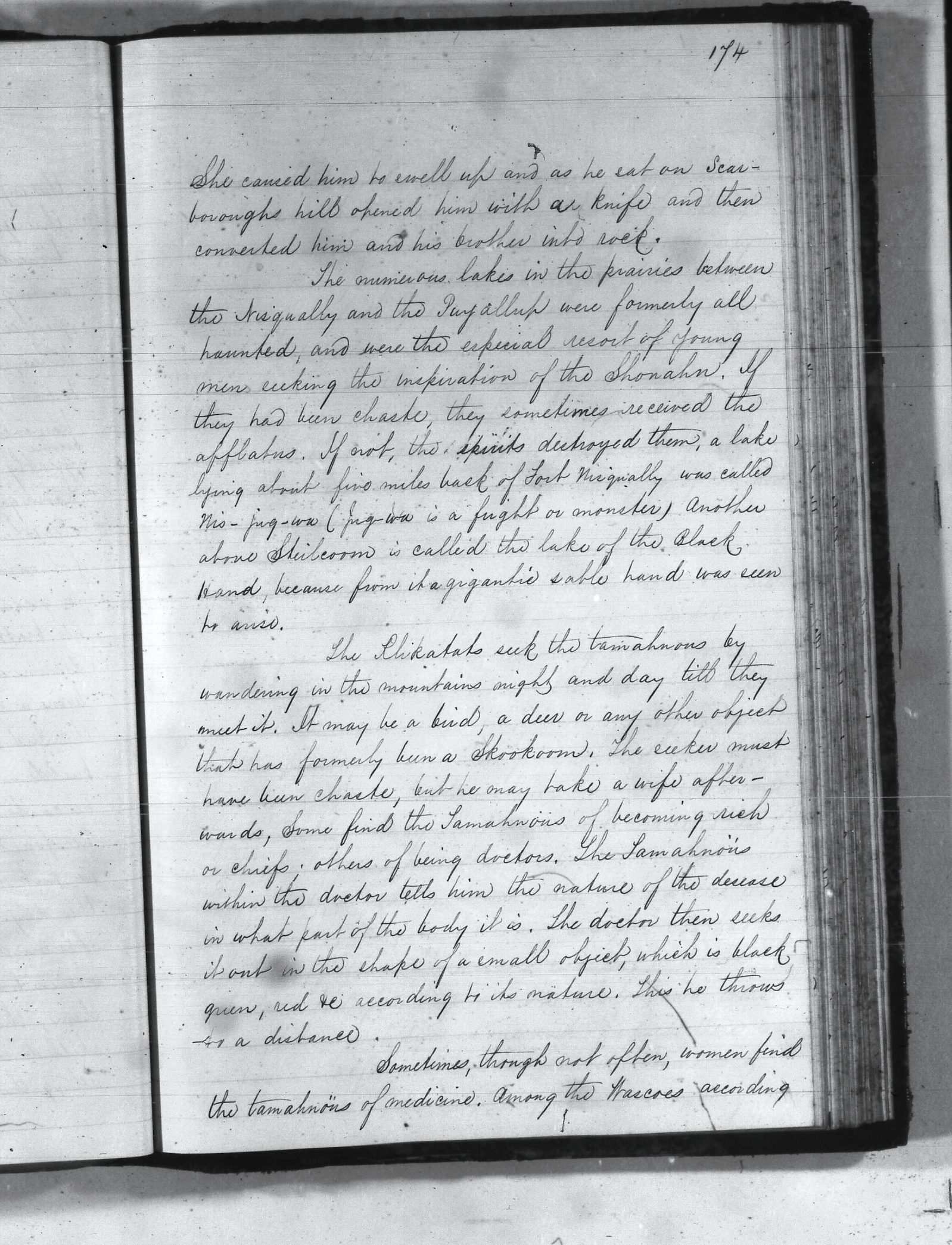
Read beside the scan
AI first transcription from the evidence pack; not independently verified. Compare with the scan.
She caused him to swell up and as he sat on Scar-
boroughs hill opened him with a knife and then
converted him and his brother into rock.
The numerous lakes in the prairies between
the Nisqually and the Puyallup were formerly all
haunted, and were the especial resort of young
men seeking the inspiration of the Tamahn[?]. If
they had been chaste, they sometimes received the
afflatus. If not, the spirits destroyed them, a lake
lying about five miles back of Fort Nisqually was called
Nis-jug-wa[?] (jug-wa[?] is a fright or monster) Another
above Steilcoom[?] is called the lake of the Black
Hand, because from it a gigantic sable hand was seen
to arise.
The Klikatats seek the tamahnous by
wandering in the mountains nights and day till they
meet it. It may be a bird, a deer or any other object
that has formerly been a Skookoom. The seeker must
have been chaste, but he may take a wife after-
wards, Some find the Tamahnous of becoming rich
or chiefs. others of being doctors. The Tamahnous
within the doctor tells him the nature of the decease
in what part of the body it is. The doctor then seeks
it out in the shape of a small object, which is black
green, red &c according to its nature. This he throws
to a distance.
Sometimes, though not often, women find
the tamahnous of medicine. Among the Wascoes according
Citation and provenance
Gibbs, G., IV. (1856). [Manuscript volume, ms p. 174]. Gibbs Family Papers, 1763-1918 (U.S. Mss Y, Micro 1117, Reel 2, frame 3823). Wisconsin Historical Society Archives, Madison, WI, United States.
Citation details need editorial review.
Historical sources retain their individual rights and credits. A scan’s presence here does not establish unrestricted reuse.
People identified in the source catalog
These are catalog labels. Individual identities and relationships have not all been reviewed.
Where the book uses this document
No quotation has yet been assigned directly to this catalog record. Its individual frames may have separate connections.