
Wisconsin manuscript
George Gibbs IV (manuscript volume, ms p. 172) · 1856 (Olympia) and later additions
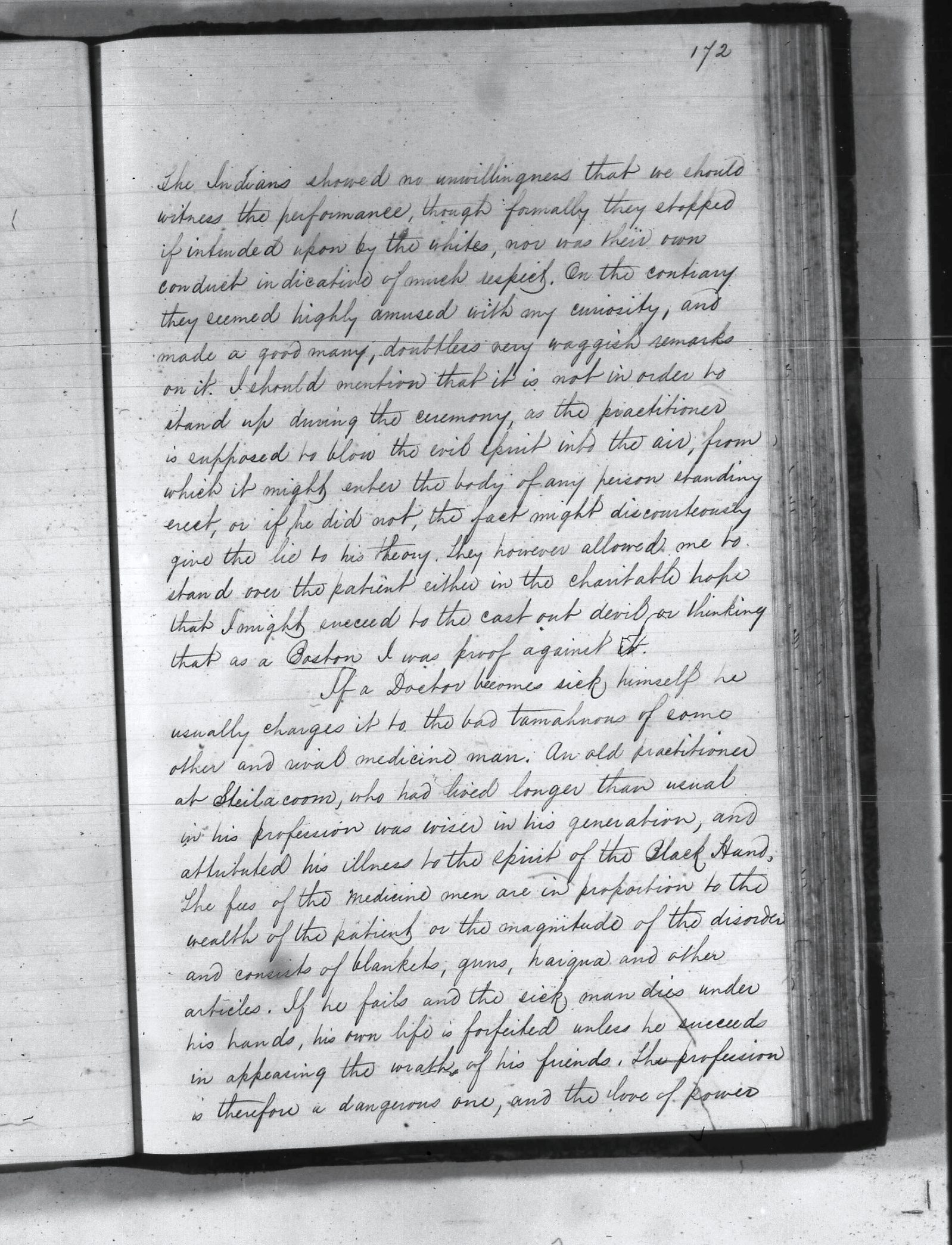
Doctors: etiquette, fees, and risk. Indians "showed no unwillingness that we should witness the performance" and were "highly amused with my curiosity"; standing up during the ceremony is out of order, since the practitioner "is supposed to blow the evil spirit into the air"; they let Gibbs stand over the patient, thinking "that as a Boston I was proof against it". A sick doctor charges it to "the bad tamahnous" of a rival; an old practitioner at Steilacoom attributed his illness "to the spirit of the Black Hand". Fees are proportioned to the patient's wealth and consist of "blankets, guns, haiqua and other articles"; if the patient dies "his own life is forfeited unless he succeeds in appeasing the wrath of his friends".
Wisconsin Historical Society, Gibbs Family Papers, U.S. Mss Y, Micro 1117
Reel 2, frames 3821
Reel 2, frame 3821
Read beside the scan
AI first transcription from the evidence pack; not independently verified. Compare with the scan.
The Indians showed no unwillingness that we should
witness the performance, though formally they stopped
if intruded upon by the whites, nor was their own
conduct indicative of much respect. On the contrary
they seemed highly amused with my curiosity, and
made a good many, doubtless very waggish remarks
on it. I should mention that it is not in order to
stand up during the ceremony, as the practitioner
is supposed to blow the evil spirit into the air, from
which it might enter the body of any person standing
erect, or if he did not, the fact might discourteously
give the lie to his theory. They however allowed me to
stand over the patient either in the charitable hope
that I might succeed to the cast out devil or thinking
that as a Boston I was proof against it.
If a Doctor becomes sick himself he
usually charges it to the bad tamahnous of some
other and rival medicine man. An old practitioner
at Steilacoom, who had lived longer than usual
in his profession was wiser in his generation, and
attributed his illness to the spirit of the Black Hand.
The fees of the medicine men are in proportion to the
wealth of the patient or the magnitude of the disorder
and consists of blankets, guns, haiqua and other
articles. If he fails and the sick man dies under
his hands, his own life is forfeited unless he succeeds
in appeasing the wrath of his friends. The profession
is therefore a dangerous one, and the love of power
Citation and provenance
Gibbs, G., IV. (1856). [Manuscript volume, ms p. 172]. Gibbs Family Papers, 1763-1918 (U.S. Mss Y, Micro 1117, Reel 2, frame 3821). Wisconsin Historical Society Archives, Madison, WI, United States.
Citation details need editorial review.
Historical sources retain their individual rights and credits. A scan’s presence here does not establish unrestricted reuse.
People identified in the source catalog
These are catalog labels. Individual identities and relationships have not all been reviewed.
Where the book uses this document
No quotation has yet been assigned directly to this catalog record. Its individual frames may have separate connections.