
Wisconsin manuscript
George Gibbs IV (manuscript volume, ms p. 166) · 1856 (Olympia) and later additions
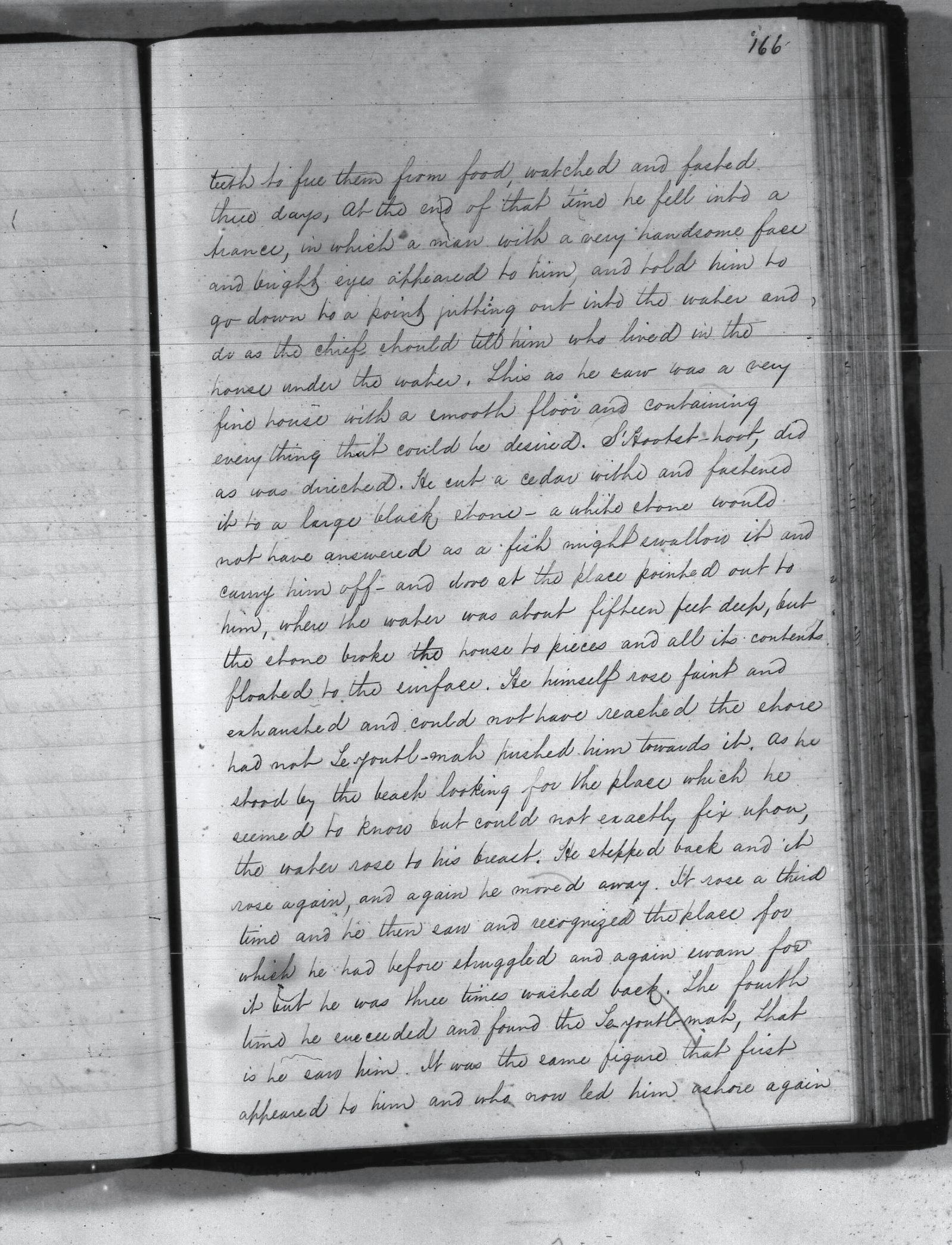
The Samahnous — S'Hootst-hoot's quest. The quest continues: after fasting three days he falls into a trance; a man "with a very handsome face and bright eyes" directs him to a point and to the chief living "in the house under the water"; he ties a cedar withe to a large black stone (a white stone would not do, "as a fish might swallow it and carry him off") and dives where the water was "about fifteen feet deep"; the stone breaks the house to pieces, the contents float up, Le-youtl-mah pushes him ashore; the water rises to his breast three times; on the fourth attempt he finds Le-youtl-mah.
Wisconsin Historical Society, Gibbs Family Papers, U.S. Mss Y, Micro 1117
Reel 2, frames 3815
Reel 2, frame 3815
Read beside the scan
AI first transcription from the evidence pack; not independently verified. Compare with the scan.
teeth to free them from food, watched and fasted
three days, at the end of that time he fell into a
trance, in which a man with a very handsome face
and bright eyes appeared to him, and told him to
go down to a point jutting out into the water and,
do as the chief should tell him who lived in the
house under the water. This as he saw was a very
fine house with a smooth floor and containing
every thing that could be desired. S'Hootst-hoot[?], did
as was directed. He cut a cedar withe and fastened
it to a large black stone - a white stone would
not have answered as a fish might swallow it and
carry him off - and dove at the place pointed out to
him, where the water was about fifteen feet deep, but
the stone broke the house to pieces and all its contents
floated to the surface. He himself rose faint and
exhausted and could not have reached the shore
had not Te-youtl-mah[?] pushed him towards it. As he
stood by the beach looking for the place which he
seemed to know but could not exactly fix upon,
the water rose to his breast. He stepped back and it
rose again, and again he moved away. It rose a third
time and he then saw and recognized the place for
which he had before struggled and again swam for
it but he was three times washed back. The fourth
time he succeeded and found the Te-youtl-mah[?], that
is he saw him. It was the same figure that first
appeared to him and who now led him ashore again
Citation and provenance
Gibbs, G., IV. (1856). [Manuscript volume, ms p. 166]. Gibbs Family Papers, 1763-1918 (U.S. Mss Y, Micro 1117, Reel 2, frame 3815). Wisconsin Historical Society Archives, Madison, WI, United States.
Citation details need editorial review.
Historical sources retain their individual rights and credits. A scan’s presence here does not establish unrestricted reuse.
People identified in the source catalog
These are catalog labels. Individual identities and relationships have not all been reviewed.
Where the book uses this document
No quotation has yet been assigned directly to this catalog record. Its individual frames may have separate connections.