
Wisconsin manuscript
George Gibbs IV (manuscript volume, ms p. 161) · 1856 (Olympia) and later additions
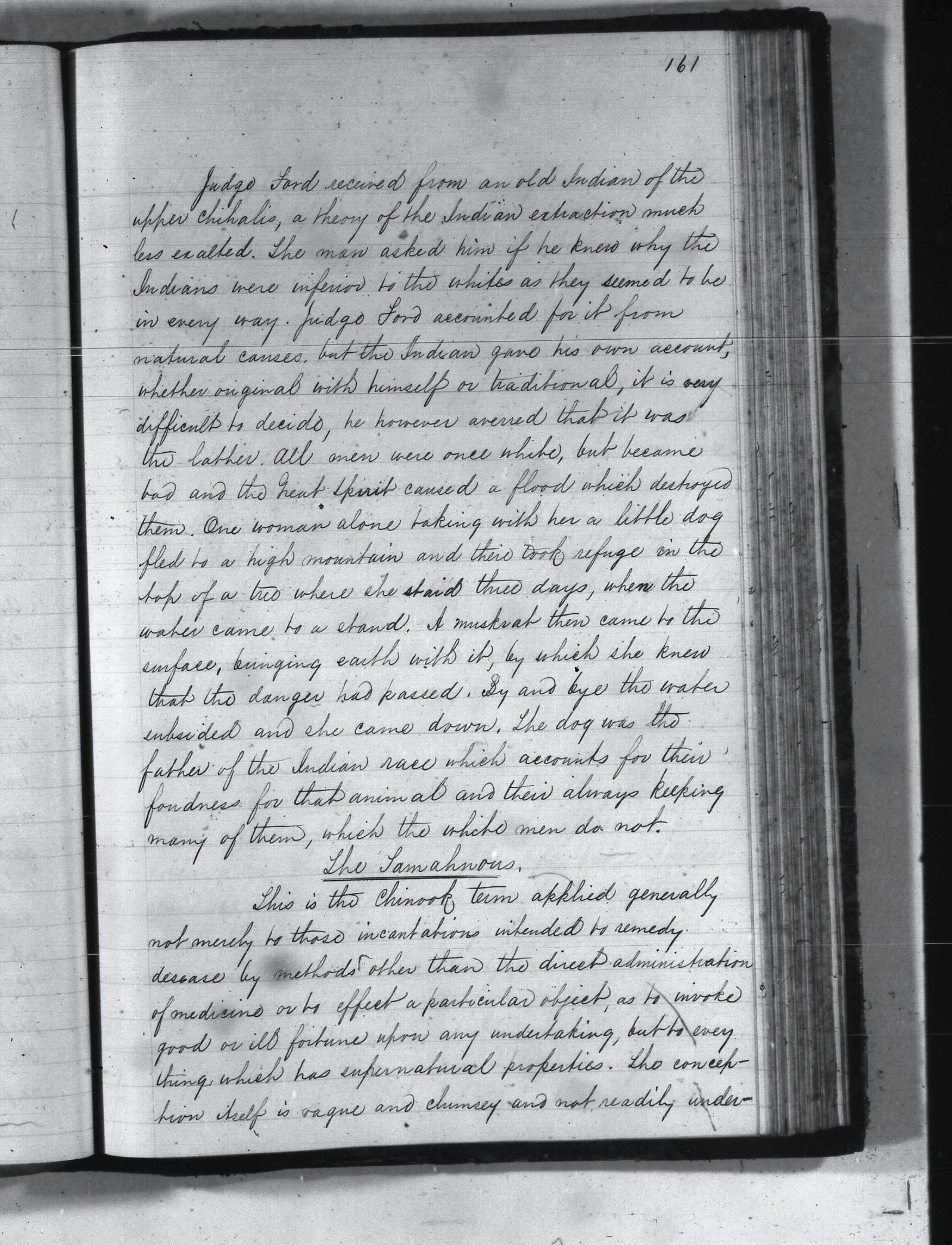
Origin traditions; new section "The Samahnous". "Judge Ford" received from an old upper Chihalis Indian a flood tale: all men were once white, the Great Spirit sent a flood, one woman with a little dog took refuge in a treetop on a high mountain three days, a muskrat brought up earth; "The dog was the father of the Indian race which accounts for their fondness for that animal". Section heading written and underlined: "The Samahnous." — the Chinook term for incantations and for everything having supernatural properties.
Wisconsin Historical Society, Gibbs Family Papers, U.S. Mss Y, Micro 1117
Reel 2, frames 3809
Reel 2, frame 3809
Read beside the scan
AI first transcription from the evidence pack; not independently verified. Compare with the scan.
Judge Ford received from an old Indian of the
upper chihalis, a theory of the Indian extraction much
less exalted. The man asked him if he knew why the
Indians were inferior to the whites as they seemed to be
in every way. Judge Ford accounted for it from
natural causes. but the Indian gave his own account,
whether original with himself or traditional, it is very
difficult to decide, he however averred that it was
the latter. All men were once white, but became
bad and the Great Spirit caused a flood which destroyed
them. One woman alone taking with her a little dog
fled to a high mountain and there took refuge in the
top of a tree where she staid three days, when the
water came to a stand. A muskrat then came to the
surface, bringing earth with it, by which she knew
that the danger had passed. By and bye the water
subsided and she came down. The dog was the
father of the Indian race which accounts for their
fondness for that animal and their always keeping
many of them, which the white men do not.
The Tamahnous.
This is the Chinook term applied generally
not merely to those incantations intended to remedy
desease by methods other than the direct administration
of medicine or to effect a particular object, as to invoke
good or ill fortune upon any undertaking, but to every
thing which has supernatural properties. The concep-
tion itself is vague and clumsey and not readily under-
Citation and provenance
Gibbs, G., IV. (1856). [Manuscript volume, ms p. 161]. Gibbs Family Papers, 1763-1918 (U.S. Mss Y, Micro 1117, Reel 2, frame 3809). Wisconsin Historical Society Archives, Madison, WI, United States.
Citation details need editorial review.
Historical sources retain their individual rights and credits. A scan’s presence here does not establish unrestricted reuse.
People identified in the source catalog
These are catalog labels. Individual identities and relationships have not all been reviewed.
Where the book uses this document
No quotation has yet been assigned directly to this catalog record. Its individual frames may have separate connections.