
Wisconsin manuscript
George Gibbs IV (manuscript volume, ms p. 151) · 1856 (Olympia) and later additions
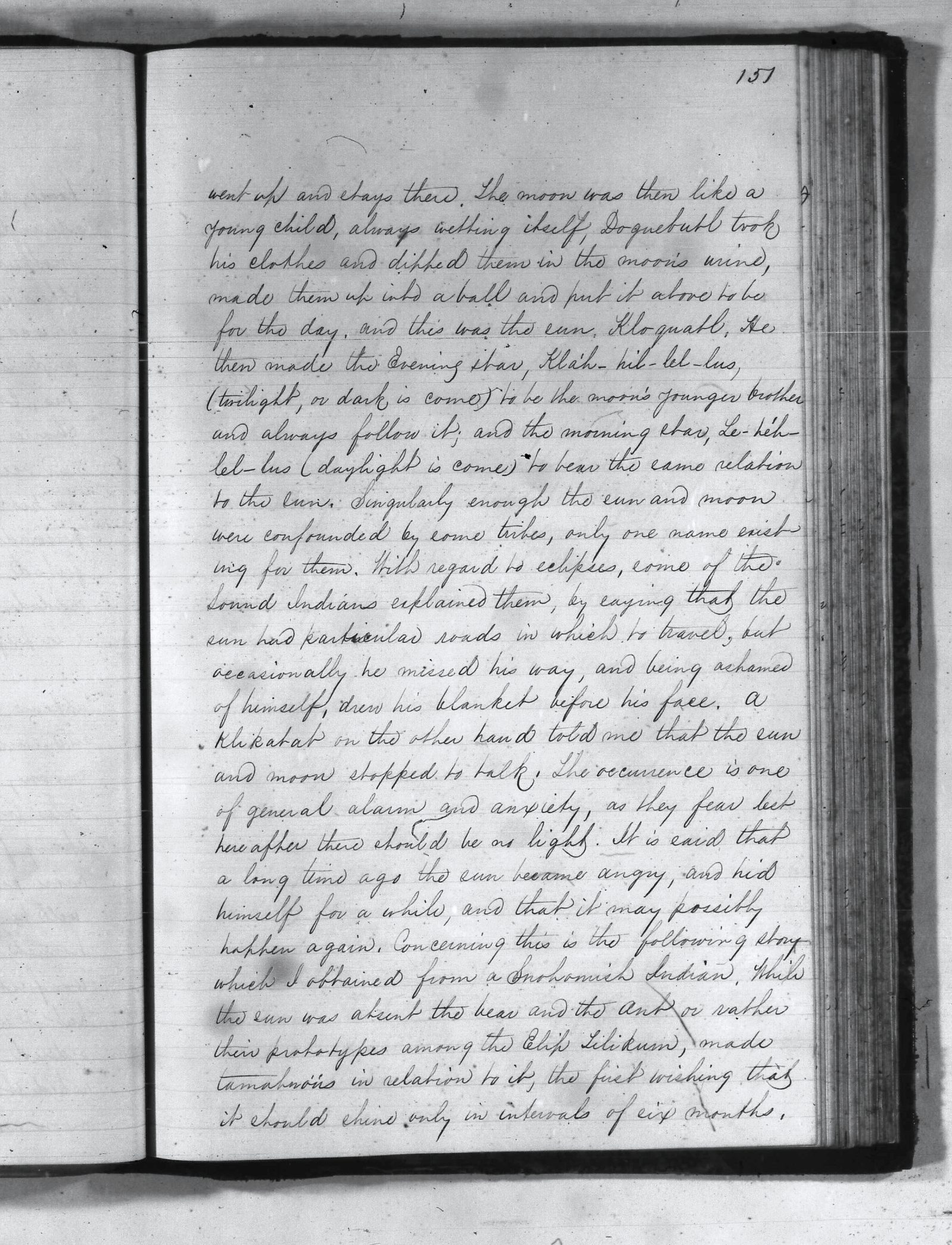
Cosmogony: sun, moon, stars, eclipses. "The moon was then like a young child, always wetting itself, Doquebutl took his clothes and dipped them in the moon's urine, made them up into a ball and put it above to be for the day, and this was the sun, Kloquatl(?)"; he then made "the Evening star, Klah-hil-lel-lus, (twilight, or dark is come) to be the moon's younger brother and always follow it; and the morning star, Le-heh-lel-lus (daylight is come) to bear the same relation to the sun"; sun and moon confounded by some tribes, "only one name existing for them"; eclipses explained by Sound Indians as the sun missing his road and, "being ashamed of himself, drew his blanket before his face"; a Klikatat said "the sun and moon stopped to talk"; general alarm lest "hereafter there should be no light"; a Snohomish story: while the sun was absent "the bear and the ant or rather their prototypes among the Elip Tilikum, made tamahnous in relation to it, the first wishing that it should shine only in intervals of six months." No sketch or diagram.
Wisconsin Historical Society, Gibbs Family Papers, U.S. Mss Y, Micro 1117
Reel 2, frames 3796
Reel 2, frame 3796
Read beside the scan
AI first transcription from the evidence pack; not independently verified. Compare with the scan.
went up and stays there. The moon was then like a
young child, always wetting itself; Doquebutl[?] took
his clothes and dipped them in the moon's urine,
made them up into a ball and put it above to be
for the day, and this was the sun, Kloquatl[?]. He
then made the Evening star, Kláh-hil-lel-lus,
(twilight, or dark is come) to be the moon's younger brother
and always follow it; and the morning star, Le-héh[?]-
lel-lus (daylight is come) to bear the same relation
to the sun. Singularly enough the sun and moon
were confounded by some tribes, only one name exist
ing for them. With regard to eclipses, some of the
Sound Indians explained them, by saying that the
sun had particular roads in which to travel, but
occasionally he missed his way, and being ashamed
of himself, drew his blanket before his face. A
Klikatat on the other hand told me that the sun
and moon stopped to talk. The occurrence is one
of general alarm and anxiety, as they fear lest
hereafter there should be no light. It is said that
a long time ago the sun became angry, and hid
himself for a while, and that it may possibly
happen again. Concerning this is the following story
which I obtained from a Snohomish Indian. While
the sun was absent the bear and the ant or rather
their prototypes among the Elip Lilikum[?], made
tamahnous[?] in relation to it, the first wishing that
it should shine only in intervals of six months.
Citation and provenance
Gibbs, G., IV. (1856). [Manuscript volume, ms p. 151]. Gibbs Family Papers, 1763-1918 (U.S. Mss Y, Micro 1117, Reel 2, frame 3796). Wisconsin Historical Society Archives, Madison, WI, United States.
Citation details need editorial review.
Historical sources retain their individual rights and credits. A scan’s presence here does not establish unrestricted reuse.
People identified in the source catalog
These are catalog labels. Individual identities and relationships have not all been reviewed.
Where the book uses this document
No quotation has yet been assigned directly to this catalog record. Its individual frames may have separate connections.