
Wisconsin manuscript
George Gibbs IV (manuscript volume, ms p. 150) · 1856 (Olympia) and later additions
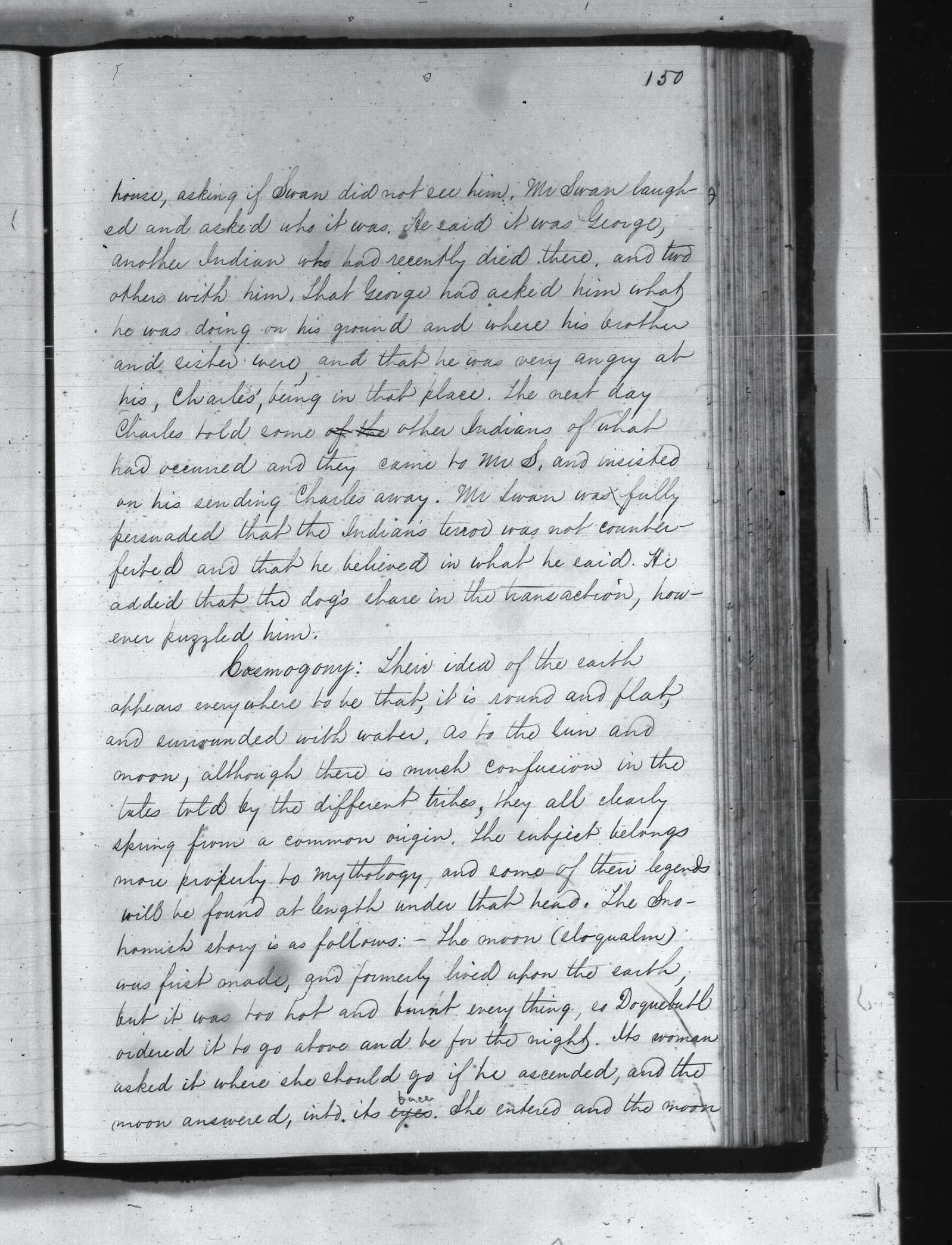
Cosmogony (section heading on this page). Conclusion of the Swan ghost story: the dead man was "George, another Indian who had recently died there, and two others with him," angry at Charles being on his ground and asking where his brother and sister were; next day the other Indians insisted Swan send Charles away; "Mr Swan was fully persuaded that the Indian's terror was not counterfeited," and "added that the dog's share in the transaction, however puzzled him"; new heading "Cosmogony:" - "Their idea of the earth appears every where to be that it is round and flat, and surrounded with water"; sun and moon tales confused among tribes but "all clearly spring from a common origin"; "The Snohomish story is as follows: - The moon (sloqualm(?)) was first made, and formerly lived upon the earth, but it was too hot and burnt every thing, so Doquebutl ordered it to go above and be for the night. Its woman asked it where she should go if he ascended, and the moon answered, into its eyes" (a small interlined word stands above "eyes," reading uncertain). No sketch or diagram.
Wisconsin Historical Society, Gibbs Family Papers, U.S. Mss Y, Micro 1117
Reel 2, frames 3795
Reel 2, frame 3795
Read beside the scan
AI first transcription from the evidence pack; not independently verified. Compare with the scan.
house, asking if Swan did not see him. Mr Swan laugh-
ed and asked who it was. He said it was George,
another Indian who had recently died there, and two
others with him. That George had asked him what
he was doing on his ground and where his brother
and sister were, and that he was very angry at
his, Charles', being in that place. The next day
Charles told some [struck: of the] other Indians of what
had occurred and they came to Mr S. and insisted
on his sending Charles away. Mr Swan was fully
persuaded that the Indian's terror was not counter-
feited and that he believed in what he said. He
added that the dog's share in the transaction, how-
ever puzzled him.
Cosmogony: Their idea of the earth
appears everywhere to be that, it is round and flat,
and surrounded with water. as to the sun and
moon, although there is much confusion in the
tales told by the different tribes, they all clearly
spring from a common origin. The subject belongs
more properly to mythology, and some of their legends
will be found at length under that head. The Sno-
homish story is as follows: - The moon (sloqualm[?])
was first made, and formerly lived upon the earth,
but it was too hot and burnt every thing, so Doquebatl[?]
ordered it to go above and be for the night. Its[?] woman
asked it where she should go if he ascended, and the
moon answered, into its [struck: eyes] [inserted: face]. She entered and the moon
Citation and provenance
Gibbs, G., IV. (1856). [Manuscript volume, ms p. 150]. Gibbs Family Papers, 1763-1918 (U.S. Mss Y, Micro 1117, Reel 2, frame 3795). Wisconsin Historical Society Archives, Madison, WI, United States.
Citation details need editorial review.
Historical sources retain their individual rights and credits. A scan’s presence here does not establish unrestricted reuse.
People identified in the source catalog
These are catalog labels. Individual identities and relationships have not all been reviewed.
Where the book uses this document
No quotation has yet been assigned directly to this catalog record. Its individual frames may have separate connections.