
Wisconsin manuscript
George Gibbs IV (manuscript volume, ms p. 149) · 1856 (Olympia) and later additions
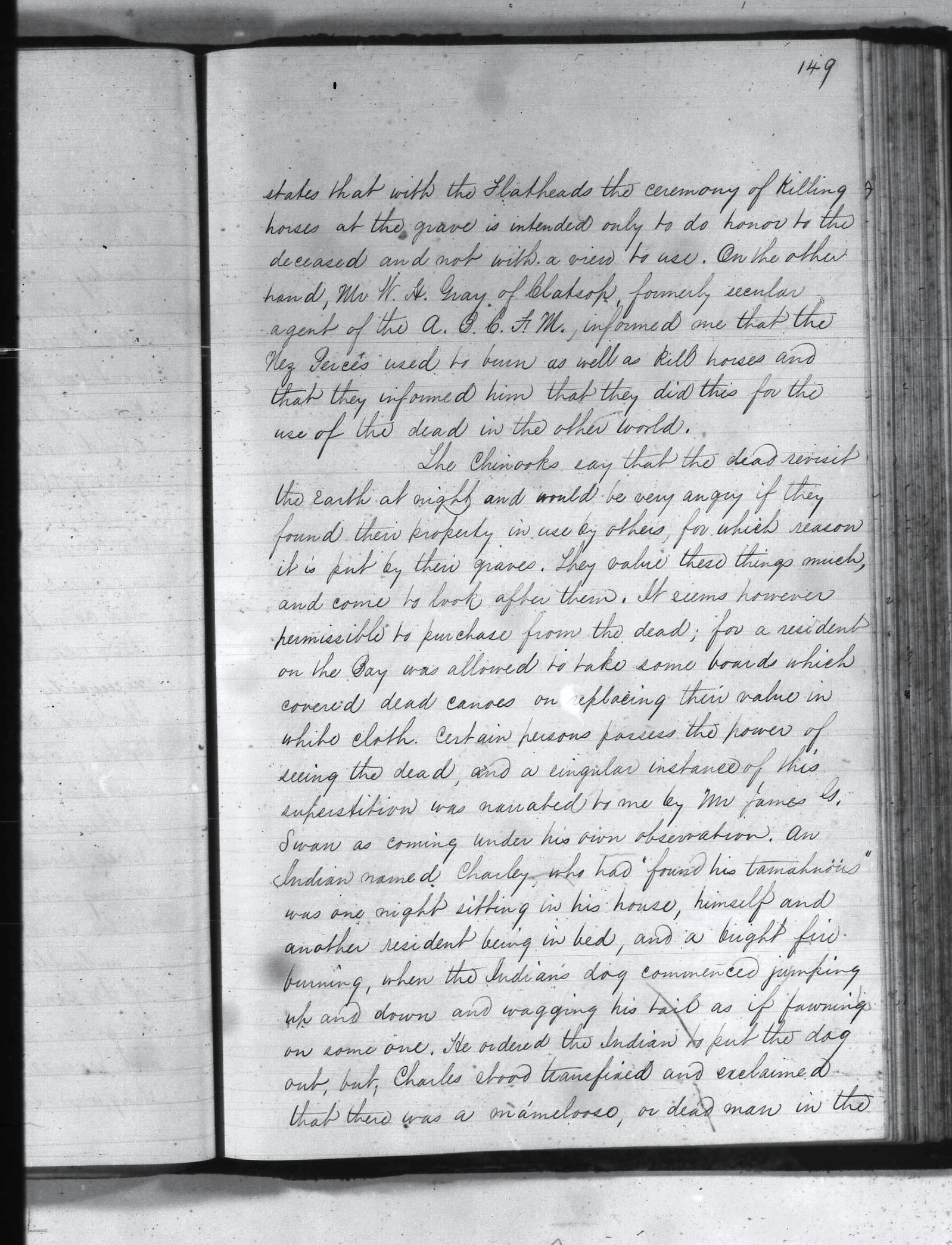
Future state; the dead and their property. Father Mengarini states that with the Flatheads killing horses at the grave "is intended only to do honor to the deceased and not with a view to use"; "Mr W. H.(?) Gray of Clatsop, formerly secular agent of the A. B. C. F. M.," reports that "the Nez Perces used to burn as well as kill horses and that they informed him that they did this for the use of the dead in the other world"; Chinooks say the dead revisit earth at night "and would be very angry if they found their property in use by others, for which reason it is put by their graves"; "It seems however permissible to purchase from the dead," a Bay resident being allowed to take boards covering "dead canoes" on replacing their value in white cloth; "Mr James G. Swan" narrates a case of seeing the dead: an Indian named Charley "who had 'found his tamahnous'" sat in his house by a bright fire when the dog began "jumping up and down and wagging his tail as if fawning on some one," and Charles "stood transfixed and exclaimed that there was a mamelooso, or dead man in the" house. No sketch or diagram.
Wisconsin Historical Society, Gibbs Family Papers, U.S. Mss Y, Micro 1117
Reel 2, frames 3794
Reel 2, frame 3794
Read beside the scan
AI first transcription from the evidence pack; not independently verified. Compare with the scan.
states that with the Flatheads the ceremony of killing
horses at the grave is intended only to do honor to the
deceased and not with a view to use. On the other
hand, Mr W. H. Gray of Clatsop, formerly secular
agent of the A. B. C. F. M., informed me that the
Nez Percés[?] used to burn as well as kill horses and
that they informed him that they did this for the
use of the dead in the other world.
The Chinooks say that the dead revisit
the earth at night and would be very angry if they
found their property in use by others, for which reason
it is put by their graves. They value these things much,
and come to look after them. It seems however
permissible to purchase from the dead; for a resident
on the Bay was allowed to take some boards which
covered dead canoes on replacing their value in
white cloth. Certain persons possess the power of
seeing the dead, and a singular instance of this
superstition was narrated to me by Mr James G.
Swan as coming under his own observation. An
Indian named Charley, who had "found his tamahnous"
was one night sitting in his house, himself and
another resident being in bed, and a bright fire
burning, when the Indian's dog commenced jumping
up and down and wagging his tail as if fawning
on some one. He ordered the Indian to put the dog
out, but, Charles stood transfixed and exclaimed
that there was a mámeloose, or dead man in the
Citation and provenance
Gibbs, G., IV. (1856). [Manuscript volume, ms p. 149]. Gibbs Family Papers, 1763-1918 (U.S. Mss Y, Micro 1117, Reel 2, frame 3794). Wisconsin Historical Society Archives, Madison, WI, United States.
Citation details need editorial review.
Historical sources retain their individual rights and credits. A scan’s presence here does not establish unrestricted reuse.
People identified in the source catalog
These are catalog labels. Individual identities and relationships have not all been reviewed.
Where the book uses this document
No quotation has yet been assigned directly to this catalog record. Its individual frames may have separate connections.