
Wisconsin manuscript
George Gibbs IV (manuscript volume, ms p. 147) · 1856 (Olympia) and later additions
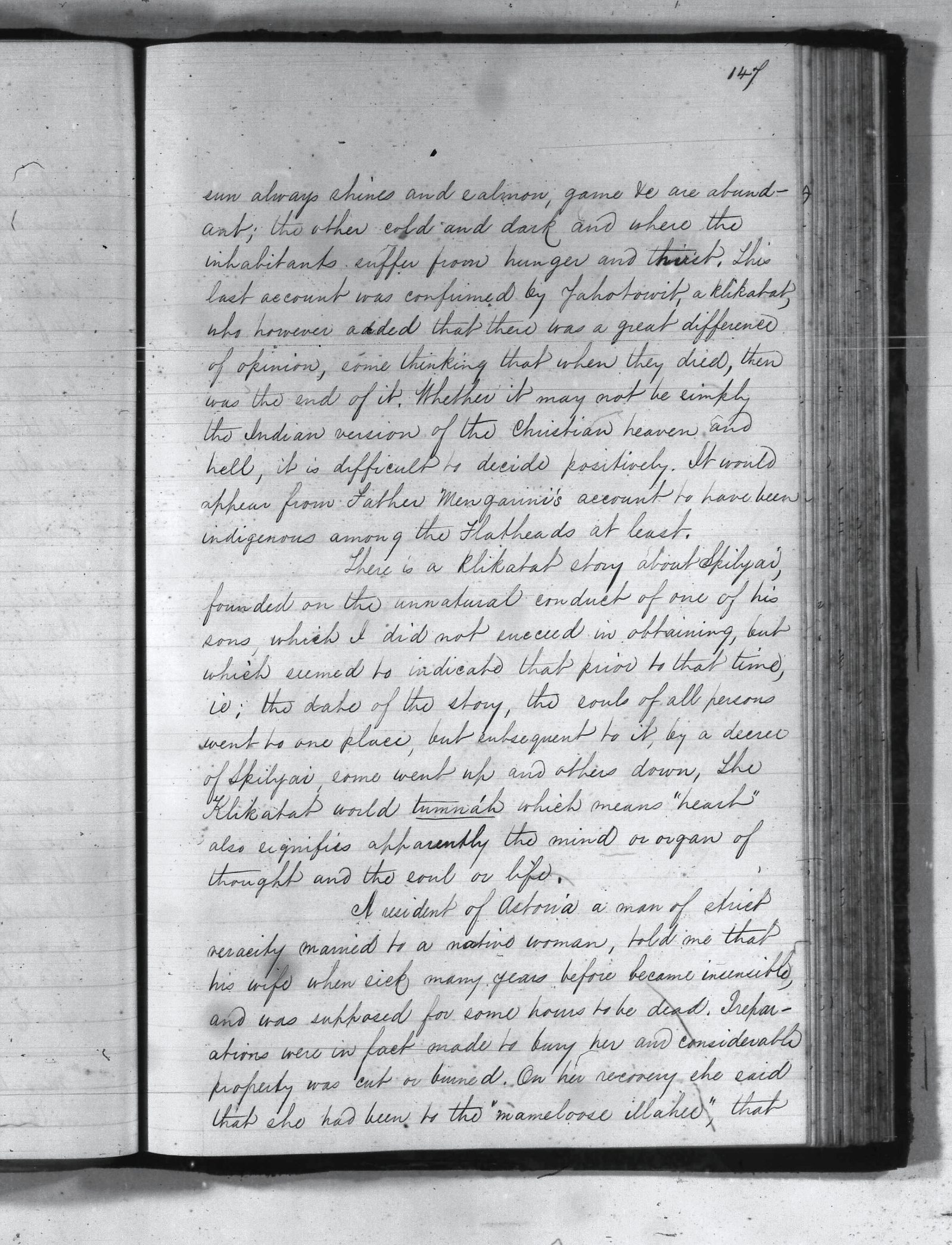
Future state. Two worlds, one where "sun always shines and salmon, game &c are abundant," the other "cold and dark and where the inhabitants suffer from hunger and thirst"; account "confirmed by Jahotowit, a Klikatat," who added that some think death "was the end of it"; whether it is "simply the Indian version of the Christian heaven and hell, it is difficult to decide positively"; "It would appear from Father Mengarini's account to have been indigenous among the Flatheads at least"; "There is a Klikatat story about Spilyai, founded on the unnatural conduct of one of his sons, which I did not succeed in obtaining," indicating that before it all souls went to one place but after, by decree of Spilyai, "some went up and others down"; "The Klikatat word tumnah (underlined) which means 'heart' also signifies apparently the mind or organ of thought and the soul or life"; a resident of Astoria married to a native woman: his wife, insensible for hours and thought dead, property cut or burned in preparation for burial, on recovery said she had been to the "mameloose illahee". No sketch or diagram.
Wisconsin Historical Society, Gibbs Family Papers, U.S. Mss Y, Micro 1117
Reel 2, frames 3792
Reel 2, frame 3792
Read beside the scan
AI first transcription from the evidence pack; not independently verified. Compare with the scan.
sun always shines and salmon, game &c are abund-
ant; the other cold and dark and where the
inhabitants suffer from hunger and thirst. This
last account was confirmed by Tahotowit[?], a Klikatat,
who however added that there was a great difference
of opinion, some thinking that when they died, there
was the end of it. Whether it may not be simply
the Indian version of the Christian heaven and
hell, it is difficult to decide positively. It would
appear from Father Mengarini's account to have been
indigenous among the Flatheads at least.
There is a Klikatat story about Spilyai,
founded on the unnatural conduct of one of his
sons, which I did not succeed in obtaining, but
which seemed to indicate that prior to that time,
ie; the date of the story, the souls of all persons
went to one place, but subsequent to it, by a decree
of Spilyai, some went up and others down. The
Klikatat world tumnáh which means "heart"
also signifies apparently the mind or organ of
thought and the soul or life.
A resident of Astoria a man of strict
veracity married to a native woman, told me that
his wife when sick many years before became insensible,
and was supposed for some hours to be dead. Prepar-
ations were in fact made to bury her and considerable
property was cut or burned. On her recovery she said
that she had been to the "mameloose[?] illahee", that
Citation and provenance
Gibbs, G., IV. (1856). [Manuscript volume, ms p. 147]. Gibbs Family Papers, 1763-1918 (U.S. Mss Y, Micro 1117, Reel 2, frame 3792). Wisconsin Historical Society Archives, Madison, WI, United States.
Citation details need editorial review.
Historical sources retain their individual rights and credits. A scan’s presence here does not establish unrestricted reuse.
People identified in the source catalog
These are catalog labels. Individual identities and relationships have not all been reviewed.
Where the book uses this document
No quotation has yet been assigned directly to this catalog record. Its individual frames may have separate connections.