
Wisconsin manuscript
George Gibbs IV (manuscript volume, ms p. 139) · 1856 (Olympia) and later additions
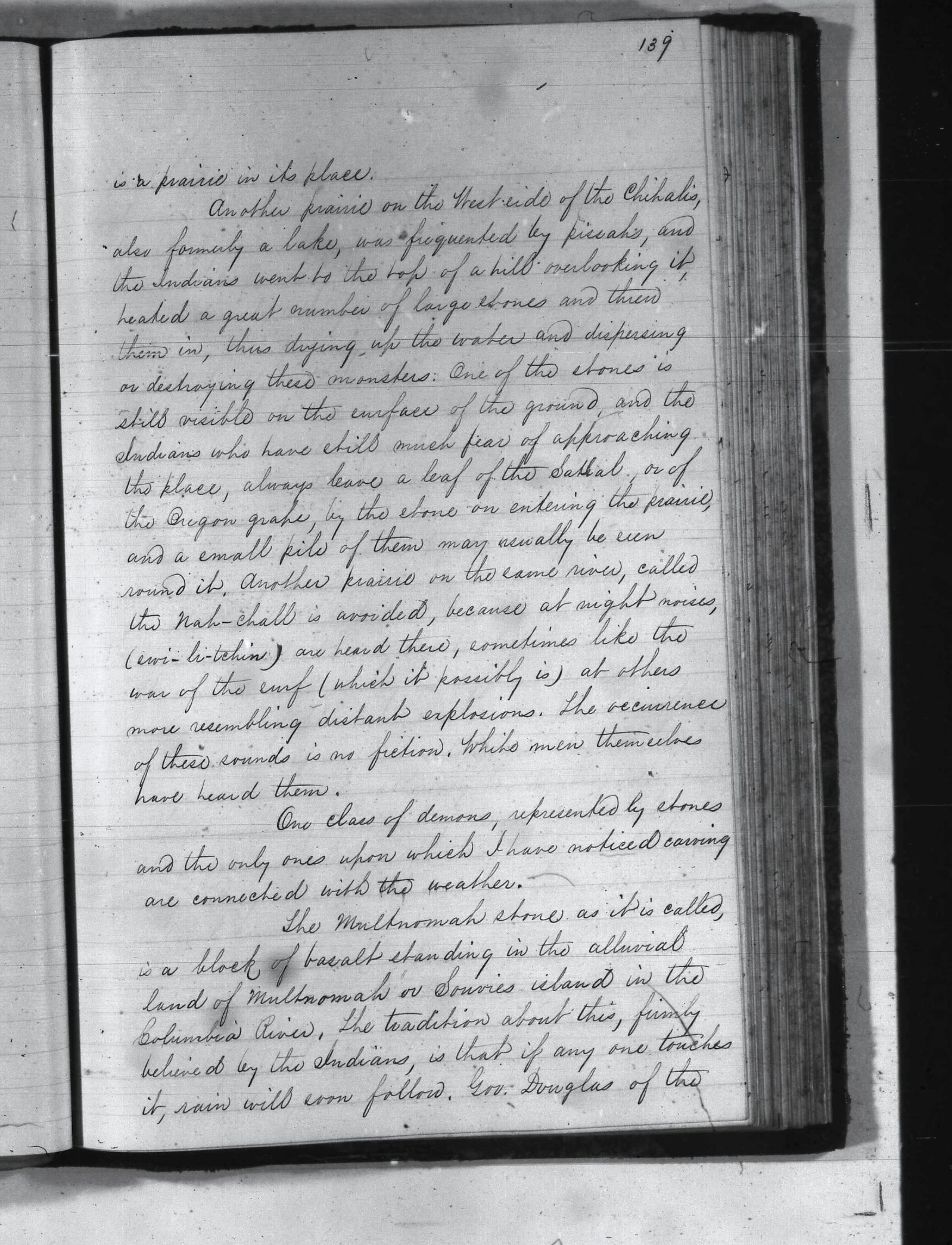
Religion and superstition: demons embodied in stones; haunted prairies. Prairie west of "the Chihalis," formerly a lake, frequented by [illegible] monsters; Indians from a hill overlooking it "heaped a great number of large stones and threw them in, thus drying up the water and dispersing or destroying these monsters"; one stone still visible, feared, passers "always leave a leaf of the Sallal(?), or of the Oregon grape, by the stone on entering the prairie, and a small pile of them may usually be seen round it"; prairie called "the Nah-chall" avoided because night noises "(ewi-li-tchin)" are heard there, like surf or "distant explosions" - "The occurrence of these sounds is no fiction. White men themselves have heard them."; class of demons represented by stones, "the only ones upon which I have noticed carving," connected with the weather; "The Multnomah stone" a block of basalt in the alluvial land of "Multnomah or Souvies island" in the Columbia River, touching it brings rain; Gov. Douglas named. No sketch or diagram.
Wisconsin Historical Society, Gibbs Family Papers, U.S. Mss Y, Micro 1117
Reel 2, frames 3783
Reel 2, frame 3783
Read beside the scan
AI first transcription from the evidence pack; not independently verified. Compare with the scan.
is a prairie in its place.
Another prairie on the West side of the Chihalis,
also formerly a lake, was frequented by pissahs[?], and
the Indians went to the top of a hill overlooking it,
heated a great number of large stones and threw
them in, thus drying up the water and dispersing
or destroying these monsters. One of the stones is
still visible on the surface of the ground, and the
Indians who have still much fear of approaching
the place, always leave a leaf of the Sallal[?], or of
the Oregon grape, by the stone on entering the prairie,
and a small pile of them may usually be seen
round it. Another prairie on the same river, called
the Nah-chall[?] is avoided, because at night noises,
(swi-li-tchin[?]) are heard there, sometimes like the
war[?] of the surf (which it possibly is) at others
more resembling distant explosions. The occurrence
of these sounds is no fiction. White men themselves
have heard them.
One class of demons, represented by stones
and the only ones upon which I have noticed carving
are connected with the weather.
The Multnomah stone as it is called,
is a block of basalt standing in the alluvial
land of Multnomah or Souvies[?] island in the
Columbia River. The tradition about this, firmly
believed by the Indians, is that if any one touches
it, rain will soon follow. Gov. Douglas of the
Citation and provenance
Gibbs, G., IV. (1856). [Manuscript volume, ms p. 139]. Gibbs Family Papers, 1763-1918 (U.S. Mss Y, Micro 1117, Reel 2, frame 3783). Wisconsin Historical Society Archives, Madison, WI, United States.
Citation details need editorial review.
Historical sources retain their individual rights and credits. A scan’s presence here does not establish unrestricted reuse.
People identified in the source catalog
These are catalog labels. Individual identities and relationships have not all been reviewed.
Where the book uses this document
No quotation has yet been assigned directly to this catalog record. Its individual frames may have separate connections.