
Wisconsin manuscript
George Gibbs IV (manuscript volume, ms p. 136) · 1856 (Olympia) and later additions
Skookooms continued — A-yah-hos, Kwak-wa-stas-mewh, Mo-kwa-tah-oom, Hweh-kwa-deh / Nah-ween-at-hlah. "A-yah-hos is a demon half deer and half snake with two heads and two pair of horns. He lives every where in the mountains and bears the same name both with the Klikatats and Nisquallies"; "Kwak-wa-stas-mewh" are "a little people who live to the North. They eat the haiqua", the shape of their mouths "or rather perhaps beak, allowing them to pull the meat from the shells", beds of which "lie round their lodges like those of clams round the houses of the Sound Indians"; their flesh "is proof against knives or arrows, but is vulnerable by feathers", pierced in "their wars with the geese"; they figure in "the story of the 'Seal Hunters' given below"; an informant reported "in his father's time there was a slave among the S'Homamish who had lived with them and cured many of their wounded with gum"; one can "paddle a great canoe by himself and catch it full of salmon halibut and sturgeon"; "Mo-kwa-tah-oom, are the inhabitants of the land of bones, or the dead world", described in a Staktamish legend; "Hweh-kwa-deh of the Sound Indians, Nah-ween-at-hlah of the Klikatats is the thunder bird, the sound of whose wings produces the noise".
Wisconsin Historical Society, Gibbs Family Papers, U.S. Mss Y, Micro 1117
Reel 2, frames 3780
Reel 2, frame 3780
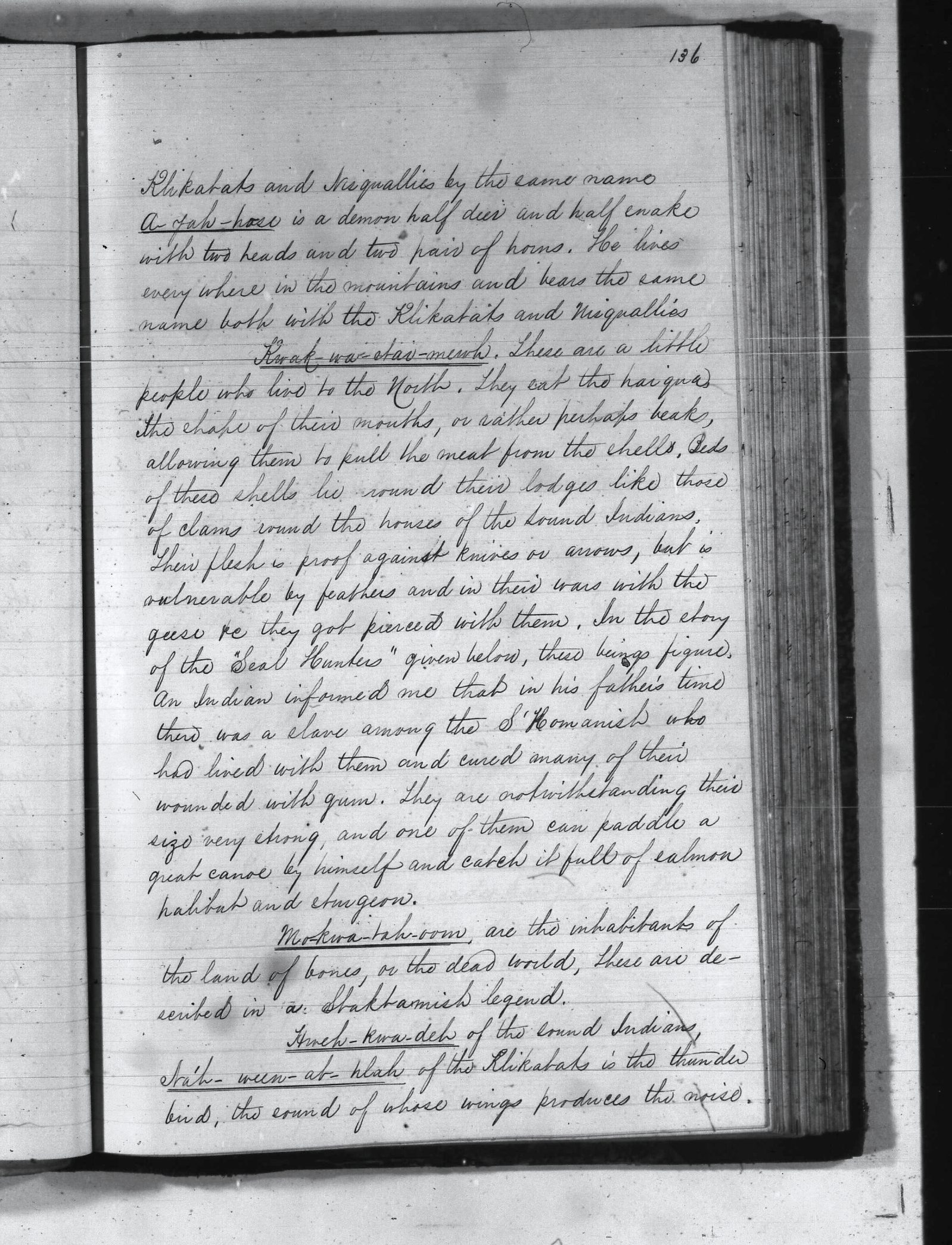
Read beside the scan
AI first transcription from the evidence pack; not independently verified. Compare with the scan.
Klikatats and Nisquallies by the same name
A-yah-hose[?] is a demon half deer and half snake
with two heads and two pair of horns. He lives
every where in the mountains and bears the same
name both with the Klikatats and Nisquallies
Kwak-wa-stai-mewh[?]. These are a little
people who live to the North. They eat the haiqua
the shape of their mouths, or rather perhaps beaks,
allowing them to pull the meat from the shells. Beds
of these shells lie round their lodges like those
of clams round the houses of the Sound Indians.
Their flesh is proof against knives or arrows, but is
vulnerable by feathers and in their wars with the
geese &c they got pierced with them. In the story
of the "Seal Hunters" given below, these beings figure.
An Indian informed me that in his father's time
there was a slave among the S'Homanish who
had lived with them and cured many of their
wounded with gum. They are notwithstanding their
size very strong, and one of them can paddle a
great canoe by himself and catch it full of salmon
halibut and sturgeon.
Mokwa-tah-oom, are the inhabitants of
the land of bones, or the dead world. These are de-
scribed in a Staktamish[?] legend.
Hwch-kwa-deh[?] of the Sound Indians,
Náh-ween-at-hlah[?] of the Klikatats is the thunder
bird, the sound of whose wings produces the noise.
Citation and provenance
Gibbs, G., IV. (1856). [Manuscript volume, ms p. 136]. Gibbs Family Papers, 1763-1918 (U.S. Mss Y, Micro 1117, Reel 2, frame 3780). Wisconsin Historical Society Archives, Madison, WI, United States.
Citation details need editorial review.
Historical sources retain their individual rights and credits. A scan’s presence here does not establish unrestricted reuse.
People identified in the source catalog
These are catalog labels. Individual identities and relationships have not all been reviewed.
Where the book uses this document
No quotation has yet been assigned directly to this catalog record. Its individual frames may have separate connections.