
Wisconsin manuscript
George Gibbs IV (manuscript volume, ms p. 134) · 1856 (Olympia) and later additions
Animal lore — the jay, crow, dogs, wolf; mammoth bones; list of Skookooms begins. The jay flew into a tree "and commenced chattering vehemently"; an Indian shot it, answering "that the bird was abusing him"; "The jay plays a conspicuous part in all the tales, having a high reputation for cunning and newsmongering"; a story of the crow: paddlers "always used the edge of their paddles, until one day accidentally the steersman turned his blade flatwise and found that to be the best way"; "Dogs were originally deer hunters"; "The large wolf and the rattlesnake rank as among the worst of the Skookooms"; "The bones of the mammoth have been discovered in the Willamette valley, but I could not learn that any tradition existed respecting it" — an Indian "supposed they were bones of one of the Skookooms who formerly inhabited the lakes"; begins an enumeration of Skookooms "who do not appear to have left any legal heirs", the first entry headed "Sat-at-hlia".
Wisconsin Historical Society, Gibbs Family Papers, U.S. Mss Y, Micro 1117
Reel 2, frames 3778
Reel 2, frame 3778
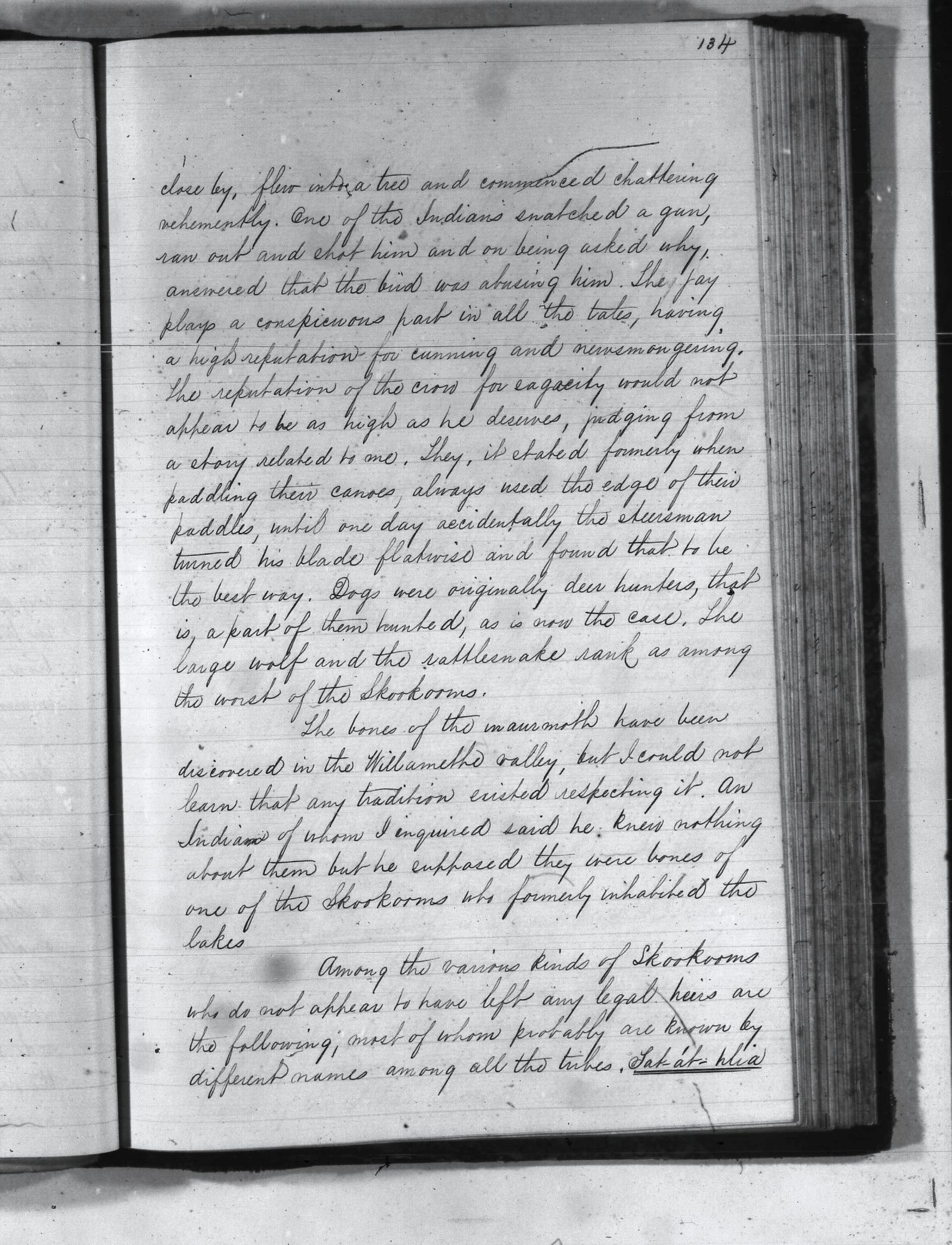
Read beside the scan
AI first transcription from the evidence pack; not independently verified. Compare with the scan.
close by, flew into a tree and commenced chattering
vehemently. One of the Indians snatched a gun,
ran out and shot him and on being asked why,
answered that the bird was abusing him. The jay
plays[?] a conspicuous part in all the tales, having
a high reputation for cunning and newsmongering.
The reputation of the crow for sagacity would not
appear to be as high as he deserves, judging from
a story related to me. They, it stated[?] formerly when
paddling their canoes, always used the edge of their
paddles, until one day accidentally the steersman
turned his blade flatwise and found that to be
the best way. Dogs were originally deer hunters, that
is, a part of them hunted, as is now the case. The
large wolf and the rattlesnake rank as among
the worst of the Skookooms.
The bones of the mammoth[?] have been
discovered in the Willamette valley, but I could not
learn that any tradition existed respecting it. An
Indian of whom I inquired said he knew nothing
about them but he supposed they were bones of
one of the Skookooms who formerly inhabited the
lakes
Among the various kinds of Skookooms
who do not appear to have left any legal heirs are
the following, most of whom probably are known by
different names among all the tribes. Sak-át-hlia[?]
Citation and provenance
Gibbs, G., IV. (1856). [Manuscript volume, ms p. 134]. Gibbs Family Papers, 1763-1918 (U.S. Mss Y, Micro 1117, Reel 2, frame 3778). Wisconsin Historical Society Archives, Madison, WI, United States.
Citation details need editorial review.
Historical sources retain their individual rights and credits. A scan’s presence here does not establish unrestricted reuse.
People identified in the source catalog
These are catalog labels. Individual identities and relationships have not all been reviewed.
Where the book uses this document
No quotation has yet been assigned directly to this catalog record. Its individual frames may have separate connections.