
Wisconsin manuscript
George Gibbs IV (manuscript volume, ms p. 116) · 1856 (Olympia) and later additions
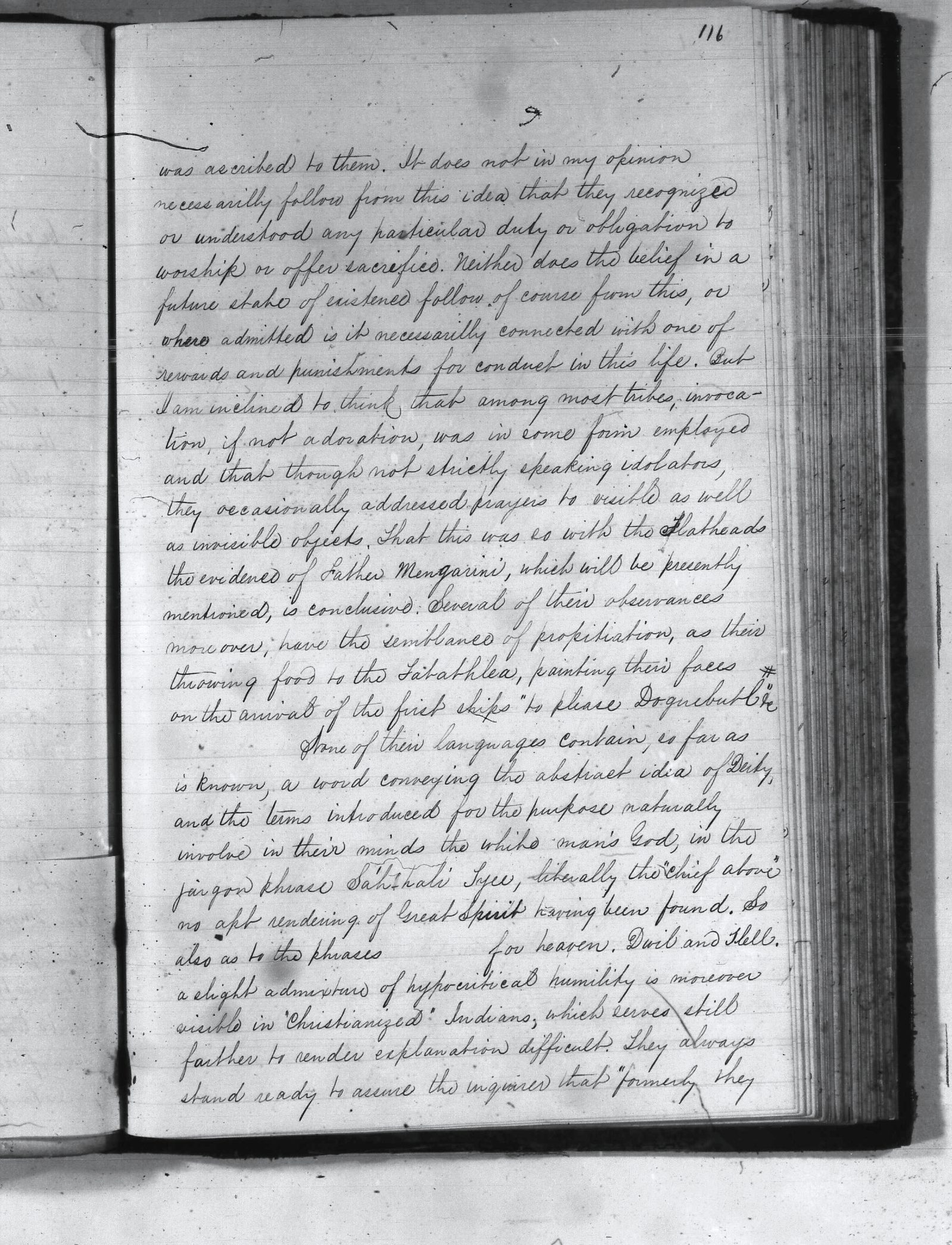
Mythology (continued). Readable exposure of page 116: creative agency ascribed to the supernatural beings does not, in Gibbs's opinion, imply "any particular duty or obligation to worship or offer sacrifice", nor does belief in a future state follow, nor is it necessarily connected with "rewards and punishments for conduct in this life"; among most tribes "invocation, if not adoration, was in some form employed" and though not strictly idolatrous "they occasionally addressed prayers to visible as well as invisible objects. That this was so with the Flatheads the evidence of Father Mengarini, which will be presently mentioned, is conclusive."; observances with "the semblance of propitiation, as their throwing food to the Tatathlea(?), painting their faces on the arrival of the first ships 'to please Doquebut'" (an asterisk keyed to a note); "None of their languages contain, so far as is known, a word conveying the abstract idea of Deity", introduced terms involving the white man's God, "in the jargon phrase Sah'-hali Tyee, literally the 'chief above'", no apt rendering of "Great Spirit" having been found; a blank space is left in the line for the corresponding phrases "for heaven, Devil and Hell"; "a slight admixture of hypocritical humility is moreover visible in 'Christianized' Indians", who "always stand ready to assure the inquirer that 'formerly they'" [believed otherwise]
Wisconsin Historical Society, Gibbs Family Papers, U.S. Mss Y, Micro 1117
Reel 2, frames 3759
Reel 2, frame 3759
Read beside the scan
AI first transcription from the evidence pack; not independently verified. Compare with the scan.
9
was ascribed to them. It does not in my opinion
necessarilly follow from this idea that they recognized
or understood any particular duty or obligation to
worship or offer sacrifice. Neither does the belief in a
future state of existence follow of course from this, or
where admitted is it necessarilly connected with one of
rewards and punishments for conduct in this life. But
I am inclined to think that among most tribes, invoca-
tion, if not adoration, was in some form employed
and that though not strictly speaking idolators,
they occasionally addressed prayers to visible as well
as invisible objects. That this was so with the Flatheads
the evidence of Father Mengarini, which will be presently
mentioned, is conclusive. Several of their observances
moreover, have the semblance of propitiation, as their
throwing food to the Satathlea[?], painting their faces
on the arrival of the first ships "to please Doquebutl[?] &c #
None of their languages contain, so far as
is known, a word conveying the abstract idea of Deity,
and the terms introduced for the purpose naturally
involve in their minds the white man's God, in the
jargon phrase Sah-hali Tyee, literally the "chief above"
no apt rendering of Great Spirit having been found. So
also as to the phrases [blank space left in text] for heaven. Devil and Hell.
a slight admixture of hypocritical humility is moreover
visible in "Christianized" Indians, which serves still
farther to render explanation difficult. They always
stand ready to assure the inquirer that "formerly they
Citation and provenance
Gibbs, G., IV. (1856). [Manuscript volume, ms p. 116]. Gibbs Family Papers, 1763-1918 (U.S. Mss Y, Micro 1117, Reel 2, frame 3759). Wisconsin Historical Society Archives, Madison, WI, United States.
Citation details need editorial review.
Historical sources retain their individual rights and credits. A scan’s presence here does not establish unrestricted reuse.
People identified in the source catalog
These are catalog labels. Individual identities and relationships have not all been reviewed.
Where the book uses this document
No quotation has yet been assigned directly to this catalog record. Its individual frames may have separate connections.