
Wisconsin manuscript
George Gibbs IV (manuscript volume, ms p. 108) · 1856 (Olympia) and later additions
Symbolic Writing. Section heading "Symbolic Writing." - Gibbs is unsure how far it is carried among the Sound tribes, probably no essential difference from "their neighbors of the plains in this art"; best explained by an example "given me by a veteran mountaineer, Dr Robert Newell of Champoeg": a party of Snakes going to hunt strayed horses; "The figure of a man with a long queue, or scalp-lock, reaching to his heels denotes Shoshonee; that tribe being in the habit of braiding horse or other hair into their own"; a number of marks follow "signifying the strength of the party"; "A foot print pointed in the direction they take shows their course, and a hoof mark turned backward, that they expect to return with animals"; if well armed and expecting attack "a little powder mixed with sand tells that they are ready, or a square dotted about the figures indicates that they have forted"; such pictographs studied and deciphered by "the shrewder or more experienced old men"; no permanent symbolic writings below the Cascades "like those which occur upon some of the rocks on the Columbia river above them, and attributed by the present Indians to the Elip Tilikum, or primeval race" (described in words only; no drawing on the page)
Wisconsin Historical Society, Gibbs Family Papers, U.S. Mss Y, Micro 1117
Reel 2, frames 3750
Reel 2, frame 3750
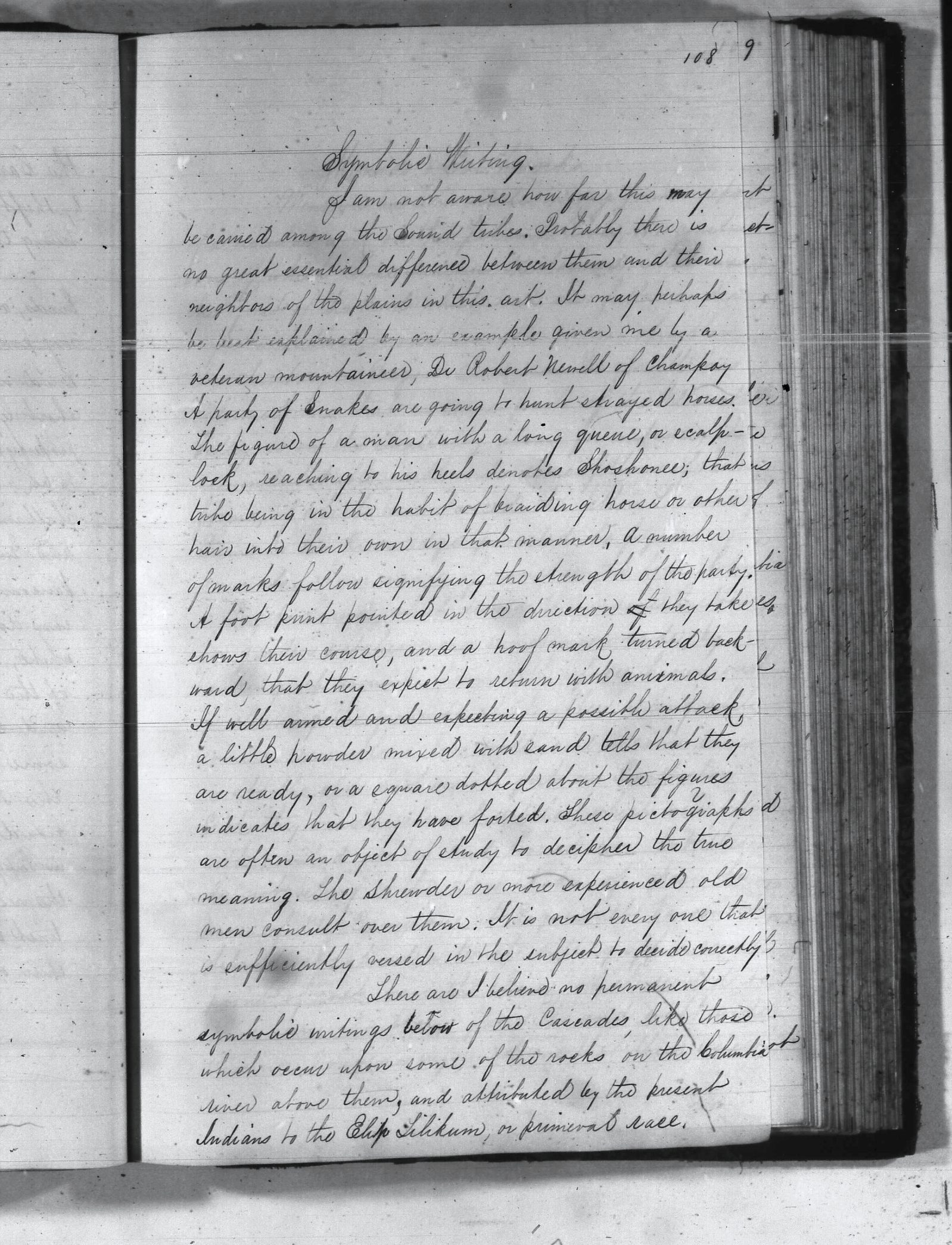
Read beside the scan
AI first transcription from the evidence pack; not independently verified. Compare with the scan.
Symbolic Writing.
I am not aware how far this may
be carried among the Sound tribes. Probably there is
no great essential difference between them and their
neighbors of the plains in this art. It may perhaps
be best explained by an example given me by a
veteran mountaineer, Dr Robert Newell of Champoeg[?]
A party of Snakes are going to hunt strayed horses.
The figure of a man with a long queue, or scalp-
lock, reaching to his heels denotes Shoshonee; that
tribe being in the habit of braiding horse or other
hair into their own in that manner. A number
of marks follow signifying the strength of the party.
A foot print pointed in the direction [struck: of][?] they take
shows their course, and a hoof mark turned back-
ward, that they expect to return with animals.
If well armed and expecting a possible attack,
a little powder mixed with sand tells that they
are ready, or a square dotted about the figures
indicates that they have forted. These pictographs
are often an object of study to decipher the true
meaning. The Shrewder or more experienced old
men consult over them. It is not every one that
is sufficiently versed in the subject to decide correctly.
There are I believe no permanent
symbolic writings below of the Cascades, like those
which occur upon some of the rocks on the Columbia
river above them, and attributed by the present
Indians to the Elip Tilikum[?], or primeval race.
Citation and provenance
Gibbs, G., IV. (1856). [Manuscript volume, ms p. 108]. Gibbs Family Papers, 1763-1918 (U.S. Mss Y, Micro 1117, Reel 2, frame 3750). Wisconsin Historical Society Archives, Madison, WI, United States.
Citation details need editorial review.
Historical sources retain their individual rights and credits. A scan’s presence here does not establish unrestricted reuse.
People identified in the source catalog
These are catalog labels. Individual identities and relationships have not all been reviewed.
Where the book uses this document
No quotation has yet been assigned directly to this catalog record. Its individual frames may have separate connections.