
Wisconsin manuscript
George Gibbs IV (manuscript volume, ms p. 104) · 1856 (Olympia) and later additions
Clothing, Utensils, &c. (weaving). Blankets of "the mountain sheep" wool mixed with "the hair of a particular variety of dog", never equalling the northern tribes, some of whose workmanship "equalled the common kind of Mexican Sarapes"; "Vancouver describes the dogs as 'resembling those of Pomerania though in general somewhat larger'. Their usual color is white."; the wool obtained by trade "from the hunting tribes next to the Cascade Mountains"; the two mixed and twisted into yarn "by rolling upon the thigh", the warp stretched singly over a frame with the ends tied, the woof "passed through with a long wooden needle"; "The Clallams and Sound Indians do not make much use of colors in ornamenting these blankets, but those farther North introduce quite complicated figures of several colors"; another robe, usually square and worn over the shoulders, made "by twisting in with the hair or wool, the down of sea birds"; "The Makahs alone manufacture the cedar bark into textures suitable for wearing" - inner bark selected, boiled or macerated, pounded and hatchelled out, the bark forming the warp and "the woof being made of grass thread"
Wisconsin Historical Society, Gibbs Family Papers, U.S. Mss Y, Micro 1117
Reel 2, frames 3746
Reel 2, frame 3746
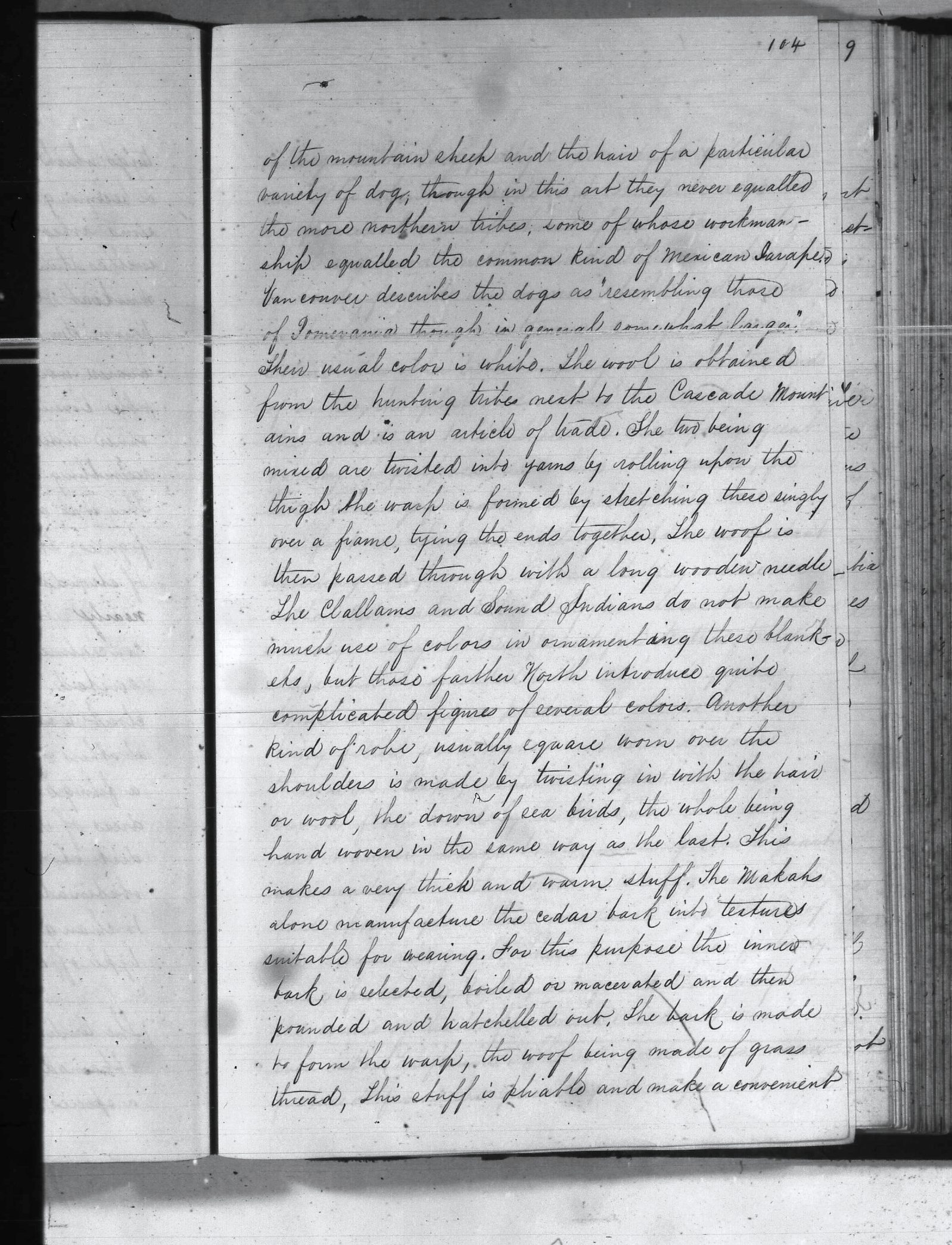
Read beside the scan
AI first transcription from the evidence pack; not independently verified. Compare with the scan.
of the mountain sheep and the hair of a particular
variety of dog; though in this art they never equalled
the more northern tribes, some of whose workman-
ship equalled the common kind of Mexican Sarapes[?].
Vancouver describes the dogs as 'resembling those
of Pomerania though in general somewhat larger."
Their usual color is white. The wool is obtained
from the hunting tribes next to the Cascade Mount-
ains and is an article of trade. The two being
mixed are twisted into yarns by rolling upon the
thigh The warp is formed by stretching these singly
over a frame, tying the ends together, The woof is
then passed through with a long wooden needle
The Clallams and Sound Indians do not make
much use of colors in ornamenting these blank-
ets, but those farther North introduce quite
complicated figures of several colors. Another
kind of robe, usually square worn over the
shoulders is made by twisting in with the hair
or wool, the down of sea birds, the whole being
hand woven in the same way as the last. This
makes a very thick and warm stuff. The Makahs
alone manufacture the cedar bark into textures
suitable for wearing. For this purpose the inner
bark is selected, boiled or macerated and then
pounded and hatchelled out. The bark is made
to form the warp, the woof being made of grass
thread, This stuff is pliable and make a convenient
Citation and provenance
Gibbs, G., IV. (1856). [Manuscript volume, ms p. 104]. Gibbs Family Papers, 1763-1918 (U.S. Mss Y, Micro 1117, Reel 2, frame 3746). Wisconsin Historical Society Archives, Madison, WI, United States.
Citation details need editorial review.
Historical sources retain their individual rights and credits. A scan’s presence here does not establish unrestricted reuse.
People identified in the source catalog
These are catalog labels. Individual identities and relationships have not all been reviewed.
Where the book uses this document
No quotation has yet been assigned directly to this catalog record. Its individual frames may have separate connections.