
Wisconsin manuscript
George Gibbs IV (manuscript volume, ms p. 99) · 1856 (Olympia) and later additions
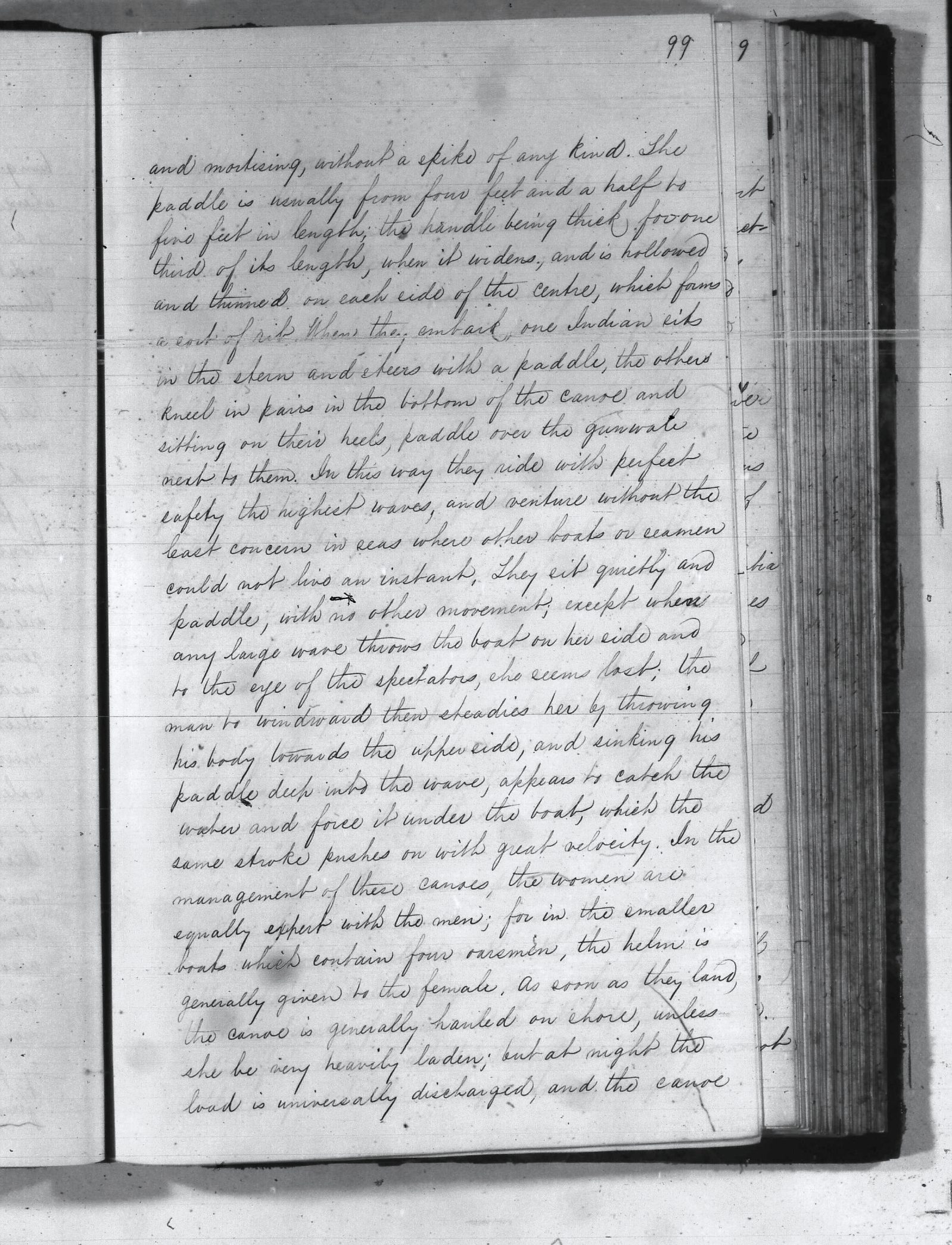
Canoes (Lewis & Clarke quotation continued). Figures united "by inlaying and mortising, without a spike of any kind"; paddle "from four feet and a half to five feet in length", handle thick for one third its length then widening, hollowed and thinned each side of the centre "which forms a sort of rib"; one Indian steers in the stern with a paddle, the others "kneel in pairs in the bottom of the canoe and sitting on their heels, paddle over the gunwale next to them"; they ride the highest waves and venture "in seas where other boats or seamen could not live an instant"; when a large wave throws the boat on her side the windward man steadies her by throwing his body to the upper side and sinking his paddle deep into the wave; "In the management of these canoes, the women are equally expert with the men; for in the smaller boats which contain four oarsmen, the helm is generally given to the female"; canoe hauled ashore on landing, load discharged at night
Wisconsin Historical Society, Gibbs Family Papers, U.S. Mss Y, Micro 1117
Reel 2, frames 3741
Reel 2, frame 3741
Read beside the scan
AI first transcription from the evidence pack; not independently verified. Compare with the scan.
and mortising, without a spike of any kind. The
paddle is usually from four feet and a half to
five feet in length; the handle being thick for one
third of its length, when it widens, and is hollowed
and thinned on each side of the centre, which forms
a sort of rib. When they embark, one Indian sits
in the stern and steers with a paddle, the others
kneel in pairs in the bottom of the canoe and
sitting on their heels, paddle over the gunwale
next to them. In this way they ride with perfect
safety the highest waves, and venture without the
least concern in seas where other boats or seamen
could not live an instant. They sit quietly and
paddle, with no other movement; except when
any large wave throws the boat on her side and
to the eye of the spectators, she seems lost; the
man to windward then steadies her by throwing
his body towards the upper side, and sinking his
paddle deep into the wave, appears to catch the
water and force it under the boat, which the
same stroke pushes on with great velocity. In the
management of these canoes, the women are
equally expert with the men; for in the smaller
boats which contain four oarsmen[?], the helm is
generally given to the female. As soon as they land,
the canoe is generally hauled on shore, unless
she be very heavily laden; but at night the
load is universally discharged, and the canoe
Citation and provenance
Gibbs, G., IV. (1856). [Manuscript volume, ms p. 99]. Gibbs Family Papers, 1763-1918 (U.S. Mss Y, Micro 1117, Reel 2, frame 3741). Wisconsin Historical Society Archives, Madison, WI, United States.
Citation details need editorial review.
Historical sources retain their individual rights and credits. A scan’s presence here does not establish unrestricted reuse.
People identified in the source catalog
These are catalog labels. Individual identities and relationships have not all been reviewed.
Where the book uses this document
No quotation has yet been assigned directly to this catalog record. Its individual frames may have separate connections.