
Wisconsin manuscript
George Gibbs IV (manuscript volume, ms p. 97) · 1856 (Olympia) and later additions
Canoes. Canoe nearly straight on the gunwale "ornamented at the bow with a carved figure head representing some bird or animal" chiefly used round "the Willamette and Cowlitz"; a small light canoe "used principally among the marshy(?) islands towards the mouth of the river, for hunting sea fowl"; another kind "particularly mentioned by Lewis & Clarke" now almost entirely confined to "Pugets Sound", up to thirty five feet long, stern rounded and rising to a point, bow "terminating in a sort of billet head"; the most used and most elegant is "the Chinook Canoe", bow rising high and projecting forward tapering to a point, stern "cut off perpendicularly and surmounted by a block"; these canoes "are usually painted black outside and red within and ornamented along the gunwale with the operculum of some sea shell set in rows"; employed far to the Northward; admirable sea boats but "exposed to be boarded from behind"; a modification used by the Northern Indians for a war canoe
Wisconsin Historical Society, Gibbs Family Papers, U.S. Mss Y, Micro 1117
Reel 2, frames 3738
Reel 2, frame 3738
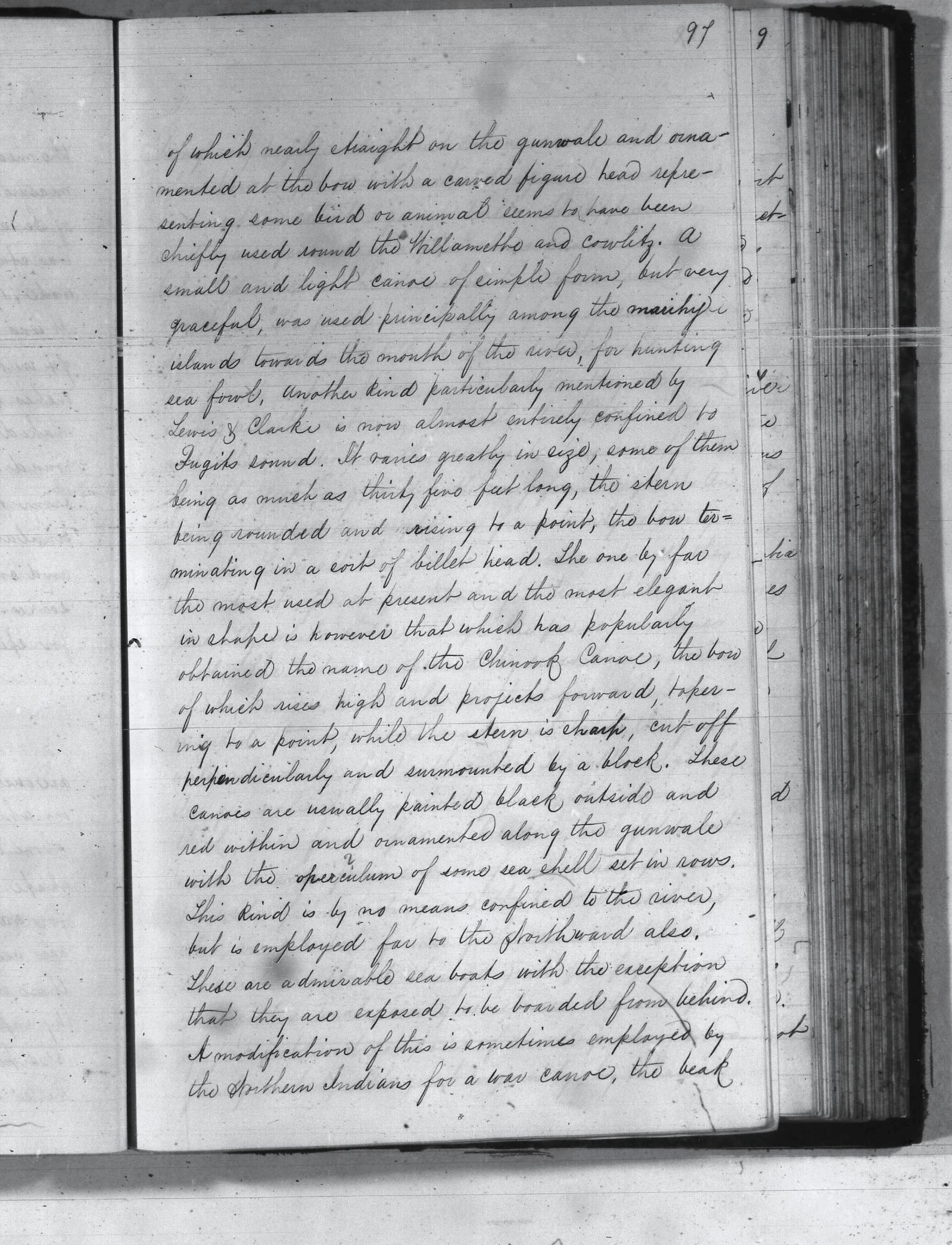
Read beside the scan
AI first transcription from the evidence pack; not independently verified. Compare with the scan.
of which nearly straight on the gunwale and orna-
mented at the bow with a carved figure head repre-
senting some bird or animal seems to have been
chiefly used round the Willamette and Cowlitz. A
small and light canoe of simple form, but very
graceful, was used principally among the marshy[?]
islands towards the mouth of the river, for hunting
sea fowl. Another kind particularly mentioned by
Lewis & Clarke is now almost entirely confined to
Pugits sound. It varies greatly in size, some of them
being as much as thirty five feet long, the stern
being rounded and rising to a point, the bow ter=
minating in a sort of billet head. The one by far
the most used at present and the most elegant
in shape is however that which has popularly
obtained the name of the Chinook Canoe, the bow
of which rises high and projects forward, taper-
ing to a point, while the stern is sharp, cut off
perpendicularly and surmounted by a block. These
canoes are usually painted black outside and
red within and ornamented along the gunwale
with the operculum of some sea shell set in rows.
This kind is by no means confined to the river,
but is employed far to the Northward also.
These are admirable sea boats with the exception
that they are exposed to be boarded from behind.
A modification of this is sometimes employed by
the Northern Indians for a war canoe, the beak
Citation and provenance
Gibbs, G., IV. (1856). [Manuscript volume, ms p. 97]. Gibbs Family Papers, 1763-1918 (U.S. Mss Y, Micro 1117, Reel 2, frame 3738). Wisconsin Historical Society Archives, Madison, WI, United States.
Citation details need editorial review.
Historical sources retain their individual rights and credits. A scan’s presence here does not establish unrestricted reuse.
People identified in the source catalog
These are catalog labels. Individual identities and relationships have not all been reviewed.
Where the book uses this document
No quotation has yet been assigned directly to this catalog record. Its individual frames may have separate connections.