
Wisconsin manuscript
duplicate exposure of 1662 (notebook p.27) · (cont.)
same Clallam/Chemakum page refilmed
Wisconsin Historical Society, Gibbs Family Papers, U.S. Mss Y, Micro 1117
Reel 2, frames 1663, 1664
Reel 2, frame 1664
Read beside the scan
AI first transcription from the evidence pack; not independently verified. Compare with the scan.
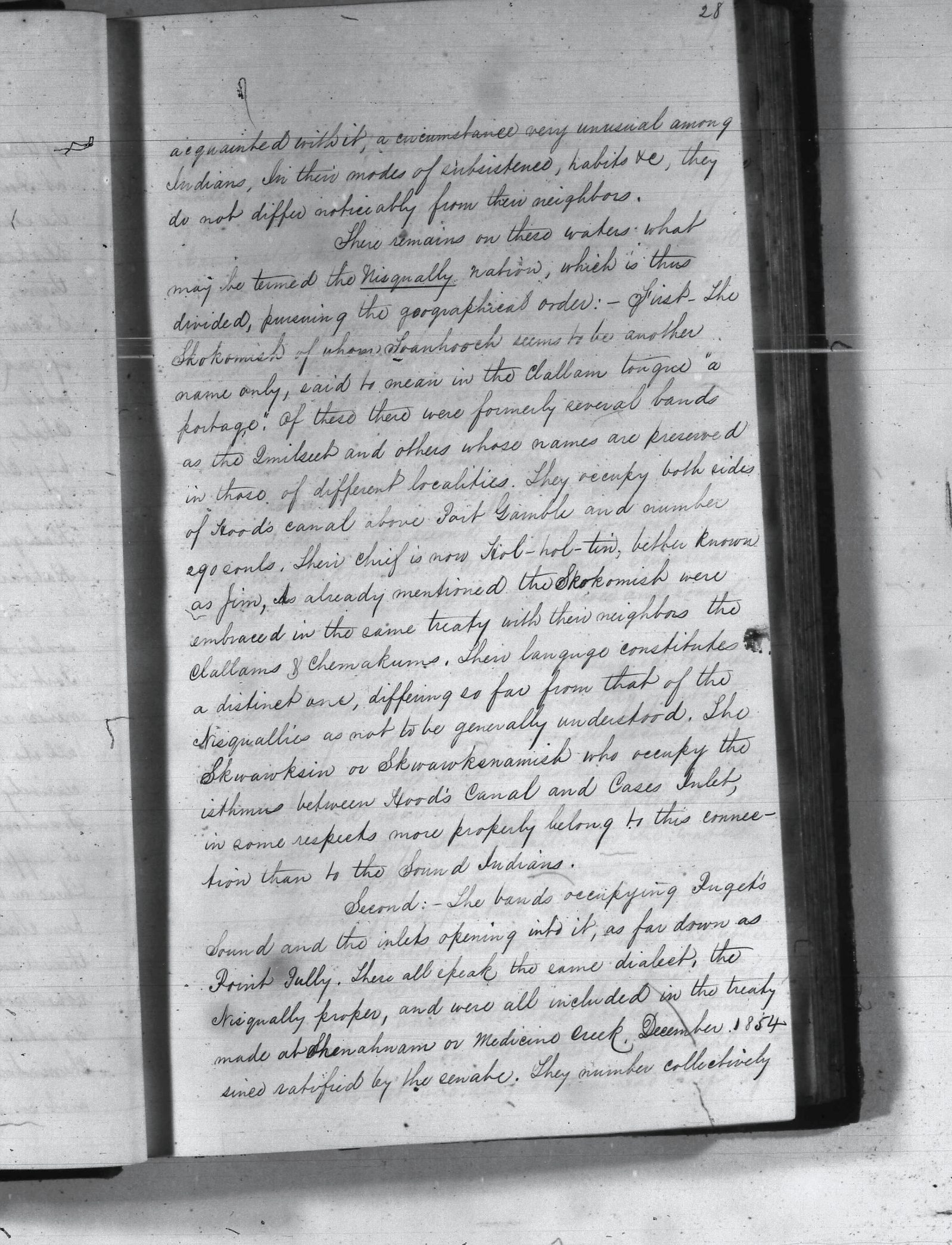
acquainted with it, a circumstance very unusual among
Indians. In their modes of subsistence, habits &c, they
do not differ noticeably from their neighbors.
There remains on these waters what
may be termed the Nisqually nation, which is thus
divided, pursuing the geographical order:- First- The
Skokomish of whom Toanhooch seems to be another
name only, said to mean in the Clallam tongue "a
portage". Of these there were formerly several bands
as the Quilseeh[?] and others whose names are preserved
in those of different localities. They occupy both sides
of Hood's canal above Port Gamble and number
290 souls. Their chief is now Kol-hol-tin[?], better known
as Jim, As already mentioned the Skokomish were
embraced in the same treaty with their neighbors the
Clallams & Chemakums. Their language constitutes
a distinct one, differing so far from that of the
Nisquallies as not to be generally understood. The
Skwawksin or Skwawksnamish who occupy the
isthmus between Hood's Canal and Cases Inlet,
in some respects more properly belong to this connec-
tion than to the Sound Indians.
Second:- The bands occupying Puget's
Sound and the inlets opening into it, as far down as
Point Pully. These all speak the same dialect, the
Nisqually proper, and were all included in the treaty
made at Shenahnam[?] or Medicine creek, December 1854
since ratified by the senate. They number collectively
Citation and provenance
[Duplicate exposure of 1662 (notebook p.27)]. (n.d.). Gibbs Family Papers, 1763-1918 (U.S. Mss Y, Micro 1117, Reel 2, frames 1663-1664). Wisconsin Historical Society Archives, Madison, WI, United States.
Citation details need editorial review.
Historical sources retain their individual rights and credits. A scan’s presence here does not establish unrestricted reuse.
People identified in the source catalog
These are catalog labels. Individual identities and relationships have not all been reviewed.
Where the book uses this document
No quotation has yet been assigned directly to this catalog record. Its individual frames may have separate connections.