
Wisconsin manuscript
(legal) · 1827 June 16
Luther Bradish, for $8000, quitclaims to George Gibbs, William C. Gibbs (of Newport), Rev Dr William E. Channing & wife Ruth G. Channing, and Sarah Gibbs all his interest (as widower of Helen Elizabeth Gibbs Bradish, daughter of the late George Gibbs) in the estates of George Gibbs late of New York dec'd and of Mary Gibbs Moore wife of Thomas Moore, lands in RI/MA/VA/PA and elsewhere; p.1
Wisconsin Historical Society, Gibbs Family Papers, U.S. Mss Y, Micro 1117
Reel 1, frames 620
Reel 1, frame 620
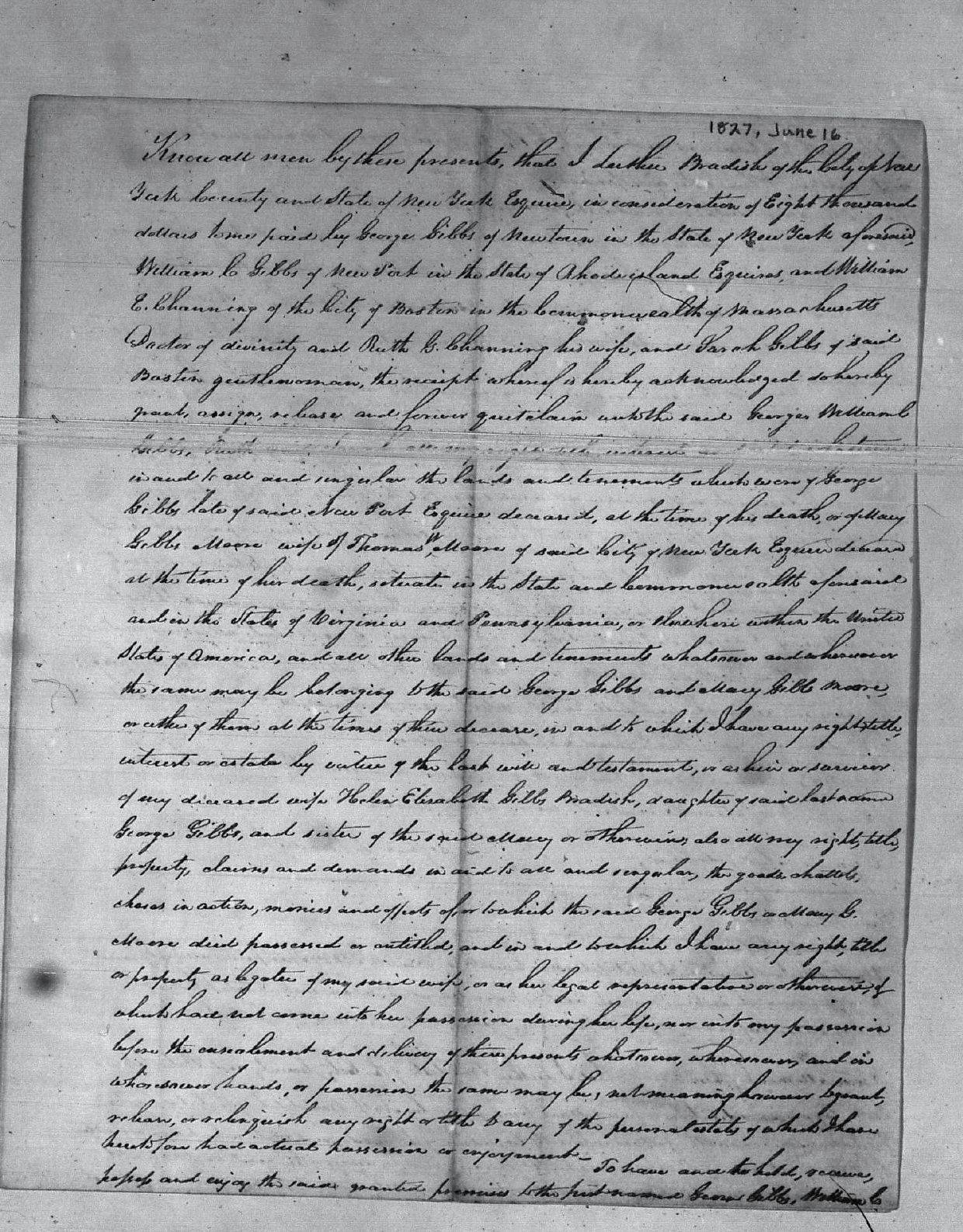
Read beside the scan
AI first transcription from the evidence pack; not independently verified. Compare with the scan.
Know all men by these presents, that I Luther Bradish of the City of New
York County and State of New York Esquire, in consideration of Eight thousand
dollars to me paid by George Gibbs of Newtown in the State of New York aforesaid,
William C Gibbs of New Port in the State of Rhodeisland Esquires, and William
E. Channing of the City of Boston in the Commonwealth of Massachusetts
Doctor of divinity and Ruth G. Channing his wife, and Sarah Gibbs of said
Boston gentlewoman, the receipt whereof is hereby acknowledged do hereby
grant, assign, release and forever quitclaim unto the said George, William C
Gibbs, Ruth [illegible, ~3 words] all my right [illegible] interest [illegible, ~3 words]
in and to all and singular the lands and tenements which were of George
Gibbs late of said New Port Esquire deceased, at the time of his death, or of Mary
Gibbs Moore wife of Thomas W. Moore of said City of New York Esquire deceased
at the time of her death, situate in the State and Commonwealth aforesaid
and in the States of Virginia and Pennsylvania, or elsewhere within the United
States of America, and all other lands and tenements whatsoever and wheresoever
the same may be belonging to the said George Gibbs and Mary Gibbs Moore,
or either of them at the times of their decease, in and to which I have any right, title,
interest or estate by virtue of the last will and testament, or as heir or survivor
of my deceased wife Helen Elizabeth Gibbs Bradish, daughter of said last named
George Gibbs, and sister of the said Mary or otherwise; also all my right, title,
property, claims and demands in and to all and singular, the goods chattels,
choses in action, monies and effects of or to which the said George Gibbs or Mary G.
Moore died possessed or entitled, and in and to which I have any right, title
or property as legatee of my said wife, or as her legal representative or otherwise, &
which had not come into her possession during her life, nor into my possession
before the ensealment and delivery of these presents whatsoever, wheresoever, and in
whosoever hands, or possession the same may be, not meaning however to grant,
release, or relinquish any right or title to any of the personal estate of which I have
heretofore had actual possession or enjoyment.—
To have and to hold, receive,
possess and enjoy the said granted premises to the first named George Gibbs, William C
Citation and provenance
[(legal)]. (1827, June 16). Gibbs Family Papers, 1763-1918 (U.S. Mss Y, Micro 1117, Reel 1, frame 620). Wisconsin Historical Society Archives, Madison, WI, United States.
Citation details need editorial review.
Historical sources retain their individual rights and credits. A scan’s presence here does not establish unrestricted reuse.
People identified in the source catalog
These are catalog labels. Individual identities and relationships have not all been reviewed.
Where the book uses this document
No quotation has yet been assigned directly to this catalog record. Its individual frames may have separate connections.