
Wisconsin manuscript
" ""Opinion"" (p1)" · 1816, July 25 (docket)
Second counsel's opinion on Mrs. Bradish's will: personalty has no locality and follows the owner's domicile (1 H. Black. 690), so the testatrix's personal property is governed by New York law; real estate is strictly local and each parcel in the schedule is governed by the state where it lies; opens the general question whether a feme covert can bequeath personalty - at common law she cannot except by license of the husband (2 Black. 498; 1 Mod. 211; Off. Ex. 196; 2 Vern. 891; 2 Mod. 170)
Wisconsin Historical Society, Gibbs Family Papers, U.S. Mss Y, Micro 1117
Reel 1, frames 392, 393, 394, 395, 396
Reel 1, frame 393
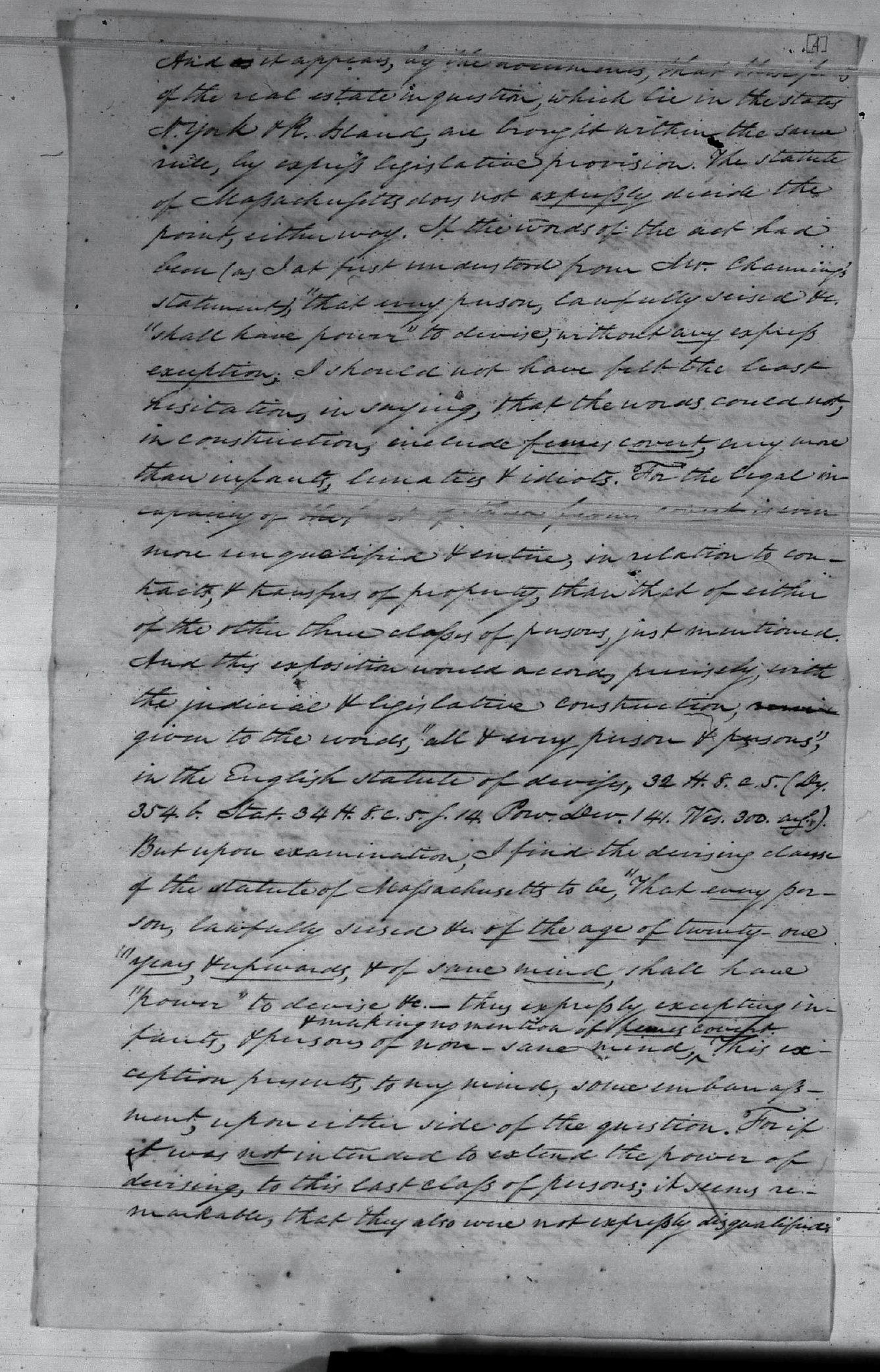
Read beside the scan
AI first transcription from the evidence pack; not independently verified. Compare with the scan.
And [struck: as] it appears, by the documents, that those p[illegible]s
of the real estate in question, which lie in the states
N. York & R. Island, are brought within the same
rule, by express legislative provision. The statute
of Massachusetts does not expressly decide the
point, either way. If the words of the act had
been (as I at first understood from Mr. Channing's
statement,) "that any person, lawfully seised &c.
"shall have power" to devise, without any express
exception; I should not have felt the least
hesitation, in saying, that the words could not,
in construction, include femes covert, any more
than infants, lunatics & idiots. For the legal in-
capacity of the first[?] of these[?] four[?] [illegible] is even[?]
more unqualified & entire, in relation to con-
tracts, & transfers of property, than that of either
of the other three classes of persons, just mentioned.
And this exposition would accord, precisely, with
the judicial & legislative construction, [struck: [illegible]]
given to the words, "all & every person & persons",
in the English statute of devises, 32 H. 8. c. 5. (Dy.
354. b. Stat. 34 H. 8 c. 5. s. 14. Pow. Dev. 141. 7 Ves. 300. arg.).
But upon examination, I find the devising clause
of the statute of Massachusetts to be, "That every per-
son, lawfully seised &c. of the age of twenty-one
"years, & upwards, & of sane mind, shall have
"power" to devise &c. – thus expressly excepting in-
fants, & persons of non-sane mind, [inserted: & making no mention of femes covert.] This ex-
ception presents, to my mind, some embarrass-
ment, upon either side of the question. For if
it was not intended to extend the power of
devising, to this last class of persons; it seems re-
markable, that they also were not expressly disqualified.
Citation and provenance
[James Gould (legal opinion)]. (1816, July 25). Gibbs Family Papers, 1763-1918 (U.S. Mss Y, Micro 1117, Reel 1, frame 392). Wisconsin Historical Society Archives, Madison, WI, United States.
Citation details need editorial review.
Historical sources retain their individual rights and credits. A scan’s presence here does not establish unrestricted reuse.
People identified in the source catalog
These are catalog labels. Individual identities and relationships have not all been reviewed.
Where the book uses this document
No quotation has yet been assigned directly to this catalog record. Its individual frames may have separate connections.