
Wisconsin manuscript
" ""Opinion"" (p1)" · 1816, July 25 (docket)
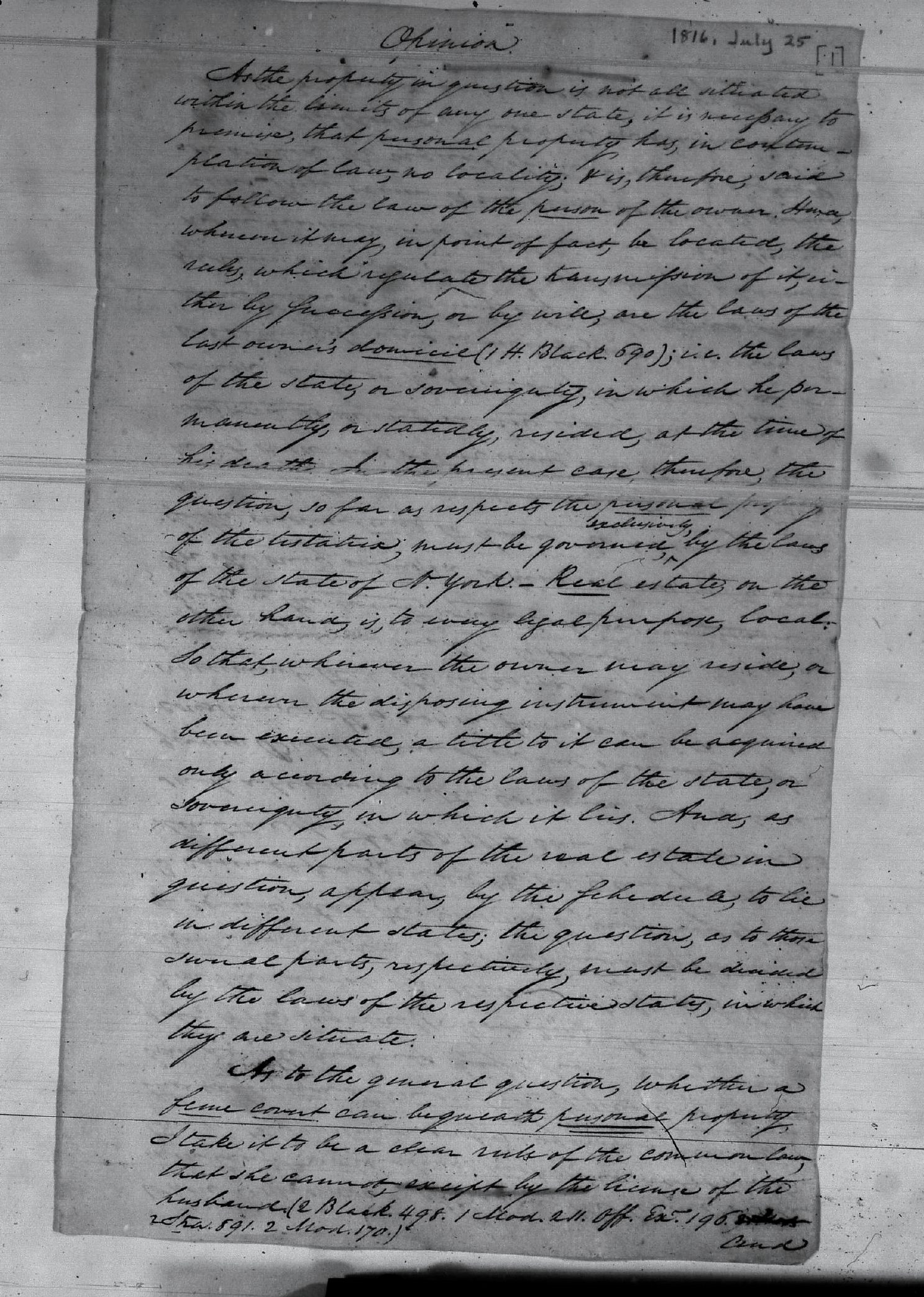
Second counsel's opinion on Mrs. Bradish's will: personalty has no locality and follows the owner's domicile (1 H. Black. 690), so the testatrix's personal property is governed by New York law; real estate is strictly local and each parcel in the schedule is governed by the state where it lies; opens the general question whether a feme covert can bequeath personalty - at common law she cannot except by license of the husband (2 Black. 498; 1 Mod. 211; Off. Ex. 196; 2 Vern. 891; 2 Mod. 170)
Wisconsin Historical Society, Gibbs Family Papers, U.S. Mss Y, Micro 1117
Reel 1, frames 392, 393, 394, 395, 396
Reel 1, frame 392
Read beside the scan
AI first transcription from the evidence pack; not independently verified. Compare with the scan.
As the property in question is not all situated
within the limits of any one state, it is necessary to
premise, that personal property has, in contem-
plation of law, no locality; & is, therefore, said
to follow the law of the person of the owner. Hence,[?]
wherever it may, in point of fact, be located, the
rules, which regulate the transmission of it, ei-
ther by succession, or by will, are the laws of the
last owner's domicil (1 H. Black. 690); i.e. the laws
of the state, or sovereignty, in which he per-
manently, or statedly, resided, at the time of
his death. In the present case, therefore, the
question, so far as respects the personal property
of the testatrix, must be governed [inserted: exclusively] by the laws
of the state of N. York. — Real estate, on the
other hand, is, to every legal purpose, local.
So that, wherever the owner may reside, or
wherever the disposing instrument may have
been executed, a title to it can be acquired
only according to the laws of the state, or
sovereignty, in which it lies. And, as
different parts of the real estate in
question, appear, by the schedule, to lie
in different states; the question, as to those
several parts, respectively, must be decided
by the laws of the respective states, in which
they are situate.
As to the general question, whether a
feme covert can bequeath personal property,
I take it to be a clear rule of the common law,
that she cannot, except by the license of the
husband. (2 Black. 498. 1 Mod. 211. Off. Ex. 196. [struck: illegible]
2 Stra. 891. 2 Mod. 170.)
And
Citation and provenance
[James Gould (legal opinion)]. (1816, July 25). Gibbs Family Papers, 1763-1918 (U.S. Mss Y, Micro 1117, Reel 1, frame 392). Wisconsin Historical Society Archives, Madison, WI, United States.
Citation details need editorial review.
Historical sources retain their individual rights and credits. A scan’s presence here does not establish unrestricted reuse.
People identified in the source catalog
These are catalog labels. Individual identities and relationships have not all been reviewed.
Where the book uses this document
No quotation has yet been assigned directly to this catalog record. Its individual frames may have separate connections.