
You came from “was always in the saddle and at times against the advice of his physician and my own protests,”. Keep that passage in view as you compare this record. Return to the quotation.
National Archives record
Peggy F. Blair Gibbs: widow’s pension file, WC 137,047
Applications, medical statements, witness evidence and administrative correspondence concerning Peggy Gibbs’s claim. Read each sheet with its own date, author and purpose; a witness’s opinion and a Pension Office decision are different kinds of evidence.
National Archives and Records Administration
transcript_034
Pension file WC 137,047, sheet 34
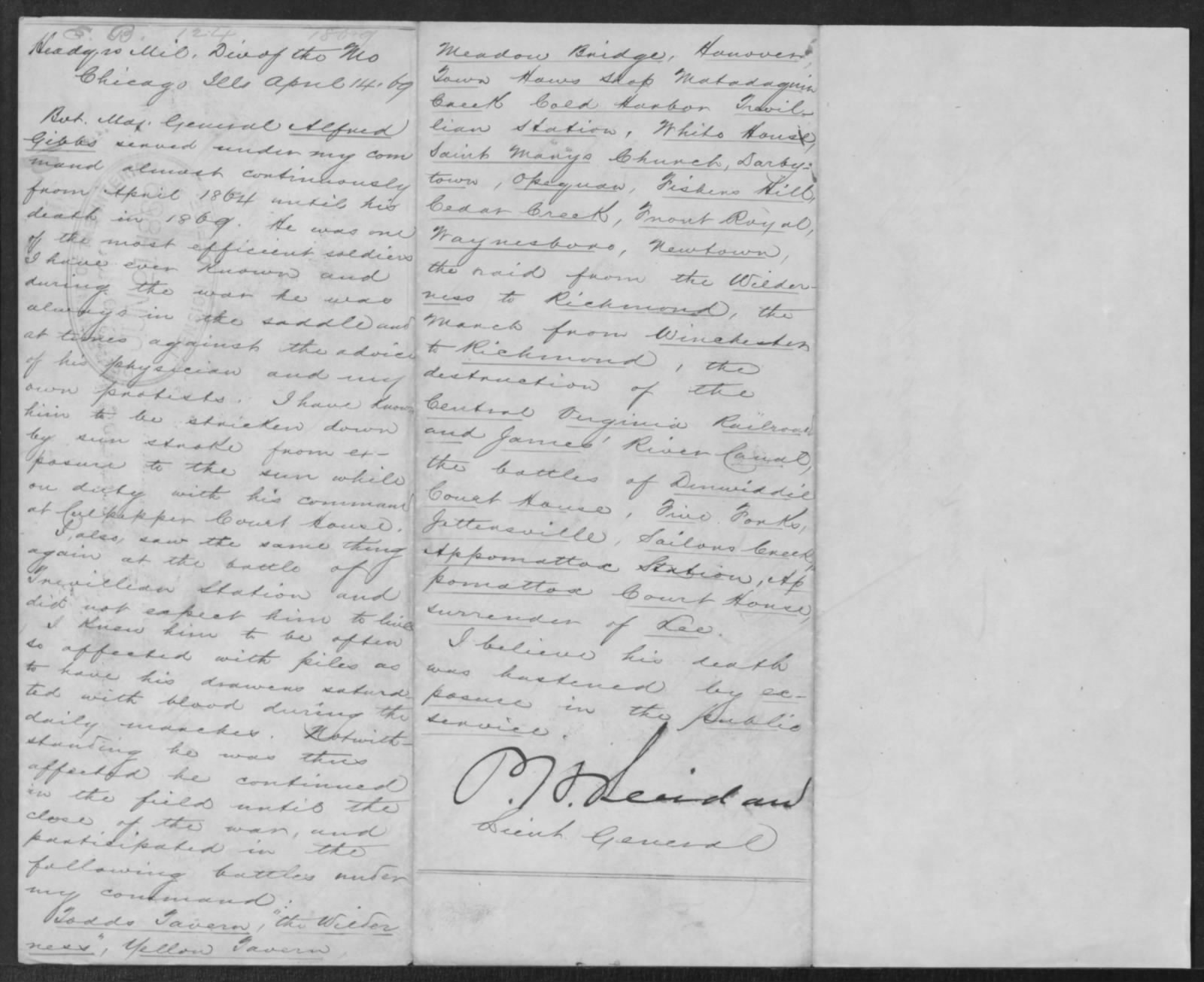
Read beside the scan
Paired by the explicitly identified WC 137,047 file and matching sheet number. This sheet has not received an individual visual transcription review.
Supplied source transcription. Preparation method is not recorded here; verify uncertain readings against the paired scan.
This is the statement the Pension Office Brief summarises as "Genl. Sheridan
gives services & sufferings under him during the rebellion." The sheet is
written in two columns.]
C.B. 1214. 1869
Head Qrs Mil. Div. of the Mo.
Chicago Ills April 14. 69
Bvt. Maj. General Alfred Gibbs served under my command almost
continuously from April 1864 until his death in 1869 [sic, for 1868]. He was one
of the most efficient soldiers I have ever known and during the war he was
always in the saddle and at times against the advice of his physician and my own
protests. I have known him to be stricken down by sun stroke from exposure to
the sun while on duty with his command at Culpepper Court House.
I also saw the same thing again at the battle of Trevillian Station and
did not expect him to live.
I knew him to be often so affected with piles as to have his drawers
saturated with blood during the daily marches. Notwithstanding he was thus
affected he continued in the field until the close of the war, and participated
in the following battles under my command:
Todds Tavern, "the Wilderness", Yellow Tavern, Meadow Bridge, Hanover Town, Haws
Shop, Matadaquin Creek, Cold Harbor, Trevillian Station, White House, Saint
Marys Church, Darbytown, Opequan, Fishers Hill, Cedar Creek, Mount Royal [?],
Waynesboro, Newtown, the raid from the Wilderness to Richmond, the march from
Winchester to Richmond, the destruction of the Central Virginia Railroad and
James' River Canal, the battles of Dinwiddie Court House, Five Forks,
Jettersville, Sailors Creek, Appomattox Station, Appomattox Court House,
surrender of Lee.
I believe his death was hastened by exposure in the Public service.
P. H. Sheridan
Lieut General
Citation and provenance
U.S. Bureau of Pensions. (1869-1875). Widow's pension file of Peggy F. Gibbs (WC 137,047). Record Group 15. National Archives.
Historical sources retain their individual rights and credits. A scan’s presence here does not establish unrestricted reuse.
Where the book uses this document
14-026 · Spite and Tyranny: an Officer in the United States Army,
15-001 · Cooke's Spring: the child, on being born, was received in my hands.
15-012 · Cooke's Spring: He remained, unattended to, in this condition for fifteen hours,
15-015 · Cooke's Spring: During the course of treatment—he was siezed with severe constipation,
16-013 · Packing for the Road: It was named John Blair Gibbs,
30-074 · I Knew They Wouldn't: an India rubber support
38-017 · The Last Season: He was insensible for several hours.
38-018 · The Last Season: suffering from acute dysentery.
39-008 · The Widow's Forty Years: may have tended to shorten his life.
39-009 · The Widow's Forty Years: a broken down condition of the general health.
39-011 · The Widow's Forty Years: it was considered that he had never fully recovered his health.
39-013 · The Widow's Forty Years: did not expect him to live.
39-019 · The Widow's Forty Years: an India rubber support
39-028 · The Widow's Forty Years: the child, on being born, was received in my hands.
39-042 · The Widow's Forty Years: Please make the necessary entry in your records.