
From your reading · 02-016
Follow these words to their source
You are exploring 261 Greene Street, New York in Laura's War. Compare the words used in the book with the source and the context around them.
L. W. Gibbs, pinxit.
Source identified; page to confirm
See how the book uses these words
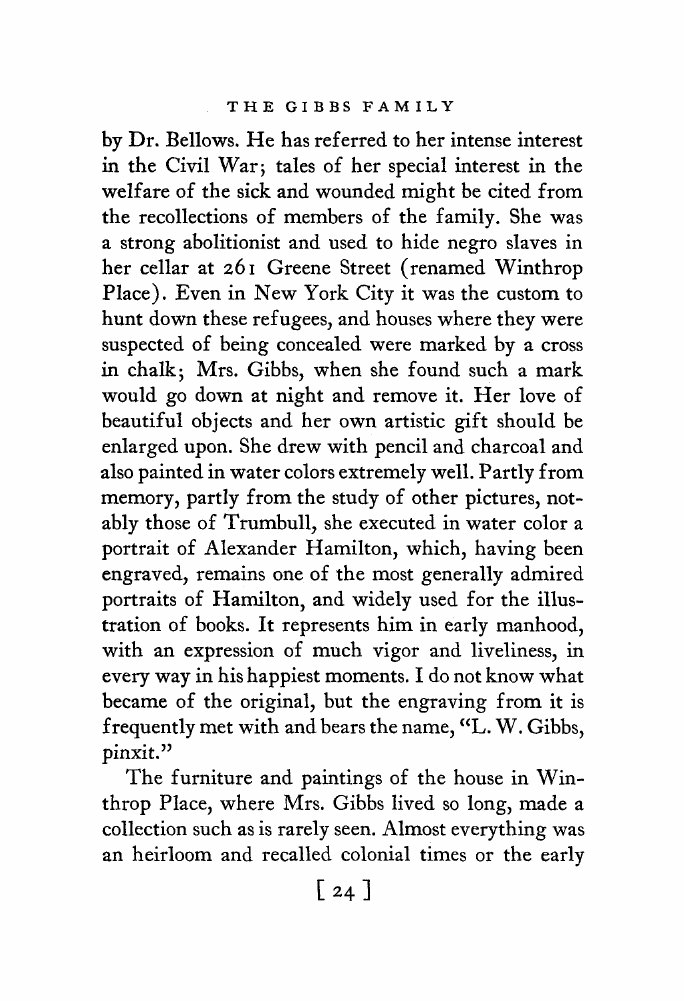
The first was a portrait. Laura drew in pencil and charcoal and painted in watercolor, and partly from memory, partly from the
pictures of Trumbull, she made a watercolor of Alexander Hamilton as a young man, the man who had worked beside her father
in Washington's government. It was engraved, and for a century the engraving went into books with her name under it: "L. W.
Gibbs, pinxit."
The connected source
The Gibbs Family of Rhode Island (1933), Laura Wolcott Gibbs chapter, which prints Dr. H. W. Bellows's 1870 tribute.
Named source · page to confirm
identified from the page that reproduces it (check against the original; "to confirm" means page or frame still open). A text match or page placement does not establish that the scan has been reviewed.
Questions to bring to the source
Who wrote this, and who was meant to read it? Is the writer describing an event they witnessed, reporting news from someone else, or remembering it later? Read the surrounding lines and compare dates, names and uncertain words.
Begin with the source page
Read beside the scan
Page image from the PDF of the book on AlfredGibbs.com. The quotation was found on this page, 10 Nov 2026.
A transcription has not yet been connected to this scan.
Read the research account used for this passage
The book catalog explicitly points to these preserved site pages. Read the account and follow its reproduced documents and citations. A research account is an intermediary, not automatically the original evidence.
Continue your learning journey
Explore the sources behind Laura's War →
Follow the people in this chapter →
Return to Laura's War and its quotation ledger →
She was a strong abolitionist, →
and used to hide negro slaves in her cellar at 261 Greene Street. →